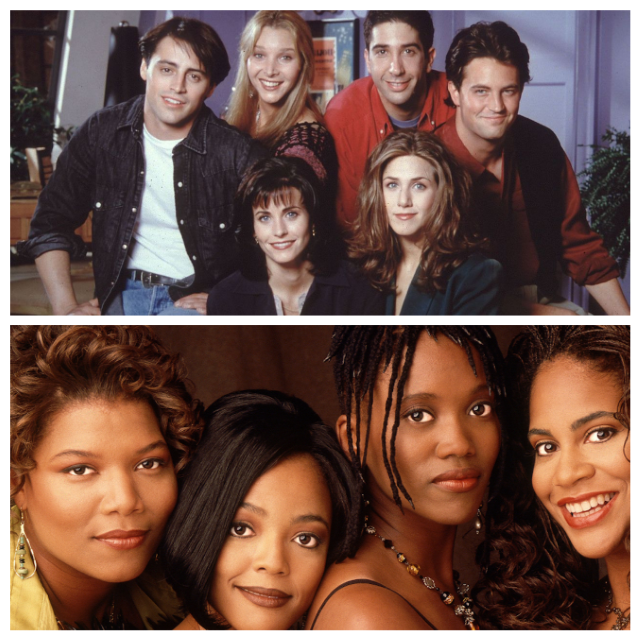
In today’s episode of “Michelle’s Unpopular Opinions, Fight Me!” we find our middle-aged pop culture research geek shaking her head after a deep dive into the now-popular claim that the iconic sitcom Friends was a rip-off of the slightly earlier, less well-known predecessor, Living Single.
The claim: Living Single, brainchild of Yvette Lee Bowser, premiered in 1993. It featured three young, professional women of color living together as roommates in a brownstone in Brooklyn. A fourth friend lived nearby and dropped in frequently, making her a “fourth roommate.” Two young-ish men, also African-American, live upstairs in the brownstone and frequently drop into the lives of the women, eventually forming romantic relationships with two of the women.
According to Bowser, the show came from her desire to write about the personal stories of “me and my girlfriends” (that’s a quote) as they navigate work and personal relationships. The original show title, not so by the way, was My Girls. The title was changed to Living Single just a few weeks before the premiere.
Queen Latifah, the star of the show and the “my” in My Girls, said that when Living Single became a hit for Fox, NBC head Warren Littlefield remarked he wished he had Living Single for his network. Then, lo, the very next season, Friends arrived.
Friends was the brainchild of Marta Kauffman and David Crane. In addition to being colleagues on previous shows, they’d been friends since college. They developed a show about a group of friends—a close-knit group of young adults living in Manhattan, who were struggling to navigate the real world and supporting each other through it. The pitch was that the show was about “that time in your life when your friends are your family.”
The producers were adamant that the actors they chose not be stars. Friends was to be about the group, not about one character and that character’s “world.” Courteney Cox, for example, was known to TV audiences, but not as much as her closest rival for the role of Monica, Nancy McKeon (who’d starred on The Facts of Life alongside Living Single actor, Kim Fields). Cox won the role precisely because she hadn’t been a star like McKeon and Fields.
In other respects, there were certainly surface similarities between the shows. Six main characters, family bonds between characters and friendships stretching back to childhood and college, non-diverse casts that led to Friends being dubbed “the white Living Single”). And, of course, the appeal to the young adult demographic that Littlefield saw in Living Single and wanted to replicate for his own network.
The verdict: To save space, I’ve woven into my narrative above some of the important differences between the shows. To recap briefly, Living Single was a star vehicle for Queen Latifah. The show centers on Latifah’s character Khadijah James and “her girls.” The two dudes upstairs were conceived as love interests, not as core members of the friend group.
If anything, Living Single reminded me of The Golden Girls. Three women of a certain age share a house in an expensive city to save on expenses. They navigate work, dating, and personal relationships. A fourth roommate joins them, one who has close ties to one of the original three. Exes and extended family drop in and out of the women’s lives, and romances spark. The show ends on the marriage of one of the roommates. This is both The Golden Girls and Living Single in a nutshell.
Friends, on the other hand, was in fact the true ensemble show it was conceived to be. Every one of the six main cast members was a core part of the friend group. There were popular storylines that followed some of the characters and not others, but all of the characters had well-developed story arcs. There were “super couples,” but that seems to have been more of response to fan interest than anything else. The show ended, Kauffman said, when its premise was fulfilled. Five of the six were in the midst of establishing families and the sixth was headed out to a new chapter in his career. “That time in your life…” had ended and a new time was beginning.
There were influences on Friends, yes, of course, but the influences were more along the lines of peer-group shows such as Cheers and Seinfeld. Other than superficial similarities and similar demographic appeals, Friends and Living Single really never had anything in common.
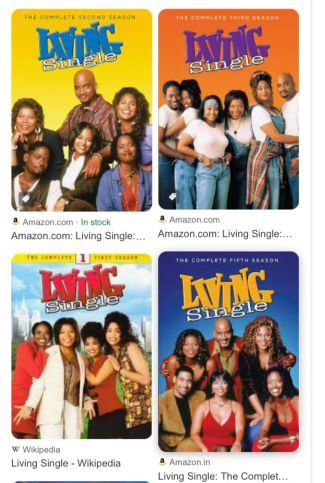
Postscript: I also realized you can see evolution in Living Single when you look at how the seasons are marketed. The first season, the focus is on the four women. They’re the show, and their image is used to sell the first season of the show. But once the Living Single producers realized they’d be competing against Friends, the marketing shifted to promoting the love interests as part of the core group, and the promotional materials for future seasons reflected that shift.
If anything, Living Single did some appropriation of its own from Friends. And, yeah, having watched about the same amount of both shows now, I’ll climb out on a limb and say Friends is the better show.
(Images: Promotional images from Friends and Living Single. Alamy, Getty, Amazon.com, and Wikipedia. Used under fair use guidelines.)