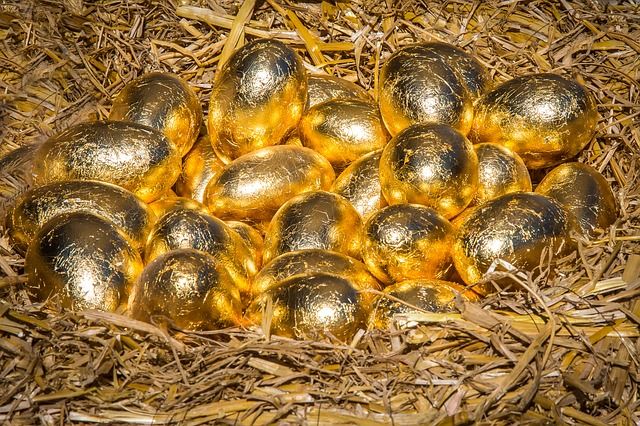
Twenty-five hundred years ago, the Greek storyteller Aesop told a fable about a farmer and his goose. The farmer was thrilled when his goose started laying one gold egg each day. Soon enough, the farmer became impatient to claim all of the riches the goose was capable of producing, so he killed the goose, thinking the goose would be filled with gold. When the farmer opened up the goose, he was dismayed to discover that there was no gold inside. To all appearances, it had been an ordinary goose. The moral was that greed can cost a person what he already has.
I was reminded of the farmer and his goose for another reason while reading The Human Instinct: How We Evolved to Have Reason, Consciousness, and Free Will by Kenneth R. Miller, which was published in April 2018.
Miller, a Catholic, is a cell biologist at Brown University who was awarded the Laetare Medal in 2014 by the University of Notre Dame for his contributions to science. He is best-known for his public critiques of creationism and intelligent design, having served as the lead expert witness for the plaintiffs in the 2005 federal court case Kitzmiller v. Dover Area School District, a successful challenge to a public school district’s policy requiring that intelligent design be taught to students.
In his latest book, Miller explores the idea of human free will, which has been under attack in recent years by scientists. He highlights the views of scientists such as Sam Harris, a neuroscientist who claims that “free will is an illusion. ... We do not have the freedom we think we have” (Free Will). Robert Wright, an agnostic who writes about science and religion, makes the same claim about free will being illusionary and says, contradictorily, that it was “brought to us by evolution” (The Moral Animal).
Miller contends that he disagrees with his fellow scientists on this point: “There is something both illogical and unsound with any narrative that depicts a species able to unravel the story of evolution as insignificant carbon-based fuzz on the surface of a small blue planet.” He acknowledges that “there is something special about Homo sapiens, something that truly sets us apart,” and that to fully understand the distinctiveness of human beings, we should “understand and appreciate the beauty and subtlety of evolution in greater depth than ever.”
But despite his thesis that humans are special and we need evolution to better understand why they are special, Miller begins to deny his own stated purpose as he progresses through his book. At one point, he calls upon his training as a cell biologist to claim:
While most of my work has been with plant cells, I’ve done a fair amount of high-resolution microscopy on animal tissue, some of it human, and from that I can make an entirely mundane and obvious observation. There is nothing special about human cells. They are, in fact, indistinguishable from those of any other mammal. ... On a cellular level, life is one. And we humans, like other animals, are collections of cells.
In the end, despite his original thesis that humans are a species set apart from the rest of life on this planet, Miller concludes that we aren’t special at all and that free will is in fact an illusion. “What we can agree upon, I suggest, is that free will, if it is not real, is at the very least a powerful illusion that affects the ways in which we think and act.”
Where in this do we see Aesop’s farmer and his gold-laying goose? The farmer assumed that a goose who could lay golden eggs must have gold in its body that could be carved out. When the farmer opened up the goose, he found that it looked like an ordinary goose. The goose’s extraordinary talent couldn’t be explained by examination of its body.
In like manner, Miller and his fellow scientists assume that free will either doesn’t exist or is, at best, “a powerful illusion,” because they can’t find it when they examine human cells under their microscopes. Because they cannot see a cellular difference between humans and other mammals, they assume little to none exists.
More than "collections of cells"
To a certain extent, there is merit in the study of how the physiological composition of the brain affects individual choice because, since we are embodied souls, our bodies play a role in the choices we make. We can see how this happens most readily in comparison to non-human animals.
Many non-human animals are capable of choice in a limited sense, but their ability is largely dependent on their bodily senses. A dog, for example, can choose to eat or not, but he cannot use reason to weigh the nutritional value of one food over another. Rather, he will ordinarily choose to eat based on whether the food looks, smells, or tastes good to him, and on whether or not he feels hunger. A dog may refuse food from a stranger, despite his senses, but that’s because he has been trained to do so by a human who knows a stranger may have ill intent in offering the food.
Humans, on the other hand, can ordinarily use reason to discern between different types of food and can choose whether or not to accept food from other people based on their understanding of that person’s motivations in offering it. In some cases, though, a human person’s ability to act on his choices can be limited by his body. Those humans who have intellectual disabilities or who have suffered brain injury may have a limited use of reason and a limited ability to choose freely. Study of the science behind how the human brain affects the ability of a person to reason and to choose is therefore helpful.
But the Catholic Church teaches that human persons are more than “collections of cells,” as Kenneth Miller put it:
Endowed with “a spiritual and immortal” soul, the human person is “the only creature on earth that God has willed for its own sake.” From his conception, he is destined for eternal beatitude. The human person participates in the light and power of the divine Spirit. By his reason, he is capable of understanding the order of things established by the Creator. By free will, he is capable of directing himself toward his true good. He finds his perfection “in seeking and loving what is true and good” (Catechism of the Catholic Church, 1703–1704).
Catholic apologist Frank Sheed told of being asked by a street-corner heckler what he meant by the term spirit:
I answered, “A spirit has no shape, has no size, has no color, has no weight, does not occupy space.” [The heckler] said, “That’s the best definition of nothing I ever heard.” Which was very reasonable of him. I had given him a list of things spirit is not, without a hint of what it is (Theology for Beginners).
In essence, Sheed explained, “Spirit is the element in us by which we know and love, by which therefore we decide.” The human senses cannot perceive the spirit because it has no material attributes. It cannot be seen under a microscope. It cannot be touched, heard, smelled, or tasted. We know it exists, though, by its effects.
Invisible things are the most profound
In a papal question-and-answer session with children in 2005, a young child asked Benedict XVI how he could know that Jesus was present in the Eucharist, since the child could not see Jesus in the Eucharist. Benedict responded:
No, we cannot see [Jesus in the Eucharist], but there are many things that we do not see but they exist and are essential. For example: we do not see our reason, yet we have reason. We do not see our intelligence, and we have it. In a word: we do not see our soul, and yet it exists, and we see its effects because we can speak, think, and make decisions, etc. ... It is precisely the invisible things that are the most profound, the most important.
Miller, on the contrary, argues that the material properties of our bodies—and indeed the universe—have become conscious.
It may confound understanding to say that “meat” ... can think. ... Life, as we have come to understand it, is a collective property of many atoms and molecules. ... But the mere fact that [the] mind has a physical basis does not devalue or undermine the validity of logic, the utility of science, or the reality of human thought and achievement. ... We [humans] are also a part of the universe that has become conscious and aware. We are the universe becoming conscious of itself.
What Miller is contending is that non-material effects are the result of material causes. He is arguing that the human ability to think and to reason and that human consciousness are the result of a material evolutionary process. But while we know that a higher spiritual agent can create a material effect (e.g., an angel can act upon the material world; cf. Tob. 3:16-17), there is no evidence that a lower material agent can cause a spiritual effect.
Sheed explained that the action of the soul in thinking is not caused by the brain but is a spiritual act that happens in union with the brain:
Mind, we say, splits the atom and calculates the light-years. It is true that in both these operations it uses the body. But observe that there is no question which is the user and which is the used. The mind uses the body, not asking the body’s consent. The mind is the principal, the body the instrument. ... This mingling of spirit and matter in human actions arises from a fact which distinguishes man’s spirit from all others. Ours is the only spirit which is also a soul—that is to say, the life principle in a body. God is a spirit but has no body; the angels are spirits but have no body. Only in man spirit is united with a body, animates the body, makes it to be a living body.
Unlike some Fundamentalist Christian communities, the Catholic Church does not forbid Catholics to believe in evolution. God is the ultimate Creator, but the Church permits belief that he may have created the material universe by an evolutionary process. Even belief that the human body may have developed from lower life forms is permissible. But Catholics must believe that the human soul, by which we are free to know and to choose to love God, is a special creation of God. Pope Pius XII wrote:
For these reasons the teaching authority of the Church does not forbid that, in conformity with the present state of human sciences and sacred theology, research and discussions, on the part of men experienced in both fields, take place with regard to the doctrine of evolution, in as far as it inquires into the origin of the human body as coming from pre-existent and living matter—for the Catholic faith obliges us to hold that souls are immediately created by God (Humani Generis 36).
What’s the difference?
What difference does it make whether the human soul is the product of an evolutionary process or the special creation of God? What difference does it make whether or not our choices are truly free?
For one thing, if all that we are, body and soul, is nothing more than the product of a material process, then we will cease to exist when we die. Material breaks down and, as the Bible says, the body returns to the dust of the earth. The human soul lives on after death precisely because it is spirit. Our hope of heaven is possible because the spiritual soul survives death.
Another factor is that evolution cannot explain human purpose. In fact, Miller makes clear that, by the light of evolution alone, humans are an evolutionary failure:
We, the members of Homo sapiens, represent “the last humans.” In evolutionary terms, we are the sole surviving representatives of a dramatically unsuccessful lineage. We are, you might say, the last hangers-on in a long line of losers.
Natural selection, when stripped of any possibility of a divine purpose that cannot be quantified by scientists studying the evolutionary process, offers a rather dismal view of the human person. Like Aesop’s goose, there seems to be nothing special about humans from a purely biological viewpoint, because the dignity imbued upon humans by God is not apparent to the human eye. This stands in stark contrast to the Church’s understanding of human creation as a divine “project.” As Benedict XVI wrote:
The story of the dust of the earth and the breath of God [in the biblical account] ... does not in fact explain how human persons come to be but rather what they are. [The creation story] explains their inmost origin and casts light on the project that they are. And, vice versa, the theory of evolution seeks to understand and describe biological developments. But in so doing [evolution] cannot explain where the “project” of human persons comes from, nor their inner origin, nor their particular nature (In the Beginning).
The original moral to Aesop’s story of the farmer and the goose, as we saw, was a lesson on human greed. Unwilling to accept the riches he was given at the pace he was given them, the farmer tried to obtain more all at once by killing the goose. All he ended up with was a dead goose and the discovery that the goose, once dead, was like any other goose. Perhaps in their quest to understand the secrets of human origins, scientists might learn from Aesop’s farmer to be wary of “killing the human” in the effort to solve the mystery of what makes human beings special.
(Image: Golden eggs, Pixabay.)