If there is one thing Christians tend to forget about Lucifer, the fallen angel who became Satan, it’s that he started out good. As the Catechism of the Catholic Church explains:
The Church teaches that Satan was at first a good angel, made by God: “The devil and the other demons were indeed created naturally good by God, but they became evil by their own doing” (CCC 391).
Lucifer is a Latin word derived from the roots lux (light) and ferre (to carry). Luficer means “light bearer” or “light bringer,” and it was not originally used in connection with the devil. It came to be associated with him from a passage in Isaiah that mocks the king of Babylon:
How you are fallen from heaven, / O Day Star, son of Dawn!
How you are cut down to the ground, / you who laid the nations low! (Is. 14:12).
“Day Star” here translates in Latin to lucifer. This passage is an allusion to the king of Babylon’s inflated self-image. Some of the early Church Fathers compared the pride that the king of Babylon displays in the passage—“I will ascend above the heights of the clouds, I will make myself like the Most High” (Is. 14:14)—with the pride of the devil.
Lucifer became Satan by his own free choice. All persons who have the use of free will have the power of choice. Angelic persons are pure spirit and therefore are not subject to change. The choice they made for good or for evil was an irrevocable choice, and where there is no possibility for change, there is no possibility for repentance:
Scripture speaks of a sin of these angels. This “fall” consists in the free choice of these created spirits, who radically and irrevocably rejected God and his reign. We find a reflection of that rebellion in the tempter’s words to our first parents: “You will be like God” (Gen 3:5). The devil “has sinned from the beginning”; he is “a liar and the father of lies” (John 8:44).It is the irrevocable character of their choice that makes the angels’ sin unforgivable. “There is no repentance for the angels after their fall, just as there is no repentance for men after death” (CCC 392–393).
Because they do not have material bodies subject to the limitations of change, the angels’ choice against God was eternal and irrevocable. Human beings, because they have bodies, can change over the course of their lifetimes; but radical, life-altering change from the shaping of a lifetime of choices is as rare as a deathbed conversion precisely because our choices shape us into who we are.
So it is with good and evil. For angelic persons, their choice for good or for evil was made in one decisive, irrevocable free act. For human persons, if we are able to reason, we must make a lifetime of choices between good and evil.
The small goods we do this day can mold us into the kind of people who can act heroically under extraordinary circumstances. And the small evils we succumb to this day—whether we engage in them for what we believe are good reasons, or whether they merely seem glamorous in the moment—can shape us into people capable of committing the kind of grave evils we see in news reports every day.
Just as Lucifer originally was a good angelic person who chose evil and fell away from God forever, so we humans were created to be good persons, and we can misuse the freedom God gave us and can choose to go to hell.
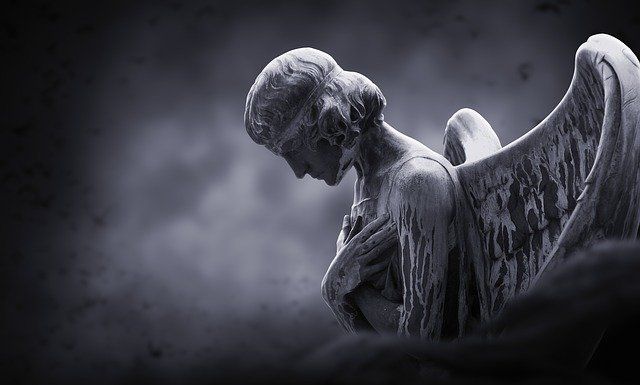
(Image: Gray angel, Pixabay.)