Friendship has been cheapened in our age. These days you can become “friends” with a stranger over the internet merely by agreeing to link up social-media pages. Friends, both real and virtual, are expected to be cheering squads who always affirm whatever you do. What we call a friend today is merely someone with whom you have fun or feel comfortable—not someone who challenges you to become a better person.
It’s no wonder, then, that many Christians are conflicted over whether or not Jesus is our friend. As Eric Sammons recently observed, some Christians have “lowered Jesus to our level to make him more palatable and acceptable to those around us.” This Jesus is presented as a buddy: someone you might have a beer with or to whom you might pour out your troubles in hope of an encouraging word but no hard challenges.
Not buddy, but friend
The “buddy Jesus” is indeed a serious misunderstanding of our relationship with Our Lord. He is God the Son, with all of the divine prerogatives that entails; he is also, in his humanity, our teacher, with all of the human prerogatives for respect that entails. The popular image of Jesus the Non-Judgmental Pal, who wants us to have whatever we want to have, is not the Jesus of the Gospels.
But neither is Our Lord wholly set apart from us, unable to relate to us in friendship properly understood. In the homily he gave at the beginning of his pontificate, Benedict XVI repeatedly urged us to seek true friendship with Christ:
There is nothing more beautiful than to know [Christ] and to speak to others of our friendship with him. ... Only in this friendship [with Christ] are the doors of life opened wide. Only in this friendship is the great potential of human existence truly revealed. Only in this friendship do we experience beauty and liberation.
Do the Gospels give us reason to regard Jesus as a friend? Although the Gospels don’t often use the word, if we look at the stories of Jesus’ interactions with people during his earthly ministry, we can see a portrait of how Jesus does approach us in friendship and provides an example of what true Christian friendship means.
Zacchaeus
When Jesus entered Jericho, the chief tax collector was eager to see him. But Zacchaeus was short, and the crowds of people weren’t about to give way to a man they heartily disliked. So he climbed a tree on the route Jesus would take through the city.
As he passed by, Jesus noticed that Zacchaeus was, quite literally, alone in a crowd—perhaps not entirely without some justice, since he’d been engaged in tax gouging. Jesus focused his attention on him anyway and asked Zacchaeus for the favor of his hospitality: an overture of friendship. Zacchaeus was so grateful for the chance to be Jesus’ friend that he immediately offered to do what he could to make things right with the taxpayers he’d defrauded (Luke 19:8).
The woman at the well
While traveling through Samaria, Jesus stopped to rest at a well. A woman approached to draw water, and Jesus asked her for a drink. She was startled by the request, not only because Jews avoided interaction with Samaritans (John 4:9) but also because she apparently was a shunned woman among her own people.
Jesus entered into conversation with her and asked her to bring her husband to meet him as well (John 4:16). At that, the woman admitted that she was living in an irregular relationship, not a true marriage. Jesus already knew this—he already knew her full marital history (John 4:17-18)—but he didn’t reproach her with his knowledge until she herself was ready to admit it.
Our Lord didn’t shy away from a difficult discussion with this woman about her personal life. He first approached her in friendship, though, treating her with respect and dignity, and waited for her to open discussion about the nature of her marriage.
Judas Iscariot
On the night before his crucifixion, Jesus waited in the Garden of Gethsemane a long time for Judas. He knew exactly what Judas had planned (Luke 22:22, John 13:26-27), and he took his disciples to the garden to wait for Judas to come. He waited so long that the disciples kept falling asleep (Matt. 26:36-46).
The hour for Jesus’ Passion had arrived, yes, but even as he faced the task of redeeming all men, Jesus suffered for the fate of one man in particular. Even before the final betrayal, Judas had already betrayed Jesus and the apostolic band more than once. He had secretly stopped believing Jesus’ teaching, and he had stolen from the common purse he was trusted to carry (John 6:64, 12:6, 13:39). Jesus had referred to Judas as a devil (John 6:70-71).
On this night, though, when Judas brought the authorities to arrest him, Jesus tried one last time to save Judas by reminding him of their relationship to each other:
And [Judas] came up to Jesus at once and said, “Hail, Master!” And he kissed him. Jesus said to him, “Friend, why are you here?” (Matt. 26:49-50).
Judas called Jesus “master,” but despite all Judas had done and despite what he was about to do, in return, Jesus called him “friend.”
Jesus, our Lord and friend
Catholic apologist Frank Sheed, in his life of Christ, observed that the Gospels show a kind of “double stream” in what Jesus said and did. Most of the time he acted and spoke as an ordinary man; yet sometimes he startled his disciples and audiences by acting and speaking as only God could. We can never forget that he is God, and we also cannot forget that he is a man. A man incapable of friendship with his fellow men and women is hardly an admirable man.
Jesus teaches us that true friendship is not always comfortable on either side. True friendship, the friendship Jesus offers us and models for us to offer to others in his name, means inspiring others by our own example to want to become better people. It means treating with dignity those who are mired in lives of sin while not neglecting to challenge them to get their lives back on track. And it means never giving up on anyone’s salvation, no matter how much they have hurt us in the past or might hurt us in the future.
As the Catechism puts it:
The New Law ... lets us pass from the condition of a servant who “does not know what his master is doing” to that of a friend of Christ ... or even to the status of son and heir (1972).
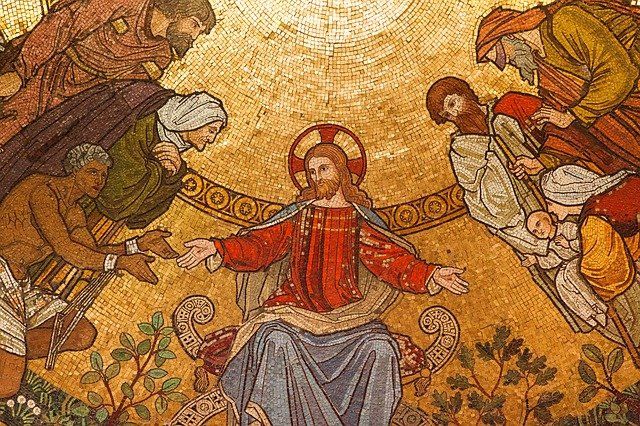
(Image: Mosaic, Jesus Christ; Pixabay.)