The Proto-Reformers (c. 1140-1415)
For three hundred years before Martin Luther, a number of men sought to reform the Church. While their individual movements foundered, their tenets would shape the Protestant Reformers who followed them.
Peter Waldo (c. 1140-c. 1205) was widely held to have been the founder the Waldensians, a lay movement devoted to poverty, preaching, and Scripture. Historians now believe the movement started before Waldo. At first, the Church was open to listening to the Waldensians’ concerns, but friction arose because of their maverick ideas about preaching without permission from proper authority, among other things. Pope Lucius III issued a papal bull condemning their errors in 1184, and in 1215 the Fourth Lateran Council echoed that condemnation.
John Wycliffe (c. 1325-1384), an English priest, criticized the lavish lifestyles of Church hierarchy. His followers, the Lollards, dissented from Church teaching on the saints, the Mass, and the papacy, among other things. Wycliffe is credited with translating the New Testament into English. He died in 1384, and in 1415 the Council of Constance declared him a heretic.
Jan Hus (c. 1369-1415), a Czech priest, criticized the Church’s understanding of ecclesiology and the Eucharist. He was condemned as a heretic and burned at the stake in 1415. Afterward, the Hussite Wars (1419-1434) broke out between various Catholic monarchs of Europe and the followers of Hus who refused the Church’s authority. A truce was reached in which the Hussites acknowledged Church authority in exchange for being allowed to practice their own rite of worship.
The 95 Theses (1517)
In 1516, the Dominican friar Johann Tetzel (1465-1519) was in Germany to raise money for the rebuilding of St. Peter’s Basilica. His “fundraiser” was the offering indulgences in exchange for alms. Martin Luther (1483-1546), an Augustinian canon, challenged Tetzel’s practice by sending a list of propositions for debate, called theses, to his archbishop. (He probably didn’t nail the theses to the church door in Wittenberg, as is commonly thought.) Over the next few years, Luther became increasingly hardened against the Church’s efforts at reconciliation.
The Diet of Worms (1521)
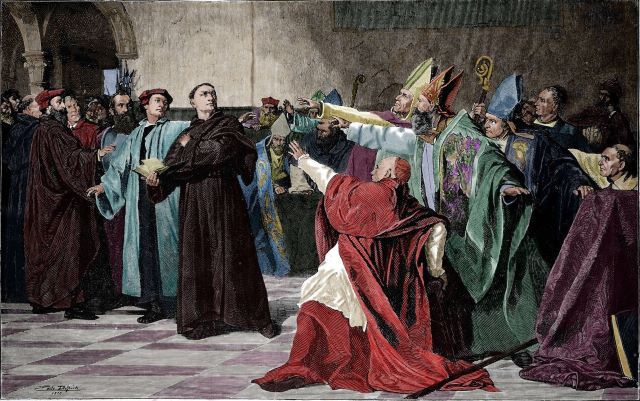
After Luther refused to recant his errors, Leo X excommunicated him in January 1521. The Holy Roman Emperor Charles V (1500-1558) convened the Diet of Worms (an imperial assembly in the German city of Worms) to enforce the Church’s ban on the 95 Theses. Luther attended the Diet but refused to recant. Charles V issued a warrant for Luther’s arrest and called for his execution, but German civil authorities protected Luther, ensuring that the Protestant Reformation would not end quickly and decisively as had earlier dissident movements.
The Anabaptist Movement (c. 1525)
The Anabaptists declared that infant baptism was not valid and that believers had to be “baptized again” (hence the name Anabaptist). Their views on baptism clashed with those of other Reformers, who accepted the validity of infant baptism and who denounced the Anabaptists’ unorthodox view of baptism as emphatically as did the Church. Anabaptists should not be confused with modern Baptists, who descend from the seventeenth-century English Separatists. The modern descendants of the Anabaptists are the Mennonites, Amish, and Hutterites.
Augsburg Confession (1530)
In early 1530, Charles V called for an imperial assembly to meet in the German city of Augsburg, inviting German civil authorities who were fostering the Lutheran movement to discuss the issues. The Diet of Augsburg convened in April 1530. Luther could not attend the Diet because he was still a fugitive from justice. Philip Melancthon (1497-1560), a close friend and collaborator of Luther’s, attended in his stead and presented an apologia for the Lutheran movement that was approved by Luther himself.
A final form of Melancthon’s apologia was approved by the Lutheran civil authorities to be presented to the Emperor. What became known as the Augsburg Confession was signed on June 23, 1530, and presented to Charles V two days later. Charles commissioned a response from the Vatican and then demanded the Lutherans’ assent to the Confutation of the Augsburg Confession. In response, Melancthon wrote a refutation of the Confutation, titled Apology of the Augsburg Confession. The Confession and Melancthon’s apologia are considered foundational documents of Lutheranism.
Protestantism Established in Denmark and Norway (1530s)
The House of Oldenburg ruled Denmark and Norway in the early sixteenth century. Frederick I (1471-1533), a Catholic, tolerated the spread of Lutheranism and attacks on the Church. Frederick died in 1533, leaving a succession crisis between his sons. The Protestant minority favored Frederick’s older son, Christian, who had become a fervent Lutheran. Christian III was elected to the throne in 1534 and promptly punished the Catholic bishops who failed to support him by confiscating Church property. In September 1537, Christian signed an order that suppressed the episcopacy in Denmark and Norway and established Lutheran superintendents in their place.
The Suppression of the Monasteries (1536-1541)
Upon passage of the Act of Supremacy by Parliament in 1534, Henry VIII (1491-1547) used his newfound authority as “Supreme Head of the Church in England” to dissolve the monasteries in England, Wales, and Ireland and transfer their income to the crown. These properties were sold off to fund Henry’s military adventures and to enrich his supporters, which ensured the success of the Reformation in England. Many of the church buildings on the old monastic properties were preserved for use as places of worship, but the rest of the properties were transformed into estates for the British aristocracy.
Book of Common Prayer (1549)
Henry VIII maintained a largely Catholic form of worship in Anglican churches even after the Act of Supremacy was passed in 1534. The Archbishop of Canterbury, Thomas Cranmer (1489-1556) began his work on the Book of Common Prayer, a translation of the liturgical rites into English, with Henry’s traditional approach to worship in mind. After Henry’s death in 1547, the accession of Henry’s son Edward VI (1537-1553), a Protestant, freed Cranmer to introduce Protestant ideology into his text. The 1549 edition was still, in the words of Bishop Stephen Gardiner (c. 1483-1555), “patient of a Catholic interpretation.”
The Book of Common Prayer was further revised over the following decades, with a standard text finally published in 1662. It is influential in Anglican worship to this day. With the creation of Anglican Use rites in the Catholic Church, starting in the 1980s, the Church authorized revisions of the Book of Common Prayer for Catholic worship by Anglicans who have sought communion with the Church. The current Catholic version of the Book of Common Prayer is the Book of Divine Worship, which is now used in parishes belonging to the Anglican ordinariates.
Calvin Disciplines Opponents (1553-1555)
John Calvin (1509-1564), the French theologian who established himself as a religious and secular power in Geneva, was opposed by a group known as “the libertines” because they rejected both Church and civil authority. Frustrated that he could not overcome their opposition, Calvin sought to resign in 1553 but was denied. Meanwhile, Calvin had been engaged in a bitter dispute with a Spanish Reformer named Michael Servetus (c. 1509-1553), who denied the Trinity and opposed infant baptism.
When Servetus, on the run from Catholic authorities, was arrested in Geneva, he asked to be tried in Geneva. Geneva gave him the same punishment he had been given by Catholic authorities: burning at the stake. Although Calvin asked that Servetus be spared burning at the stake in favor of beheading, the execution of Servetus was a triumph for Calvin, who was lauded as a defender of Christian orthodoxy. This gave Calvin the standing he needed to crush the libertine opposition and regain control of Geneva.
The Peace of Augsburg (1555)
After nearly forty years of tumult in Germany, Charles V and the princes who supported Luther came to an agreement that established Lutheranism alongside Catholicism as a state religion. The agreement would be known as the Peace of Augsburg. Operating under the principle of cuius regio, eius religio (“whose region, his religion”), the agreement provided that the religion of the ruler of a region would be the religion of the region and its inhabitants. Those citizens who could afford to do so were allowed a grace period to move to regions where their own preferred religion was the established religion.
“Whose region, his religion” was, in effect, a bastardization of the principle that first created Christendom, when nations would follow their kings into the Church. It was perhaps fitting, then, that this peace agreement would crack the foundation of Hapsburg rule, setting up competing branches of the family as rulers of the Catholic and Protestant regions of the Empire.
Under this agreement, only the practice of Catholicism and Lutheranism was provided for. Calvinism did not become an established option until the Peace of Westphalia in 1648.
French Wars of Religion (1560-1598)
The French Wars of Religion, also called the Huguenot Wars, were battles between warring families of France over that country’s throne and over whether Catholicism or Calvinism would be the accepted state religion. The House of Guise was Catholic and supported the Church; the House of Condé was Calvinist. While the House of Guise was more powerful, the House of Condé held the right of succession to the French throne.
The fighting reached a boiling point in August 1572 with the St. Bartholomew’s Day Massacre, during which French Catholics killed thousands of Protestants. (Estimates range from 5,000 to 30,000 casualties.) Finally, a truce, called the Edict of Nantes, was reached in 1598. The French king, Henry IV (1553-1610), converted to Catholicism so that the throne would remain in Catholic hands but granted substantial rights to French Protestants.
The Edict of Nantes did not end the conflict in France. Henry IV was assassinated in 1610. In 1685, Louis XIV issued the Edict of Fontainebleau, which revoked the Edict of Nantes and led to a mass exodus from France by the Protestant Huguenots. In 1787, Louis XVI issued the Edict of Versailles, which restored religious and civil freedom to non-Catholics in France but came too late to forestall the French Revolution, which was in part a reaction to abuses by Catholics in France.
Book of Concord (1580)
Published on the fiftieth anniversary of the Augsburg Confession, the Book of Concord is a collection of ten documents that form the foundation of classical Lutheranism. The Concordia, as it is also known, was commissioned by German civil authorities who wanted to put a stop to doctrinal disputes that erupted in Lutheran territories after the death of Martin Luther.
The book contains ancient Christian creeds shared in common with Catholics, such as the Apostles, Nicene, and Athanasian creeds. It also contains Luther’s catechisms and Philip Melancthon’s defenses of Lutheranism. The Book of Concord is still influential in Lutheranism, with modern English translations published within the last ten years to mark the 475th anniversary of the Augsburg Confession.
Thirty Years’ War (1618-1648)
War broke out in Europe when the Holy Roman Emperor, the Catholic Ferdinand II (1578-1637), attempted to restore religious uniformity throughout the Holy Roman Empire by forcing the Protestant regions to accept Catholicism. The Protestant regions, which had been assured of a right to choose between Catholicism and Protestantism by the Peace of Augsburg (1555), resisted and banded together to fight back against Ferdinand.
Casualties ran in the millions, and whole regions of Europe were subjected to famine and disease that resulted not just from the fighting but from the looting and other war crimes engaged in by mercenary armies hired by the warring factions. The Thirty Years’ War is considered to be the most destructive war Europe had ever seen until the twentieth century.
The war finally ended with the Peace of Westphalia in 1648. Among other consequences, Hapsburg rule in Europe was sharply limited, and countries like France and the Netherlands gained power and cultural influence that would last well into the seventeenth century. France, in particular, became a world power.
(Image: "Martin Luther at the Diet of Worms" by Emile Delperée, Wikimedia Commons.)