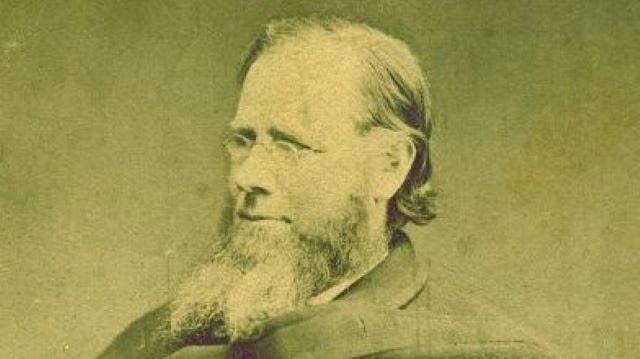
It seemed like a good idea at the time. When a handful of American priests of the Congregation of the Most Holy Redeemer decided in 1858 to petition their superior general in Rome for permission to start an English-speaking foundation in the United States, they had the support of American bishops. The prelates wanted the Redemptorists to minister to a wider audience than the German immigrants with whom they primarily worked. The Redemptorists sent their leader—a young, charismatic convert priest named Isaac Hecker—to plead their case in Rome.
The undertaking was risky because in order to cut down on unimportant petitions that cost Redemptorist communities a lot of money that could be better spent elsewhere, the superior general had recently ruled that his men could no longer travel to Rome to meet with him. Whatever they wanted to say to him, they must put in writing.
But a written petition to Rome had been denied. The Redemptorists’ constitution allowed for meetings with the superior general for serious reasons, and the Americans felt their cause was serious. So they sent Fr. Hecker.
The superior general saw this as an act of disobedience and summarily dismissed Fr. Hecker from the Congregation of the Most Holy Redeemer. With help from contacts in the Vatican, Fr. Hecker pleaded his case to Pius IX.
While sympathetic to Fr. Hecker, Pius felt it would set a bad precedent for a pope to overrule the lawful superior of a religious congregation on a matter internal to the congregation. Pius offered Fr. Hecker a proposal: he’d dispense him and his fellow Americans from their vows with the Redemptorists, which would free them to begin a new society of apostolic life—one that would be dedicated to the evangelization of the United States.
Hecker and Orestes Brownson, Catholic converts
While Isaac Hecker was in Rome to make the case for his U.S. Redemptorist community’s plans to start a new foundation, he submitted a document outlining his personal religious journey to his director:
Born of Protestant parents and in the midst of a Protestant community, no positive religious instructions were imparted to me in my youth, and my religious belief, therefore, was left for me to decide ... at some future period and according to my own choice (Isaac Thomas Hecker: Spiritual Pilgrim, by John J. Behnke, ebook edition, Kindle location no. 166).
His lack of religious formation sounds quite modern, but Isaac Thomas Hecker was born in 1819 in New York City to a middle-class Protestant family. Hard times hit the family when Isaac was young, forcing his brothers and him to seek work at an early age to help support their family. They managed to rebuild the family’s fortunes through milling flour and selling baked goods, giving them firsthand experience with the injustices faced by many Americans, especially immigrants, in the working class.
For a while, Hecker thought political involvement was the best route to remedy the social injustices he saw in his community. Politics soon proved dissatisfying, and he turned to Transcendentalism, an American philosophical movement popular in the mid-nineteenth century that was based on belief in the inherent goodness of man. It was during this phase of his life that Hecker met Orestes Brownson.
Brownson, a philosopher and journalist, had been preaching the harmony of religion and social engagement for years before he met young Hecker. Brownson, who as a minister had started his own church in Massachusetts, was popular on the New England speaking circuit. He became a mentor to Hecker, showing him how to merge his religious and political ideals.
Brownson’s interest in Catholicism reinvigorated Hecker’s longstanding fascination with the Church, and the two men entered the Church in 1844. After their respective conversions, Brownson, a family man, concentrated on writing and publishing, and Hecker discerned a vocation to the priesthood and the Redemptorists.
The two men were temperamental opposites. Orestes Brownson loved debate—and he especially enjoyed winning debates. (Hecker said of Brownson, “No one loves to break a lance with him because he leaves such ungentlemanly gashes.”) Fr. Hecker, on the other hand, “was a person of great charm; even people who disagreed with his ideas seldom disliked the man” (Russell Shaw, "The Weathercock and the Mystic: The Prophetic Friendship of Orestes Brownson and Isaac Hecker," Crisis Magazine).
Their paths diverged in other important ways. While Brownson quickly turned away from his earlier confidence in the goodness of man, Hecker remained convinced that man was good and could be made better by the work of the Holy Spirit within the Church. “The Church,” he wrote to Brownson, “is the only institution which has for its object the bettering of men’s souls” (Behnke, Kindle location no. 308).
The founding of the Paulists
When Fr. Hecker returned to the U.S. with the papal dispensation to start a new community, he and his brother priests faced the challenge of supporting themselves while getting their new missionary venture off the ground. Hecker’s family, which had grown prosperous by its commercial ventures, provided the priests a place to live in New York City.
The archbishop of New York, one of the episcopal supporters of the priests’ new mission, offered them a parish where a new church was to be built. They called themselves the Missionary Society of St. Paul the Apostle (shortened to the Paulists) and undertook the mission of evangelizing the people of North America in a manner suited to the continent’s culture.
The early years of the Paulist Fathers were consumed with internal struggles. Priests left and rejoined the society, and the Paulists worked to attract enough member priests to run their New York parish while taking on the speaking engagements for which the American bishops had sponsored them.
The society took on a distinctively American individualism, in line with Fr. Hecker’s vision of the Holy Spirit at work within the hearts of men to bring them to salvation. “Hecker once said he would rather suffer from the excesses of liberty than from the arbitrary actions of tyranny,” wrote his biographer (Ibid., Kindle location no. 630.)
After Fr. Hecker’s death, his emphasis on American individualism as a religious ideal would eventually draw the attention of a future pope to writings about the Paulists and their founder and would lead to a papal denunciation of a homegrown American heresy. At this point, though, in the mid-1860s, Hecker resolved some of the challenges facing his new community by putting their speaking engagements on hold and launching the Paulists into the world of publishing.
Evangelism through print media
At the beginning of the twenty-first century, we are seeing the death of print media thanks to the rise of digital technology. Few magazines, especially those devoted to the concerns of niche markets, still survive, much less thrive, in the United States. But in the mid-nineteenth century, printing presses were starting to hit their stride as a means of cheap mass production of information, and postal delivery services became a reliable method of delivering newspapers and periodicals to subscribers.
For Fr. Hecker and his Paulists, this became the perfect means to continue their mission for souls in the U.S. In 1865, in the same month the American Civil War ended, Fr. Hecker launched The Catholic World, a journal of Catholic intellectual thought.
In a country such as the nineteenth-century US, which was largely Protestant and had a deep-seated anti-Catholic bigotry at all levels of society, The Catholic World was revolutionary. One of the first writers featured was Orestes Brownson, who wrote at length for the magazine on the relationship between church and state.
With upheavals brewing in Italy over the status of the universal Church and the worries US Protestants had about the loyalties of Catholic immigrants flooding the country during those years, American Catholics needed formation in how to understand their religious rights and obligations in their adopted country.
The journal also helped American Catholics understand their Faith with articles devoted to explaining the teachings of the Church. An early issue, from March 1866, offered articles on Mary, Queen of Scots, and Charles II; “California and the Church”; and “Saints of the Desert” (penned by an Anglican convert named John Henry Newman). The journal also featured fiction and poetry.
The Catholic World helped launch in the U.S. a new method of sharing the gospel, one that would grow over the next century as hundreds of magazines devoted to all aspects of Catholic customs, doctrine, and practice flourished and brought the Church into the mainstream of American life. It also laid the foundation of the Paulists’ own publishing house, Paulist Press, which endures to this day.
In 1866, Fr. Hecker spoke to the Second Plenary Council of Baltimore, urging the American bishops to “labor with a lively faith, a firm hope, and a charity that knows no bounds, by every good work and good example for the reign of God’s kingdom” (Paulist archives, quoted by Behnke, Kindle location no. 668). In 1869, he was a participant at the First Vatican Council, acting as a proxy for the bishop of Columbus, Ohio, and as a personal theologian for Archbishop Martin John Spalding of Philadelphia.
Death and scandal
Ill health vexed Fr. Hecker’s final years, forcing him into retirement from the Paulists and semi-retirement from public activity. When he was well enough to write, he concentrated on collating and editing the articles he’d published throughout his career into The Church and the Age. The subtitle of this collection, “An Exposition of the Catholic Church in View of the Needs and Aspirations of the Present Age,” captured well his belief that the Church needed to remain relevant to modern times.
But Fr. Hecker’s work would come under much scrutiny in the years to come, especially for the radical individualism he seemed to promote. It’s important to note that Fr. Hecker didn’t deny the need for the Church’s magisterial authority. At the beginning of The Church and the Age, clearly seeing the need for a disclaimer, he wrote:
The office of divine external authority in religious affairs in providing a safeguard to the individual soul and assisting it to a freer and more instinctive cooperation with the Holy Spirit’s interior inspirations is often treated of in this book and the false liberty of pride and error is plainly pointed out (Hecker, The Church and the Age, 2).
Isaac Hecker died December 22, 1888, not long after the publication of his book. Fr. Walter Elliott, a Civil War veteran who was one of the first priests to be ordained for the Paulists, wrote a biography of Hecker that quickly became the center of controversy.
The American experiment had long been a source of inspiration for revolutionaries in France. In the eighteenth century, the American Revolution was a major influence on the French Revolution; in the nineteenth century, French political reformers sought to remake France from a monarchy into a form of government patterned after American republicanism.
Even French Catholics, struggling to reestablish the Church in France after the revolution, looked to American Catholics for guidance. Isaac Hecker’s emphasis on religious freedom and the place of the Church within a democratic nation was attractive to some sectors in the Church in France.
When Fr. Elliott’s biography of Hecker was translated into French, it included a preface by Abbé Felix Klein that drew attention from the Vatican. Historian David J. O’Brien explained that Abbé Klein’s introductory remarks sparked alarm, in part, because “he pointed to Hecker’s understanding of the ‘radical change’ taking place in history, central to which was ‘freedom’ and personal independence ... [and] ever greater reliance on the indwelling of the Holy Spirit.” Perhaps most alarming of all, Abbé Klein concluded that this “American idea ... he [Hecker] knew to be God’s will for all civilized people of our time” (O’Brien, Isaac Hecker: An American Catholic, 383).
In his letter to Baltimore’s Cardinal James Gibbons addressing the controversy in 1899, Leo XIII noted that his concern was not with Hecker himself but with “the biography of Isaac Thomas Hecker, especially through the action of those who undertook to translate or interpret it in a foreign language”:
The underlying principle of these new opinions is that, in order to more easily attract those who differ from her, the Church should shape her teachings more in accord with the spirit of the age and relax some of her ancient severity and make some concessions to new opinions. Many think that these concessions should be made not only in regard to ways of living, but even in regard to doctrines which belong to the deposit of the faith. They contend that it would be opportune, in order to gain those who differ from us, to omit certain points of her teaching which are of lesser importance, and to tone down the meaning which the Church has always attached to them (Testem Benevolentiae Nostrae, “Concerning New Opinions, Virtue, Nature and Grace, with Regard to Americanism”).
“Such a policy,” Leo argued, “would tend rather to separate Catholics from the Church than to bring in those who differ.”
Public redemption
Unfortunately, Fr. Hecker’s reputation suffered by association with the Americanism heresy, which became known in some Catholic circles as “Heckerism.” O’Brien noted efforts even by Hecker’s friends and colleagues to distance themselves from his legacy, calling his ideas “ambiguous,” “queer,” and “too general” (O’Brien, Isaac Hecker, 390-391).
Fr. Hecker’s reputation would eventually recover decades later when the Second Vatican Council took up many of the ideas on religious freedom proposed by Hecker and other theologians of his day. It was at Vatican II that the council fathers would finally thread the needle between the role of the Church in preserving truth and the necessary freedom of the individual in accepting truth:
[The] human person has a right to religious freedom. ... Men are to be immune from coercion on the part of individuals or of social groups and of any human power, in such wise that no one is to be forced to act in a manner contrary to his own beliefs, whether privately or publicly, whether alone or in association with others, within due limits. ... In consequence, the principle of religious freedom makes no small contribution to the creation of an environment in which men can without hindrance be invited to the Christian faith, embrace it of their own free will, and profess it effectively in their whole manner of life (Dignitatis Humanae 2, 10).
In 2008, with Fr. Hecker’s reputation finally fully reestablished, Cardinal Edward Egan granted the request of the Paulist Fathers for a cause to be opened for Hecker in hopes that he can one day be declared a saint. Today, Isaac Hecker is known as a Servant of God, and his cause for canonization is ongoing.
SIDEBAR
Hecker’s Friendship with Newman
In 1845, a year after Isaac Hecker was received into the Catholic Church, John Henry Newman also entered the Church. Frs. Newman and Hecker were well known to each other. During his journey toward the Church, Hecker had considered Episcopalianism. When Hecker launched The Catholic World, one of his early contributors was Newman. Fr. Newman and Fr. Hecker saw in their own conversions a vocation to draw in others and to make Catholicism understood and respected in countries where the faith was viewed, in their time, with suspicion and animosity.
Newman shared Hecker’s interest in the primacy of the rightly formed conscience to know truth while respecting the limits of private judgment. Scholar David E. DeCosse points out that Newman “rejected a singular emphasis on a subjectivist ‘private judgment’ ... [and] affirmed an indispensable role for conscience in the life of the Church” (DeCosse, "Pope Francis, Newman and the Canonization of Conscience," National Catholic Reporter).
For example, in response to criticism from Charles Kingsley, Newman wrote, “Catholic Christendom is no simple exhibition of religious absolutism but presents a continuous picture of authority and private judgment alternately advancing and retreating as the ebb and flow of the tide” (“General Answer to Mr. Kingsley,” 1864).
When Fr. Hecker died, Fr. Newman commented on the parallel paths their lives had taken, noting “a sort of unity in our lives” that had led each man to start “a work of the same kind” (O’Brien, 375).
(Image: Isaac Hecker, Wikimedia Commons.)