Catholic Answers’ apologetics department fields many questions from Catholics that ask for resources on various topics of Catholic interest. Confronted with scandals plaguing the Church, secular culture wars, or the latest book or movie denigrating the Church, Catholics want good resources that will strengthen and edify. At Catholic Answers we take this responsibility seriously and do our best to find resources inquirers need to better understand and defend their Faith.
One problematic aspect to these questions, though, may not seem problematic on the surface. Often we are asked to provide a resource that is “one hundred percent faithful to the magisterium of the Catholic Church” and authored by a Catholic who is “absolutely orthodox.” Oftentimes we may know of resources that would be helpful, but we’re hesitant to recommend them because it might not be possible to call them “pure” from an orthodox perspective or authored by someone who can be considered “totally” orthodox.
The value of a “purity filter”
I have found that many orthodox Catholic inquirers are cautious about whom they will listen to or read. The desire is for a particular author or speaker who has produced a book, video, DVD, or CD that is one-hundred-percent orthodox—according, mind you, to this person’s perception of what constitutes Catholic orthodoxy—or else the resource is dismissed as anathema. This is an understandable and noble impulse because the Catholic is doing his best to avoid falling into error about the Faith. Nevertheless, it is misguided. Allow me to explain why.
If someone limits his resources to only those individuals whom he believes conform to his own understanding of the Faith, it is unlikely that he will ever grow in his own understanding of the faith. Applying “purity tests” to all resources and rejecting any that fail means that one cannot benefit from the legitimate insights others may offer.
Rather than “purity tests,” orthodox Catholics should seek to develop “purity filters.” The goal should be to learn the faith well enough from orthodox sources to develop the ability to filter out the impurities while still accepting and benefiting from the legitimate insights an otherwise problematic resource can offer. As an analogy, think of a gold miner panning for gold. A miner has to shake a lot of dirt from his pan to find the few flecks of gold that may be hiding within. Although the work is messy and painstaking, the reward for doing so is great.
If there is a question about whether a particular idea or claim is valid or should be trapped by the filter, then orthodox resources such as Catholic Answers can be relied upon to help figure out what the Church teaches or requires. A particular resource may end up worthless and can be thrown out. Others, though problematic, may be useful.
Take, for example, John L. Allen Jr., senior correspondent for the National Catholic Reporter, a newspaper known for its dissident posture toward the Church. Allen is a good source for reasonably fair information on current Vatican affairs. His books have included an in-depth analysis of Opus Dei and a book-length interview with Cardinal Timothy Dolan of the Archdiocese of New York. In my opinion, his book All the Pope’s Men should be on the required reading list of all aspiring apologists, particularly those who seek to explain why the Vatican undertakes actions that do not seem logical to the layperson. But because of Allen’s employer and his own slightly center-left approach to Catholicism it is difficult to recommend him to a general Catholic readership without caveats (e.g., “Yes, Mr. Allen works for the National Catholic Reporter, but his book on Opus Dei is quite fair and informative, and you can feel comfortable giving him a try”).
This also holds true for non-Catholic and non-Christian resources. While a Catholic would not turn to Evangelical Christian philosopher Dr. William Lane Craig for an explanation of the Catholic Faith, he might want to read Craig’s work debunking atheism. Likewise, a Catholic might find much profit in reading Jewish conservative culture warrior Michael Medved for his analysis of Hollywood and secular society while setting aside his commentary on debates that are internal to American Judaism.
Be not afraid
The objection might be raised in some quarters that perhaps not everything that should be caught by a purity filter will be caught. Might not some people inadvertently accept as Catholic orthodoxy ideas that are cleverly disguised error?
It is unfortunate that many orthodox Catholics seem to be afraid of error to such an extent that the avoidance of it can become for them the driving force in their spiritual lives.
Please understand me: This isn’t a bad impulse. Wanting to avoid error because one wishes to remain faithful to the Church’s magisterium is a good thing. When this impulse is developed well and used in a prudent manner, such an impulse can be protection against false teaching.
The problem arises when the person’s fear of error prevents him from taking reasonable chances. The often unspoken fear appears to be that the person is afraid that error is inherently sinful—and that a person who is in error in not just wrong on some point but headed toward hell.
Being in error is not a sin. The only time it can become sinful is when someone is so set in his erroneous opinions that he is not open to correction from properly constituted authority, such as the Church. For example, a person who innocently believes that Jesus did not found the Catholic Church does not sin by such a belief. Only if that person has reason to believe he should investigate the claims of the Catholic Church to be founded by Christ and refuses to do so does the possibility of culpability for error develop.
If he does investigate the claims to the best of his ability and cannot in good conscience understand those claims to be true, he does not sin even though he is objectively mistaken. But if he comes to the conclusion that the claims are true and refuses to act on those beliefs in a manner to which they should call him, then he may be culpable for his decision not to become Catholic.
You see, the problem is not innocent ignorance or even innocently accepting something as true that is objectively incorrect. The problem is refusing to act upon the knowledge that we have in a manner that is faithful to God. We are not judged on what we know, but on how well we have remained faithful to God through the knowledge we have been given. We should seek not to be know-it-alls but faithful to what we know.
In the words of Christ echoed by late John Paul II: Be not afraid! In your reading, you may come across ideas that are not orthodox. Your purity filter may not catch everything that should be filtered out. You may, in the short term, not have an entirely correct understanding of a particular issue. And that’s okay. So long as you remain open to correction from those you know can provide you with Christian orthodoxy, you need not fear. God will not abandon you, and he will bring forth good from the true knowledge that you have. What matters to God is not your expertise but your obedience and thirst to know the truth.
Remember the Great Western Schism. There were saints on both sides of the divide who stumped for the various papal contenders. One famous example was St. Vincent Ferrer (1350–1419), a Dominican friar who supported one of the antipopes. Even when St. Vincent was in error over who was the true pope, he worked miracles and was not directly told by God the identity of the true pope. For many years, St. Vincent’s reputation was bound up with his support of an antipope.
The heroic virtue of St. Vincent was that when he realized his error he immediately stopped his support for the antipope and pledged his allegiance to the true pope. He did not seek to justify his past support or rationalize away his knowledge of who the true pope was out of fear for his reputation. He sought only to be faithful. And God rewarded that faithfulness with sanctity even though St. Vincent was not a know-it-all.
Developing a purity filter
Another objection might be that the busyness of everyday life makes it difficult to choose the right books in which to invest one’s limited spare time. A purity filter may be good but not much help when someone has chosen materials that are useless. How does the lay Catholic seeking to learn his faith on his own find the materials he needs quickly and reliably?
Perhaps you have heard the old adage that you should never judge a book by its cover. That’s nonsense.
The apologists at Catholic Answers often get calls from inquirers asking whether we have read such-and-so book and, if so, what we think about it. Unless the book happens to generate a lot of inquiries—on the order of, say, Dan Brown’s The DaVinci Code—the answers are often “No” and “We don’t have an opinion on it.”
Don’t despair. There are ways to glean a lot of information about a book without having to read it. Here are some tips for skimming:
Title: What does the title say about the author’s approach to the subject? If you were wandering through the parenting section of your local bookstore, a quick scan of the titles can give insight into the approaches taken to parenting. If you have a gentle parenting philosophy, you are more likely to be drawn to Unconditional Parenting than to Laying Down the Law. You do need to be careful here, though. Sometimes titles are chosen for purposes of irony or are given their titles by publishers more interested in sales than in accurately describing the contents. A title is helpful but not conclusive.
Author: What else has this person written? What are his credentials in the field? The answers to these questions and many more can be found by plugging the author’s name into an Internet search engine. Many authors maintain personal websites for use as marketing tools, and you are likely to find out a great deal about an author from the Internet.
Cover blurbs: Who is endorsing this book? Have you heard of them before? Do you know their reputations? If we move back to the parenting section example, if names like James Dobson or Dr. William Sears appear on the dust jacket, you have found an important clue about the author’s parenting philosophy. In the Catholicism section of the store, an endorsement of a book by dissident priest Fr. Richard McBrien will suggest one thing, while an endorsement by conservative commentator and papal biographer George Weigel will suggest something else.
Publisher: What other titles has this company published? What is the company’s target audience? What does its website reveal about the company? If the book is on Catholicism, is the publisher a Catholic company? If so, is the Catholic publisher orthodox, heterodox, or is it a mixed bag? Is the company secular? If so, what other religious titles has the secular company produced? Secular publishing houses have released great titles—Doubleday published two of Pope Benedict XVI’s three-volume series Jesus of Nazareth—but prudence suggests looking more carefully at the offerings by a secular publisher.
Copyright: If the copyright date is old, will current information be missing? A book on nutrition from decades ago might still talk about the four food groups rather than the newer food pyramid. A Catholic book written before 1983 might reflect the 1917 Code of Canon Law and thus be out of date in some matters of ecclesiastical law. You will need to be aware that some of the disciplinary injunctions of an older book may no longer be binding, and that some of the doctrinal injunctions may be lacking the certitude of later developments (e.g., a pre-1950 book may teach the Blessed Virgin’s Assumption without the dogmatic certitude a post-1950 book should have).
Notes: If the book is nonfiction, does the author cite sources? Does he cite sources in a uniform manner, or is his citation haphazard? Are the bulk of the sources primary (e.g., studies, academic papers) or does he rely on general information books in his field in which the authors agree with his thesis? (You’d be surprised at how sloppy research can be.)
Bibliography: What titles did the author use for research? Does the author recommend certain titles? If so, do you know anything about these titles or authors?
Acknowledgements: Who does the author thank? Names of experts whom the author thanks can be plugged into Internet search engines for information about credentials and philosophy.
Foreword and afterword: Who wrote introductory and/or summary matter? What is that person’s experience in the field? A book on the liturgy with an introduction by the former Joseph Cardinal Ratzinger would suggest that the book would be orthodox, while an introduction by the dissident Sr. Joan Chittister, OSB, would suggest something quite different.
After your gleaning, take stock. Are there red flags flying? If so, the book may not be worth your time. If you do have time to spare and your curiosity continues to be piqued, you may still want to read the book, but you’ll know to rev up your purity filter before reading. In any case, you’ll have a pretty good gauge of the book before diving in.
When you are first starting out in developing your filter, it may take a while to gather information about the people and institutions you are researching. You may spend a couple of hours researching whether a single book is worth your time. Do not let this discourage you. Once you have done this a few times, you’ll have gathered information that can be helpful to you when assessing future books. Eventually you’ll have enough information and experience that you’ll be able to tell at a single glance at a bookstore shelf or online catalogue whether a resource is worth further investigation.
When proper precautions are taken, yes, it is quite possible to judge a book by its cover. As St. Paul noted, “Do not quench the Spirit, do not despise prophesying, but test everything; hold fast what is good, abstain from every form of evil. May the God of peace himself sanctify you wholly; and may your spirit and soul and body be kept sound and blameless at the coming of our Lord Jesus Christ” (1 Thess. 5:19-23).
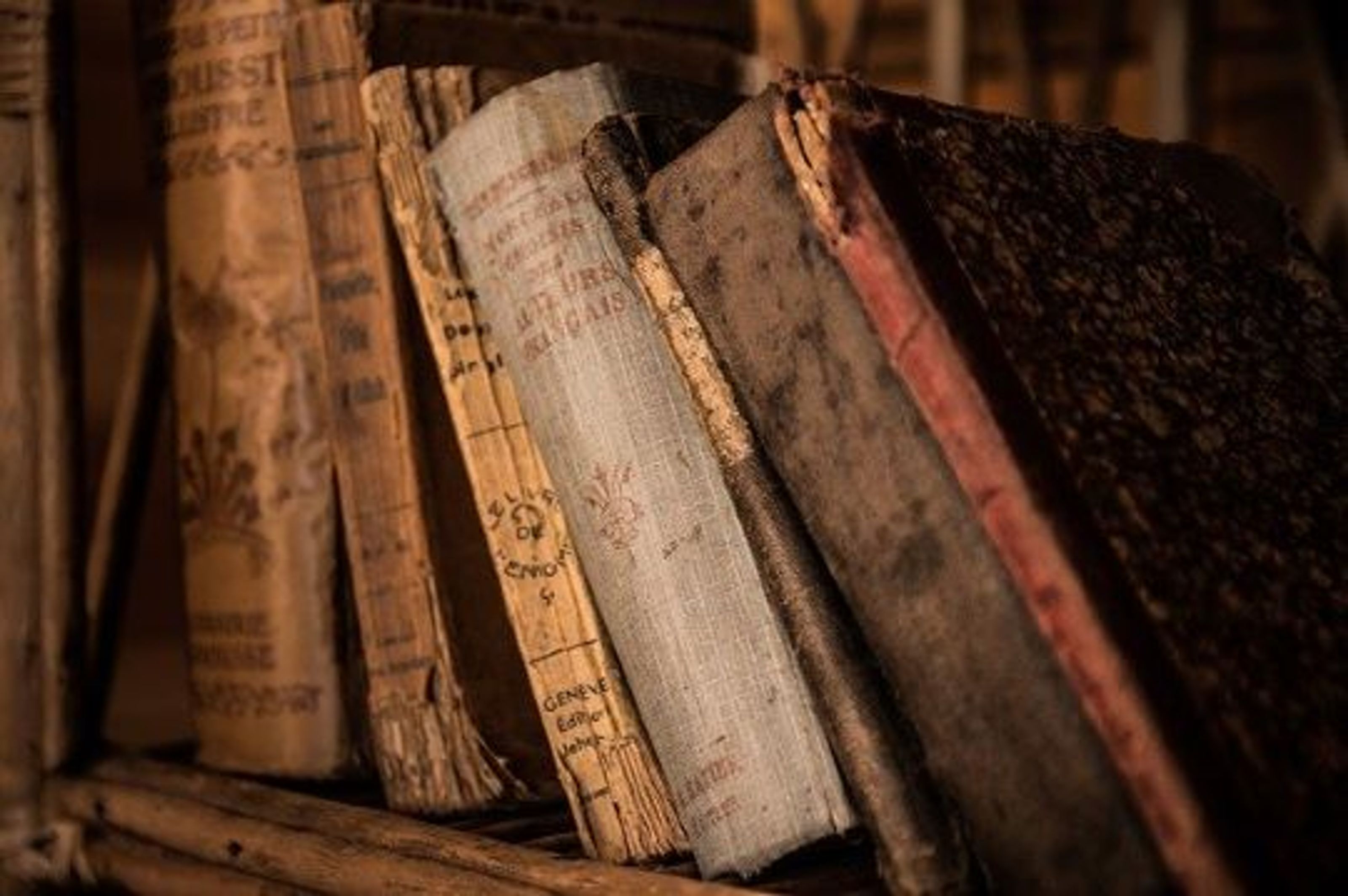
(Image: Books, Pixabay.)