
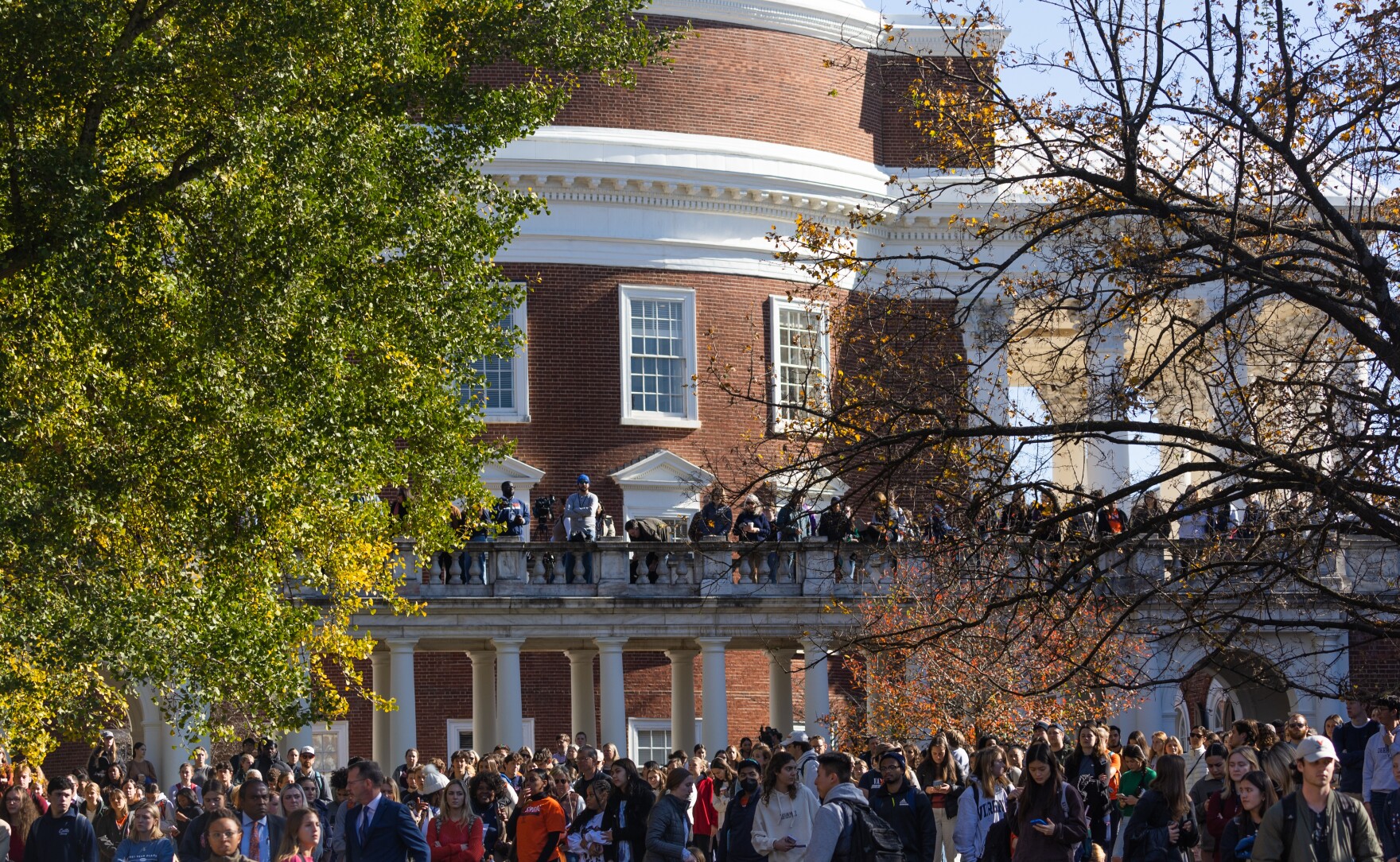
Students gather on the ground of the University of Virginia on Monday, November 13, 2023 in Charlottesville, Virginia.
Virginia state Sen. Creigh Deeds: "I'm just trying to get some answers."
Pressure is mounting from students, faculty and lawmakers for the University of Virginia's Board of Visitors to release more details about the ouster of Jim Ryan, how it plans to select its next president and more.
Virginia state Sen. Creigh Deeds (D–Charlottesville) recently sent a detailed letter with nearly 50 questions to Rector Rachel Sheridan and Vice Rector Porter Wilkinson, including questions about the potential involvement of board members in pressuring Ryan to step down.
"I'm just trying to get some answers," Deeds told VPM News in a recent interview. "Two of the big jobs of the Board of Visitors of any school are to protect the university and protect the president from outside pressure. And I don't think that happened here."
He said members of the community want more answers, too.
On Aug. 6, a coalition of staff, faculty and students held a "Hands Off Our University" press conference to draw attention to what they say is a lack of transparency on the board's part — as well as a lack of willingness to collaborate on the presidential search.
Adam Barnes, an executive committee member at UVA's chapter of the American Association of University Professors, said the lack of transparency related to Ryan's ouster "gives us pause as to what constraints – either real or perceived – fall upon the incoming president."
Some of Deeds' questions are about consulting firm McGuireWoods' involvement in handling responses related to federal Department of Justice investigations. According to a public records request, the OAG has confirmed to VPM News that McGuireWoods has been retained to represent UVA in relation to "letters received from the Department of Justice regarding a Board resolution and the undergraduate and law school admissions processes."
Multiple faculty members told VPM News that in July, select faculty and staff from multiple UVA schools, including the School of Nursing, were questioned by attorneys with McGuireWoods about their involvement in anything related to the practices of diversity, equity and inclusion.
The purpose and scope of the review wasn't made clear, and was initiated "without explanation," according to a letter of no confidence in the university's board the university's AAUP chapter sent on Aug. 10.
During the August press conference, Barnes said the AAUP is alarmed about the "secretive and coercive" nature of the compliance review underway.
"We need more information about who is funding it, who requested it, why it is being conducted, and why the interviewees have been forced to sign gag orders during the interviews," Barnes said.
UVA spokesperson Bethanie Glover did not answer VPM's specific questions about McGuireWoods' review, but said in an email statement that: "UVA is committed to complying with all federal laws and has been cooperating with the Department of Justice in the ongoing inquiries. The federal government's support of the University is essential to continue the core mission of research, education, and clinical care."
Barnes also pointed to recent compliance agreements that other universities have signed with the federal government, stating "we believe that no compliance agreement should be signed without input from the Faculty Senate, and we cannot agree to any federal overreach that is going to compromise our academic freedom."
Manuel Lerdau, who represented Jewish faculty during the "Hands Off" press conference, also has concerns about a lack of transparency at UVA right now.
He was among a group of 40 Jewish faculty members who signed onto a statement in July about President Donald Trump's administration "disingenuously" labeling "politically disfavored speech" as antisemitic; he's also called Ryan's ouster "top down interference."
"I hope the board realizes the amount of good that they can do by increasing transparency and sharing more," Lerdau said. "I'm not sure the board realizes how much good they can earn and win by doing those things."
Students and faculty are also continuing to press the board for greater inclusion in the search for the university's next president.
On Aug. 8, UVA's student council passed a "no confidence" resolution about the board — following multiple requests for more student involvement in the search for its next president that they said were not honored.
"I hope it serves as a wakeup call, and can ignite genuine, transparent collaboration going forward," said Student Council President Clay Dickerson.
The council's resolution states it cannot support any presidential appointment made through a process that "inadequately represents" students.
Walt Heinecke, immediate past president of UVA's AAUP chapter, said many faculty feel the same way.
"They pretend to adhere to principles of shared governance, but that's not happening," Heinecke said. "The process that's leading to the nomination or the selection of a permanent president … that's all happening within a political context that does not lend confidence to the entire process."
That's why Michael DeCesare, senior program officer with the AAUP, told VPM News that it's important for UVA to conduct a search that is as open and transparent as possible — especially because of the circumstances surrounding Ryan's departure.
According to AAUP's policy standards, each major group of faculty and students should elect its own members to serve on any joint presidential search committee. UVA faculty and students told VPM News that wasn't the process followed in the selection of committee members announced in late July.
Though there are some faculty and students on the committee, Faculty Senate wasn't asked to name representative(s) to the search committee, according to Chair Jeri Sheridan. Dickerson said they the council wasn't asked to name student representatives, either.
"The president should be equally qualified to serve as the executive officer of the board, but also as the chief academic officer of the institution," DeCesare said. "And it's because of those dual roles that both the board and the faculty should pretty much be on equal footing in terms of the search process."
Additionally, DeCesare said university presidential searches should include an "open phase" at the end in which finalists are invited to campus for interviews with faculty and students — and the final appointment shouldn't be made over the objections of a faculty group like UVA's Faculty Senate (when a joint search committee including elected faculty representatives isn't utilized).
"From our perspective, it would be deeply unfortunate if they [UVA] did not have an open phase at the end that gave campus constituencies an opportunity to talk with the finalists," he said.
He said that part of the process isn't only beneficial for the institution and faculty, but also for the finalists themselves.
"It puts the eventual appointee in a very difficult position if they're only meeting the faculty for the first time when they arrive on campus on their first day of work," DeCesare said.
VPM News asked UVA how it plans to engage presidential finalists and if it plans to follow AAUP guidelines for conducting an open process at the end of the search in which faculty and students can interview the candidates. So far, the university hasn't publicly announced any plans to do so.
A UVA spokesperson did not address specific VPM News questions about this, but instead said in an email statement: "several listening sessions will be held with students, faculty, staff, alumni, parents and supporters, and the entire UVA community will be invited to share their thoughts in an online nomination and feedback form."
Hannah Davis-Reid and Meghin Moore contributed reporting to this story.
Copyright 2025 VPM