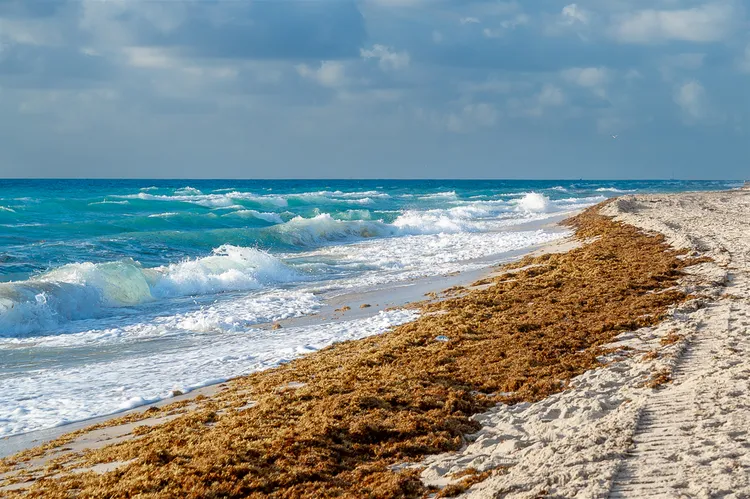
Nothing puts a damper on a beach vacation like piles of brown seaweed rotting on what should be a beautiful sandy shoreline. But it just got easier to figure out if that unappealing algae might derail your idyllic time at the shore.
Sargassum, a floating brown algae, typically begins washing up on beaches in the spring and summer. And now, the National Oceanic and Atmospheric Administration (NOAA) has started publishing daily reports that show vacationers heading to coastal areas in the southeastern United States, Caribbean, and South America the likelihood of sargassum washing ashore at their destination.
NOAA’s Sargassum Inundation Risk tool tracks the density of sargassum in the water to identify the coastal areas where it’s most likely to wash up in the coming weeks. NOAA uses a color-coded system to break sargassum risk down into four categories: blue indicates the lowest risk, while red is a flag that a beach is likely to become inundated.
“Our updated risk tool is now more timely and the higher resolution offers more detail on where sargassum is and where it is not,” Matthieu Le Henaff, an oceanographer who oversees the NOAA tool, said in a statement.
Sargassum has become such a problem in recent years that NOAA began pouring resources into helping communities plan for its arrival. It’s now using satellites to detect and monitor sargassum levels at sea and predict where and when it may wash up on shore.
Until around 2011, sargassum primarily existed in the North Atlantic Ocean, rarely inundating the Florida coast, Puerto Rico, and Caribbean island destinations as it does now.
While the naturally occurring algae is a key component of the marine ecosystem, things change when large piles of it come ashore. It typically rots under the hot sun and begins to give off an unpleasant smell, a combination of ammonia and hydrogen sulfide gas that can irritate people’s eyes, noses, and throats. It can also interfere with turtle nesting on the beach and make sandy beach walks or frolicking in the water a whole lot less fun. Additionally, it can harbor all sorts of tiny marine organisms like jellyfish larvae, which can cause skin irritation to swimmers, per the Environmental Protection Agency (EPA).
Julio Morell, the Puerto Rico-based director of the Caribbean Coastal Ocean Observing System, noted the improved tool’s daily updates would be key in monitoring the less-than-desirable algae.
“It will help us to know where there is not a threat of sargassum and it’s safe to go,” Morell said in the statement.