Soto addresses all of the Yankees’ woes: He’s a top-5 hitter in MLB who plays a corner outfield position and rarely strikes out or gets hurt
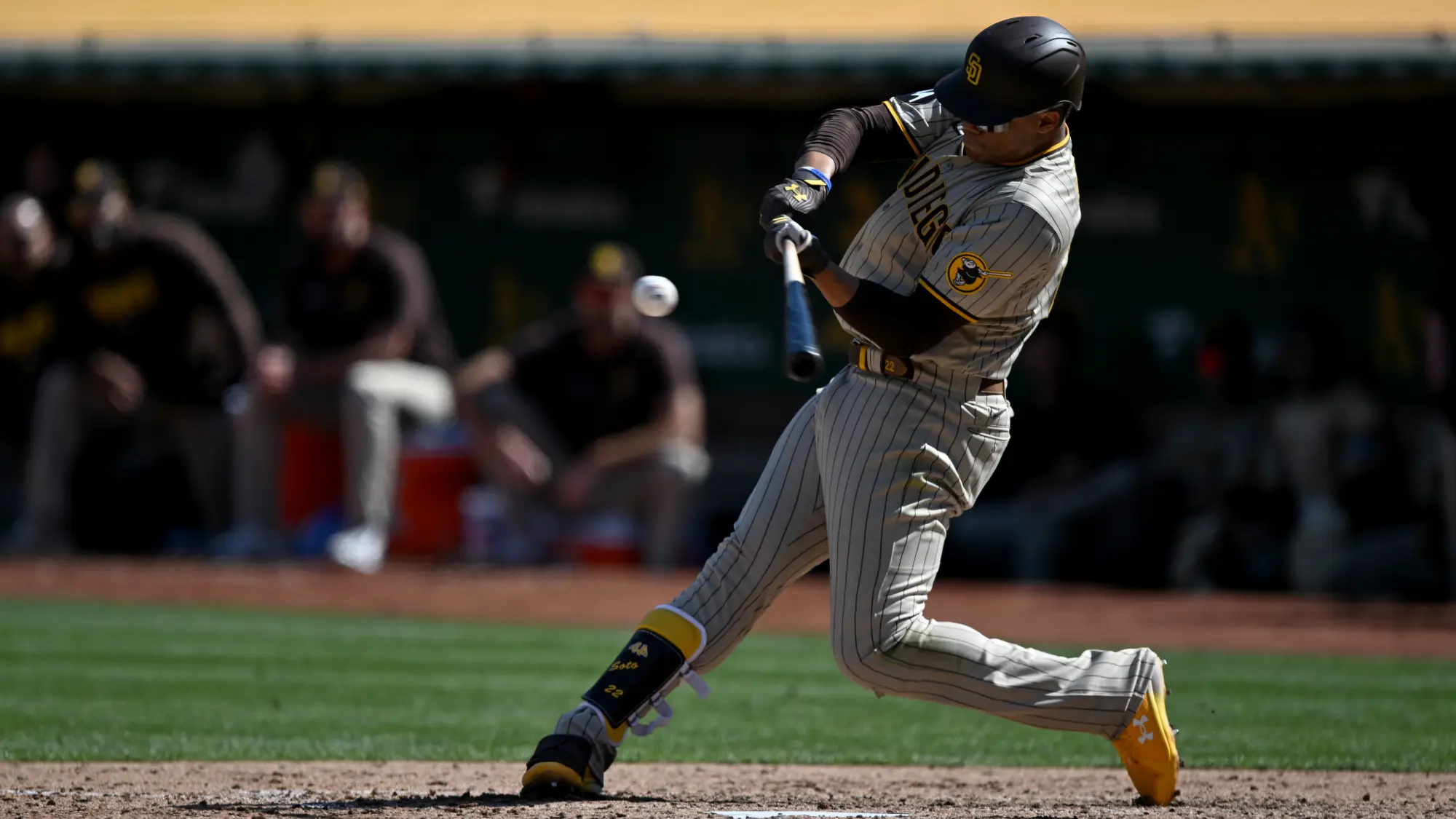
More than 70 years after the fabled trade of Joe DiMaggio for Ted Williams was nearly consummated after a night of scotch drinking, the New York Yankees finally made a move to secure the second coming of The Greatest Hitter Who Ever Lived.
Juan Soto, whom the Yankees acquired late Wednesday in a seven-player blockbuster deal with the San Diego Padres, is one of the most accomplished young hitters in baseball history. To get him and center fielder Trent Grisham, New York had to send four pitchers — Michael King, Jhony Brito, Randy Vásquez and Drew Thorpe — and veteran catcher Kyle Higashioka to San Diego.
That’s a lot of young pitching talent to give up for Soto, who will be a free agent after the upcoming season, and the glove-first Grisham, who has batted below .200 each of the last two years. But rarely does a player of Soto’s caliber become available in a trade once, let alone twice, at such a young age. In fact, the only twice-traded player before free-agent eligibility who comes close to Soto in terms of talent is Mark Teixeira, who was 28 when he was dealt for the second time. Soto turned 25 in late October and is a much better hitter than Teixeira was then. The Yankees balked at the cost of getting Soto when the Washington Nationals dealt him and first baseman Josh Bell to the Padres just before the 2022 trade deadline for three former first-round picks ( outfielder Robert Hassell, shortstop CJ Abrams, starting pitcher MacKenzie Gore), outfield prospect James Wood, pitching prospect Jarlin Susana and first baseman Luke Voit. But after finishing last season with their worst record in 30 years, the Yankees couldn’t afford to pass on him again.
“He’s a transformational bat,” Yankees GM Brian Cashman said of Soto on Tuesday at the MLB Winter Meetings, one night before finalizing the trade. “He’s one of the best hitters in the game. So he’s an impact, period.”
That might actually be underselling Soto. Among players with at least 3,000 career plate appearances through their age-24 seasons, Soto ranks fifth with a 157 OPS+. The four players ahead of him: Ty Cobb, Mike Trout, Mickey Mantle and Jimmie Foxx. Soto is most often compared to Williams, who is not on the list because he missed his age-24 season to military service. Soto’s superior plate discipline and advanced approach as a young, lefty batter is reminiscent of the Splendid Splinter.
New York’s lineup sorely lacked a transformational bat last season, especially when Aaron Judge missed almost all of June and July after banging his right toe into the right-field wall at Dodger Stadium. Judge batted .267/.406/.613 with 37 home runs last season, but played in only 106 games. The rest of the team combined to slash .224/.296/.381. Altogether, the Yankees posted a .227 batting average (29th in MLB), a .304 on-base percentage (27th) and a .397 slugging percentage (22nd); they scored 4.15 runs per game, the sixth fewest in the majors.
What went wrong? Well, mostly everything, but the foundation upon which this team was built had started to collapse before last season. Judge’s historic 2022 campaign masked many of their flaws. It took his absence for the organization to acknowledge that it had assembled a strikeout-heavy lineup that in recent years had become too old, too right-handed, and too injury prone. On top of that, except for Judge, New York’s marquee players all played the infield or, in the case of Giancarlo Stanton, were mostly limited to DH. According to Baseball Reference, the Yankees had the least-productive outfield in the majors last year.
As a top-5 hitter in baseball who bats left-handed, plays the corner outfield and rarely strikes out or gets hurt, Soto addresses all of the team’s biggest woes. Last season, Soto played in all 162 games, set a career high with 35 home runs, and led the majors in walks for the third time. He slashed .275/.410/.519 and posted 5.5 WAR. His performance was all the more remarkable considering how much he struggled, relatively speaking, in home games. His OPS at Petco Park was nearly 200 points lower than it was on the road. Getting out of San Diego should mean even greater production for Soto in 2024.
That said, the Yankees are going to need more than just Soto to keep pace in the American League. The two other players they added this week, Grisham and outfielder Alex Verdugo, who was acquired Tuesday in a rare trade with the Red Sox, are nice depth pieces. Grisham is one of the best defensive center fielders in baseball and an excellent baserunner. For now, it seems that the Yankees are planning to use him as a fourth outfielder and a defensive replacement, with Verdugo playing left, Judge in center and Soto in right, though that could certainly change between now and Opening Day.
In addition to the four pitchers in the Soto swap, the Yankees also gave up three pitchers — righties Greg Weissert, Richard Fitts and Nicholas Judice — to get Verdugo, as well as three others in the Rule 5 draft, meaning that this week alone, they have lost 10 pitchers from their organization. That they were willing to part with that many pitchers speaks to the depth they have developed in recent years, but it also indicates that more moves to replenish the major-league staff and the pipeline are on the way.
The Yankees are scheduled to meet with 25-year-old Japanese ace Yoshinobu Yamamoto, who across seven seasons in the Nippon Professional Baseball league has a 1.82 ERA. Some of the other top free-agent starting pitchers include former Yankee Jordan Montgomery, Marcus Stroman and a trio of San Diego starters from a year ago: NL Cy Young winner Blake Snell, Seth Lugo and Michael Wacha.
Along with the Soto deal, the availability of those three starters and closer Josh Hader signifies a retrenchment for the Padres after a few years of uncharacteristic spending. The trade was primarily a cost-cutting move. The Padres play in one of the smallest media markets in baseball and are losing a primary source of revenue following the collapse of their regional sports network deal with Diamond Sports Group. This is still a pretty good team that will have star infielders Manny Machado and Xander Bogaerts, outfielder Fernando Tatis Jr., and pitchers Joe Musgrove and Yu Darvish under contract through at least the end of the 2027 season. Taking a step back now should allow the Padres to contend again within the next few years.
The Yankees, meanwhile, are going all in by trading for one year of Soto, who is almost certainly going to be a free agent after this season. New York will try to lock him up long term before he hits the open market, but considering he is a Scott Boras client and turned down a 15-year, $440 million deal from the Nationals before they traded him in 2022, Soto is unlikely to accept an extension. Even so, the Yankees should have the upper hand to re-sign him as a free agent, because he will know what it is like to play for them and, assuming things go well, would be interested in staying if the price is right.
About that price: Despite recent evidence of frugality, these are still the Yankees. Yes, they have several hefty, long-term contracts on the books, but not as many as you may think. First baseman Anthony Rizzo could be a free agent as soon as next season, depending on if the Yankees exercise his $17 million club option for 2025. Infielder DJ LeMahieu, who turns 36 in July, has three seasons left on his deal, but at $15 million per year, his contract should not prohibit them from spending. And then there’s 34-year-old Giancarlo Stanton, who is signed for the next four seasons. He has a club option for a fifth year, but the Yankees almost certainly will not pick that up. His buyout for 2028 is $10 million, compared to the $25 million he would otherwise make.
That means that, as things stand, the Yankees will have only three players under contract after 2027: Judge, Cole and lefty Carlos Rodón. Money shouldn’t prohibit them from keeping Soto in pinstripes for the rest of his career. No cost should be too high for this generation’s Ted Williams. Well, except Joe DiMaggio.