The Diamondbacks stunned the Phillies to get to the World Series, but don’t call them inexperienced. Arizona has seen everything in its surprising up-and-down season
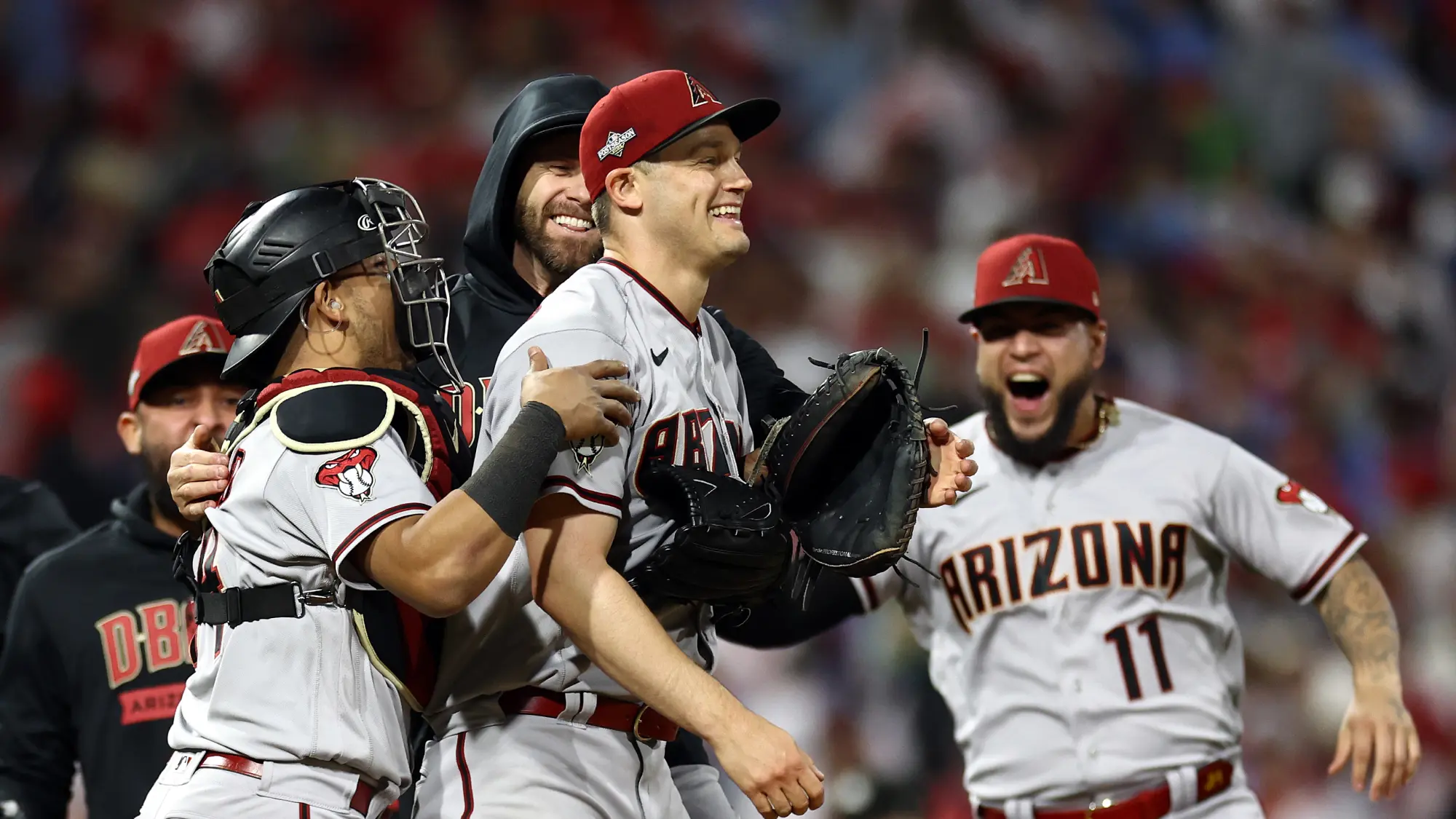
PHILADELPHIA — For a moment, the loudest environment in Major League Baseball fell silent. With two outs in the ninth, a hush fell over Citizens Bank Park as the Arizona Diamondbacks’ rookie right fielder, Corbin Carroll, glided toward the foul line and settled under pinch-hitter Jake Cave’s lazy fly ball.
As Carroll squeezed his glove for the final out, a small eruption of cheers and shrieks could be heard from a section of reserved seating for the visiting club’s family and friends. The hometown crowd then filed out of the stadium, stunned and confused.
The National League Championship Series was over. The 84-win Diamondbacks, not the vaunted and vibe-y Phillies, were headed to the World Series with the 4-2 victory.
To most of the baseball world, this wasn’t how it was supposed to be. It was merely evidence of a postseason format that had become so bloated as to incentivize mediocrity over excellence.
But maybe the playoffs should allow for young, talented teams such as these Diamondbacks to mature over the course of the six-month regular season. And, if that growth results in a pennant, maybe such a metamorphosis is exactly what should be rewarded. Maybe we should start to accept that the Diamondbacks deserve to represent the National League in the World Series against the Texas Rangers.
“We knew this was a good team,” says general manager Mike Hazen, who stood just outside the visitors’ clubhouse, his NL championship T-shirt drenched with beer. “They're just so young. We knew we were going to deal with a lot of ups and downs.”
Three months into this season, the Diamondbacks were a first-place team with the second best record in the NL. But a July 2 loss to the Angels — the game in which Mike Trout hit his final home runs of the season — kicked off a brutal stretch of 25 losses in 32 games. The Diamondbacks went from 15 games over .500 to two games under.
Hazen admits now that panic had indeed set in as the Diamondbacks spiraled. He couldn’t help but wonder whether that early season success had been just another mirage in Arizona’s vast desert. Same for manager Torey Lovullo, who says, “I’m not gonna lie, there were some dark days. We couldn't get the bleeding to stop.”
There were some glimpses of hope, such as when the Diamondbacks took two of three in Atlanta after losing three straight coming out of the All-Star break. At the end of July, they were seven games over .500 and locked in a three-way tie for the final NL wild-card spot — good enough for Hazen to reinforce the roster ahead of the Aug. 1 trade deadline. They swapped with the Mariners for closer Paul Sewald and acquired outfielder Tommy Pham from the Mets.
“Tommy and Paul Sewald have revamped and taken this clubhouse to a different place,” Hazen says, even though the two veterans could hardly be more different.
Like most relievers, Sewald is a bit goofy. (In the dugout before Game 6 of the NLCS, he and Joe Mather greeted each other by first name and title. “Hitting Coach Joe,” Sewald said, to which Mather replied, “Closer Paul.”) But he is also warm, inviting and reflective. Pham, meanwhile, is fiery, confident and demonstratively passionate. He is unafraid to air his grievances behind the scenes or in public, but you never doubt his sincerity. He’s emotional because he cares deeply and feels strongly.
Their divergent demeanors were on display after Arizona clinched the pennant. Standing next to Diamondbacks owner Ken Kendrick on stage just before the on-field trophy ceremony, Pham shouted to his teammates, “We’re going out tonight. It’s on Ken!” Pham was later at the center of the clubhouse party, dancing with shortstop Geraldo Perdomo and left fielder Lourdes Gurriel Jr. Sewald, though, was off to the side, nursing a beer and soaking in the moment.
“I did not have the National League Championship on my bingo card when this season started,” Sewald says.
Many who spent the whole year with Arizona didn’t either, especially after the Diamondbacks lost their first nine games of August. At 57–59, their playoff odds had fallen to 13.4% and they had a 0.8% chance to win the pennant, according to FanGraphs.
“I came over and I blew my first save,” Sewald says. “I was a part of that nine-game losing streak. But I just explained to the guys that they put themselves in a position before I got here to have a bad six weeks. If you have a bad six weeks and the rest is good, you're gonna go to the postseason no matter what.”
To borrow from Tony the Tiger, the rest was more than good; it was great. Arizona went 27–19 to finish the regular season. Including the playoffs, the Diamondbacks have won 36 of their 58 games since then, a pace of 100 wins over a full season.
Their path through the playoffs has followed a similar trajectory. They went undefeated in the first two rounds, beating the Brewers in the best-of-three Wild Card Series and embarrassing the 100-win Dodgers, who finished 16 games ahead of Arizona in the NL West standings, with a three-game sweep in the Division Series.
Still, there were doubts — not just about whether the Diamondbacks could pull off another upset, but also whether they were actually a good team. Their detractors became even more vocal after the Phillies took the first two games of the NLCS by a combined score of 15-3. Arizona’s top two starting pitchers, All-Star Game starter Zac Gallen and Merrill Kelly, each allowed three home runs.
The Diamondbacks returned home for the middle three games of the series, facing a backs-against-the-wall situation they had become comfortable with throughout the year.
“I think it's nice to play the underdog,” Sewald says. “It's a lot easier to come into an environment knowing that if you lose, the story is still gonna be, ‘You had a great season,’ rather than, ‘I can't believe you blew it.’ ”
Behind rookie Brandon Pfaadt, who was optioned to the minors twice this year and went 3–9 with a 5.72 ERA during the regular season, and the high-leverage law offices of Thompson, Ginkel and Sewald, the Diamondbacks won Game 3, 2-1, on a Ketel Marte walk-off single in the ninth off Craig Kimbrel.
The next night, they were trailing 5-3 in the bottom of the eighth and facing Kimbrel again when center fielder Alek Thomas crushed a pinch-hit two-run homer. With two outs, Marte singled and Carroll was hit by a pitch, prompting Phillies manager Rob Thomson to bring in lefty José Alvarado. The next batter, rookie catcher Gabriel Moreno, lined the game-winning RBI single.
In Game 5, Philadelphia got to Gallen again and won, 6-1. To advance to their second World Series in as many seasons, the Phillies needed to win just one of the final two games at Citizens Bank Park, where they hadn’t lost up to that point in the postseason.
The Diamondbacks, however, deployed a different pitching strategy during the final two games of the series, electing to mostly pitch around Kyle Schwarber and Bryce Harper, two of the best lefty hitters in playoff history. If Schwarber and Harper chased pitches out of the zone, all the better, but Arizona was content to walk them and take its chances with the rest of the lineup. It was an overwhelming success. The Phillies scored a total of three runs across Games 6 and 7. Schwarber and Harper went a combined 1-for-12 with four walks and six strikeouts.
The Phillies last won the World Series in 2008, beating the Tampa Bay Rays in five games, with the clincher coming at Citizens Bank Park. In the opposing dugout was 23-year-old third baseman Evan Longoria, a soon-to-be Rookie of the Year who already was the face of an emerging core of young players.
Now 38, Longoria is no longer the player he was in his youth. He signed a one-year deal with Arizona to chase the World Series title he has yet to win. The team was not expected to win the pennant this season, but he figured he could provide veteran leadership and maybe play well enough for the Diamondbacks to bring him back in 2024, when their window of contention was more likely to open.
Fittingly, things came full circle on Tuesday night. Longoria, now the elder among a band of talented youngsters on an upstart team (which has its own soon-to-be 23-year-old Rookie of the Year in Carroll), vanquished the same organization that had ended his World Series hopes 15 years ago, in the same ballpark no less. Standing shirtless in the clubhouse celebration with a cigar in his mouth, a Budweiser in hand, a backwards hat on his head and orange crocs on his feet, Longoria looked the part of a dad just chilling at a boozy barbecue.
“It's just an opportunity to win a ring, man,” Longoria says. “We've traveled a very hard road. We beat some really, really good teams. That should only make us stronger.”