The Texas Rangers lefty — the starter in Game 2 of the World Series — wants opponents to underestimate a repertoire that includes a deadly curveball
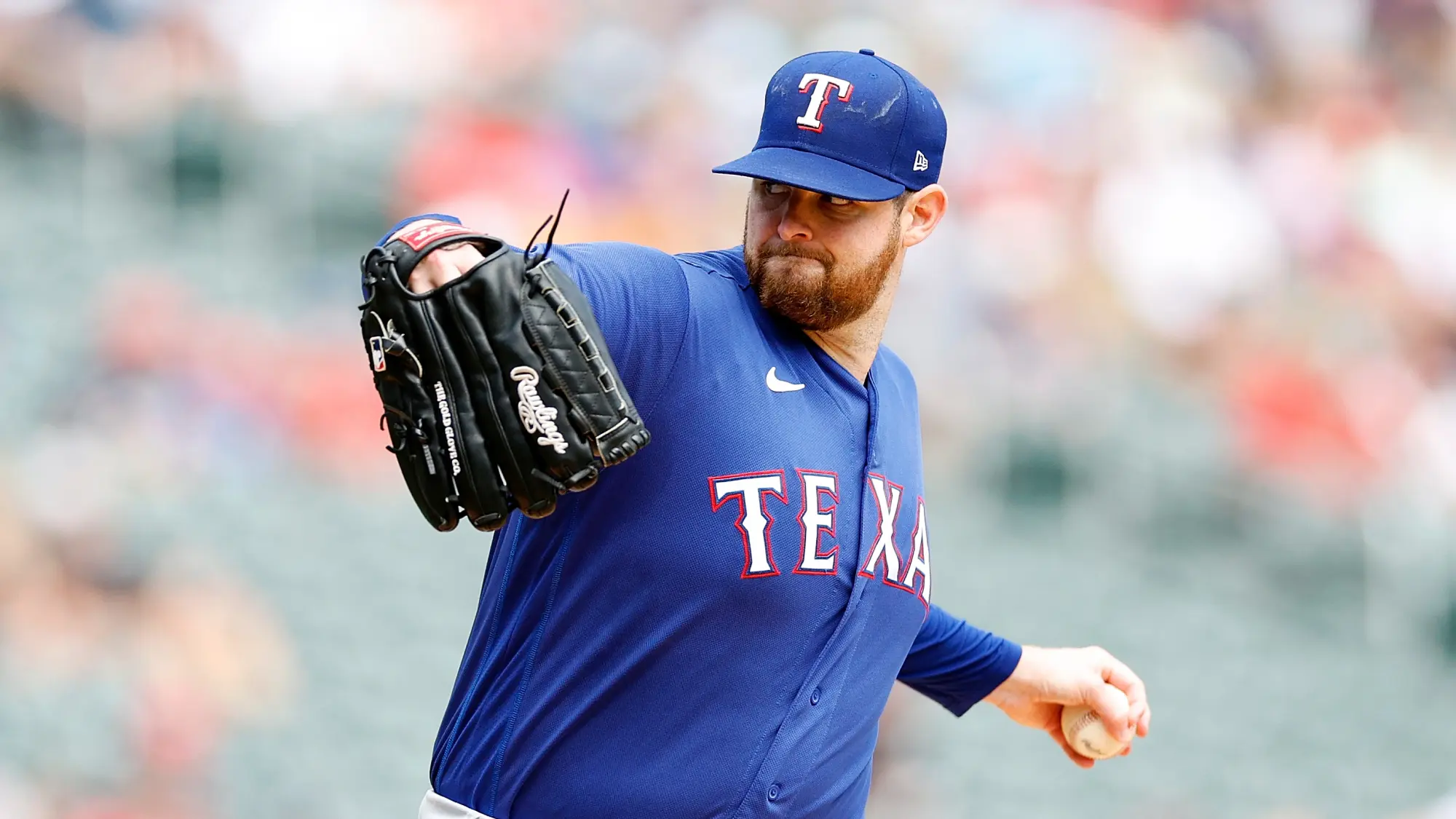
David Berding/Getty Images
About a month ago, Jordan Montgomery went on the baseball web show “Foul Territory” and sealed his status as a wife guy.
Montgomery was asked by former big-league catcher Erik Kratz, one of the show’s hosts, about his dermatologist wife, McKenzie Dirr, whom he married last December.
“You got a doctor?” Kratz said, feigning incredulity. “Do you guys not talk?”
“We talk all the time,” Montgomery responded with a grin. “She loves how dumb I am. That’s what makes it work.”
Making it work is also how Montgomery, 30, has unexpectedly become the ace of the Texas Rangers this postseason. A twice-traded lefty who doesn’t generate a lot of strikeouts, and the starter in Game 2 of the World Series, Montgomery doesn’t fit the profile of a top starting pitcher on a pennant-winning team. He is more crafty than overwhelming. He offsets his below-average fastball velocity with a five-pitch mix that he throws to all quadrants of the zone.
He throws his four-seamer, sinker and curveball from similar release points, making it more difficult for batters to determine which pitch is which — a skill known as tunneling. And while he may describe himself as a “big dumb idiot,” he is actually an intelligent pitcher who knows how to exploit a hitter’s weaknesses and adapt when he doesn’t have his best stuff.
“He's a guy that can adjust on the fly if he thinks he needs to do so,” Rangers manager Bruce Bochy said earlier this postseason. “He's using the fastball well to both sides. He can sink it, he can go up with it, and he's got a couple breaking balls and a changeup. He pounds the strike zone very well.”
The Rangers acquired Montgomery from the St. Louis Cardinals on July 30, two days before the trade deadline, to stabilize an injury-depleted rotation that had lost Jacob deGrom for the season and would be without Nathan Eovaldi for more than a month. Montgomery was considered a depth piece more than a major addition, and the deal was overshadowed by the blockbuster trade Texas made with the New York Mets for future Hall of Famer Max Scherzer.
Even so, Montgomery emerged as the team’s best starter down the stretch. He went 4-2 with a 2.79 ERA over 67 ⅔ innings. In eight of his 11 starts with Texas, Montgomery pitched at least six innings while allowing two or fewer runs.
“Great job by our front office getting him here,” Bochy said. “Jordan has been so consistent in giving us six or seven innings, and that became an issue with us there for a while, but he's the guy that's been doing that.”
His success has continued this postseason. Beginning with seven scoreless innings in Game 1 of the American League Wild Card Series, Montgomery is 3-0 with a 2.16 ERA over 25 innings.
His lone relief appearance in his five playoff outings came in Game 7 of the ALCS against the Astros in Houston. Two days after throwing 82 pitches, Montgomery replaced Scherzer with two outs, a runner on third and the Rangers leading, 4-2, in the third inning. He escaped the jam and then pitched two more scoreless frames to earn the win. It was a gutsy performance that was reminiscent of the last time Bochy called on a lefty ace to pitch out of the bullpen on short rest in a winner-take-all playoff game: Madison Bumgarner in Game 7 of the 2014 World Series.
To understand how Montgomery got to this point, you have to go back to his time with the New York Yankees, who selected him in the fourth round of the 2014 MLB draft out of the University of South Carolina.
Montgomery made his big-league debut in 2017 and went 9-7 with a 3.88 ERA in 29 starts, good enough to receive some down-ballot Rookie of the Year votes. But he missed most of the next two seasons recovering from Tommy John surgery and struggled in the pandemic-shortened 2020 season.
Even after he bounced back in 2021 with a solid 3.83 ERA in 30 starts, he was viewed as a high-floor, low-ceiling starter whose consistency would give him staying power as a back-of-the-rotation guy. Minutes before the 2022 trade deadline, the Yankees dealt him to the Cardinals for center fielder Harrison Bader, who was injured at the time. Montgomery was shocked and sad.
“I think he was super underappreciated in New York,” says Rangers lefty Andrew Heaney, who was a teammate of Montgomery’s in 2020.
More than a year later, Montgomery acknowledges that leaving New York was the best thing that could have happened to him. “Getting out of there and needing to prove myself with a new team made me like, ‘Alright, well, I'm on a new team. I can either get better or I'm done,’ ” he says. “And I chose to get better.”
Upon joining the Cardinals, pitching coach Mike Maddux — then with St. Louis and now with the Rangers — encouraged him to throw his four-seamer more frequently. The repertoire change caught opposing hitters off guard, and the results followed: He went 6-3 with a 3.11 ERA in 11 regular-season starts with the Cardinals.
He is back to throwing fewer four-seamers as batters have adjusted to the pitch. But after using it so much down the stretch last season, he has become more comfortable throwing it, especially to his glove side — the inside part of the plate to right-handed batters. Because righties know that he is comfortable throwing inside heat, they have to be prepared for it and can’t just sit on outside sinkers and changeups.
And then there’s his curveball, aka The Death Ball, which he used to baffle Astros slugger Yordan Álvarez in Game 1 of the ALCS. It comes out of his hand like a fastball because he throws it from a similar release point to his four-seamer and sinker.
“I think I'm executing more because my delivery is more consistent,” Montgomery says. “I think my curveball and my sinker have gotten significantly better, which I think just kind of came with being on time more. I'm throwing glove-side fastballs more.”
Beyond Game 2 of the World Series, Montgomery is also slated to pitch in Game 6, if necessary. A free agent after the season, he has at most two more chances to earn ace-like money on the open market. His lack of strikeout stuff could suppress his value a bit, but he should be in fairly high demand because this offseason’s free-agent class of starters is rather thin.
He can’t worry about that yet, though. For now, he is focused on pitching the Rangers to their first ever World Series title. If he does, the lucrative offers should follow.
“I hope teams want a big lefty that throws strikes,” Montgomery says, “one who can go deep in games and always gives you a chance to win.”
In other words, one who makes it work.