Tim Sheehy’s aerial firefighting company has provided him with planes and office space for his campaign
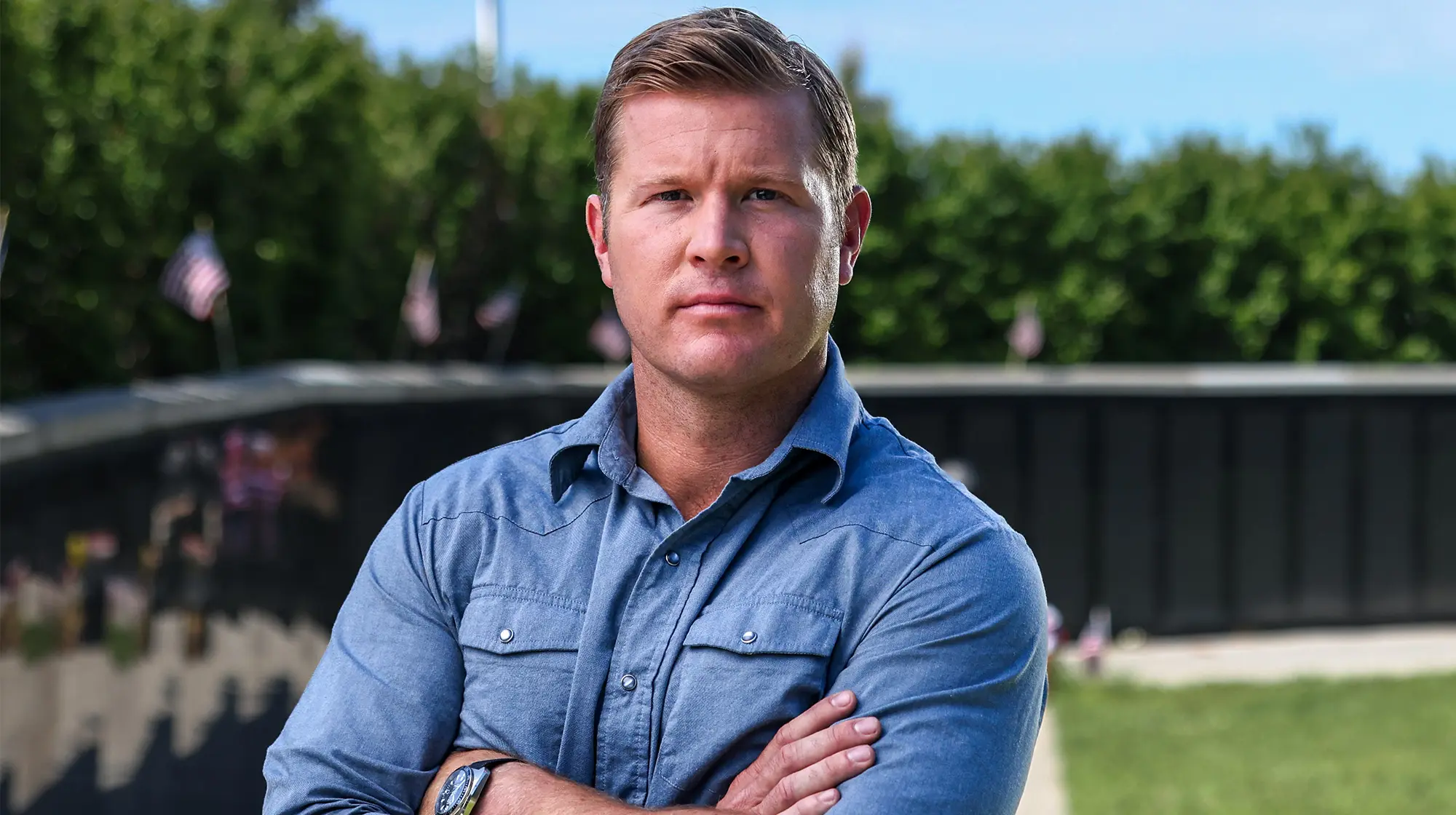
Retired Navy SEAL Tim Sheehy’s Senate campaign is crucial to the Republicans’ hopes of taking back the chamber.
The founder and CEO of Bridger Aerospace, an aerial firefighting company based in Montana, is running in the GOP primary for the right to take on longtime Democratic Sen. Jon Tester, a top target for Republicans in 2024.
Sheehy has criticized Tester for violating the ethics pledge he set for himself in his 2006 race, and has released an ethics pledge of his own.
But Sheehy appears to be mingling business and politics in questionable ways as he seeks the GOP nomination. He has used his company plane to travel to campaign events and fundraiser and even rented space at his company’s headquarters for his campaign, according to a Messenger analysis of his most recent Federal Election Commission filing. The fundraising disclosure also showed that he weighed his candidacy for five months before going public with his campaign, flouting the FEC’s “testing the waters” rules.
Sheehy has previously said he would uphold a high ethical standard if elected.
“When I make a promise, I keep it – unlike the career politicians who are more focused on their political careers than serving our country,” Sheehy said in a statement. “As your next Senator, I am pledging to the people of Montana that I will raise the bar for ethical responsibility and accountability in Washington.”
Bridger Aerospace’s revenue is heavily dependent on federal contracts, and it went public in 2023 through a special-acquisition company (SPAC) meant to minimize its tax bill. The company is featured prominently in Sheehy’s campaign ads – including his campaign launch video – and is central to his theory of the case: That a Montana-based CEO is best equipped to defeat Tester, who is seeking his fourth term.
- Trump-Backed Ohio Candidate’s Campaign in Violation of Pentagon Rule on Political Ads
- Top GOP Recruit Tim Sheehy Launches Montana Senate Bid
- China Rises as an Issue in Senate Campaigns
- Montana GOP Senate Hopeful Tim Sheehy Reports $2.8M Fundraising Haul
- Montana GOP Senate Hopeful Sheehy Sees Numbers Rise Amid Flurry of Ads: Poll
- Montana Sen. Jon Tester Handicaps the 2024 Senate Map
NBC News previously reported on Bridger’s code of business conduct and ethics, which requires legal reviews and approval before company funds were spent on behalf of candidates or campaigns.
As recently as October, Sheehy took a Washington Free Beacon reporter on a Bridger airplane and sat for an interview at the company’s headquarters. His campaign has paid Bridger over $9,000 for rent, described in the campaign’s most recent FEC report as office space, conference rooms, and administrative labor. Sheehy also reimbursed himself for having Little Belt Cattle Company’s food truck cater his announcement – even though he owns the veteran-led beef company.
The travels of a plane registered to his company mirrored his fundraising itinerary on at least one trip. He also used the company plane to travel to a Trump rally in South Dakota and a campaign event and fundraiser in North Dakota. He has reimbursed Bridger Aerospace around $38,000 in air travel costs.
There are three expenditures on his latest campaign finance report for air travel on June 29, Oct. 8, and Oct. 17-20. On Oct. 20, he attended a breakfast roundtable ahead of the North Dakota Petroleum Council’s annual meeting in Watford, North Dakota, according to Politico. He also took a round-trip flight to South Dakota to attend a rally of former President Donald Trump.
According to the FEC, candidates are allowed to spend money on air travel in planes that are “owned or leased” by a candidate or a candidate’s immediate family, including an aircraft owned or leased by any entity in which the candidate or a member of the candidate’s immediate family has an ownership interest – as long as the entity is not a public corporation and the use of the aircraft is not more than the candidate’s or immediate family members’ proportionate share of ownership allows.
A lawyer from Campaign Legal Center, a nonpartisan campaign finance watchdog, told The Messenger that Sheehy’s plane arrangement could be legal. The “campaign must reimburse Bridger an amount equivalent to the prevailing charter or rental rate for a similar plane, and it must make the reimbursement within 7 days of each of Sheehy’s flights,” a lawyer for the group told The Messenger. “Alternatively, Sheehy could reimburse Bridger himself, and then the campaign could reimburse Sheehy (or Sheehy could treat his payment as an in-kind contribution to his campaign, which the campaign would report).”
The lawyer added that it is possible that Sheehy and his campaign are following the rules,” citing the campaign’s most recent FEC report. The report suggests that “Sheehy could sometimes be paying for the plane travel and seeking reimbursement from his campaign, and sometimes the campaign might be reimbursing Bridger directly,” the lawyer said. “Relevant questions to assessing the legality of the arrangement would be (a) whether Bridger is getting paid on time, and (b) whether it is being paid enough. The FEC reports, unfortunately, don’t provide answers to those questions."
A Sheehy spokesperson told The Messenger: "Yes, we pay fair market value."
Brendan Fischer, the deputy executive director of Documented, an independent campaign finance watchdog, said that the general rule is that a campaign can rent office space or other facilities from a business owned by the candidate, but it has to be fair market value.
“More broadly, it does show how closely tied the candidate is to this business that depends on government largesse,” Fischer told The Messenger. “And if he were elected it could indicate, or be a preview of some of the ethics issues that may arise.”
Sheehy is still serving as Bridger’s CEO and a spokesperson told Bloomberg Government that he would step down as CEO if elected to the Senate. Bridger has brought in around $87.6 million worth of government contracts. The Daily Beast reported that when Montana Rep. Ryan Zinke — who has endorsed Sheehy — was the Secretary of the Interior, Zinke awarded Sheehy’s company its first government contract.
And the matter of reimbursing his business for planes and office space is not an uncommon among rich candidates, but Fischer said campaigns “need to be careful” when doing so.
“Because if they pay above market value, and they’re potentially converting campaign funds to personal use, they’re enriching the candidate’s business. And if they pay below market value that results in a contribution from the business to the campaign, because they’re getting more than what they’re paying for, and typically that would result in a prohibited corporate contribution,” he told The Messenger. “But in this instance, because it’s a publicly traded corporation, there would also be a violation of the contractor contribution ban on government contractors making contributions.”
‘Testing the waters’ for a long time
The FEC has outlined certain activities that it considers to indicate whether a candidate is or isn’t seeking office. But once a candidate either raises or spends more than $5,000 and decides to run for office, then that candidate must file a statement of candidacy with the FEC.
Sheehy’s latest campaign finance report reveals that he was weighing a Senate candidacy for five months before he launched his campaign.
According to the FEC, one test that could determine whether campaigning is “conducting activities for a protracted period of time.” And Sheehy made in-kind contributions to his campaign nearly five months before he officially launched his Senate bid.
“The real requirement is that if you both raise and spend $5,000 and decided to become a candidate,” said Fischer. “So that’s the part that is a bit more ambidigous and more ripe for exploitation.”
Sheehy’s in-kind contributions where he paid a fleet of communications consultants and pollsters almost five months before he actually launched his bid, totaling over $130,000 dollars. He paid Delve LLC $6,000 for research services on February 9, 2023 and GOP pollster Moore Information Group $44,600 for survey research on March 31, 2023. He also paid for communications consulting and research services to Big Dog Strategies LLC and
“That does raise questions about whether he had become a candidate before actually declaring his candidacy and filing paperwork with the FEC,” Fischer said.