

Any filmmaker would be an underdog if challenged to replicate the miraculous success of Mad Max: Fury Road. George Miller’s Wasteland epic is dystopian perfection; Furiosa: A Mad Max Saga is not. Miller’s origin prequel for Imperator Furiosa is a welcome return to chrome-shelled mayhem, although a haze of redundancy washes over certain scenes. Furiosa: A Mad Max Saga is eons away from poor quality yet far enough from its predecessor; it’s bloated and less chaotically spectacular. Mad Max: Fury Road set a bar that few follow-ups could reach. Furiosa: A Mad Max Saga tries and excels often—there’s just more stop-and-go momentum than Miller’s full-throttle masterpiece.
Anya Taylor-Joy is a valiant warrior as Furiosa, a daredevil mechanic for Immortan Joe's (Lachy Hulme) Citadel before her Imperator promotion. However, she only appears for half the film. We first meet Alyla Browne as "Young Furiosa," abducted by Chris Hemsworth's deranged Biker Horde leader Dementus. Furiosa's origin spans years and actresses, illustrating wee Furiosa's maturation into a one-armed, grease-smeared savior. Everyone's paths eventually cross, there's vehicular manslaughtering, and Furiosa leads us directly into Mad Max: Fury Road. Miller's excited to be back playing in his Wasteland sandbox, but he's less in control. The production's sunburnt grandiosity is overwhelming, and the story's bearings rattle without being securely fastened.
The Wasteland's picturesque junkyard is no less enticing with its sprawling dunes, high-contrast color filtering, and automotive monstrosities. Miller's sandtrap of societal decay and festering dictatorships cultivates an atmosphere of carnal lawlessness; a magnificent tapestry of desert hues and dehydrated landscapes become beautiful imperfections. Furiosa: A Mad Max Saga doesn't lose any photographic appeal, replicated by incoming cinematographer Simon Duggan. To borrow an iconic Hollywood phrase: "Heartbreak feels good in a place like this." Furiosa's tragic upbringing sparks the fieriness of a rising phoenix, represented on-screen by emblematic and flame-hurling visuals because only cowards use subtext.
However, it's worth noting that some scenes feature digital effects that are nowhere near what Fury Road accomplishes. Anything tactile still makes its impression (from Australia's terrain to metallic props), while post-production animation isn't as blended or polished. The downgrade is real.
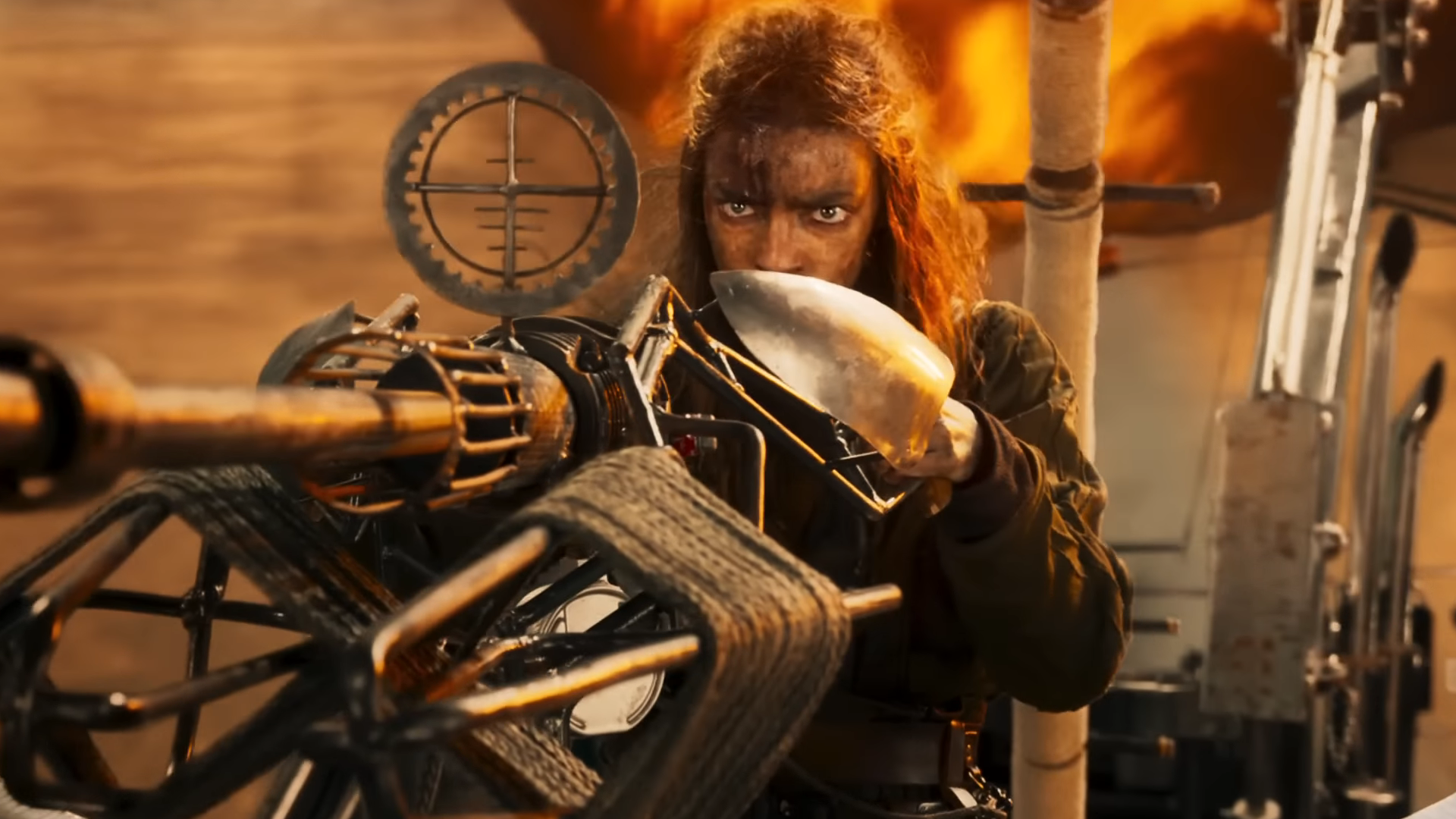
Miller and co-writer Nico Lathouris use Furiosa: A Mad Max Saga to cement the title character's legacy while contextualizing the Wasteland's environment. Recurring characters—including John Howard's nipple-twisting People Eater or Angus Sampson's Organic Mechanic—are further realized, as well as Immortan Joe's ruthlessness after Dementus threatens the Wasteland's export arrangements. Miller's prequel treats the Wasteland as a character that gets establishing subplots, enriched in tandem with Furiosa's evolution from prisoner to rebel. From the rotting burrowed peasants living underneath Immortan Joe's mountain hideout to the governing bodies who gaze below at their suffering ant-farm communities, Miller's world-building is god-tier. Mad Max: Fury Road thrusts us into misery and delusion, whereas Furiosa: A Mad Max Saga helps explain how the Citadel became the version Max Rockatansky encounters.
Frustratingly, for all the glory there is to witness, Furiosa’s origin plotting is a weaker link. Where some find Miller’s anarchistic storytelling methods a feature, I find them a bug. Furiosa is given a male mentor slash romantic interest in Tom Burke’s Praetorian Jack, Immortan Joe’s favorite Fury Road driver. His function is to instill survivalist knowledge and unlock Furiosa’s furious-er potential, which is promised—aloud through dialogue—and then completely ignored a scene later. I thought I passed out for an entire scene, possibly an entire training montage? There’s some wonky continuity as Miller throws structure out the window like a burger wrapper before littering fines, which can be brazenly notable or sloppily ambitious. Burke’s portrayal is passable as Furiosa’s whatever, but the script’s handling of his functionality is littered with stale origin story tropes.
It’s not a one-off instance, either. Taylor-Joy displays a ferocity unbound as Furiosa, soaring as an unflappable hero as she clings to a speeding war rig’s undercarriage or hunts her brawny bearded kidnapper through sandstorms, but the character’s milestones are, in spots, oddly placed. There’s a lack of narrative rhythm (possibly because there’s no Doof Warrior), especially around the second act’s transition from Browne to Taylor-Joy. Expect more apocalyptic grandstanding and less propulsive advancement, sometimes painting by numbers, other times leaving us breathless. Where Mad Max: Fury Road only ascends higher until reaching Valhalla, Furiosa: A Mad Max Saga requires pit stops to refuel.
Nevertheless, Miller’s eye for road rage and Death Race creations set Fury Road ablaze with toasted War Boy corpses. It never looks as dangerous as Mad Max: Fury Road—for legitimate safety reasons—but imparts fresh tweaks like paragliders and octopus-themed paramotorists with mounted machine guns. Immortan Joe’s prized 18-wheeler war rig becomes an in-motion platform where Wasteland gangs duke it out against War Boy bombers, with nifty secret compartments where Furiosa can spring from underneath for another death blow. Dyed flare explosions are back, and actual destructive explosions are too, as Miller’s signature style of mobile Wasteland action pleasingly achieves the same paint-huffed highs. Few live to talk about their travels along Fury Road, and as Furiosa finds out firsthand, there’s a damn good reason.
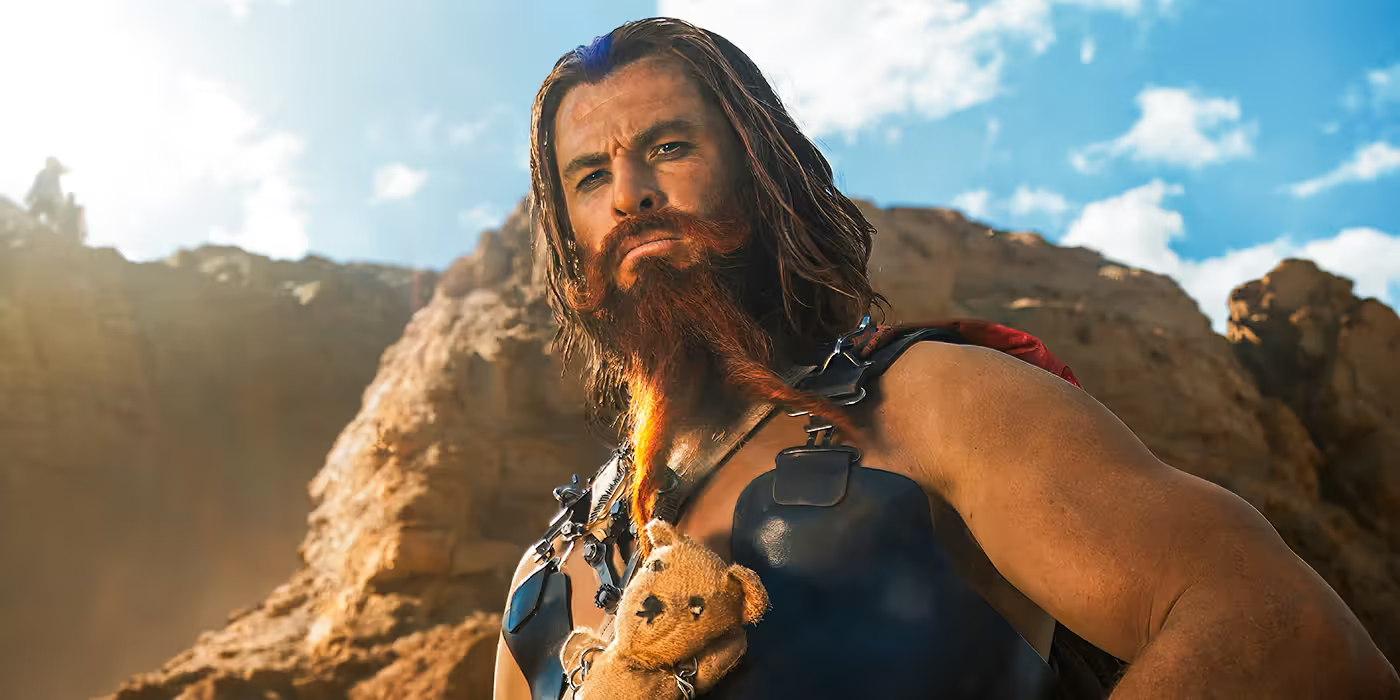
Then there’s the film’s other newcomer: Chris Hemsworth. If you’ve seen Bad Times at the El Royale, you already know pure-hearted Thor can transform into a maniac leader like a chameleon. Furiosa: A Mad Max Saga lets him project a more cartoonish villainy, riding his motorcycle-led chariot and speaking from his ring announcer’s microphone like a rejected The Warriors leader. He’s batty, blending devilish deliveries with an unpredictable twinkle in his eye. Taylor-Joy’s unflinching reactions when acting against Hemsworth’s charming yet bozo brute earn the film’s highest praise, as they deflect each other’s personalities with combative appeal. Hemsworth never goes full Bad Times at the El Royale, but his take on a Greecean ruler without the proper sense to execute his lofty ideas fits right into the Wastelands gallery of rogues.
Furiosa: A Mad Max Saga is above average but not an immortal icon. Miller’s tour of Wasteland landmarks like Bullet Farm and Gas Town feels like home, but he’s driving on a bent axle that keeps veering the story off course. Taylor-Joy is a sublime replacement for Charlize Theron and works wonders with a tyrannical Hemsworth. Unfortunately, that’s saved for later acts. The film experiences slight ballooning or even incompleteness. Miller’s action-forward obsessions are cavalier yet hinder Furiosa: A Mad Max Saga. It’s still an engine-revving sensory overload and keeps us begging for more time in the Wasteland—Miller just can’t punch into that final Mad Max: Fury Road gear.
3.5/5