
Street Fighter is a video game adaptation in the arcade sense: pop in a coin, button-mash for quick thrills, then move on to the next machine. That's not (wholly) a diss. Filmmaker Kitao Sakurai helms a 90s action goober that revels in manchild humor and cocaine-fueled style, an antidote to this year's soulless, dead-on-arrival Mortal Kombat II. But even for a tournament-style brawler, storytelling is flakier than an unfrosted toaster pastry. Sakurai's comedic background can't escape massive continuity and payoff problems, because you're here for bit jokes flying like E. Honda's furious palm strikes—no meat and potatoes in this throwback stew.
The year is 1993. Metrolao City's dictator M. Bison (David Dastmalchian) stages a second World Warrior tournament to draw Ryu (Andrew Koji) out of hiding. He wants to harness enough "Psycho Power" to become an unbeatable champion, and he needs Ryu's "Hado Power" to inflict maximum damage. So, Chun-Li (Callina Liang) assembles a roster of combatants worthy of the ultimate prize—including Ryu's brother, pretty-boy influencer Ken Masters (Noah Centineo). Only Ryu can protect Ken from evils that not even M. Bison knows about, even if it means walking straight into a trap.
Truth be told, my summation is markedly more comprehensive than Sakurai and T. J. Fixman's screenplay (or whatever parts made the final cut). The story introduces a tournament, yet entire matchups happen off-screen or are lazily forgotten and never mentioned again. Characters disappear from existence without a word, like poor Zangief (Olivier Richters). Sakurai can't track narrative throughlines as edits cobble together nonsense violence, making for a truly baffling first movie that begs for a sequel because, oh yeah, it just ends? Street Fighter has a massive third-act problem: it rushes to an incomplete conclusion, leaving us with a cliffhanger moment where most other climaxes are only getting started. What a glorious mess, with no apologies.
And yet, Street Fighter nostalgia hits fast and frequently, like a two-liter of Jolt Cola injected straight into your heart. Sakurai honors Steven E. de Souza's 1994 Street Fighter lunacy, as well as Paul W.S. Anderson's rival dojo and his cult-adored 1995 Mortal Kombat. Stupid is as stupid does, which gives Sakurai the confidence to incorporate Guile's (Cody Rhodes) absurd lines about being a "family man," vehicular carnage, retro needle drops (albeit period-incorrect)—whatever deep cuts you can handle. Continuity hangs by a thread, but it dangles long enough to support whatever hot nonsense occurs. Perspective pivots into 2D staging screens, replicated level designs, and overall video game vibrancy are the antithesis of everything Mortal Kombat II fails to deliver. It's juvenile, smashy, moronic, and whoops ass when it's allowed to—are you not entertained?
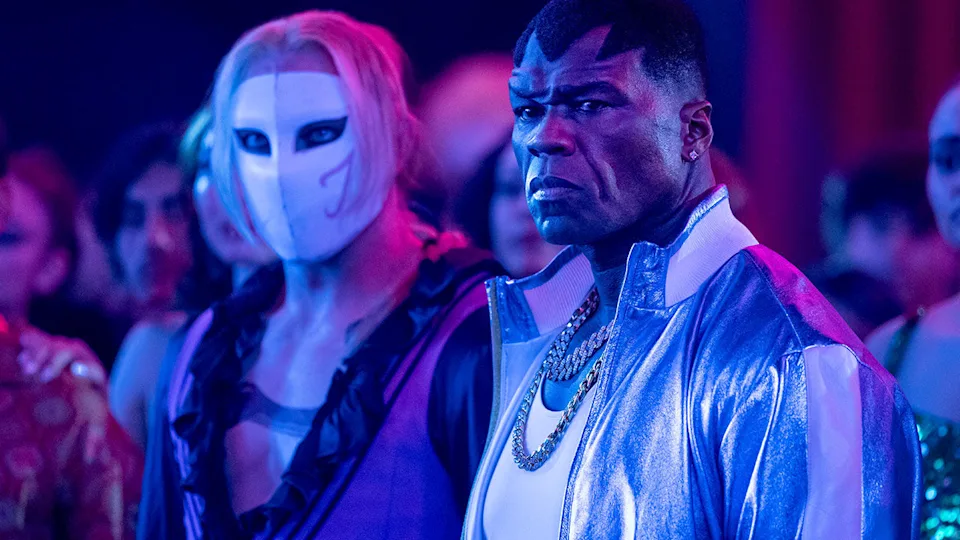
To be fair, some of you will not be entertained. Street Fighter's emphasis on nuking toxic masculinity from its aggro roster leaves women out to dry, which is a noticeable defect. Mel Jarnson's Cammy is the "hot maniac," Bison’s Dolls are eye-candy, and Chun-Li is frequently sidelined to spotlight her male counterparts (why does Andrew Schulz’s Dan Hibiki get more screen time???). Then there are character takes like Jason Momoa's Blanka, who keeps … smelling his stinky armpits? Or Curtis "50 Cent" Jackson's boxer Balrog, who aligns himself with M. Bison in an early shot but disappears during later gang battles? Some characters are handled well; others are thrown at the screen for comedic effect and treated like cameos. All that, while performers have to contend with Sakurai's Tarantino-level foot fetish because THAT was an important subplot, I guess?
But I found the film's jovial not-give-a-shit-ness strangely addictive. Eric André's loudmouth announcer Don Sauvage thrives as M. Bison's scummy mouthpiece; Rhodes's G.I. Bro gets flirty with Vega and buddy-happy with Vidyut Jammwal's stretchy Dhalsim (knockout casting). When performers key into the errant idiocy of softball humor, the schtick actually works. The same goes for fantastical Street Fighter elements like Dhalsim's Mr. Fantastic abilities, infinite health bars, or the ultimate joke: Alexander Volkanovski's hot-shot with no action, Joe. Everything is about indulgence—karaoke callbacks, Centineo's washboard ab shots, beautiful people in skimpy outfits—which mostly works despite Sakurai's attention-deficit leadership.
Just don’t expect Street Fighter to mine anything worthwhile from Ryu and Ken’s brotherly beatdowns in the key of rekindled bonds. Alanis Morissette’s “What’s Up” has a stronger arc than even the film’s leading men.
Is Street Fighter a brash satire of neon-lit 90s nostalgia through a modern lens, or emblematic of the problems that permeated big-bad-brute action flicks of decades past? Sakurai doesn't care. All that matters is whether you're laughing and having a blast with surprisingly coherent action sequences that lean into flashy arcade chaos (plus phenomenal anime flashbacks). It's not a particularly great movie by filmic standards, but only nerds use words like "filmic." Street Fighter doesn't take itself seriously for a second and dives headfirst into its Mountain Dew-ass injection of basement-sleepover entertainment. Dedication, my friends, goes a long way.
3/5