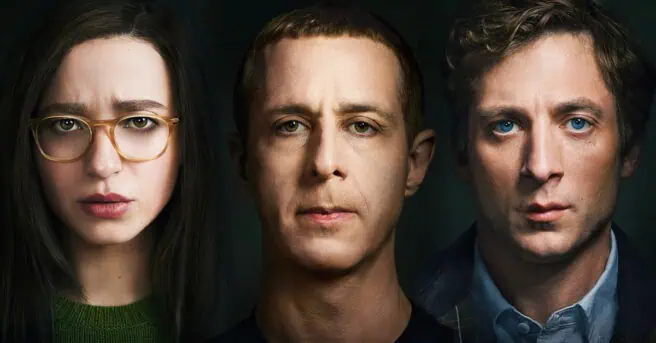
Aaron Sorkin’s a helluva screenplay wizard whose director resume just got spottier. The Social Reckoning misses Jesse Eisenberg’s talents, but misses David Fincher’s vision even more. Jeff Horwitz’s Pulitzer-awarded Wall Street Journal reporting on social media blew the doors off Mark Zuckerberg’s reckless stance on political ads and fact-checking, a bombshell feeling that The Social Reckoning fails to recreate. It’s The Trial of the Chicago 7 all over again—a wooden series of staged reenactments that lacks organic drama and cinematic depth.
The film leans on Horwitz’s investigative journalism, hoping to cement The Social Reckoning in conversations with Spotlight and The Paper. Jeremy Allen White does his best as Horowitz, a Washington correspondent the Journal curiously hired as its tech beat guy. The same for Mikey Madison’s Frances Haugen, a sheepish data engineer who would become the famed Facebook whistleblower. Sorkin takes us from Horowitz’s career swap to Haugen’s on-record testimony, hitting all the milestones in between: the COVID-19 lockdown; the January 6th insurrection; the evolution of bullying. Facebook played a significant role in all these events, and Sorkin won’t let audiences forget that.
But The Social Reckoning has a glaring issue: Jeremy Strong’s Mark Zuckerberg. The proud method actor tackles the alien version of Zuckerberg with this too-trimmed bowl cut and detached emotionality, but it’s strangely out of sorts. That’s not to say Zuckerberg isn’t an android of a billionaire with suspect social skills—this is the Zuckerberg we mocked mercilessly as A.I. in a skinsuit. But Strong’s performance undercuts the five-alarm seriousness Sorkin hopes to translate. The Social Reckoning isn’t farcical, yet Strong’s Zuckerberg reads like a farce. Eisenberg might have rejected the role, but his Zuck-inspired Lex Luthor in Batman v Superman: Dawn of Justice reads more genuine than Strong’s gimmicky, cartoonishly exaggerated Zuckerberg, which doesn’t fit Sorkin’s hyper-dramatized biopic.
It’s a problem. The Social Reckoning should be taken seriously. Sorkin’s poignant illustration of how easily gullible folks can be radicalized by extremists on social media (and why) champions a clear case for government intervention. Better yet, the filmmaker still makes our blood boil with the reason behind Facebook’s uptick in dangerous misinformation—Zuckerberg’s direct orders. Flashbacks to Zuckerberg’s callous decision to overhaul “Meaningful Social Interactions” or his inability to halt January 6th chatter in alt-right groups before it was too late show his spinelessness, his delusion, and his black heart. These moments are reminders of why users like myself abandoned the platform years ago—and, in a just world, would open the eyes of those most susceptible to Facebook’s spigot of bigotry, fearmongering, and asinine fabrications.
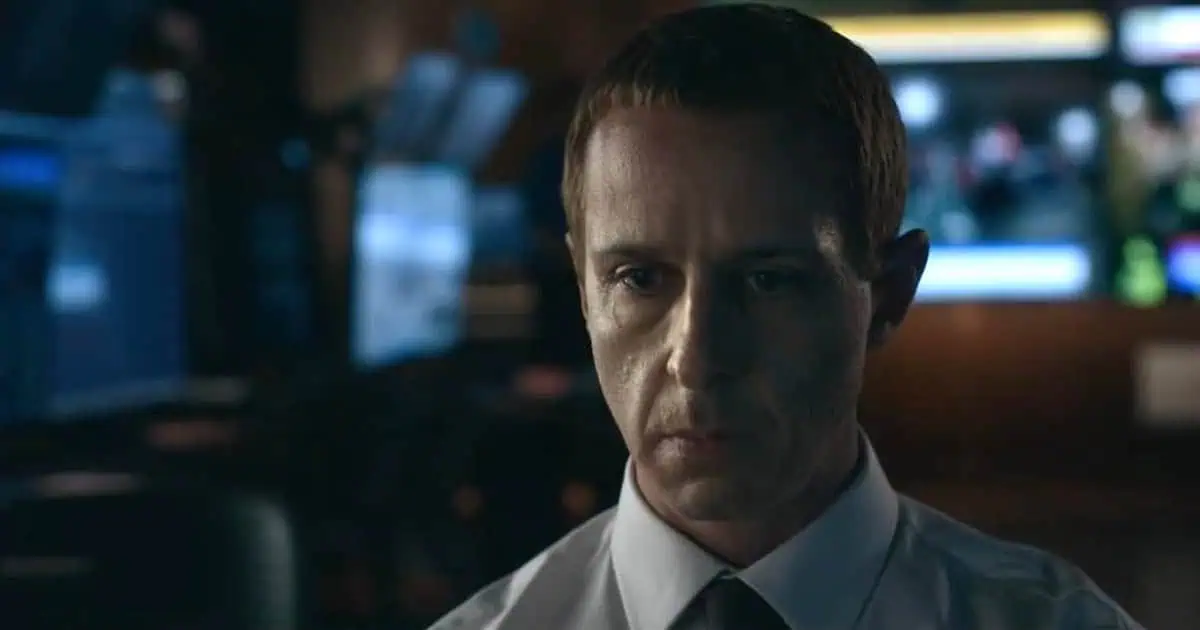
Yet every time Zuckerberg appears, Sorkin doesn’t know how to massage Strong’s daffy and robotic performance into his searing indictment of abuses of online power. It’s the opposite of Billy Magnussen, who steals scenes as Facebook’s culture-huffing public relations tyrant, Teddy. Zuckerberg’s the man of the hour, sure, but Sorkin can't control Strong’s larger-than-life interpretation, which clashes with the otherwise sublime supporting work of Wunmi Mosaku’s Raya, the legal counsel trying to humanize the inhuman Meta CEO. There is no yin to Strong’s yang, as he stomps all over the production like Godzilla destroying another coastal metropolis.
The Social Reckoning boasts tremendous talking points: I almost jumped out of my seat when Horowitz, while debating Facebook’s morals with Haugen, bluntly states that not every voice deserves a microphone. Or, when Horowitz clarifies his bias against Facebook to Haugen, he says he’s not mad because the internet is stealing journalism jobs; he’s mad because what’s replaced professional journalism is trash-heap imposters. Sorkin romanticizes print media and a time when truths meant a damn, which comes out through White and Madison’s undercover relationship as reporter and source. Haugen’s journey from Facebook-loving employee to determined whistleblower rides a wave of high stakes and gusty payoffs because kicking the hornets' nest is scary—but as Sorkin coyly writes, it’s time to disrupt the disruptors.
Sadly, I couldn’t stop thinking, “What would Fincher do?” Because The Social Reckoning—for all its reckoning—retells current events like flipping through a social studies report. Sorkin’s lack of panache and dry, filmic language projects flatly on the screen. No technical flourishes, and nary a daring choice. It’s point-and-shoot filmmaking that sees everything as one-to-one: narrative blueprints to follow, conflicts to resolve; characters to move forward. It’s a rollercoaster without a spiraling helix, second launch, or upending loop-de-loop. You can read Horowitz’s published works and walk away with the same knowledge; watching Sorkin’s theatrical chronicle adds little marquee value.
The Social Reckoning is hardly The Social Network. What is said bears repeating: don’t trust the internet; social media is a hellscape; and Mark Zuckerberg threatens us all. Unfortunately, Sorkin delivers a ho-hum dramatization that somehow lacks crucial dramatics. “It’s not our job to tell people what’s right,” Strong’s Beaker-but-drowsy Zuckerberg insists. It’s a line that should send a chill up your spine, if Sorkin could handle his obsessive method actor whose methods lose the plot. The Social Reckoning is nothing more than the movie version of a fancy coffee-table book, led by Jeremy Strong’s suspect Mark Zuckerberg spliced with an always-stunned turkey impersonation.
2.5/5