by Manick Govinda
20/08/2026
#WomanLifeFreedom…the hashtag that became a crying call, bringing to light the struggles of Iranian women against the brutally oppressive regime of the Islamic Republic of Iran. Late 2022, a movement erupted sparked by the killing of a young woman, Mahsa Zhina Amini, an Iranian Kurdish, she was only 22 years old, murdered by the Iranian morality police for her incorrect wearing of the hijab.
Her death at the hands of the Islamic regime lit the fire for a resistance movement, women and men took to the streets, bravely protesting against the repressive state and its agents; the Islamic Revolutionary Guards Corps (IRGC), The Guidance Patrol aka the ‘morality police’, the Islamic clerics and ayatollahs, fighting for the everyday freedoms that we in the west take for granted – equal rights, women’s rights, dignity and bodily autonomy, freedom from Islamism. Since 2022, thousands have been imprisoned, tortured, women raped and abused, the youth gunned down and executed by this brutal dictatorship. The blanket internet blackout since January 2026 has meant that the number of deaths are hard to verify, but according to the UK Government website, “estimated number of deaths, predominantly of protesters, numbered between approximately 12,000 and 20,000 by mid-January 2026”. Diasporic Iranians have publicly protested, peacefully demonstrating outside Iranian embassies, but the struggle still receives minimal mass media interest in the west.
Political upheavals and instability here in the UK pale into trivia – seven prime ministers in 10 years, 6 resigned, three general elections. All marks of a healthy, sometimes messy robust liberal democracy. Iran doesn’t have such privileges. Our British government doesn’t slaughter us. Some critics suggest that the art currently produced in the west is “boring”. The British political writer and journalist Janan Ganesh asked in the Financial Times, where are the artists, writers and filmmakers who are responding to our turbulent decade? While it is true that there are no significant young great writers or artists responding to our times compared to artists of the past, Picasso, The Futurists, Käthe Kollwitz to name a few, I sense that we are seeing a growing generation of young artists beyond the UK who are making powerful work that responds to the repressive regimes of Iran, Russia, to global terrorism, particularly Islamist terrorism, but we need to actively seek it. Journalists need to get out more, away from the comfort of their work-from-home offices.
It is within conflict and war that Tima Aalizadeh’s artistic practice evolved. Due to the highly charged situation in Iran, the artist's own personal experience cannot be disclosed. They are, however, the foundations of her art practice, she is far more than a witness of political turmoil.
Aalizadeh graduated in 2021 with a BA degree in Graphic Design at Guilan University in Iran. She managed to leave Iran in 2023 and enrolled for an MA in Printmaking at Middlesex University, which she completed in 2024.
Tima Aalizadeh’s medium is primarily printmaking, an artistic tradition that began in Europe in the 15th century. It’s a language that melds together her preoccupation with themes of trauma, memory, intimacy, death, desire and transformation. She also expresses herself through words. Her work isn't political or protest art. She doesn’t sloganize, or perform art activism. She is far too poetic for that. For her art is not a political weapon but a process of making sense of her experience through metaphor, imagery, the imagination and the physical action of creating intaglios to process trauma.
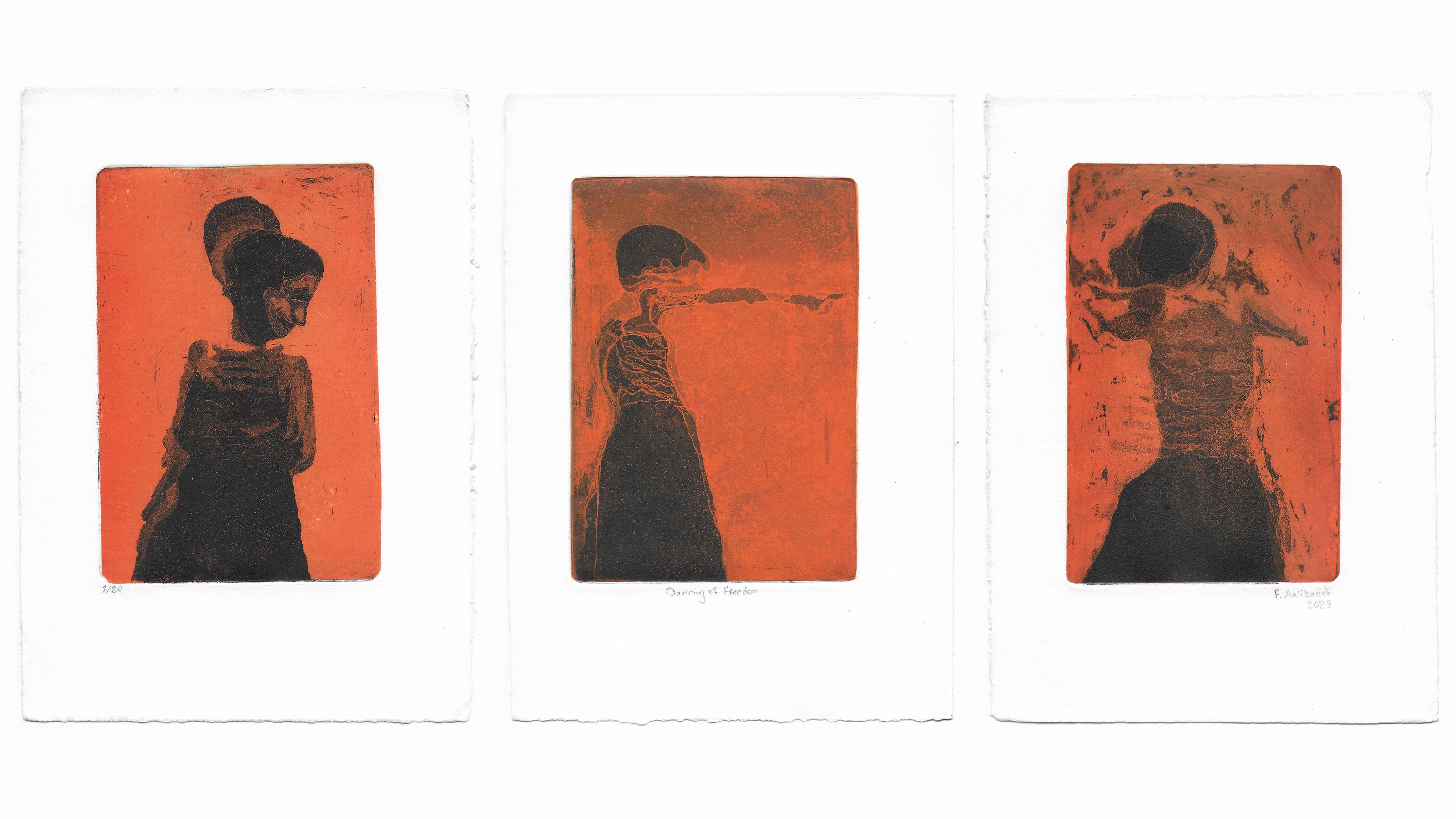
Dancing of Freedom (Aquatint, 23.5 x 16 cms, 2023), which was selected for the prestigious Royal Academy Exhibition 2025, is a triptych, a tableaux of a grainy grey, shadowy woman in motion set against a smoke-filled bloody orange-red abstracted background, and an unsettling depiction of a beheaded woman. The title is a variation of the Woman Life Freedom slogan. The aquatint heightens a dramatic situation, a moodiness of texture, with no single print being an exact replication (all 20 editions sold out at the summer show). Aalizadeh’s text is no descriptor of the work, it's storytelling that serves to enhance the mood and emotion of the image:
“A ghostly scream echoes from beyond the windows. The woman rises from the bed and throws out all the memories of making love from last night. She finds her small nail clippers in her pocket to pull out the cactus needles that a man and his friends left in her fingers the night before. With a sharp blade once left behind by another woman like her, she cuts her throat. She draws the warm blood down from her neck to her body, takes her own lifeless head by the hair, and dances until she finds the sinister ghost.”
To Woman, Life, Freedom Movement in Iran.
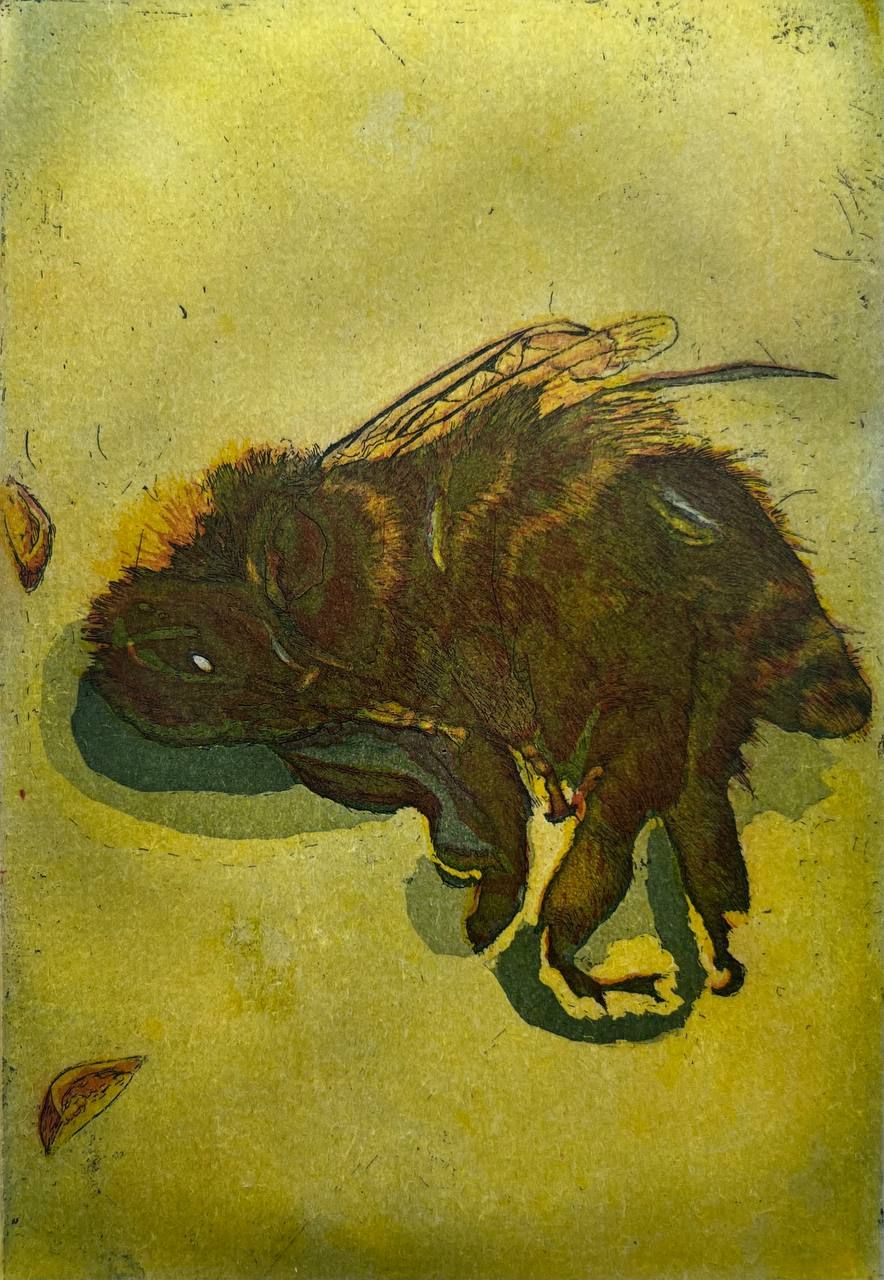
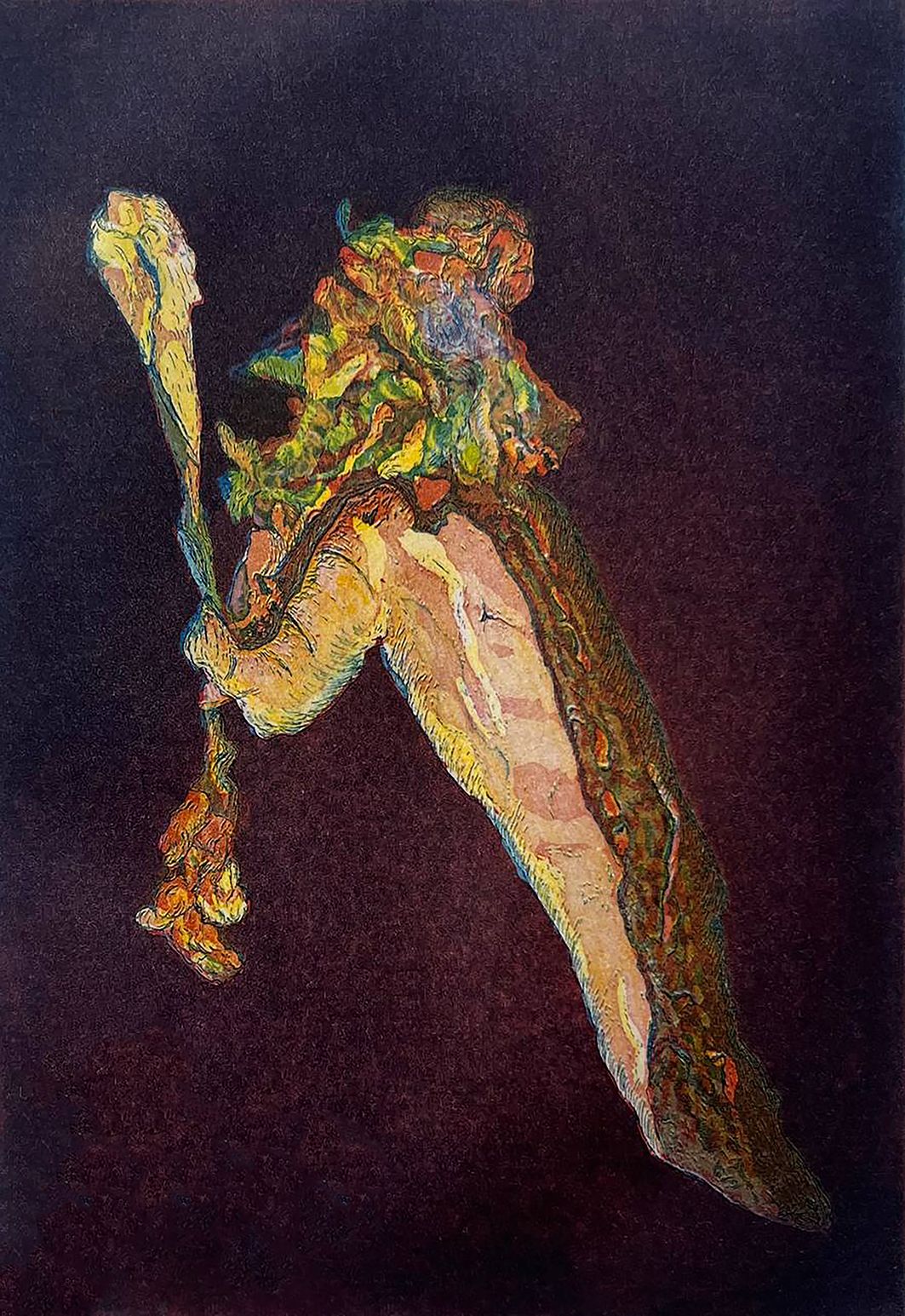
Abrupt (Etchings, 13 x 9 cms, 2024), a momento mori of delicate, fragile, still, deceased tiny creatures – a ladybird, bee, caterpillar, squashed slug. Again, the spectre of death looms large in these etchings, which remain vibrant, rich in colour and tone, the moment before decay. The series bring to mind an episode from E.M. Forster’s A Passage to India (1924) of the Hindu notion of the sanctity of all living creatures and how far this philosophy can possibly go before boundaries or limits are drawn:
“…And the wasps? He became uneasy during the descent to wasps….And the bacteria inside Mr. Sorley? No, no, this is going too far. We must exclude someone from our gathering, or we shall be left with nothing.”
Death as metaphor hovers uneasily in Aalizadeh’s work – we are seduced, attracted by the images, but the material reality is the end of life, or perhaps a transmutation? Matter is never destroyed, it becomes something else.
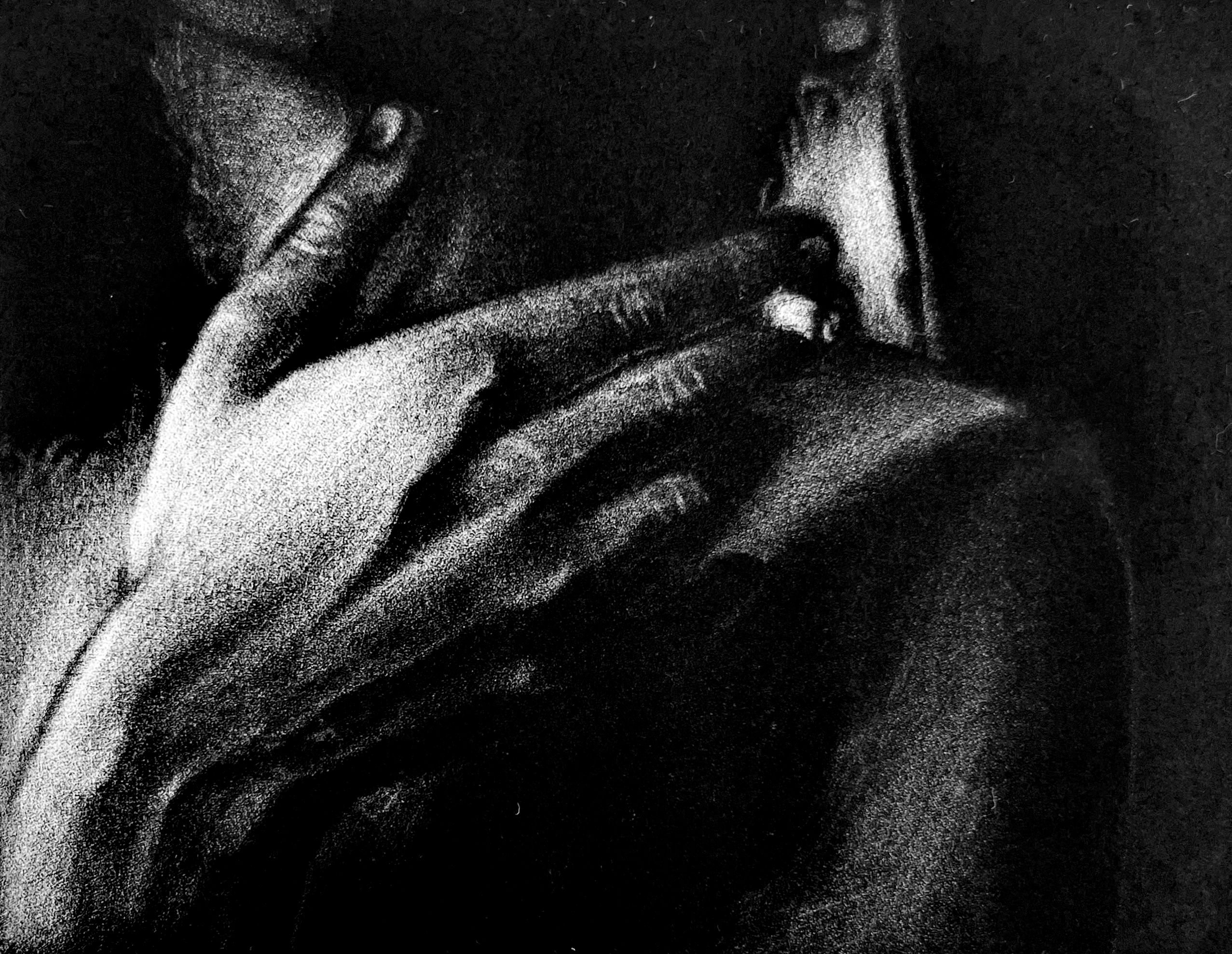
Echoes of a Shadow (Mezzotint, 21 x 17 cms, 2024) brings light out of darkness, both in the tactile process of scraping and burring the treated inked copperplate and as spiritual metaphor. Achieving an illustrative effect, the prints reveal a ghostly noir-ish narrative of a woman, an interiority of shadows and darkness, where intimacy and the sensuous are freely expressed, becoming melancholic memories. The prints are accompanied by text, a narrative that punctuates the shadowy illuminated languid presence. It is apt that the artist has also created a leather bound hand-crafted limited-edition book version of this series, of image and text.
“In a small room, the lights went out. The darkness and silence of the night prevailed. The smell of perfume, soaked in the steam of the bathroom, came out from under the door and surrounded the body. An unpleasant sound was ticking in the small skull. The woman's body slid to the threshold of the bed. A flame flared under Winston's slim cigarette. The shadow of the hand walked on the skin and danced on the wall. The time for hugging was over. Eyes swam in an ocean and hands drowned in colors. The flowers rotted. Smiles dried up in small frames. The woman stirred the night in her black coffee mug until the day came. The night came. The day came. The night came. The day came and the story was left half-finished.”
Memory is never fixed, it’s curated by the mind, mood, emotion, by what is remembered, witnessed, experienced and/or erased by trauma. Dreams can be falsified memory. Behind Closed Eyes (Mezzotint, 15 x 20 cms, 2026) is a beautiful inky blue artwork; three faces of a woman, floating like the motion of reflection on water and like memories or dreams they become unstable, fluid, unreliable.
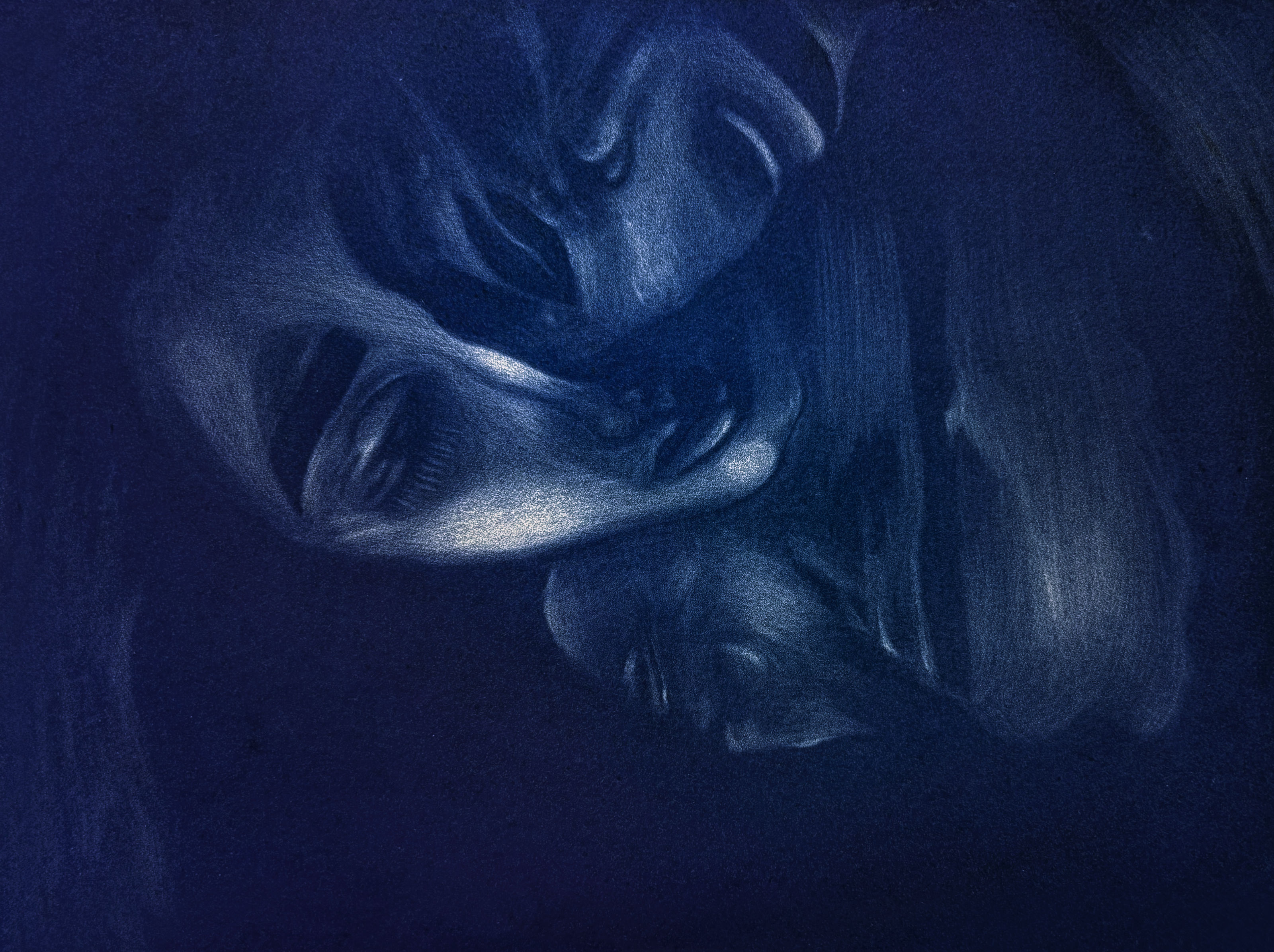
“One night in a dream I saw myself murdered in a corner and my hair was on fire. When I woke up, I found myself in the same situation.”
Tima Aalizadeh is a gifted artist, emerging from the trauma unleashed by a heinous regime upon its young people. Her skill and talent as a printmaker is a labour of love, her images born from light and shadow. Printmaking is a physical, enduring, tactile medium that many great artists have employed, from Goya, Rembrandt, William Hogarth to Edward Munch, Picasso and, within contemporary art, Kara Walker who also processes historical trauma and violence through intaglio printmaking. It is a powerful aesthetic medium, a much needed counterpoint to the artificial intelligence saturated image creep and slop that abounds our visual culture. With time, space and investment, Aalizadeh will become a significant artistic voice, making complex, expressive works of beauty, melancholy and sorrow rooted in observation, intimacy, cultural memory, the natural world and the free imagination.
She is undoubtedly an artist to watch, having twice been selected for the Royal Academy Summer Exhibitions 2025 and 2026, and exhibiting in group shows across England since 2024.
Tima Aalizadeh is on Instagram as timasshadoww.
Abrupt 2 is currently on display at the RA Summer Exhibition 2026, until 23rd August.
Manick Govinda is an independent arts consultant and writer. His work includes mentoring artists and arts professionals, providing personal and professional development support and guidance. As a writer and cultural commentator, he has appeared on Sky News, BBC Radio 4 and has written for Index on Censorship, British Council, Spiked Online, The Critic, Arts Professional and curated artists on themes of identity, migration, diversity, freedom of expression and censorship in the arts.
He was formerly Programme Director for SPACE and previously headed Artsadmin’s innovative artists’ development programme for 18 years, which led to producing film & video installations by internationally acclaimed artists such as 2007 Turner shortlisted artist Zarina Bhimji, 2021 Venice Biennale representative for France Zineb Sedira and Paul Hamlyn Foundation Awardee Larry Achiampong, to name a few. He commissioned artists such as Serena Korda and David Blandy to create works for major Uk galleries, and co-curated a collection of artworks for the 5-star Town Hall Hotel in Bethnal Green in 2010-2012.
Govinda also curated debates, talks and screenings on contemporary themes of identity, artificial intelligence, belonging, free speech and Brexit.
More recently Govinda has been active in supporting Jewish artists as a curator, writer, mentor, access support worker and undertook some campaign work for Artists Against Antisemitism UK against the rise of antisemitism in the arts. Artists he’s recently worked with include Mina Kupfermann, Maya Amrami, Richard Butchins, Sivan Rubinstein.
In 2008-2012 Govinda headed up a campaign to change UK visa regulations for non-EU artists, which led to the introduction of the permitted paid engagement visa and the Tier 1 (Exceptional Talent) visa. He liaised closely with, petitioned and lobbied the UK Government, Arts Council England and the UK Home Office/Borders Agency for more effective routes for artists (across all art-forms) than the certificate of sponsorship route.