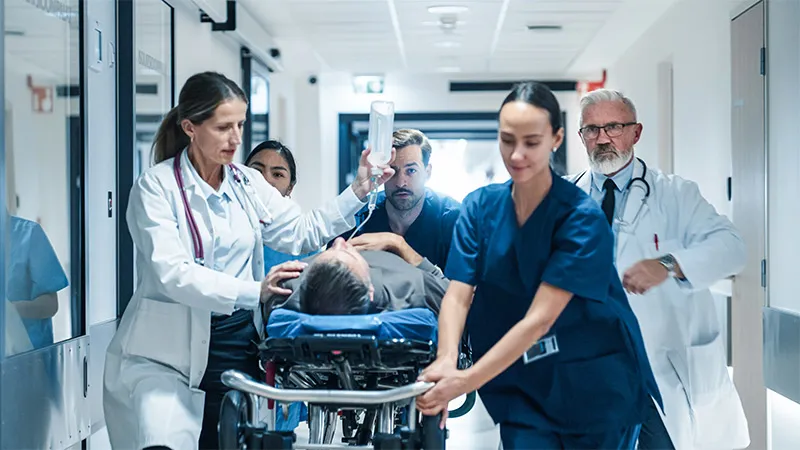
Forensic nursing is a specialty that carries as much passion as it does stigma. Often misunderstood, experts say the training they’ve received has enhanced their skills and approach to patient care.
What exactly does a forensic nurse do? And what type of opportunities are available to nurse practitioners (NPs), registered nurses, and advanced practice nurses with a passion for patient care and justice combined with a unique lens?
Though most often associated with caring for victims of sexual assault and violence, the field spans a multitude of settings.
“Sexual assault nurse examiners are indeed the most visible type of forensic nurse but not the only type,” said Victor Petreca, PhD, DNP, PMHNP-BC, CNP, assistant professor and director of the Center for Police Training in Crisis Intervention at the Boston College William Connell School of Nursing in Boston.
Two Feet, Firmly Planted
Forensic nurses have been at the forefront of caring for vulnerable patients long before the specialty had a name. Florence Nightingale might have been one of the first, given her trauma-based approach to tending to wounded Crimean War soldiers. But more than a century would pass before scholar, rape crisis innovator, and medical-legal death investigator Virginia Lynch, MSN, RN, formalized forensic nursing practice as a scientific discipline and subsequently founded the International Association of Forensic Nurses.
The rules of the road might vary, depending on the state one practices in.
“It is not the patient population that defines or makes someone a forensic nurse but rather the integration of nursing knowledge with an understanding of the legal system, that is, evidence, ethics, and patient rights,” said Petreca.
Petreca provided an example of the duality of skills required, for example, when an NP conducts a sexual assault examination.
“They’re collecting evidence, but they are very aware of how the legal context impacts patient care and vice versa. Forensic NPs are not purely in the legal or healthcare systems; these systems have different priorities,” said Petreca. “Healthcare centers on the patient and legal systems on security, order, public safety, and attention,” he said.
Jeanne Parrish, DNP, APRN, FNP-C, forensic NP and forensics coordinator at UVA Health in Charlottesville, underscored the need to possess, at the very least, a rudimentary understanding of what might be important depending on state laws, particularly as it applies to assessing and documenting whether there might be a potential criminal element attached to a specific injury.
“This is where abuse comes in, for example, domestic violence, strangulation, elder abuse, sexual assault, etc,” Parrish told Medscape Medical News. “The laws on mandated reporting are different in every state. Here in Virginia, domestic violence is not mandated, while penetrating trauma (gunshots or knife wounds) and elder and child abuse are,” she said.
Kimberly Kasper, DHSc, RN, CRNP, ACNP-BC, AFN-C, assistant professor of the Advanced Practice Forensic Graduate, Acute Care Adult Gerontology, and Family Practice NP programs at Duquesne University School of Nursing in Pittsburgh, was responsible for bringing trauma-informed care and assessment of elder abuse to the university’s nursing curriculum. Kasper’s program has since expanded and is considered one of the nation’s foremost forensic nursing offerings.
“A forensic nurse responds to patients who have experienced violence and trauma, and that includes mental and physical trauma, not just one without the other,” said Kasper. The approach, she noted, is “centered on the how.”
She provided an example of a patient presenting with a bruise on their upper arm. She explained she’d measure it, photograph it, and then ask the patient how it got there.
“It’s looking at the injury with a forensic mindset and asking if the mechanism of injury aligns with what I’m seeing,” said Kasper. “If somebody was punched in the face and they have a black eye and they say they fell into the couch, it doesn’t line up.”
Kasper said the same would apply to a child who falls off their bike and presents with a clean fracture vs one who presents with a twist injury. “The latter is intentional,” she said.
A Passion-Driven Pursuit
Karmen Harris, MSN, APRN, PMHNP-BC, SANE-A, said the pivotal point in her career path was when she received training as a sexual assault nurse for adults and adolescents while working at Womack Army Medical Center at Fort Bragg, North Carolina. She went on to serve as a medical death investigator and thereafter as a medical examiner trainer.
The skills she has acquired — interpreting crime scenes; ensuring the cause/manner of death are appropriate; and being the eyes, ears, nose, and hands for the pathologist — have served her well in her current position. So has her psychiatric and training as a sexual assault nurse examiner-adult/adolescent.
“I’m with the police department and work under the investigations unit as a forensic nurse investigator and advocacy specialist assisting with child abuse cases, homicides, and sexual assault cases,” said Harris.
Harris said that she believed forensic nursing should be part of all nursing curricula because it trains nurses to approach patients and their needs with a sharper lens and as a front-line defense.
“I tell my students that even if they have no desire to be a forensic nurse, get this training, especially if you are leaning toward working in the emergency department. It is going to make you a better nurse,” said Harris.
“From the very start, NPs are conditioned not to define a person by a diagnosis or legal status. We inherently recognize that the person who might have committed an offense might have been victimized as well,” said Petreca.
“I’m there to advocate for my patient and treat them as human beings, just like I would any other patient,” said Kasper. “We are there to tell the truth and provide evidence in a trauma-informed care way.”
Forensic nursing, like other nursing pursuits, is a challenging field. Petreca noted it can be practiced full- or part-time, and although rewarding, it carries the risk for burnout and vicarious trauma. It is also a field that carries stigma, said Petreca, who incidentally shifted to academia after spending more than a decade in correctional settings.
“It’s been documented in the literature that people see this type of work as less prestigious, but it was a deliberate choice,” he said.
Kasper has likewise made difficult choices; aside from her academic responsibilities in Ohio, she maintains a clinical practice in Florida that serves uninsured adult patients, migrants, and victims of human trafficking.
Parrish said her team has expanded the focus on domestic violence to include strangulation. “We’re seeing it a lot. We are noting elders are getting strangled, as are kids and college women. And we’re missing it because the presentation is different or they can’t speak for themselves, or in the case of young women, have sexual partners who’ve learned about it by watching porn.”
Harris explained that death investigation has given her “a retrospective lens on how to better care for the living.”
No matter the area, or the choice to enter the field full- or part-time, there are endless out-of-the-box opportunities. Aside from academic institutions, the Academy of Forensic Nursing, of which Kasper is president-elect, offers information, training, certification, and support for nurses interested in learning more.
Petreca, Harris, Parrish, and Kasper reported having no financial disclosures of interest.
Liz Scherer is an independent health and medical journalist. She has previously reported on mental health in correctional institutions.