
Have you ever had a migraine attack that felt like something was punching or stabbing you from behind the eyes? You’re not alone! Pain behind the eyes is a common symptom in migraine attacks.
Keep reading to learn about the connection between migraine and pain behind the eyes, how to tell the difference between migraine-related eye pain and other kinds of eye pain, and practical tips for relief.
Understanding the Migraine-Eye Connection
The Trigeminal Nerve: Your Brain’s Pain Superhighway
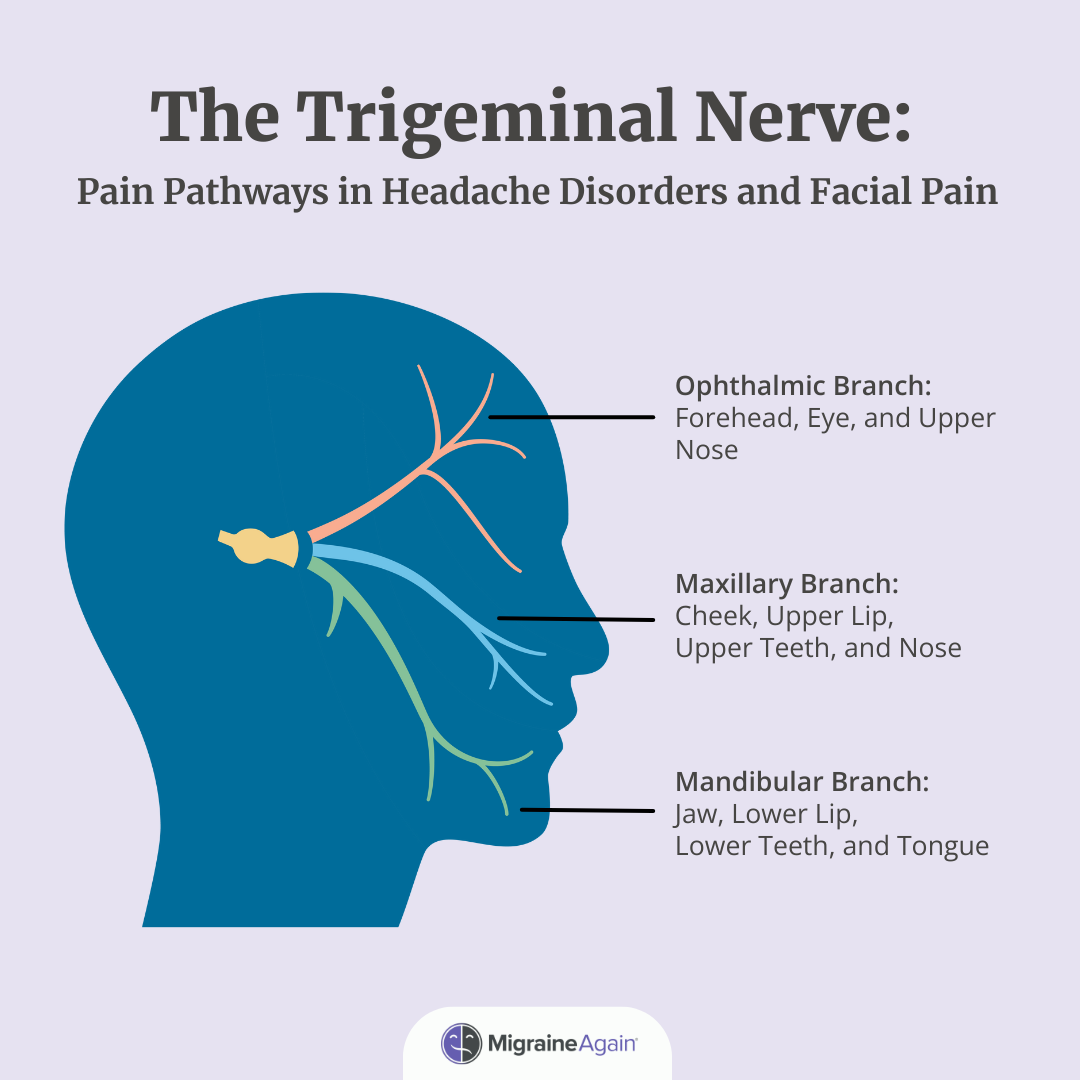
The trigeminal nerve is a major nerve bundle that reaches around the front and sides of the human head. It has three main branches: one that reaches the lower face (mandibular nerve), one that reaches the middle of the face (maxillary nerve), and one that reaches the upper face (ophthalmic nerve).
Each of these larger branches is connected to networks of tiny nerves; together, they transmit sensory information from the face and head to the brain.
The nerves in the trigeminal nerve network may release substances like peptides (including calcitonin gene-related peptide (CGRP), neurotransmitters, and cytokines as part of their regular function. But during a migraine attack, more of these substances are released and can trigger inflammation and overstimulate nerves.
When that happens, the trigeminal nerve turns into a kind of “pain superhighway,” sending lots of pain signals to the brain during the migraine attack process.
How Migraine Can Affect the Eyes
The ophthalmic branch of the trigeminal nerve is especially vulnerable in migraine, explains Deborah Friedman, MD, neuro-ophthalmologist and headache medicine specialist at Yellow Rose Headache and Neuro-Ophthalmology in Dallas.
“The ophthalmic nerve … senses pain from the upper eyelid, the forehead, the front of the head, the meninges in the frontal two-thirds of the head, as well as the eyeball and everything else in the eye socket,” says Dr. Friedman. “It also supplies the lacrimal gland, which produces tears. The cornea (the clear part in the front of the eye) has one of the richest nerve supplies in the body. Thus, the eye area is “wired” for producing pain during a migraine attack, and migraine is the most common cause of pain behind the eye.”
When the nerves leading to the ophthalmic branch of the trigeminal nerve are activated during a migraine attack, they can produce sensory and autonomic symptoms like:
- Pain behind the eye and around the entire eye socket area
- Dry eyes or excessive tearing
What Migraine Eye Pain Feels Like
We asked Migraine Again followers on social media how they would describe their pain around or behind the eyes during a migraine attack. The most common sensations they shared were pulling/pushing, stabbing, or “scooping.” [Many of these descriptions are witty, but they’re not for the squeamish!]
I describe it as someone ramming an ice pick into my eye: at times, it’s a red-hot ice pick. — Kala C.
[It feels] like someone trying to scoop my eyeballs out with a spoon. — Karen B.
[I feel] intense pressure pushing on my eyeballs from behind, like my eyeballs are trying to pop out of my head. — Kris L.
An evil gnome is pushing on my eyeball. Or someone took out my eyeball, bounced it a few times on the floor until it was bruised, and then stuck it back in the socket. — Janet C.
[It feels] as though someone is trying to scoop out my eye with an ice cream scoop or melon baller while repeatedly stabbing an ice pick behind my eye. — Rubi L.
[During a migraine attack, I feel] like someone is stabbing me with a screwdriver. — Christine N.
How Migraine Eye Pain Differs From Other Headache Types
Eye pain is a frequent feature of many types of headache disorders. However, the sensations, severity, duration, and other details of eye pain vary from one type of headache to another and from one person to another.
Headache-related eye pain usually resolves when you treat the attack itself, so having the right headache diagnosis will help you receive appropriate treatments and faster, more effective relief. (It’s possible to have more than one kind of headache disorder, so be sure to discuss all your symptoms with your healthcare professional.)
Some headache diagnoses associated with eye pain (like trigeminal autonomic cephalalgias or TACs) are extremely rare, but here are the headache disorders besides migraine associated with eye pain to be aware of.
Tension or Eye Strain Headache
The most common kind of headache attack is the tension-type headache (TTH). TTH may affect nearly 8 out of 10 people worldwide at some point in their lives.
TTH attacks usually last from 30 minutes to a week with fluctuating discomfort. It most often feels like a band squeezing around the forehead, but the “squeeze zone” may be wide enough to include your eyes. Although TTH doesn’t have the same sensory sensitivity, throbbing sensation, and nausea/vomiting features common to migraine, it can be disruptive to people who have TTH attacks frequently.
If you spend all day looking at a computer screen, you might be susceptible to TTH from eye strain. To reduce the impact of computer eye strain headaches, try these ideas:
- Position your monitor so that it’s about 20 to 26 inches away from your eyes and low enough so that you need to look down slightly instead of straight ahead.
- Take breaks to focus on objects in the distance for a few minutes at a time. Aim for at least once an hour to start.
- If you wear eyeglasses or contact lenses, make sure your prescription is up-to-date. “… [I]f your eyes are not focused properly, if you're not wearing the right prescription — either glasses or contact lenses — or refractive surgery, after a while, it can cause headache,” said Friedman in her 2024 interview with the Migraine World Summit.
- Adjust the brightness setting on your screen and the ambient lighting in your workspace to reduce sharp contrasts between bright and dim light. If your workspace is dimly lit but your monitor setting is 100 percent bright, the contrast will make your eyes (and brain) struggle to adapt. Use blinds or shades to soften daylight coming through any windows.
- Use blue light filters to block the most irritating spectrum of light from your electronic devices. There are eyeglasses that filter out blue light, external blue light filters that attach to your computer monitor, and newer computer monitors that have built-in blue light filter settings.
Tension-type headaches may trigger migraine attacks in people with migraine disease, but it’s not always easy to distinguish a run-of-the-mill TTH from a TTH that’s helping a migraine attack sneak up on you. If you pay close attention to your symptoms and note them in your headache diary app, you may see symptom patterns that will help you know when it’s time for acute migraine treatments.
Migraine vs. Cluster Headache Eye Pain
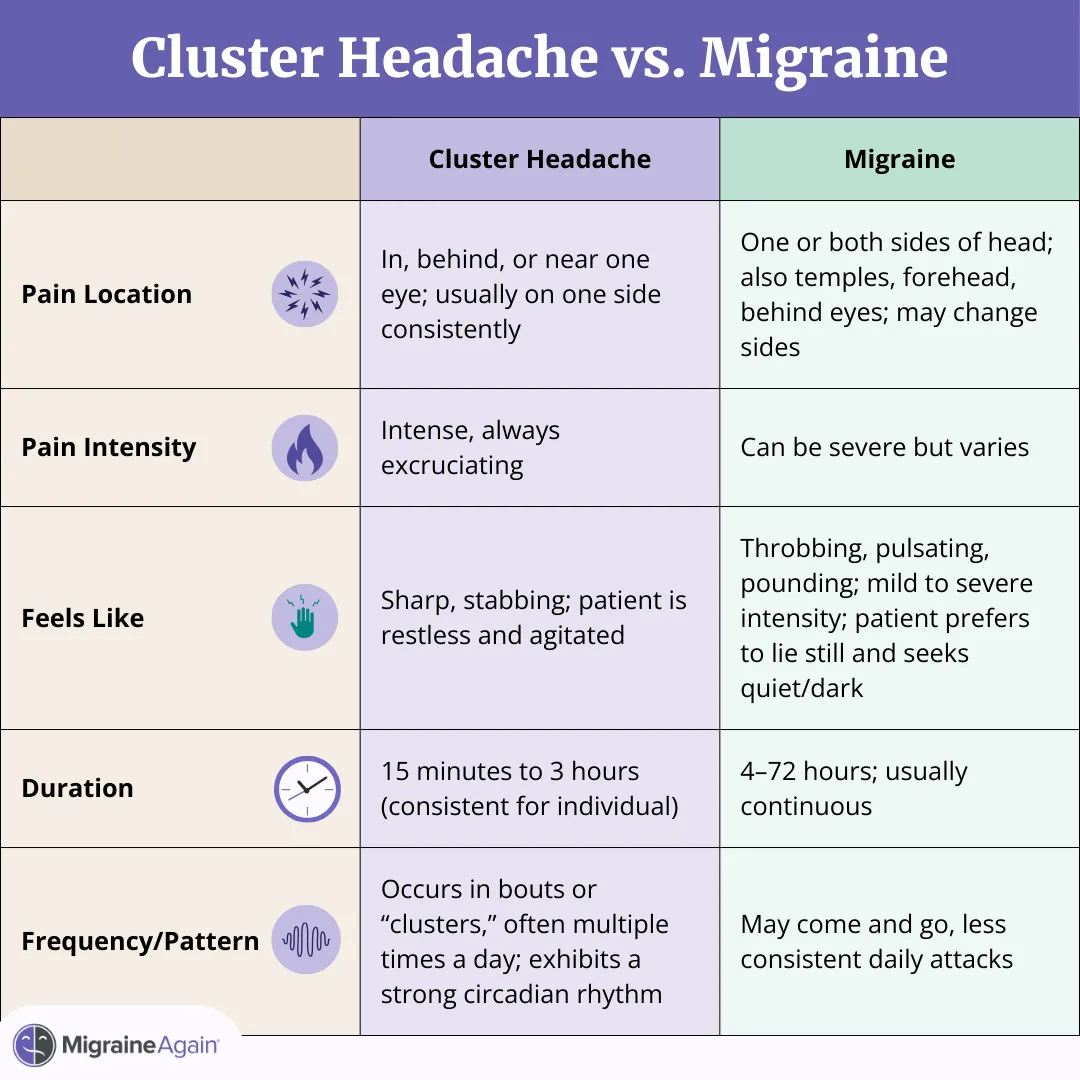
Cluster headache attacks usually occur in episodes or “clusters” of a month or longer, with months or years of pain-free time before the next episode. During a cluster episode, individual attacks come on suddenly and last from 15 minutes to three hours, often at the same time every day (and sometimes multiple times a day). Attacks often include autonomic symptoms on the same side as the pain, like a droopy eyelid, bloodshot eye, excessive tear production, stuffy or runny nose, or eyelid swelling.
Cluster headache attacks are excruciatingly painful, perhaps the most severe pain a person can experience without a potentially maiming or fatal injury. They’re sometimes called “suicide headaches” because of the high rate of suicidal ideation among patients during attacks.
“Cluster headache causes very severe, agonizing pain that is most commonly in the eye area, affecting the same side of the head each time,” says Friedman. “People describe it like a hot poker, or as though they are being stabbed in the eye — and the knife or ice pick was left in there. ... Most people with cluster headache can’t sit still, as opposed to those with migraine, who generally prefer to remain motionless.”
Cluster headache is rare enough that many healthcare providers may never have treated patients who have it. If these symptoms describe what you’ve experienced, please talk to your healthcare provider about finding a certified headache specialist to help you.
What About Visual Symptoms: Photophobia, Aura, and Retinal Migraine
What about other common migraine symptoms that affect vision, like photophobia (sensitivity to light) and migraine aura? Or retinal migraine?
Migraine Light Sensitivity (Photophobia)
Migraine Aura’s Visual Symptoms
The strange visual disturbances of a migraine aura have more to do with the visual cortex of your brain than with your eyeballs.
“Many individuals describe seeing their visual aura from one eye, but it is actually seen from both eyes, although it may be more noticeable in one eye,” says Friedman. “That’s because it arises from the brain.”
Retinal Migraine
Retinal migraine is a rare subtype of migraine that can interfere with your vision the way a migraine aura can, but it has a different cause.
(Note: You often see terms like optical migraine or ocular migraine in articles about migraine, but that’s because these are terms people search when seeking information about unfamiliar symptoms. They’re not actual diagnoses. “For the record, there is no such diagnosis as ‘ocular,’ ‘optical,’ or ‘ophthalmic’ migraine; it is either migraine visual aura or retinal migraine,” says Friedman.)
“The symptoms of retinal migraine are seen in one eye only and are thought to be caused by a process in the retina itself or the blood vessels supplying the retina or optic nerve,” says Friedman.
While both migraine aura and retinal migraine can occur without a migraine pain phase, here are some differences to be aware of:
Migraine aura:
- Tends to lessen or resolve completely anywhere from five minutes to an hour after onset
- Usually has consistent symptom patterns with both aura and headache pain
Retinal migraine:
- Often appears as a “negative” symptom, such as a black or gray “curtain” blocking part of your vision in one eye
- May last from minutes to hours or even longer
- Tends to have more variable patterns in relation to headache pain
If you experience the symptoms of retinal migraine, talk to your healthcare provider right away. Although migraine with aura and retinal migraine have similar symptoms, they have different but potentially serious consequences if they’re misdiagnosed. The proper diagnosis can help you get the treatments and follow-up care right for you.
Practical Strategies for Managing Eye Pain
The best way to treat pain around the eyes from a migraine attack (or any other kind of headache) is to treat the headache attack itself. Treating migraine attacks with the right medications can bring you faster, longer-lasting relief. Talk to your healthcare provider about acute and preventive migraine treatments to find the options best for you. If you suspect you have cluster headache or one of the rarer headache conditions, talk to your healthcare provider about getting an accurate diagnosis and finding the care team best equipped to help you.
Many Migraine Again readers with eye pain use nonmedicinal treatments along with their acute medications:
I use heat and the eyeball massager I bought a few years ago. — Marni F.
For me, ice packs, the migraine hat, and also a frozen pack at the nape of the head bring relief. — Aisling B.
Sometimes I use cold packs; other times I use heat packs as hot as I can stand because the heat overpowers the pain for a short time. — Nola P.
An ice pack and peppermint oil [help me]. — Louise P.
I use pressure points to help some, like pinching where the earlobe meets the head and the bridge of the nose. My dog can also sense my migraines and licks my affected eyelid. — Terri H. (We can’t recommend letting your pet lick your eyes, but we love pets who want to comfort us during migraine attacks.)
Final Thoughts
Pain behind or around the eyes is a common feature of migraine attacks. The culprit is a network of nerves around the eye socket that feed into the ophthalmic branch of the trigeminal nerve, a major player in migraine pathology.
Treating the migraine attack with the appropriate medication is the best way to relieve the eye pain, but many people with migraine also use comfort measures like massage tools, ice, or heat.
Other kinds of headache attacks often include painful symptoms around the eyes, but the symptoms vary widely depending on the type of headache attack. You can ease the impact of things like eye strain on tension-type headaches with lifestyle interventions, but rare conditions like cluster headache require expert medical care.
Living with migraine and other headache disorders is a journey, but there’s no single map that works for everyone. One of the best ways you can take charge of your health is to document your symptoms — like eye pain — in detail as they occur. Those details can help you and your healthcare team find the treatments that work best for you.
Do you experience eye pain during migraine attacks? How do you cope with it? Share your advice with fellow migraine warriors on TIPPI.