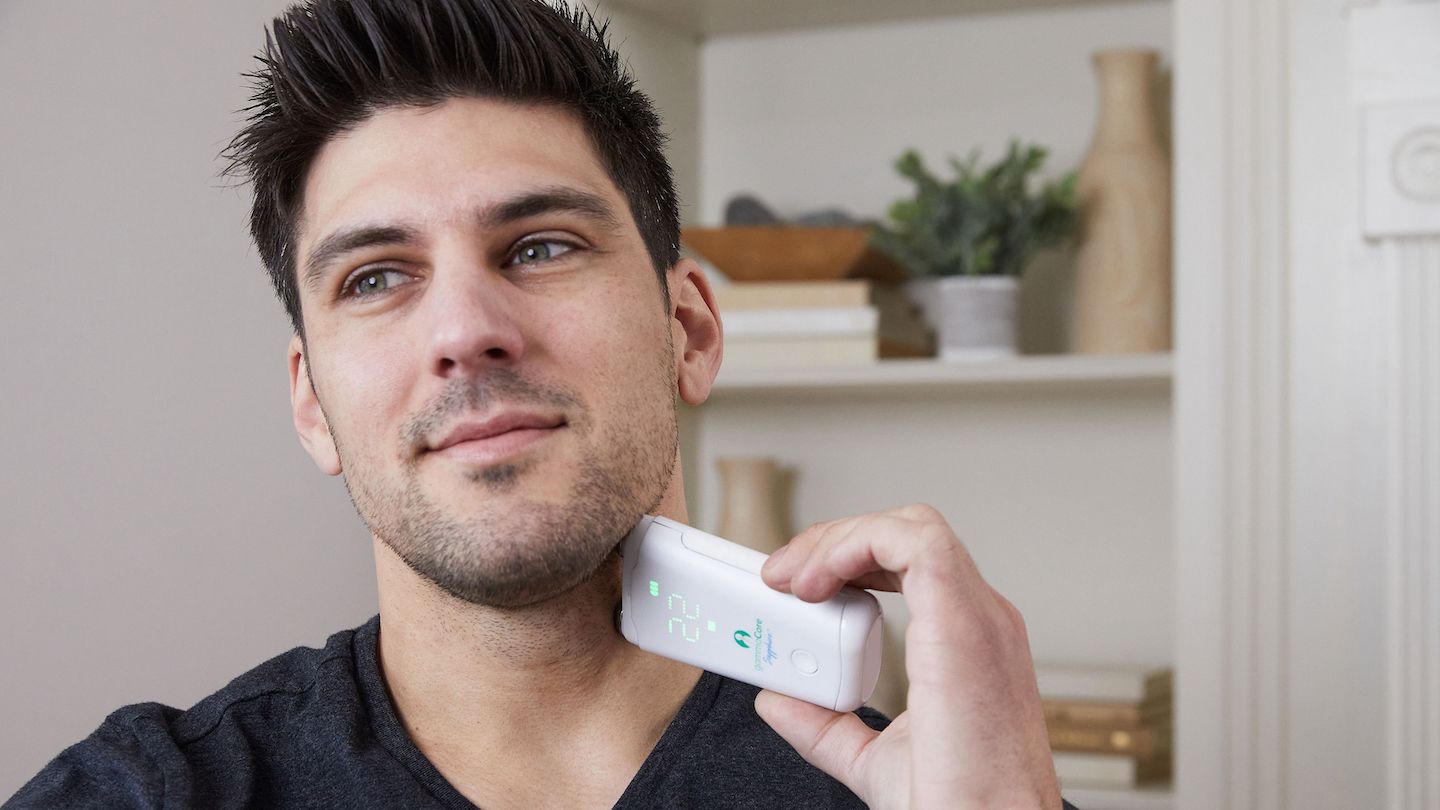
What if you could zap away the pain of a migraine or cluster headache attack with a device that fits in your hand? It’s not a gadget from a comic book — it’s gammaCore® (nVNS), a noninvasive vagus nerve stimulator cleared by the U.S. Food and Drug Administration (FDA) to treat and prevent cluster headache and migraine attacks in adults.
Here’s what you need to know about gammaCore, how it works, how to get it, and if it’s right for you.
According to the manufacturer’s website, the handheld device is cleared by the FDA in the United States for:
- Cluster headache: acute and preventive treatment of episodic cluster headache in adults
- Migraine: acute and preventive treatment of migraine in patients ages 12 and older
- Trigeminal autonomic cephalalgias (TAC): acute treatment of paroxysmal hemicrania and hemicrania continua in adults
The latest version of the gammaCore device, the gammaCore Sapphire, is a small, portable device that fits in your hand. To use gammaCore, you hold it against your neck, where electrical currents pass through the skin to stimulate the fibers of the vagus nerve.
“The vagus nerve controls many vital involuntary functions such as heart rate, digestion, and breathing, and helps regulate the body’s stress and pain responses,” says Fred Cohen, MD, a certified headache specialist and assistant professor of medicine and neurology at the Icahn School of Medicine at Mount Sinai in New York City.
Emerging science suggests that the “gut-brain axis,” the network of connections between the brain and the digestive system, may affect many aspects of our health. The vagus nerve, a major part of the gut-brain axis, is part of the parasympathetic nervous system (PSNS). The PSNS controls the “rest and digest” functions in the brain and body after the sympathetic nervous system (SNS) activates the “fight or flight” functions to handle stress or perceived threats.
Migraine is just one of many chronic diseases that are thought to be influenced by inflammation.
“For the treatment of migraine and cluster headache, vagus nerve stimulation alters pain pathways, reduces inflammation, and modulates brain activity involved in headache generation,” says Dr. Cohen.
Clinical Evidence for Migraine
Results from PRESTO found that acute treatment with gammaCore was superior to sham for pain freedom. At 120 minutes after treatment, 30 percent of gammaCore users reported pain freedom and 41 percent of gammaCore users reported mild or no pain (compared with 19.7 percent and 27.6 percent in control groups).
In the PRESTO study, as with previous studies, gammaCore was well tolerated with a low incidence of adverse effects.
Clinical Evidence for Prevention of Cluster Headaches
The PREVA study found that patients receiving gammaCore plus standard of care had 3.9 fewer cluster attacks a week on average compared with those using medication or oxygen therapy alone, and 40 percent of patients in the gammaCore group experienced reduction in weekly cluster attacks — nearly five times the number of patients who used standard of care alone.
The average out of pocket cost for gammaCore in the United States is $656.60 per month, according to SingleCare. The cost of a month of gammaCore is comparable to the cost for CGRP monoclonal antibodies, like Emgality, another FDA-approved treatment available for cluster headache and migraine prevention.
Once you receive a prescription for gammaCore from your healthcare provider, a specialty pharmacy will reach out to you to help you determine your coverage. If the device is covered by your plan, you simply have a copay.
Although many commercial insurers in the United States do not cover the cost of gammaCore, a growing number of insurers do. According to an electroCore spokesperson, plans administered by CVS Caremark or Ascent Health Services on behalf of Express Scripts may reimburse automatically with copays typically ranging from $25 to approximately $100, depending on the plan. Certain Blue Cross Blue Shield plans have issued favorable coverage policies for gammaCore, including Highmark and BCBS North Dakota.
If your insurer does not cover the device, the company encourages patients to contact the gammaCore Customer Experience team at 888-903-2673 for personalized support and assistance finding options that could help reduce the out-of-pocket costs. The company does not currently offer a formal copay assistance program.
GammaCore May Be Available Free of Cost for Veterans
If you’re a veteran in the United States, you may be able to try gammaCore for free.
GammaCore Outside the U.S.
- First, find the branches of your vagus nerve. Use two fingers to find your pulse on the area where the underside of your jaw meets your neck. The left and right branches of the vagus nerve run through the areas where you feel the pulse on either side of your neck.
- Next, turn the device on and wait for a single beep to indicate that it’s ready for use.
- Next, put a pea-sized application of gammaCore gel on the two metal spheres on top of the device and hold the device against the pulse spot with the spheres in a vertical position (one sphere above the other, not next to each other).
- Last, administer the stimulation using the button on the side of the device. You can adjust the intensity with the control button on the side of the device, which should be within easy reach of your index finger. When you feel a tingling sensation and a pulling-down sensation on your lip on the same side as the device, you’ve reached the right intensity. (These muscle contractions shouldn’t feel painful, but if they are, you can adjust the device intensity downward.)
Each individual treatment will last for two minutes before the gammaCore device beeps twice and turns off.
Dosage for prevention:
- Use two consecutive two-minute treatments on the same side of the neck twice a day.
- Apply the first two consecutive two-minute treatments within an hour of waking.
- Apply the second two consecutive two-minute treatments at night.
Dosage for acute treatment:
- Apply two consecutive two-minute treatments.
- You can apply both treatments to the same side of the neck or switch sides.
- You can apply a third treatment if pain persists after 20 minutes.
- Pregnant or pediatric patients (under 12)
- Patients with active implanted medical or metallic devices (e.g., pacemaker, stent) near the neck
- Those who have had vagus nerve surgery or have abnormal neck anatomy
- Patients with active cancer or who are in remission
- Patients with a history of brain tumors, aneurysms, head trauma, or seizures
- Patients with cardiovascular conditions like heart rhythm abnormalities, recent myocardial infarction (within five years), or significant hypertension/hypotension
The most common side effects of gammaCore include:
- Discomfort at the application site
- Irritation/redness at the application site
- Local pain in the face/head/neck area (including toothache)
- Muscle twitching and/or contractions, face/head/neck area (including facial droop and/or lip pull)
- Headache/migraine
- Dizziness
- Tingling, pricking, or a feeling of “pins and needles” on the skin where the device is applied (paresthesia/dysesthesia)
Most side effects were mild to moderate and went away after treatment.
We asked members of the Migraine again Facebook page if they had experience with gammaCore. The biggest message we got was about the cost barrier.
You know it’s amazing all these new treatments but who can afford them? My insurance will not pay for them. I’m on disability. I can’t afford them on my own. So frustrating!!! — Kristen
Tried didn’t work for me. — Sherry
Great device. Easy to administer and pain-free unlike others but unfortunately didn't work for me. — Miriam
I had already tried the gammaCore and found it to be fantastic, but couldn’t get it on the NHS. —Nicola
“My colleagues and I have seen many patients respond well to gammaCore, but as with all headache treatments, effectiveness varies from person to person,” says Cohen, but he notes that cost remains an obstacle for many patients.
“While some patients purchase cheaper alternatives from retailers like Amazon, I advise against this, as these devices are often not FDA approved,” Cohen says. “Some insurance plans may provide coverage, so it’s important to check with your provider. Using HSA or FSA funds can also be a cost-effective way to help cover the expense.”
If you’re interested in using external neuromodulation for migraine, here are more devices to try:
- Cefaly is an external trigeminal nerve stimulation device (eTNS) available over the counter for acute and preventive treatment of migraine.
- HeadaTerm 2 is a transcutaneous electrical nerve stimulation device (TENS) available over the counter for preventive migraine treatment.
- Nerivio is a remote electrical neuromodulation device (REN) available by prescription for acute and preventive treatment of migraine.
- Relivion MG is a combined occipital nerve-trigeminal nerve stimulation device (ON-TNS) available by prescription for acute treatment of migraine.
- SAVI Dual is a single-pulse transcranial magnetic stimulation device (sTMS) available by prescription for acute and preventive treatment of migraine.
The makers of gammaCore have also released an over-the-counter external vagus nerve stimulation device called Truvaga. Although the device is not cleared by the FDA for treating migraine, it’s marketed as a general wellness product for improving stress, insomnia, mood, and cognitive function.
Final Thoughts
As with most treatments, gammaCore won’t work for every person or with every attack. This new treatment does provide an exciting option and new hope for those unsatisfied with their current treatment. The low risk of side effects makes this device attractive for many looking for a more natural approach.
The device is costly, and access varies. Those with cluster headache in the U.K. and veterans in the United States can get gammaCore covered free of charge. Despite gradual improvements in U.S. insurance coverage, most insurers do not cover gammaCore or other neuromodulation devices. Equal access to new treatments remains a huge priority in patient advocacy.
If you want to try gammaCore in the United States, or in the U.K. for migraine, talk to your healthcare provider about trying the device. You will need a prescription and will have to navigate a lot of paperwork, but the results might be worth the effort!