
One of the defining symptoms of a migraine attack is the presence of nausea or vomiting. Whether you’re vomiting or “merely” feeling queasy, this symptom is not just unpleasant but can also interfere with oral medications you take to stop a migraine attack.
The good news: An anti-nausea medication called prochlorperazine (Compazine) is so effective in treating migraine symptoms that new treatment guidelines urge healthcare providers in emergency and urgent care settings to offer it to patients with severe migraine!
Here’s what you need to know about how prochlorperazine works, why it’s a staple in the “migraine cocktail,” and how it might help you.
What Is Prochlorperazine (Compazine)?
Compazine was the original brand name of prochlorperazine, a drug used to treat nausea and a variety of other conditions. (Although the brand name has been discontinued, the term “Compazine” is still widely used.)
[1]
Compazine works by blocking D2 dopamine receptors in the brain, along with histaminergic and cholinergic receptors.
It’s available by prescription in oral tablets, injectable formulas for intramuscular or intravenous use, and rectal suppositories.
[2]
Using Prochlorperazine for Migraine-Related Nausea
Migraine-related gastrointestinal (GI) symptoms can make it harder for your usual acute migraine medications to work properly. If you vomit soon after taking acute medications, for example, you may not have absorbed enough medication to work on the migraine attack.
Even if you can keep your meds down, migraine-related GI symptoms can still cause trouble. A migraine attack can trigger delayed emptying of the stomach, known as gastric statis. If your acute medications get stuck in the gastric statis traffic jam, they may not get metabolized quickly enough to relieve your migraine attack.
When migraine-related GI problems prevent your usual acute medications from doing their jobs, or if they lead to dehydration, you might need more intensive treatment from an emergency department or urgent care center — where healthcare providers may introduce you to Compazine.
Compazine and the ‘Migraine Cocktail’
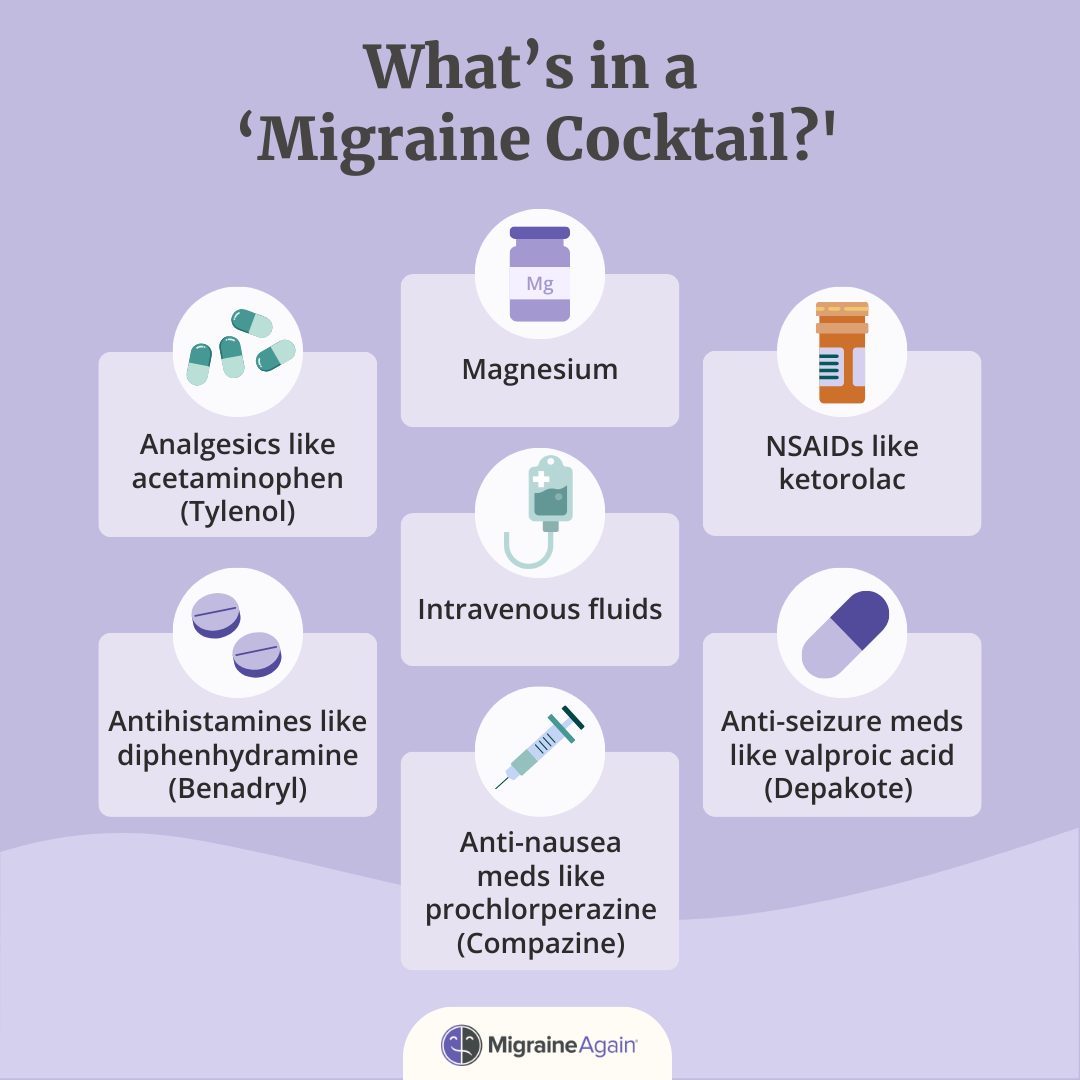
When you go to an emergency department or urgent care center for a severe migraine attack, healthcare providers may use a “migraine cocktail,” a combination of intravenous fluids and multiple medications that treat migraine symptoms.
The “recipe” varies depending on the facility and provider, but the basic migraine cocktail typically includes ingredients like:
- A nonsteroidal anti-inflammatory drug (NSAID) like ketorolac
- An analgesic medication like acetaminophen (Tylenol)
- An antiemetic (anti-nausea medication) like prochlorperazine
“The updated data we reviewed showed that there are new high-quality studies supporting prochlorperazine (Compazine) or greater occipital nerve blocks as first-line treatments,” says Jennifer Robblee, MD, the lead author of the new AHS guidelines. Dr. Robblee is a certified headache specialist at the Lewis Headache Center and an associate professor in the Department of Neurology at Barrow Neurological Institute in Phoenix.
“For prochlorperazine (Compazine), two new class 1 studies demonstrated its benefit as a treatment, including one that showed it outperformed hydromorphone, an opioid,” says Robblee.
“The previous 2016 ED guideline also reported two older class 1 studies. Combining the newer and older evidence, four high-quality studies show prochlorperazine to be a beneficial treatment. This convincing evidence led us to recommend it as a first-line treatment for the appropriate patient.”
How Compazine Differs From Other Treatments
The two new studies Robblee cites demonstrated that prochlorperazine was more effective than other medications at resolving migraine pain as well as nausea:
- prochlorperazine (Compazine) reduced patients’ headache severity scores better than chlorpromazine (Thorazine), a similar drug used to treat severe nausea and vomiting, in a randomized, double-blind trial in Australia. Patients in the prochlorperazine arm of the trial reported fewer side effects and needed additional rescue medicine than those in the chlorpromazine arm.[4]
- In a randomized, double-blind trial studying migraine patients in two New York City emergency departments, nearly twice as many patients who received IV prochlorperazine plus the antihistamine diphenhydramine (Benadryl) reported mild to no pain than patients who received IV hydromorphone (Dilaudid, a powerful opioid).[5]
Although Compazine doesn’t work on the same receptors or targets as migraine-specific acute treatments like triptans or gepants, it’s one of many medications developed for other conditions that has proved useful in migraine treatment.
“Any medication, though it may carry a label of having a specific purpose (such as being an ‘anti-nausea’ medicine), might be useful for any number of conditions, depending on dose,” says Mark N. Youssef, MD, an internist and headache medicine specialist in Cincinnati.
“Compazine, in addition to treating nausea, is an anti-psychotic medication, a migraine medication, and an anxiolytic. It has independent evidence for the treatment of migraine on its own,” says Dr. Youssef. “It has been shown to have better efficacy than Reglan, which also has some effectiveness to treat migraine, and medications such as antihistamines, which may treat nausea and migraine as well.”
Compazine may be a suitable rescue medication for a migraine attack in patients who don’t get relief from triptans or who can’t use them because of contraindications like cardiovascular conditions. Despite its close association with emergency departments, Compazine comes in enough formulas to be useful outside healthcare facilities, too.
“It is available in IV form, suitable for the ER, hospital ward, or out-patient infusion suite, yet it also comes as a suppository, which makes it useful in the out-patient or home setting,” says Youssef.
If you and your healthcare provider agree that prochlorperazine belongs in your migraine toolkit, you may be able to use oral or rectal formulations in the early stages of migraine attacks before the nausea/vomiting becomes severe.
Prochlorperazine vs. Other Anti-Nausea Drugs
- metoclopramide (Reglan), a dopamine receptor agonist
- chlorpromazine (Thorazine), a dopamine receptor antagonist
- promethazine (Phenergan), an antihistamine
- ondansetron (Zofran), a serotonin agonist
The 2025 AHS guidelines rated metoclopramide as a Level B drug healthcare providers “should offer” to migraine patients in emergency settings.
Chlorpromazine is rated as a Level C drug providers “may offer.” No updated recommendations were made for promethazine or ondansetron.
Individual Results May Vary
Prochlorperazine may carry the strongest recommendation from headache experts, but individual reactions to these medications vary widely. What’s best for the largest number of migraine patients may not be best (or safe) for you. Talk to your healthcare providers about all your medications and any experiences you’ve had with migraine cocktails.
Dosage and Safety Considerations
- Intramuscular: 5 to 10 milligrams (mg), repeated every three to four hours as necessary; maximum 40 mg/day
- Intravenous: 2.5 to 10 mg slow IV injection or infusion at a rate not exceeding 5 mg/min; maximum 10 mg per single dose, 40 mg/day
- Oral: 5 to10 mg, three to four times a day; maximum 40 mg/day
- Rectal: 25 mg two times a day
Common Side Effects
Prochlorperazine’s most common side effects include headache, dizziness, drowsiness, agitation/restlessness, skin rash or itching, and dry mouth/stuffy nose.
“It is common to feel sleepy and/or restless with this medication,” says Robblee. “Because it makes you feel sleepy, be sure you have a driver to get you home safely.”
Severe Side Effects
- A more severe version of the “jitters” called akathisia, an uncontrollable urge to fidget and move around
- Severe, uncontrolled muscle contractions of the head, neck, trunk, and limbs
- Uncontrolled movements of the tongue, jaw, lips, or face, such as pursing, chewing, or frequent eye blinking
- Uncontrolled movements of the fingers or toes, head nodding, or pelvic thrusting
- Tremors, stiff posture
- Fast, irregular breathing
Healthcare providers often administer an antihistamine like diphenhydramine alongside prochlorperazine to minimize extrapyramidal symptoms, but these symptoms can become dangerous if severe or untreated. If you experience these side effects and you’re not in a healthcare facility, contact your healthcare provider immediately.
Prochlorperazine Warnings
Among the warnings for Compazine:
- Do not use prochlorperazine in older adults with dementia-related psychosis.
- Do not use prochlorperazine if you have recently used significant amounts of alcohol, sedatives, tranquilizers, or narcotic medications.
- Do not give prochlorperazine to children under 2 years of age or 20 pounds.
- Do not give prochlorperazine to children before or after surgery.
Talk to your healthcare provider if you have had heart disease, seizures, brain tumor, glaucoma, low blood pressure, breast cancer, low white blood cell counts, chemotherapy, or other complex health conditions.
Final Thoughts
Prochlorperazine (Compazine) is an anti-nausea drug that can treat migraine pain as well as migraine-related nausea and vomiting. It’s often part of the “migraine cocktail” you may get at the emergency department or urgent care center to treat a severe migraine attack, but it also comes in formulations you can use at home.
Studies have shown that it may be even more effective on migraine pain and GI symptoms than many other medications, including opioids.
Compazine isn’t suitable for all migraine patients and can cause side effects requiring immediate medical intervention. Talk to your healthcare provider to find out if it’s safe for you, and how you can include it in your migraine treatment plan to get more relief.