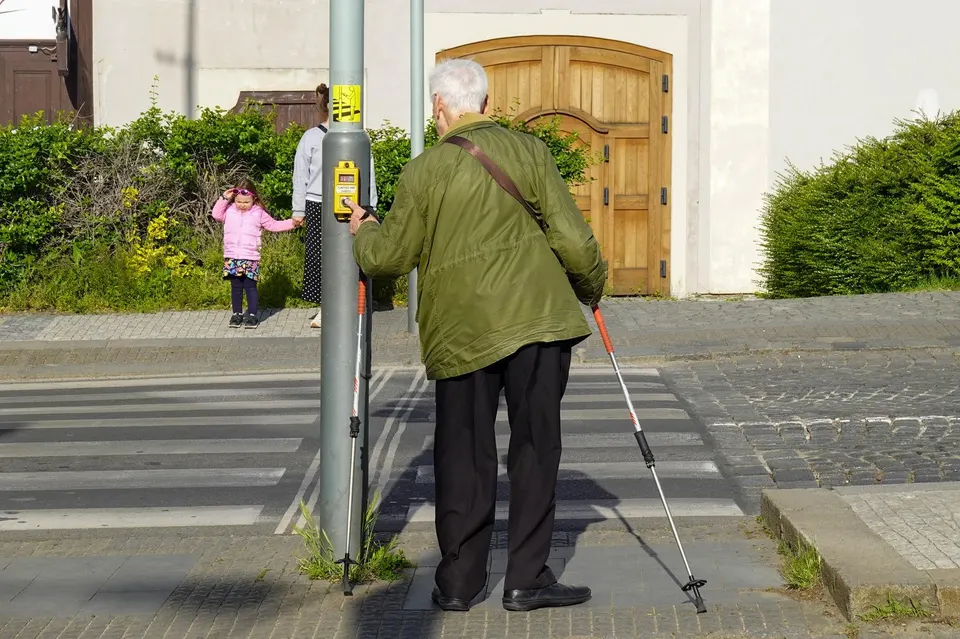
Research from the UK shows that pedestrian crossing times don’t account for people living with limited mobility
How long does it take you to cross the road at a traffic light? Chances are, if you’re young and able-bodied, you’ve never felt rushed on a pedestrian crossing, but that’s not the case for a growing portion of the population. For older people and those with limited mobility, crossings are a source of stress and a major safety hazard, all because they’re based on an assumption of how quickly people move.
A new study from behavioral and health scientists at the University of Bath shows that those assumptions – which are baked into traffic planning schemes in cities all over the world – are inaccurate and outdated.
To slow to cross
The team, led by Dr Max Western, analyzed the walking speed of 1,110 adults, aged over 65 and living with mobility restrictions in major cities across the UK. “Our instruction was to imagine they were walking down the road to the local shop, at whatever their natural, most comfortable speed is,” says Western. As the participants walked, their gait speed was measured, and each test was repeated four times. From this, the researchers found that the average walking speed for this group was 0.77 m/s (1.72 mph).
The issue is that most signal-controlled pedestrian crossings in the UK (and in many other countries) are timed to a walking speed much higher than this, as Western explains: “The length of the green signal on these crossings is based on the idea that pedestrians can walk at a speed of at least 1.2 m/s [2.68mph]. But hardly anyone in our cohort could comfortably walk that fast.”
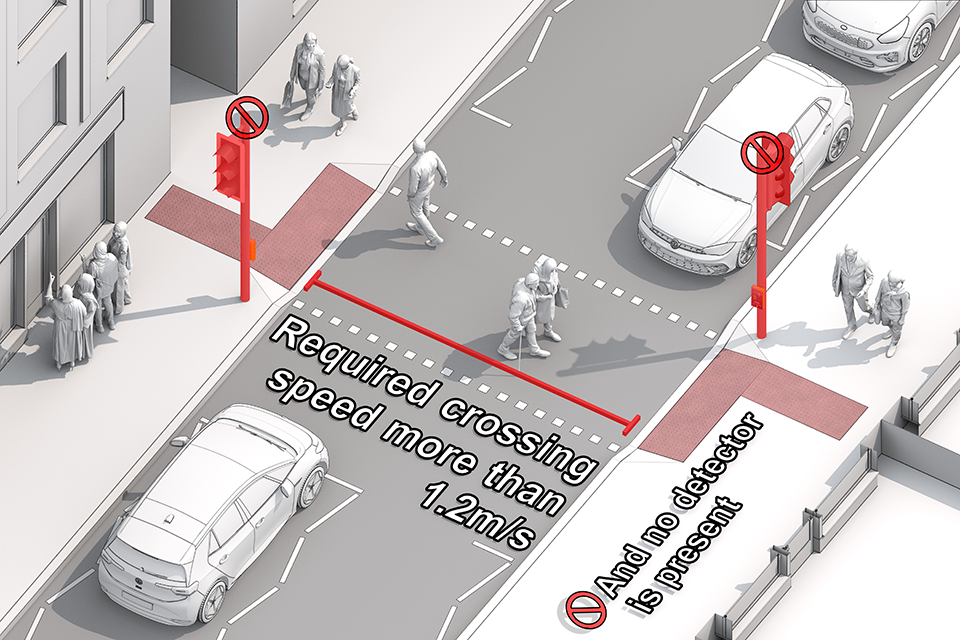
He’s not exaggerating. Of the 1,110 people tested, just 17 (1.5%) could meet that gait speed.
“I wasn't expecting it to be that low,” he says. “Yes, we were targeting a sub-group of older people with some mobility limitations, but these people are all independently living in their communities. They're not in institutional settings like care homes. They're regular citizens who get out and about; they are road users, so they need to be accommodated for.”
Western is not the first to find that the older pedestrians struggle with pedestrian crossings. A 2012 study found that the mean walking speed of men aged ≥65 in the UK was 0.9 m/s and for women it was 0.8 m/s. A study focused on Dublin, Ireland found that on average, gait speed declined from 1.3 m/s at age 60 to 0.73 m/s at age 89. A 2014 literature review conducted by Transport Research Laboratory (commissioned by charity, Living Streets) also concluded that “there is evidence that quite a fair proportion of people who use pedestrian crossings struggle to reach the 1.2ms-1 speed.”
Not fit for purpose
This assumed walking speed is widely cited to have been set by the UK’s Department for Transport sometime in the 1950s. While I couldn’t find an original source for that specific figure, I suspect it was an output of the Slough experiment, which established a lot of the pedestrian safety infrastructure still used in the UK, including signal-controlled crossings. The problem, says Western, is that “this assumed walking speed was set 70 years ago and it’s never been updated, even as our demographics have changed.”
The demographic shift truly has been significant. According to official government statistics, in 1953 there were around 3.5 million people aged 70 years and over in the UK. In 2024, that figure was ~9.6 million. As a proportion of the population, this group has now effectively doubled in size (6.99% in 1953 to 13.84% in 2024).
If – as this research suggests – the vast majority of people in this age category can’t meet the minimum speed that road crossings rely on, then ultimately, it means cities are home to an increasingly large group of people who cannot safely cross the road.
“Our research focuses on how we preserve or improve people's mobility throughout their lives,” says Western. “We know that the walkability of a neighborhood is a key facilitator of physical activity, so anything that hinders that – like road crossings that don’t give you long enough to cross – can have a profound effect on how older people move around their neighborhoods.”
In more informal conversations with the study cohort, Western heard numerous reasons why people avoid walking on their local streets, “Some say they feel really overwhelmed because they have to speed up, and that puts them at risk of falling and getting injured. A lot of them mentioned noise pollution too. Really, they describe this frantic world where they don't feel they belong.”
This, he says, contributes to a lack of confidence, which can result in people spending more time at home, which “contributes to social isolation” and “perpetuates a cycle of a lack of physical function which can push them into further frailty.”

Give people time (and space)
So, what needs to happen?
Western suggests that extending green signal times at locations frequently used by older adults would be a good start, as would prioritizing cars only at rush-hour. “For a five-meter-wide crossing, we’d recommend giving people 7 seconds rather than the 4.2 seconds currently set.”
To understand if this could be a practical approach, I spoke to Prof Nick Tyler. He is the Director of the Centre for Transport Studies at University College London, and the creator of PEARL (Person-Activity-Environment Research Laboratory) – an enormous (44,000m3) research facility that allows scientists to study how people interact with their surroundings, including simulated urban environments. For him “fiddling around with the crossing time to accommodate pedestrians” is not enough on its own.
“You always need to come back to the question of why are the people there? We are interested in people crossing a road because there is a conflict: it interrupts people in cars. Why does a person in a car think that they have some greater right to that piece of infrastructure than the person who is walking across it? There is no rational reason for that.”
He continues, “There should be more space in our cities given over to the pedestrian, to enable them to have the freedom to move. Starting there and getting it right for pedestrians – at all ages and stages – ultimately fixes things for everyone else. And that means thinking quite hard about people that are in vehicles; controlling where they go a little bit more. So actually, designing for ‘feet’ first, and then you see what you can spare for everything else.”
Western hopes that these findings provide an “opportunity for policymakers and practitioners in transport and urban planning to create more accessible walking environments for older adults.”
Ultimately, he says “people are living longer, but are not doing enough exercise. Anything that could meaningfully enhance mobility and independence for this growing population is worth investigating.”