
Birdwatcher data reveal that urban areas are changing how species diversity is spread across the planet.
“If you come from a temperate climate and you go to the tropics, you immediately notice the difference in diversity,” says Associate Professor Anna Hargreaves, an ecologist at McGill University. More birds, more insects, more of nearly everything, on land and in the oceans. Biologists call this the latitudinal diversity gradient – species richness – or diversity – rises steadily from the poles toward the equator.
The mechanism that causes this gradient is yet to be fully understood. Over a hundred hypotheses have been proposed, including climate stability, plant productivity and extinction rates. What isn’t debated is how reliable it is. “It’s the world’s biggest ecological pattern,” Hargreaves tells me, over video call. “As an ecologist, you’re used to dealing with a ton of variation and idiosyncrasy, but the latitudinal diversity gradient is just remarkably consistent, across continents, across taxa, across taxonomic levels.”
But two new studies suggest that cities are flattening that gradient, highlighting the planetary-level impact of human activity.
Citizen science in action
The first – published in the journal PNAS – is from Hargreaves and her colleagues at McGill. They chose to use urbanization as a way to study biodiversity at a global scale because, she says, the process “functionally creates a new biome”, which means that two distant cities resemble each other more than the landscapes they replaced. Hargreaves continues, “Unlike any natural biome that’s ever existed, this urban biome actually occurs on all continents, and it occurs from the Arctic all the way down to the equator.” This provided a unique opportunity to investigate whether or not the diversity gradient still applies.
The data they used to answer this question came from eBird; the enormous citizen-science database, where birdwatchers across the world log their geo-located observations. From this, the McGill team could estimate bird species richness across a range of latitudes, using only data collected in accordance with eBird best practices (e.g. observations should record every bird species seen during an outing) between 2017 and 2023. They also didn’t distinguish between native and introduced species because, they write, “each species contributes to the modern diversity and ecological trait matrix of each cell it occupies.” Then, the team used a grid to divide the planet into one-kilometer squares, classifying each cell according to its degree of urbanization, and overlaid the bird observation data. This left them with 44,233 squares, 10,163 species and 143 countries. “There’s no data like it,” Hargreaves says of the database, “Its unparalleled”. The study, she asserts, “would not have been possible without the literally millions of birdwatchers around the world that upload their data to eBird.”

A flatter slope
Their findings show not only that “urbanization generally reduces local diversity”, but that the latitudinal diversity gradient in birds is 3x weaker in cities than in natural areas. Moving from a latitude of 65° (north or south) to the equator (0°) saw bird diversity more than double (up 104 %) in natural areas, while in urban areas it rises by only 36 %. The scale of the flattening wasn’t evenly spread – tropical cities lost a higher proportion of species than temperate cities. The authors credit this disproportionate impact to specialization; the idea that tropical species have evolved narrower niches because their climate tends to be fairly stable. In contrast, Hargreaves says, the birds that do best in cities tend to be “generalists, the jack-of-all-trades species, like crows and jays.”
Seasonal migration had what the authors describe as “a dramatic effect on the avian latitudinal diversity gradient.” Hargreaves explains, “In winter there’s an enormous redistribution – a huge increase in diversity in the tropics because of the arrival of species that don’t live there year-round. But in urban areas during summer, there’s no real change in bird diversity.”
The presence of urban greenery seems to help mitigate the impact, though the specific evidence is thinner. Among a subset of about 445 cities with greenspace data, the tropical losses were smaller in the greenest cities. Hargreaves calls those results “a bit more tentative”, because the sample size is smaller, but adds that “combined with other studies that have found similar effects, I think the argument’s pretty compelling.”
Cities as winter refuges?
A second paper, published last week in Nature Cities, takes a slightly different approach to studying the latitudinal diversity gradient of birds. Assistant Professor Xiao Feng, an ecologist at the University of North Carolina (UNC) Chapel Hill, and his colleagues also used eBird records. But their focus was on North America, and they included specific analysis of both native and non-native species across summer and winter. After quality control, their eventual dataset consisted of ~5 million eBird observation checklists collected between 2015 and 2019. This represents 452 North American cities plus their paired ‘surroundings’ – land rings of equal area.
They found that the pattern of diversity depends on both the season and on whether the species is native or non-native. For non-native birds, such as starlings and house sparrows, the authors found no clear difference between city and surroundings. For native birds, cities generally have fewer species than the land around them, as in the McGill study. In summer, that gap is about the same at every latitude. But in winter it shrinks as you head north. By around 50°N, in southern Canada, cities and their surroundings are about level.
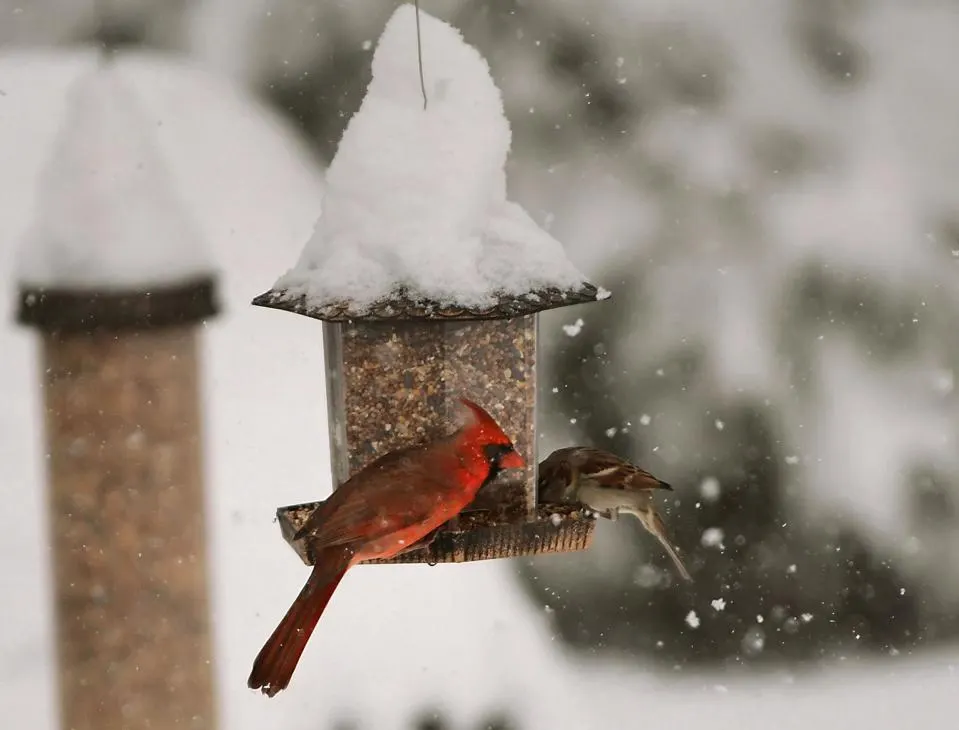
So why would cities close the gap in the cold? “The human impact can be negative for native birds in general,” Feng tells me. “But when the temperature is cold, or at higher latitudes when the conditions are harsh, the urban environment could potentially provide a benefit for birds, like providing shelter and food resources.” The authors suggest that higher building density can “create warm microclimates in cold seasons” for urban birds, while also providing greater access to food. This includes, says Feng, “the bird feeders people might have in their backyard – they can help to promote regional species diversity.”
There are caveats. The effect explains only a small share of the variation, the study counts species rather than the number of surviving birds, and it covers only North America. But Feng says it holds up. “Our analysis has been repeated a lot of times... eventually the results are consistent. They always tell the same story.”
Data points in the same direction
In our interview, Feng admits he was relieved to see the Hargreaves result, “I’m glad that they found a similar pattern... it seems to be consistent even across different continents.” Hargreaves felt the same, describing it as “reassuring”.
Both papers found that at the highest latitudes in winter, the bird diversity in cities and natural areas tend to converge. “If you’re in northern Canada in the winter and you go birdwatching in a city and in a natural area, there’s a good chance you’ll see roughly the same number of species,” Hargreaves says. “While they won’t be the same species, the diversity will be similar.” But there were differences in other findings. For example, only the UNC team found that in some higher-latitude places, the species diversity in cities slightly exceeded its surroundings.
Regardless, the larger message of these two studies is hard to miss. “If there was ever a pattern that you thought would be immune to anthropogenic change, it would be the latitudinal diversity gradient, because it’s so pervasive,” remarks Hargreaves. “We still see it in natural areas, so we haven’t completely messed it up. But our activity [as humans] has the power to really substantially weaken, and in some cases pretty much erase this foundational macro-ecological pattern.”
Feng concluded our conversation similarly, “The natural biodiversity has already been modified by humans. So, we have to be careful about what we do, right? We have really a lot of power.”