Doctors most frequently use catheter ablation to treat SVT. A 2024 study found that it helped nearly 82% of 2,470 people with AFib.
Catheter ablation takes place in an electrophysiology laboratory. It takes about 3 to 6 hours. While you’re under general or local anesthesia, a doctor makes a needle puncture through skin on your groin, arm, neck, or upper thigh, then inserts a small, thin tube called a sheath in the blood vessel.
Next, the doctor places a catheter inside the sheath, followed by electrode catheters that they guide to your heart. To locate the irregular tissue causing your arrhythmia, the doctor sends a small electrical impulse through the electrode catheters.
Once they’ve found the irregular tissue, the doctor sends mild radiofrequency energy, similar to heat in a microwave oven, to the tissue. The energy only destroys the irregular cells.
Implantable devices for arrhythmia
Depending on the type of arrhythmia, a doctor may recommend one of the following implantable devices that shocks your heart so it beats regularly:
- Implantable cardioverter defibrillator (ICD): This small device contains a battery and computer that monitors your heart rate and delivers an electric shock if necessary. A doctor may recommend it if you have a VT or other serious arrhythmia.
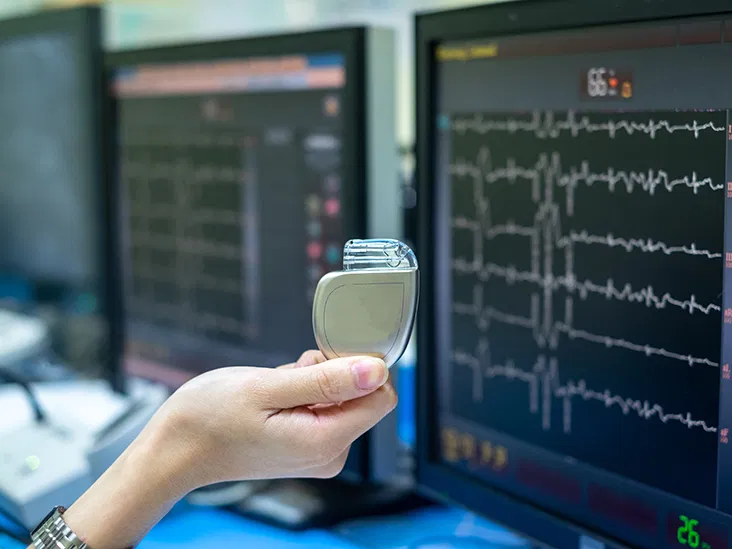
- Pacemaker: A surgeon can implant a pacemaker under your skin, most commonly near your collarbone. The device contains a generator, wires (some are wireless), and electrodes. It releases an electrical pulse that is not as strong as an ICD’s.
- Cardiac resynchronization therapy (CRT): Doctors can insert a cardiac resynchronization device or biventricular pacemaker, usually near your collarbone. The device delivers electrical impulses that enable your heart’s ventricles to contract at the same time.
- Implantable loop recorder: This electrocardiogram (EKG) monitoring device implanted in your chest can monitor your heart’s electrical activity for 3 years or longer. The device may transmit information to a medical facility or monitoring company.
Doctors can implant these devices while you’re either awake and sedated or under general anesthesia in an electrophysiology laboratory.
The procedure may take 1 to 3 hours. After the procedure, you’ll stay in the hospital for 24 hours for recovery and monitoring.
Maneuvers to help manage arrhythmia
If you have an SVT, as an alternative to medications or other arrhythmia treatments, you may be able to temporarily slow your heart rate by performing a simple exercise called a vagal maneuver.
This technique tones the vagus nerve, located between your brain and abdomen, which affects your heart rate.
The following are common vagal maneuvers:
- Standard Valsalva maneuver: While sitting or lying on your back, inhale and then pinch your nose, close your mouth, and then exhale forcefully against your closed mouth for 15 to 20 seconds while bearing down like you’re having a bowel movement.
- Modified Valsalva maneuver: Lean back about 30 to 45 degrees and perform the same steps as for a standard Valsalva maneuver. A healthcare professional then raises your legs 45 degrees for about 45 seconds.
- Carotid sinus massage: As you lie on your back with your head turned to one side, a healthcare professional applies gentle pressure to your carotid artery, located on the side of your neck.
In a 2019 clinical trial involving 98 people with SVT, the success rate for those performing the modified Valsalva maneuver was 43%. It was 24.2% for the standard Valsalva maneuver and 9.1% for carotid sinus massage.
Experts recommend you only perform vagal maneuvers if you have no symptoms of a stroke or heart attack, such as chest pain, shortness of breath, or a sudden headache.
Lifestyle changes
Certain lifestyle changes and strategies may help prevent arrhythmia. They include the following:
- Eat heart-healthy foods and avoid caffeine.
- Exercise regularly.
- Reduce stress.
- Avoid smoking. Quit smoking if you do smoke.
- Drink alcohol only in moderation.
- Maintain a moderate weight and healthy blood pressure and cholesterol levels.
- Avoid some over-the-counter medications and recreational drugs that may increase your heart rate.
You may also want to consider consulting a healthcare professional about a sleep study. If you have obstructive sleep apnea, using a CPAP machine can reduce arrhythmias, according to some research.
Takeaway
Arrhythmias are usually mild with no symptoms, so treatment may not be necessary. However, arrhythmias that originate in your heart’s ventricles may become life threatening. Contact a doctor if you experience the feeling that your heart rate isn’t typical.
Depending on the type of arrhythmia you have, treatment may involve lifestyle changes, medications, or implants that correct your heart rate.
Treatment may prevent arrhythmias from developing into more serious issues like stroke, cardiac arrest, or even death.
How we reviewed this article:
Our experts continually monitor the health and wellness space, and we update our articles when new information becomes available.
Current Version
Jul 1, 2024
Written By
Laura Goldman
Edited By
A. L. Heywood
Medically Reviewed By
Abby Sikorcin, MPAS, PA-C
Copy Edited By
Sara Giusti