The world is round. Left to right, up and down, all round.
Over the last year I have traveled to Cuba, Ireland and parts of Mexico. Those are countries that are awfully not like the United States in which I grew up in. In some ways, they are better and more fun. In other ways, maybe not so much. Here I will post some of my thoughts and adventures.
Cuba
Why Cuba? It’s the first thing that people asked me, when I got back, in April of last year. Why visit a grim, hellish dictatorship where the people slave under the yoke of brutal Marxism?
Why indeed visit a country with abundant supplies of cheap, high quality rum and $30 a night oceanfront apartment rentals? With seemingly endless beaches, attractive locals, warm Caribbean waters, incredible music and did I mention the rum?
I had some time on my hands. I have lived and visited all over other parts of the Caribbean and Latin America, including some right-wing military dictatorships where things could get a bit rough for dissidents. I wanted to see the lefty alternative for myself.
I was born almost three years to the day after Che Guevara, an Argentinean doctor and sometime poet, led his rag-tag troops against a numerically overwhelming army in the center of the Cuba, smashed the right-wing, corrupt government of Fulgencio Batista, and elevated his friend and comrade Fidel Castro to the leadership of the island country. So my life and modern Cuban history have been contemporary. The Bay of Pigs, the Missile Crisis, airline hijackings, wars in South America and Africa – all these were a backdrop for my personal history.
Last year, I watched with interest as changes came to the longstanding animosity between the United States and Cuban governments. After winning a second term, President Obama signaled that he wanted a friendlier relationship with the Cuban government, which has been ruled by the Castro brothers since the 1959 revolution. Within the last year, the U.S. has removed Cuba from the very short list of “state sponsors of terrorism” that also had the Sudan, Iran and Syria. The Obama administration, backed by the U.S. Chamber of Commerce, resumed formal diplomatic relations after 55 years.
And the U.S. government this year allowed lung cancer patients access to a vaccine, developed by Cuban scientists 25 years ago, that significantly improves the lives of those who are sick with the disease, without any negative side-effects. So time and medicine ultimately triumphed over anti-Cuban bias, at least when it comes to lung cancer.
I don’t mean to ignore the complicated history of the two countries. Since the Spanish-American war in 1898, America dominated Cuban politics by constitutional guarantee, at one particularly disgraceful point, in 1912, intervening militarily to insure that black-skinned Cubans remain second-class citizens. The back-story on that is we had promised those Cubans full voting and educational rights if they supported American interests in the Spanish-American war, which they did. We repaid them with bayonets, hand grenades and machine guns.
The U.S. dominance came to end with Castro nationalized American-owned businesses, especially the mob-controlled resorts and American oil company properties, in 1960, and it’s pretty much been ugly since then. Cuba supported communist insurgents and some terrorist groups around the world, and still harbors some violent anti-government terrorists wanted for crimes in the United States. The U.S. government engaged in violent covert and overt military actions of various kinds through the 1960s, and in documents released last year, the Pentagon proposed in 1960 to bomb and kill American targets, including American college students, and blame it on Castro, in an effort to gin up support for an invasion of the island. Those detailed proposals were rejected by President Kennedy, fortunately.
Cuba may be just 90 miles south of Florida, but despite more than a century of our repeated insistence that the people and land belong to us, they do things their own way. This despite the fact that we continentals can give them more homicides, infant deaths, poorer nutrition and inadequate schools, just like we have! We here in the United States, which has the highest incarceration rate in the world, criticize the Cuban government for not properly embracing freedom.
You have to wonder: Why don’t they get it? But they don’t, even though we have for almost 60 years made American investment illegal, American tourism illegal, we have banned their doctors and teachers from doctoring and teaching here in the States, we have invaded their country with guns and bombs and airplanes and exploding cigars – still. They refuse to understand why we represent the best of the Americas.
They are eager, however, to attract American tourists and investment, if the U.S. embargo ever ends.
Another thing to understand is that Cuba is big. Literally, big. I have a good friend, a world traveler, who like most Americans knows the island nation with the scary communist leadership from television newscasts and thundering denunciations from the halls of Congress. And as I said, she’s been around the block and has traveled with me to several Caribbean destinations.
In a recent conversation, she told me that she thinks the island is 80 miles long, or about as far as Mesquite is from Las Vegas. Other friends have made similar guesses to me about the size of Cuba.
Actually, Cuba is close to 800 miles long, roughly the distance from New York City to Madison, Wisconsin.
No, Cuba is another place. It is a big, beautiful country, filled with good things and bad things and good people and an occasionally horrible government.
Like most visitors to the island, I started my two-week recent visit in Havana.
You land at Havana’s Jose Marti International Airport, which looks like any airport except that there are a lot more people in uniforms, and a diversity of different kinds of uniforms, than you would see in most. Most visitors notice right away that the women in the Customs department wear flowery black lace pantyhose along with their severe green uniforms, complete with epaulets. There are heavily armed soldiers around, and of course, drug-sniffing dogs, but that’s standard operating procedure in most of the world’s international airports.
I noticed that the few other American citizens on my flight seemed to share my nervousness in encountering the Marxist state. For them, like for me, it was probably the first time. There was nothing to worry about. The Customs and security people were curt and efficient but polite and the process of entering the country was speedy.
God help you, though, if you happen to be an anti-Castro activist carrying explosives or, worse yet, a drug smuggler. All those automatic weapons are not just for show. They take those issues very, very seriously in the socialist paradise.
By the way, I saw one recent media report from the recent diplomatic action in Havana that like a lot of teevee reports was completely off. It described this run-down airport filled with dilapidated Cubana airlines planes. There is a national airline, but those planes are just a fraction of the total. There are plenty of new 737s from Latin America, Canada and especially Europe at the airport. I checked the arrival monitors, and they were busy, and they were from all over the world. Except, of course, from the United States.
In the airport parking lots, you will see many of those old, pre-1959 revolution cars that are camera magnets for just about every visitor to the island. They are pretty cool, but people don’t hang on to those cars just because of the trade embargo. They keep them because they are private property. Most new cars belong to the government.
In fact, there are many modern, or modern-ish, vehicles on the roads, plenty of Chinese and European models of various kinds, and plenty of wheezing Russian Ladas from the period of Soviet dominance. There are just no American cars of recent vintage.
Havana is an easy 10-minute drive from the airport.
Havana is the capital city, the center of arts and culture and Marxist theory and music and great food. It has a population of about 2 million, one fifth of the island’s total. And it really is as charming and cool as it looks in the photographs.
The city is on the northwest coast. It has a 4-mile seawall and wide boulevard called the Malecon. On one end, there is a colonial-era fortress, El Morro, that is perched on the hill over the city. There is a hotel, which was once a casino, called the Nacional. It was founded by noted American mobster Meyer Lansky and features performances of Cuba’s most notable export, salsa music.
On the other end, there is a hotel, once a casino, called the Riviera. It was founded by noted American mobster Meyer Lansky. There, you can see performances of Cuba’s signature musical style, salsa.
In between, you will find the old city of Havana, where there are a number of important plazas filled with statues and gorgeous colonial buildings in various states of repair and disrepair. The old city is towards the east side but the entire waterfront is historic. A walking tour through the old city is essential.
You won’t just see buildings from the colonial era, but there are buildings representing every architectural period up to the Revolution. You’ll see Victorian, you’ll see googie and other modernist constructions, and the big solid concrete constructions in the style known as brutalist. One large concrete pile is the headquarters of the Revolutionary Navy.
I thought then, “It could be lifted from Stalinist Russia,” and I assumed that it was a product of the Castro government. But I was wrong. In fact, the navy headquarters were built by the pre-revolutionary Batista government. I don’t know what that says, except, perhaps, that bad taste transcends political boundaries.
You will see more of this type of architecture, modernist, concrete and cold, nearby at the Plaza de la Revolucion, Revolution Plaza, along with huge portraits of Che Guevara and other revolutionary leaders.
Most of these buildings, although repurposed to support the Marxist state, were built or were under construction before the 1959 revolution put Fidel Castro in control of the government. After Batista, the old dictator, ran away with his money to Europe, construction continued on the buildings around this huge square. There’s a lesson in that, I suppose, but I’m honestly not sure what it is.
As grand as Havana is – and it really is – it is not the whole of Cuba. You have to get out of the city.
*
I hope I will always remember the drive from Havana to the East, on the beachside road called the Via Blanca. I noticed two things. The road itself was well-maintained, especially compared to the terrible conditions that I have found on the roads in other Caribbean islands. The stretch right outside Havana is a boulevard that was built by French contractors and has some moderne-looking light fixtures along it for a few miles. A little further on, and you are likely to see the first evidence of what may be Cuba’s greatest public-service failure, and that is to effectively collect garbage, but otherwise things look pretty good.
You will also see one of the ugliest vestiges of the Soviet era, and that is the collectivized housing apartment complexes that you will find all over Cuba. They are shabby and ugly, but there is a housing shortage and they are obviously packed with people. They look like they could be lifted straight from East Germany of 1970, except the paint, and sometimes the revolutionary slogans painted on them, are faded. I don’t want to judge the people that live in them. It is housing. They were built with Soviet support when the Soviets still believed that concrete and concentrated housing could build the new socialist man.
But on the same drive, about 20 minutes east of the capital, you’ll see the beach towns, and they are gorgeous. There are resorts and clubs, private houses and beautiful sandy beaches, and when I saw them for the first time, I knew I was going to love Cuba.
My traveling friend and I ended up in the community of Guanabo, which is kind of a honky-tonk beach town for vacationing Cubans. There are also some foreigners like us, although very few U.S. visitors.
There are ample numbers of clubs and bars and restaurants, both private and government-owned. It’s easy to trade money. There are hookers, and according to Cuban friends who may or may not have been government informants, prostitution is sort of a grey area, legally. I did not, for the record, indulge, but it’s another sign that capitalism is popular among the locals.
If you accept the charge that Cuba is run by a Marxist dictatorship – and I do, mostly – it’s a peculiar type of Marxist authoritarianism. More Montego Bay than Pyongyang; it’s daiquiris and mojitos, not cheap vodka and pruno.
As an example, I was and remain very interested in Cuban television. Cuba is now extensively wired for government-controlled cable teevee. There are seven or eight channels, most of which feature a weird mix of propaganda, really stale talk shows with government-approved artists or doctors or bureaucrats, or educational programming. For example, introductory lessons in the French language. There’s a 24-hour news program, Telesur, out of Venezuela, which in my judgment, is no Fox News, but it’s pretty evenhanded in covering issues from the United States and throughout the Americas.
But there are more exciting options. American television dramas, including The Flash and Chicago PD, which few Americans seem to watch, are presented with Spanish subtitles. English-language movies from Hollywood and Great Britain are also aired, again, usually in their original English language with Spanish subtitles – although clearly, it would be easy to find or make versions with Spanish dubbed in.
Anyway, here’s my favorite story about Cuban television: When my traveling buddy and I found a place to say in the beach city of Guanabo, a very nice place with two separate bedrooms, a kitchen and living room with cable teevee, I turned it on.
The first thing that came on, and I am not making this up, was a video by the rock and roll band The Killers. Most of you have heard of Brandon Flowers and the Killers, a band from Las Vegas. The video in question was their big hit, “Somebody Told Me.”
You know it? “Somebody told me that you had a boyfriend that looked like my girlfriend I had in February of last year…” Of course, it was filmed in Las Vegas. I traveled two thousand miles to see a video that was filmed a couple of miles from my house.
Anyway, the world is round and small and Las Vegas rules it all. But my point is that if Cuba is a Marxist dictatorship, it’s a peculiar dictatorship that essentially allows their subject people to watch promotional videos of sinful Las Vegans rockin’ out in the desert.
Here’s another example of media that suggests that contemporary Cuba is not the Stalinist nightmare that its opposition insists that it is. Like every good American, I love zombie movies. Cuba’s contribution to the genre is, following the success of Dawn of the Dead, Dawn of the Dead the remake, and of course the fine English spoof zombie film Shaun of the Dead, called Juan of the Dead. Dawn, Dawn, Shaun, Juan.
This is a movie filmed with the approval and support of the Cuban government. It features a cross-dresser, gay men and, of course, zombies. In a clever twist, the film has the Cuban government, on television, denouncing the zombies eating their way through Havana’s tourist community as political dissidents.
Juan of the Dead – Juan de los Muertos – is a very funny film that totally skewers the self-important anti-dissident obsession of some Cuban government officials. And it could not have been made without the knowledge and approval of the supposedly dictatorial government.
And another anecdote about the society. There are American flags all over the place. The stars and stripes are on bikini bottoms, bikini tops, on beach towels and doo-rags, t-shirts and trucker hats. It’s true that the Cuban flag is also red, white and blue, but there’s only one star on the Cuban flag, and it’s red. Somehow, the Cuban cops, government militias and communist bureaucrats don’t mind the widespread dissemination of the American symbol of freedom.
Anyway, these things I learned while I was in Guanabo, as I say, sort of a Myrtle Beach of Western Cuba. Fortunately, we could and did go farther east on the Via Blanca.
It was still dark when we left Guanabo, in our rented car, in an effort to go as far east as we could.
It was very hard to see the blanca, but through the feeble lights of our rented Chinese crap car, which didn’t like to go in reverse, I saw fields of sugar cane, oil refineries and big agricultural operations, dark Atlantic oceans to our left, gorgeous colonial-era towns and in the long, empty rural areas, land crabs.
These six-inch wide land crabs, red, with their claws waving threateningly as our car approached, were moving from the land to the ocean and the road and a gringo driver were their downfall. Crunch. I felt terrible. I’d traveled 2000 miles to kill the native inhabitants. It was an environmental Bay of Pigs disaster, and we were the only vehicles along most of the road.
The Via Blanca runs along the north side of the island from Havana through the suburban beach communities, and the very colonial port city of Matanzas, which I hope to see again, and on to the model tourism center of Varadero, a 10-mile spit of sand on which tourists from all over the world drop their hard currency in exchange for beach umbrellas and hookers. That is the land of the all-inclusive resort, and I must admit on the one hand how that appeals to some people, but on the other, it’s not really the way to see Cuba or to meet the regular people. We stayed in the all-inclusive resort one night, and there wouldn’t be much more to say about that except for one very lucky coincidence.
On the night we arrived, we chose to take advantage of the weak but endless stream of “free” cocktails at the communal bars. After the sun went down, I went for a swim on the long sandy beach. There were no lights, which is the way I like my nighttime beach visits.
After assuring the hotel security guard posted on the beach to keep drunken tourists out of the water that I knew how to swim, I was soon floating in relaxed, post –cocktail sea of tranquility. A few minutes later my swim was interrupted by my traveling buddy, who was shouting from the beach about some sort of emergency.
The emergency, it turned out, was a performance just a mile away by the legendary jazz-salsa group the Buena Vista Social Club. To make a long story short, we went, had a great time, and hung out backstage with the group, all for $20. For me, that’s the equivalent of seeing Led Zeppelin or some such. So although the “all inclusive” resort wasn’t for me, or my friend, it certainly paid off with this unexpected benefit. I can’t promise that every visitor to Cuba will see Buena Vista Social Club, but I can say that it is far more likely there than in, say, Henderson, Nevada.
On the same trip to the east, I visited the central industrial city of Santa Clara. Santa Clara is a very important city to the Marxist government. It is where Che Guevara, Fidel Castro’s well-educated friend and a leader of one of the five brigades that toppled the corrupt regime of Generalissimo Fulgencio Batista. It was in Santa Clara that Che destroyed the government army. His capture of Santa Clara on New Year’s Eve, 1958, led to Batista fleeing Havana the next day, and within a week Castro assumed total control of Cuba.
There are monuments to Che’s tactical and political success all over Santa Clara, and there is a huge, North Korean-style plaza adjacent to his mausoleum and museum. This fits my mind’s eye of big, Marxist memorials.
Parts of the memorial are also quite moving, particularly the grassy amphitheater in which Che’s revolutionary colleagues are buried in concentric rows. Most of the graves are filled now, but some are still empty.
The guards, by the way, take this revolutionary stuff very seriously. No cameras are allowed in the mausoleum, although of course you can take photos of the 22-foot high statue of Che perched about a 40-foot concrete base. There is a lot of verbiage etched into the concrete about the importance of education and such, which is actually kind of boring, but the crypt where Che and his leftist co-combatants who died in Bolivia in 1965 is actually pretty profoundly moving. Even if you disagree with what they were fighting for, you have to recognize their commitment and sacrifice for what they believed.
And this, of course, illustrates why there is the deep animosity between the governments of the United States and Cuba. Cuba is a Marxist dictatorship. Things may be a bit looser now than they were in the 1970s and 1980s, but the symbols of communist ideology are impossible to miss. They are, frankly, exotic.
Some people like to imagine that Castro could have been an American ally. After all, the Eisenhower administration had ended formal support for Batista six months before the fall, after reports reached the international media of widespread atrocities committed by the dictator against civilians. But Castro not only kicked out the mobsters that ran the casinos and hotels in Havana, more importantly, he kicked out that American oil companies that had a profitable monopoly on energy production on the island. I think from then on the die was cast.
The United States cut economic support for Cuba, and Cuba turned to the natural alternative in that bi-polar, Cold War world, the Soviet Union. By the time of the Bay of Bigs invasion in 1960 – which is a huge deal in Cuba, a week-long observance that I was lucky to witness – the U.S. and Cuba were essentially at war and have remained at war, essentially, until this year.
For my lefty friends, Cuba was supposed to be the socialist paradise of the Western Hemisphere, a place, for true believers, which would forever be free of the cutthroat competition, environmental destruction and social and economic inequities fostered by (they believed) the corrupt capitalist tyrannies exemplified by the United States. From the late 1960s to the present, thousands of Cuba supporters, including Las Vegans, traveled to the island nation as volunteers to cut sugarcane (a horrendous, back-breaking and dangerous job) and take on other industrial jobs.
Cuba remains a Marxist state, but the heavy hand of the party is much more gentle than in years past. The Obama administration has recognized the changes as it chips away at more than 50 years of punitive economic and political sanctions with the goal of normalized diplomatic relations, including an announcement May 29 that it is dropping its classification of Cuba as a “state sponsor of terrorism,” a short list that includes Iran, Sudan and Syria.
Cuba is successfully developing its tourism industry, but remains burdened by a centralized, command economy that looks a lot like the Soviet Union of the 1970s. While people are justifiably proud of the schools and health care, they are eager to get jobs that pay in hard currency rather than government scrip. Many of the people I met, including highly skilled government workers such as doctors and engineers, have private side-jobs working as taxi drivers or other tourism-related gigs.
It’s a nation in which the government owns the international resorts and car rental agencies, but where gas stations often have no gas, and where those numerous car-rental spots are filled with new-looking vehicles that do not run, and where the governments large and modern high-rise beach resorts sit closed and empty while neighboring resorts are completely booked.
I have a good friend who lives in the former socialist paradise of Poland, which 25 years ago, like Cuba, was a “client state” of the Soviet Union. He predicts without hesitation that Cuba will be overrun with the same sort of oligarchy and gangsterism that has plagued the former Warsaw Pact nations of Eastern Europe.
It could happen. Let me suggest why it might not.
Even those individuals who are willing to risk jail time in what by all accounts are really horrendous prisons say they want to keep what Cuba does well: health care, education and nutrition. What they want is the simple right to criticize, to talk, to find alternatives to the status quo. Does that inevitably mean a descent into Koch-Brothers style capitalism? Again, Cubans really like some of what they have, and as part and parcel of their social structure, they have highly trained cadres of would-be upper middle class engineers, doctors and other medical professionals, accountants and software coding punks. Those men and women don’t want to give back access to medical care and education. They do want to avoid prison for opposition to specific government policies.
In any case, it will be very, very interesting when – if – Cuba opens up to unencumbered commentary and criticism. Because there is no doubt that posting an anti-government flier in public would land you in jail. In fact, one of the notable things about Cuba generally is that compared to U.S. or European cities, there is almost no graffiti. Walls that just cry out for messaging – if they are not already home to revolutionary slogans and images of the Cuban flag or Che Guevara – are totally empty, a weird tableau for someone from a major American urban center such as downtown Las Vegas.
Cuba is a society, an island, a people on the precipice of enormous change. You can feel it in the air, see it in the airport filled with international tourists, hear it from the people on the street who desperately want to profit from the changes to come. The future of Cuba, of course, is unwritten. How we relate to that island, as individuals and as a government, will help write that future.
I should stop there, but I think it is important for people to know some very important things about Cuba. One is the food. If you’re on a budget, you’re going to want to cook at home. That’s easy to do. The house rentals that are available in Havana and other cities, and especially on the beaches, usually include kitchens. Shopping is simultaneously easy and a challenge: there are small corner grocery stores everywhere. They will sell a variety of canned and refrigerated foods, but this is Cuba, where the state is everywhere and has very odd impacts on the market.
You are not likely to find everything you need in one place. Bread and eggs, for example, we only found at specialized stores. One egg man only sold eggs with the government scrip, so our international hard currency bills called CUCs were no good to him, and as visitors, we’re not allowed the government bills. We worked it out.
You get your bread at the bread store, duh, and one giant hard-roll loaf kept two of use satisfied for most of a week. We kept it in the refrigerator, and sliced off pieces as needed.
Other kinds of food can be challenging but shopping in Cuba is an adventure. There’s little refrigeration so watch out for fresh meats.
Vegetables and fruits can be found at both permanent stores and carts, and their fragrance of pineapple, mango, banana and guava is wonderful. Those fresh staples are your best bet in terms of value and health – cucumbers, mangos and tomatoes, onions and garlic, along with lime juice and soybean oil kept us in delicious salads for days.
And cheese: Cheese is very important for the international traveler on a budget. In my 10 days in Cuba, I found two kinds of cheese available at the little corner: a soft gruyere, suitable for grilled cheese sandwiches, and (to my eyes, a bizarre alternative) brie, the choice of Chardonnay swilling capitalists all over the world. As good soldiers of the proletariat, we went for the gruyere and endless grilled cheese sandwiches.
Another important thing would be car rentals. Getting a driver with a car can be fun but it’s expensive. Getting a rental car is expensive and, it turns out, harder than it looks.
It seemed easy, at first glance. There are car-rental lots all over the place – at least two within walking distance of our beach house rental.
One of those lots, however, had no cars in it. We walked to the other, which had about 20 new-looking vehicles of various makes, including French Peugeots. The on-site manager, however, said that not one of those cars was working. Car-rental operations are a state monopoly, and all the rental cars have license plates indicating that they are property of the state, but the reason that they weren’t working is that the government gas stations don’t usually have the high-octane gas that these vehicles need to keep running. So people use the cheap stuff and destroy the engines.
My friend and I grabbed a taxi and headed to Havana, figuring the big city would have to have a working automobile for rent. We struck out at a couple of other rental lots before stopping at a rental office in Villa Panamerica, an attractive and new suburb just east of the capital.
There was one car available, a silver Chinese-manufactured Emgrande sedan. Just the ticket!
Not so fast. Of course there would be complications. First, the car needed to be cleaned. The car-rental employees said the cleaning would take an hour – time enough for us to grab a late lunch at a café. The car had a manual transmission, which was fine as we both can drive a stick, but it really, really did not want to go in reverse – just like the Cuban government, forward!!!
But the Emgrande did get us around most of the island, including a bout in which we were lost in the mountains and rain forest of the central Cordero, so for that, I am grateful to the Cuban and Chinese bureaucrats without whom we would have been traveling by bus.
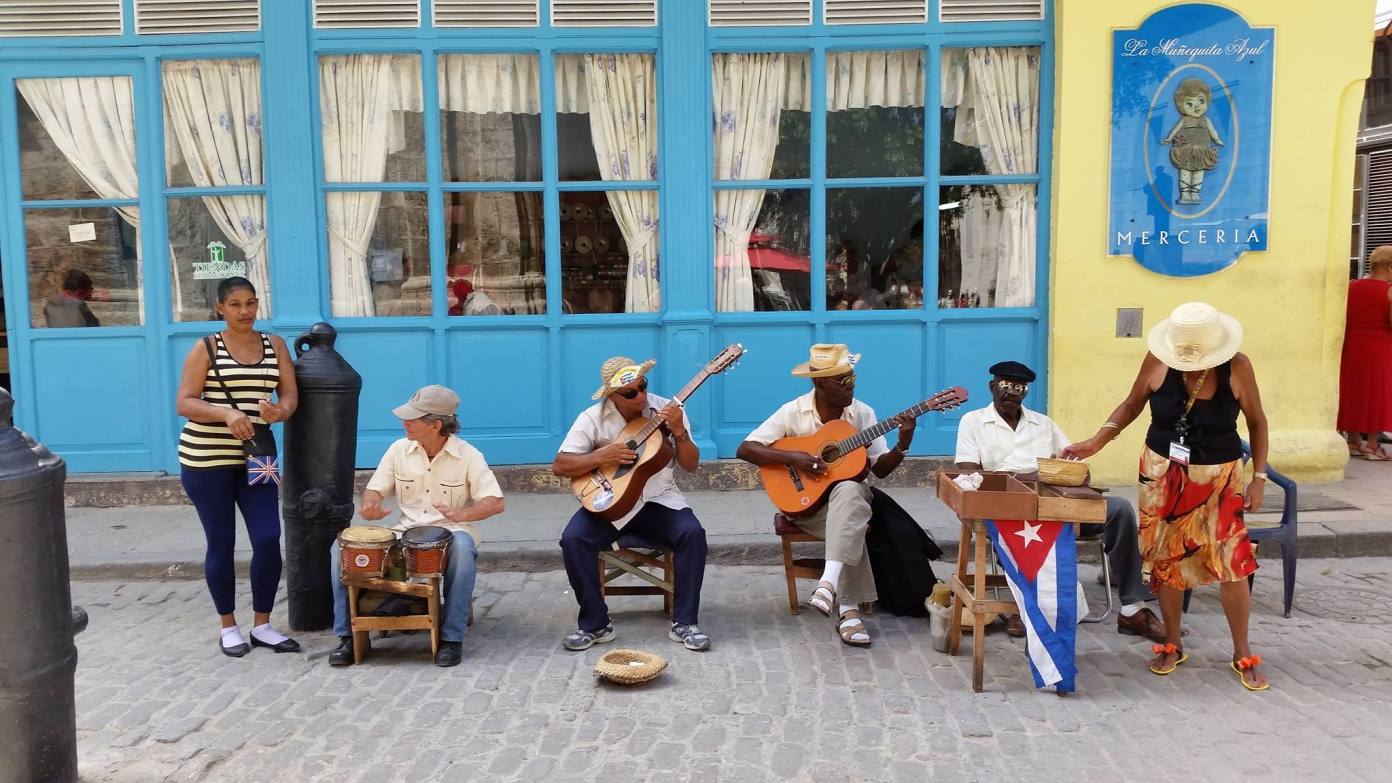
Is that all there is to Cuba? Oh, hell no. I am hoping that the governments of the United States and Cuba are not so friendly that they will compare notes and keep me from going back. I want to see the world-renowned nature preserves and national parks. I want to visit Santiago, on the far east of the island, which has been the crucible for revolution and resistance to distant rulers for 500 years. I want to see how the growing solar power revolution is developing on the island, and how Cuba is adapting to the Internet. But mostly, I want to enjoy a cold mojito while listening to a hot salsa band!
For a much shorter and better-edited story, see the Seven magazine story I penned here: http://vegasseven.com/2015/07/01/cuba-not-so-foreign-relations/