But overall, machine learning approach closely matches what human scholars had long suspected about ancient documents
Menahem Kahan/AFP via Getty Images
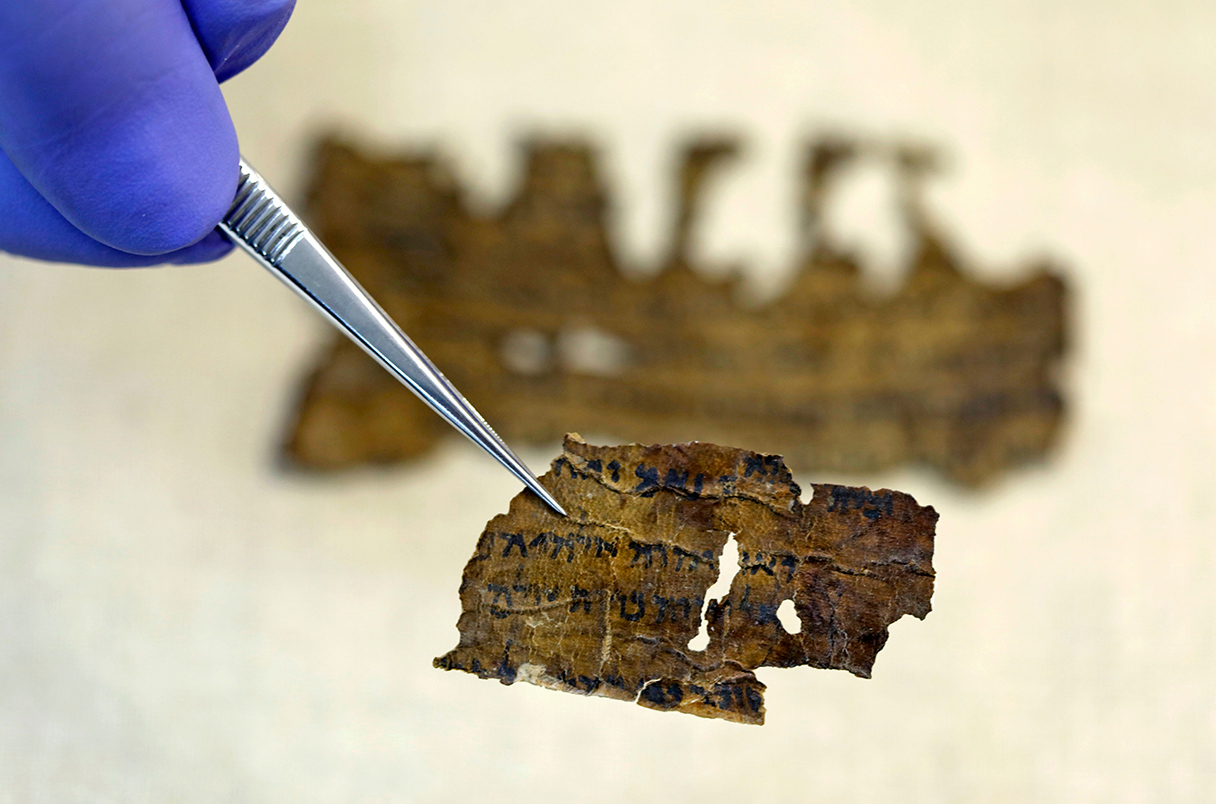
Since the discovery of the Dead Sea Scrolls some 8 decades ago, researchers have relied on the vast trove of Hebrew and Aramaic writings to tease out how Jewish communities lived more than 2000 years ago. Combined, the thousands of scraps of parchment and animal skin contain everything from some of the oldest known books of the Hebrew Bible to laws that governed the communities during centuries of turmoil.
But as informative as these fragments are—some contain a few lines of text on a brittle scrap the size of a thumbnail, preserved and protected for millennia in the desert caves of what is now the West Bank—most of the scrolls lack something important: timestamps that securely confirm their age, such as mentions of a particular monarch’s reign. So for decades, researchers have relied on handwriting style and radiocarbon dating. Now, scientists have harnessed artificial intelligence (AI) to create a new way to date the scrolls, revealing that some may be up to a century older than previously thought.
The new technique, announced today in PLOS ONE, uses machine learning, an algorithmic approach that teaches computers to “read” the Dead Sea Scrolls, to cross-reference two kinds of data: carbon-14 dates from a selection of scrolls, as well as geometric data on the fragments’ words and letterforms. About 80% of the time, the resulting AI model—called Enoch, after the Hebrew prophet and early scientist—came up with median age estimates earlier than those of human paleographers, scholars who decipher and interpret the properties of ancient texts. These discrepancies may make scholars re-evaluate how ideas and literacy spread across the ancient Near East.
SIGN UP FOR THE AWARD-WINNING SCIENCEADVISER NEWSLETTER
The latest news, commentary, and research, free to your inbox daily
But Enoch won’t put human paleographers out of business anytime soon, says the study’s lead study author, Mladen Popović, head of the Qumran Institute at the University of Groningen. “AI needs human beings, especially in its development,” he says. “It’s a tool like the microscope is a tool for a biologist.”
By itself, the use of machine learning in analyzing ancient texts is nothing new. In 2021, Popović and his colleagues used machine learning to show the Great Isaiah Scroll—among the largest and best preserved Dead Sea Scrolls—was the product of two scribes working together, rather than a single scribe’s handwriting. More recently, carbonized scrolls from the Roman town Herculaneum have been digitally “unwrapped” to reveal 2000-year-old Latin poems and philosophical treatises.
Popović and his colleagues sought to extend these techniques to dating the Dead Sea Scrolls. They hoped the fragments’ algorithmically tuned dates could shed further light on their creators, who lived in and around Jerusalem between the fourth century B.C.E. and the second century C.E.—a place and time of enormous turmoil. In 332 B.C.E., Alexander the Great brought the area under pagan control. Less than 2 centuries later, in 160 B.C.E., the Greek state descended from Alexander’s conquest faced a Jewish rebellion now known as the Maccabee uprising. In 70 C.E., another 2 centuries later, Roman forces laid siege to Jerusalem and destroyed the Jewish temple for a second time.
“Because none of the scrolls really have dates, we’re just kind of left to fill in the gaps,” says Drew Longacre, a research associate at the Duke Divinity School who also wasn’t associated with the study. “We kind of create this story, this picture—this metanarrative—about how the script works.”
According to previous paleographic analyses of the Dead Sea Scrolls, many of the fragments’ particular script styles mapped to different periods within this fractious political history. The “Hasmonean” script used on some Aramaic fragments, named for the Jewish Hasmonean dynasty, was thought to span roughly 100 B.C.E. to the first century C.E. The later “Herodian” Hebrew script, by contrast, was standardized by the time of Herod, the notorious Roman ruler who reigned over Judea at the time of Jesus Christ’s birth.
The Enoch AI model sees things differently. The new study finds the transition between Hasmonean and Herodian script is a bit messier than previously thought, with “Herodian” scripts that predate the existence of King Herod by as much as 50 years.
However, Enoch also delivers a vindication of old-school paleography, in the form of new dates for scroll 4Q114, which contains three chapters of the Book of Daniel. According to paleographer Christopher Rollston, a professor of Northwest Semitic languages and literatures at George Washington University, paleographers had placed 4Q114’s creation around 165 B.C.E. because the scroll describes events that place it around the Maccabee uprising, including the desecration of the temple in Jerusalem. Enoch predicts a range between 230–160 B.C.E., within Rollston’s estimates.
Rollston adds that the study’s results come as little surprise. “Initially, [the study] sort of seemed to criticize paleography as entirely subjective, you know?” he says. “Nonpaleographers will often do that … and I’ll sometimes remind them that what I do with scripts, they do with pots.”
Researchers not affiliated with the work say that whether the scroll analysis is done by humans or AI, handwriting alone can only date a document so precisely. Longacre, for one, says paleography isn’t well-suited in general for high-precision dating, especially when there’s not a lot of well-labeled data. And Rollston emphasizes that new AI techniques like Enoch can be useful tools—but they should never be the only tools a scholar uses to understand the writing of a manuscript.
“After all,” he says, “human handwriting—and all of its variations and idiosyncratic features—is a deeply human thing.”
Correction, 5 June, 11:30 a.m.: An earlier version of this article misstated how many of the Enoch model’s median age estimates were older than paleographers’ median age estimates.
Get Science’s award-winning newsletter with the latest news, commentary, and research, free to your inbox daily.