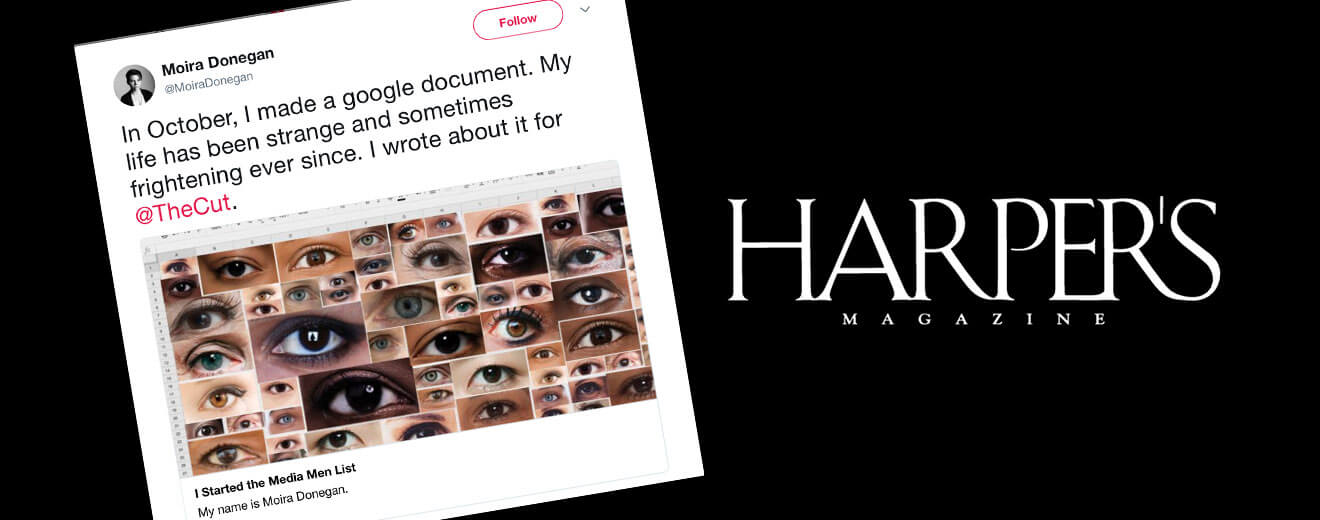
Today’s cultural conversation around gender and power, turbocharged ever since allegations of sexual assault and harassment took down Harvey Weinstein, has been a long time coming. The #MeToo movement, pioneered by Tarana Burke, grew into a juggernaut on social media, a communal reckoning that both demanded men be held accountable for their actions, and invited women to share their stories of being sexually harassed and assaulted. For women in journalism, the Shitty Media Men list, created and shared anonymously, was a place to name names, to out the senior editor known for drunkenly groping new hires, to warn about the staff writer who liked to follow women home from parties and press himself against them.
Women sought, and many received, catharsis and satisfaction from sharing their own stories and hearing others. Like any radical cure, talking about sexism in this way was painful but ultimately empowering. We learned that secrets shared, often for the first time, forge solidarity. As women in the 1970s said, sisterhood is powerful. But if you’ve ever watched Mean Girls, read Little Women, or attended a sixth-grade sleepover, you also know that sisters can turn on one another, and that solidarity can be elusive, even treacherous.
When news broke this week that Harper’s magazine was preparing to publish an article (reportedly a cover story) that would identify the woman who created the Shitty Media Men list, women reacted with outrage. Warning that doxxing the list’s creator would cause her long-term harassment, threats, and possible physical or economic harm, writer Nicole Cliffe announced on Twitter that she would pay writers with articles slated for Harper’s to pull them from the magazine in protest, and DAME publisher Jennifer Reitman offered pay and a place to publish—a real moment of feminist solidarity that was quickly overtaken by the news that the piece’s author was also a woman, Katie Roiphe. Best known for her book The Morning After: Sex, Fear and Feminism on Campus, which painted anti-rape activism as overwrought political correctness and claimed that “the line between fact and fiction is a delicate one when it comes to survivor stories.” Book, magazine, and especially New York Times editors ate it up (for more on what she called “the selling of Katie Roiphe,” read Jennifer Gonnerman’s excellent Baffler article of the same name).
This morning, New York’s The Cut ran a brilliant essay by Moira Donegan in which she outed herself as the creator of the Shitty Media Men list. The risks in voluntarily renouncing her anonymity were less, she wisely figured, than what she might face if the Roiphe article did it for her. Or to her.
Every contribution we get from readers like you allows us to keep reporting and keeps our content free and accessible for everyone. Our reporting digs deep into the important policies, issues, and cultural trends that matter most in these unprecedented times. Join now to help fund this important work.
Like most media stories these days, the whole thing has moved at the speed of light. Twitter, for those of us who follow a lot of women in journalism, was blindingly hot. Writers like Heidi Moore tweeted threads about why Donegan’s list was so important, and why outing her would do serious harm. And they called into question Roiphe’s own motives.
“I hope what’s happened to Roiphe’s story serves as a good example to women who think they can make money by selling out other women,” Moore wrote. “If you are willing to destroy another woman’s career because a dude thinks it’s a good idea and will pay you to do it, dragging will occur.” Lyz Lenz wrote a blistering takedown on The Rumpus, titled “Come for Me, Katie Roiphe.”
It all took me back a couple of years, to when a group of women founded Binders, a community of women writers on Facebook (named for then-presidential candidate Mitt Romney’s bizarre promise during a debate that he had “binders full of women” to hire). Despite the group’s secret identity on Facebook, and rules against posting anything about it, much less from it, Emily Greenhouse joined Binders, then wrote breezily about it for Vogue. She even praised it as “a seed of solidarity,” which is strange coming from the same person who has breached the group’s terms.
There’s a scene in the movie Quiz Show in which Dick Goodwin’s wife berates him for favoring Mark Van Doren, a cheating WASP, over the Jewish Herb Stempel, and calls him “the Uncle Tom of the Jews.” I’ve been thinking about that line a lot lately, because it’s hard not to see Roiphe and Greenhouse in similar terms. What does it say about solidarity among members of an often-marginalized group when one of its own betrays it?
Solidarity among women has always been fraught, of course, as Mikki Kendall amply detailed in her Twitter hashtag #solidarityisforwhitewomen. We are divided by race and class, by politics and generation, by marital and maternal status. White women, a subgroup of which I am a part, have been notoriously missing in action when women of color have sought our solidarity. Too often, we have co-opted rather than cooperated, lectured rather than listened. Then, too, in a world still dominated by male power, there’s always the allure of being the cool girl who sells out the other girls to curry favor with the guys.
Part of the problem with the Harper’s and Vogue articles lies in a diffuse media landscape in which more and more writers compete for a shrinking pot of money and attention. For a woman journalist, knowing you can get a story your male colleague can’t—whether it’s about the Shitty Media Men list or the Binders Facebook group—might seem like an irresistible temptation. There’s a push-pull between the demands of loyalty to the sisterhood and the need to hustle after every possible clickbait article.
Some women—and more than a few men—took to social media to defend the Harper’s article. Why not name the list’s creator, they asked, since the list itself named names? Aren’t complaints about doxxing overblown? “We find it disturbing that voices from the bog are criticizing and issuing threats over a piece that they have not yet read and is not even finalized,” a representative from Harper’s told the media magazine The Folio. “We look forward to talking about what is and is not in the piece when it is published.”
These criticisms are easily dismissed. Not every legitimate story about a whistleblower requires exposing the individual. The list itself was created anonymously to protect those who could not afford to go public with their accusations, but who had hoped to protect others from the same dangers they’d encountered. And it bears noting that the danger of doxxing, which is abundantly clear to digital natives, is often downplayed or downright ignored by an older generation.
Still, the entire story circles back, for me, to the idea of sisterhood. What do women owe each other? Is solidarity a false promise? Are we held back by loyalty to an ideal that is more like a trap, or is sisterhood the only safe harbor in a dangerous world?
Here’s all I know: Back in those sixth-grade sleepovers, when a few other girls broke my heart by talking about the various defects in how I looked (flat chest, big forehead, glasses), my other friends had my back. They had defects, too, and besides, we all shared the same basic liability: We were girls in a world in which women weren’t treated fairly. I didn’t need to read research on sexism to see it play out all around me (but I also read the research).
Being a woman in today’s world is better in some ways than it was in the 1970s, but most of the battles we still fight are dismally familiar. I don’t believe in an essentialist view of the differences between men and women, but I do think most of us who grew up female are socialized to make connections, to value the group as much as the individual. And that, I think, is what we can use now as our strength. It’s all too easy to take down another woman—it makes your male editor happy, it satisfied the current appetite for contrarian takes, it offers a bracing sense of independence and neutrality. But it’s a sham.
Let’s not fight each other. Let’s fight for each other. The only way to beat the old boys’ network is to form our own network, one that links all kinds of women. One of the most powerful lessons I’ve taken from this entire drama has been that women are extraordinary when we help each other, and that the whip-smart tweeting, reportage, and editorial writing by women angered by Roiphe’s actions has been a thing of beauty. A solidarity of inclusion, a sisterhood that is truly powerful, is still our best weapon to take down all the shitty men the world puts in our way.
We urgently need your help!
Covid-19 has dramatically impacted our ability to keep publishing. DAME is 100% reader funded and without additional support, we can’t keep publishing. Become a member at DAME today to help us continue reporting and shining a light on the stories that need to be told, from perspectives that aren’t heard enough. Every dollar we receive from readers goes directly into funding our journalism. Please become a member today!
(If you liked this article and just want to make a one-time donation, you can do that here)

Dear Black People,
These are defiantly ignorant times we’re living in, to say the least.
In the first few days of 2018, we saw H&M reach into that old trove of racist stereotypes to market a Black child as a the “cutest monkey in the jungle.” The president called Africa and other countries of color “shitholes”—and his GOP enablers like Senators Cotton and Perdue denied hearing it, even when there were witnesses on both sides of the aisles. And on the heels of that vulgarity, the conservative writer Shelby Steele once again tap-danced for his massa, Rupert Murdoch, by declaring in a Wall Street Journal piece that racism is now “recognized as a scourge, as the crowning immorality of our age and our history.”
America has become a nation led by a demented, corrupt, aggressively mediocre, nihilistic bigot-in-chief—a self-proclaimed “stable genius” who is neither of those two things. Trump has created a culture so debased that anyone can spew hateful attacks with no fear of reprisal. The moral universe has been inverted. People can lie without consequence. Nothing is sacred. And in these worst of times and this age of foolishness, Black people are chronically being called upon to baptize White folks, save the country, clean up the mess White people have made, and usher them into civility while guarding our own precarious lives against the snares of white supremacy.
Every contribution we get from readers like you allows us to keep reporting and keeps our content free and accessible for everyone. Our reporting digs deep into the important policies, issues, and cultural trends that matter most in these unprecedented times. Join now to help fund this important work.
We’re being pleaded with to vote for candidates who may offer nothing more than not being fascist pedophiles and pussy grabbers, or to explain racism and white supremacy for the billionth time to White people on both sides of the political spectrum. Or to be magical Negroes, as Reese Witherspoon portrayed Oprah Winfrey in her introduction to her during the Golden Globes, when she said her “hugs can end wars.”
Oprah thankfully erased all memories of that in her much talked-about speech on the heels of receiving the Cecil B. DeMille Award, the first Black woman to do so. Oprah recounted her childhood memories of beholding the sight of Sidney Poitier being the first Black man to win a Golden Globe, of the horrors endured by the late Recy Taylor who was gang-raped by six White men who were never so much as indicted. She talked explicitly and expressly about being a Black woman, of sexual assault, of being a role model to young Black girls. And so the internet decided she was running for president in 2020, and continues to debate a week later about whether she could and should run, whether she’d be good for America.
Did folks not listen to what she was actually talking about?
Why are we pinning this responsibility on Oprah? Do we want an actual Black woman billionaire to clean up after that slovenly fake-billionaire orange menace? Remember when she portrayed Sophia, who had been battered and broken after being forced to serve as Ms. Millie’s maid for years, in The Color Purple? Well, we saw what happened the last time she worked in a white house, so I’m not too keen on Oprah running for POTUS in 2020.
Jokes aside, one of the dangers of racism is when Black people naively believe that taking on the burden of cleaning up after and educating white folks about racism will lead to systemic change. It is an emotional soul-killing trap. White people who claim that they “don’t get it” are actually engaging in a devious ruse of willful ignorance. Why should they get it? We have to understand that the people who say they don’t get it might not be the KKK or the David Dukes or Donald Trumps or Richard Spencers or Ann Coulters of the world. But don’t get it twisted: They are the tillers of this racist ecosystem. An oppressive system does not require malice. It requires routine behavior, tunnel vision, and cognitive dissonance.
This cognitive dissonance reminds me of the rise of the Third Reich, the insidious way it became systemic and citizens became complicit. Today’s American fascists are far less educated than the fascists of the Third Reich, and they’re proud of their ignorance—they’re defiantly stupid and mediocre and resentful of hard working educated people of color, immigrants, and women. And that defiant ignorance has gotten into the American bloodstream. Even among the educated and the liberal white people, who are determinedly blind to their own racism and committed to ignorance so they can deny their role in perpetuating the larger system of white supremacy, which they have been socialized to do.
So when White people keep demanding examples of racism, or come to Black people asking that they show them how to be better, they don’t have to look that far, and they know it, now more than ever.
We live in a society where Attorney General Sessions has declared war on marijuana, which is his way of putting more people of color in prison, where we have a craven Massa-in-chief who has a wannabe Josef Goebbels as his communications director (ol’ dead eyes Stephen Miller), where even liberals are fighting over whether Oprah should run for president because she delivered an incredible speech about women and sexual assault, where our Democratic party is wholly dependent on Black voters to get to the polls (facing voter suppression, intimidation and gerrymandering) and pull the lever for candidates that may only be marginally better than their GOP opponents simply for the fact that they’re not racist sexual predators like Roy Moore.
Listen, it is time for Black people to stop edifying White America on racism and white supremacy. White people’s determined failure to recognize systemic racism, the continuum of racism, and their refusal to reckon with themselves and once again put it on Black people (not unlike men who demand women explain misogyny, only to mansplain it back to us, etc.) is exhausting. Even the act of writing this piece, even as it is addressed to Black readers, feels like a drain, that I even have to say it, ask it of people—but it’s never been more necessary.
As the writer Shannon Houston recently suggested in her Paste piece, we need to cease the emotional, intellectual, and spiritually draining reflex of creating a bibliography of books, blogs, articles or anything else that might finally convince them of our humanity; to end all expectations that White women will prioritize gender solidarity even at the expense of cashing in on the privileges of whiteness; to never again patiently explain for the umpty-leventh time why they “cannot say the N-word,” even in song lyrics; to stop consciously stepping out of their way in public spaces as to avoid conflict or white discomfort; and to break the addiction to forgiving their racist deeds.
It’s time for us to let go of the notion that fails us time after time—that we can persuade them to change by educating them into civility and justice. That if we can clear up their misunderstandings about our culture then they’ll treat us justly and they’ll magically stop doing what they’ve always done. We need to emotionally divest from them and instead, talk with each other, among ourselves, about the ugly truths of racism, and work together toward viable solutions.
For 500 years, across multiple generations, we have let White people bamboozle us into thinking that they don’t understand racism, white privilege, or white supremacy. They know and still keep cashing in on a system that empowers them. Racism is their creation. They planned, designed, constructed and keep evolving it to the current social, economic, political and psychological needs of the moment. They devote their entire lives and the bulk of their resources to maintaining these structures of inequity and injustice against People of Color in general and Black people in particular. What kind of sense does it make to think they don’t understand how it works?
Do we really believe that the millions of Africans who survived the Middle Passage were under the illusion that their captors just didn’t know what they were doing? Do we really believe that our enslaved ancestors were under the illusion that plantation owners just needed to better understand racism so that they would stop raping, brutalizing, and breaking up Black families for profit? Do we really believe that segregationists and the KKK just needed a diversity seminar to change their ways? Do we really believe that the first 43 out of 45 presidents actively sustained institutionalized racism as an oversight?
We are told over and over again that the root cause of racism is White ignorance. That if they just had it explained properly, if they could only be made to truly understand the harm they are causing, they would wake up and stop doing it. But racism is not born out of ignorance. As a friend of mine recently reminded me, it is grounded on centuries of meticulous indulgence, practice, research, action, and premeditated intent.
One core pillar to racist propaganda is the unquestioned belief, presented as scientific fact, that White people are intellectually superior to Black people. We have everything from eugenics, IQ measures to standardized testing throughout school, to SAT and ACT tests to determine college eligibility, to measuring and X-raying people’s brains. All of these are designed to maintain their position as intellectually superior.
The logical question is: How can you be intellectually superior and ignorant of your behavior at the same time? How can you be smarter than everyone else except in the one area where you are set up to win at everyone else’s expense? You can’t take credit for inventing mathematics, science, astronomy, language and white Jesus, and not understand the basic physics of racism. You can’t play wide-eyed and slack-jawed dumb when it comes to the dynamic that makes you and your world tick. That’s like a casino owner who fixes all the games in his favor claiming not to understand why the house always wins.
Generations of Black historians and scholars believe that if they dig up the RIGHT historical facts and present them compellingly enough, it will make a difference. If we show them Emmett Till’s disfigured face. If we dig up the numbers of lynching victims. If we write in exhaustive detail about the intersections between capitalism and the rise of the prison industry and how it disproportionately ensnares Black and Brown people. If we show them the data. If we show them the cell phone footage of our deaths, then they’ll believe. Our words, and truths have not convinced White America of our humanity, much less compelled collective action in the name of justice for us. But Black studies has existed for half a century, and White people have dissed it at every turn—scores of Black scholars who have dedicated their lives to producing credible evidence of racism, only to be discredited and devalued and pushed aside. Do we need 500 more years of racial fuckery before we finally get this truth?
There is not a single thing that White people do not understand about racism and white supremacy except the thing that we are addicted to believing we can somehow magically make them see: Our humanity and the suffering caused by living in a racist society. And if White people can pretend that they “don’t see race” or color, they can also pretend not to see racism. Not to see their own privilege, power, or culpability in maintaining an entire system built upon inequality. This game they play is a form of cognitive dissonance that they use to protect racial privilege and reproduce racism in dialogues about race. By faking ignorance, they don’t have to take responsibility for the things they do. By claiming naïveté, they absolve themselves of racist sins so they can turn around and sin again.
Face it: History reveals that change, justice, wasn’t a result of White America finally seeing the light. Slavery wasn’t eradicated because White people woke up and saw that it was wrong. Jim Crow wasn’t dismantled because White people recognized its inherent evil. These institutions did not self-destruct, they shape-shifted into police brutality and the prison pipeline. Into inherently unequal schools and neighborhoods. Into urban gentrification and displacement of generations of African Americans who devoted their lives to getting a few crumbs of the cake labeled “American Dream.”
They can’t divorce individual racism from the system that enables it to grow and thrive. White supremacy is furtive. Racism isn’t sustained by fringe groups or headline-grabbing acts of racial extremism. It happens behind desks. It happens in the policy that creates the laws that run every single institution in this country. It happens in meetings. It happens in paper-pushing. It happens in stores of all kinds. It happens in playgrounds. It happens on street corners.
And when they DO admit it, when they DO claim awareness of racist history, they smugly suggest that we “just let it go and get over it already. Slavery is over. Jim Crow is dead. We had a Black president, for God’s sake. Move on!” We can choose to invest our time and energy to engage them in conversation about this, to try to persuade them that we’re right and they’re wrong, but I don’t recommend that. I say we acknowledge their games, their passive-aggressive tactics, and refuse to engage any more. DIVEST!
Centuries of respectability politics haven’t helped us much at all, have they? We’ve been programmed to believe that if we just talk “proper,” display flawless manners and a sense of etiquette, maintain a calm demeanor no matter what, dress nicely, pull up our pants, straighten our hair, be better fathers, or disprove the stereotypes they feed upon, that we have the power to make things better. But we’ve seen that disproven too.
We are in the words of Maxine Waters, reclaiming our time in the fight against racism. We’re not accepting their claims of ignorance. We’re not accepting responsibility for educating them or blame for being on the receiving end of racist aggression and oppression. We cannot waste another generation of blood, sweat and tears, killing ourselves to be accepted.
I’m not suggesting that Black people should stop talking about and working to fight racism or that we should stop uncovering our history. We should never stop telling our truths or learning from history to create new paths on our march toward justice. But we have to change our focus and our mission. We should stop centering on White people. It’s White folks’ turn to do the work within their own community. The research, histories, and truths exist. From Google to Netflix, from the public library to any number of bookstores, from Tim Wise and Jane Elliot to the White Nonsense Roundup, to Siri and Alexa the truths about white supremacy, white privilege, and “the faces at the bottom of the well” are well within White people’s reach. They must find that knowledge, converse among themselves, and join with white anti-racist organizations and activists to be accomplices in the struggle for justice. Our time and attention should be spent elsewhere.
The day that Black folks stop making excuses for White people’s racism will be the first step toward emotional emancipation and the tyranny needed to destroy this system.
We urgently need your help!
Covid-19 has dramatically impacted our ability to keep publishing. DAME is 100% reader funded and without additional support, we can’t keep publishing. Become a member at DAME today to help us continue reporting and shining a light on the stories that need to be told, from perspectives that aren’t heard enough. Every dollar we receive from readers goes directly into funding our journalism. Please become a member today!
(If you liked this article and just want to make a one-time donation, you can do that here)