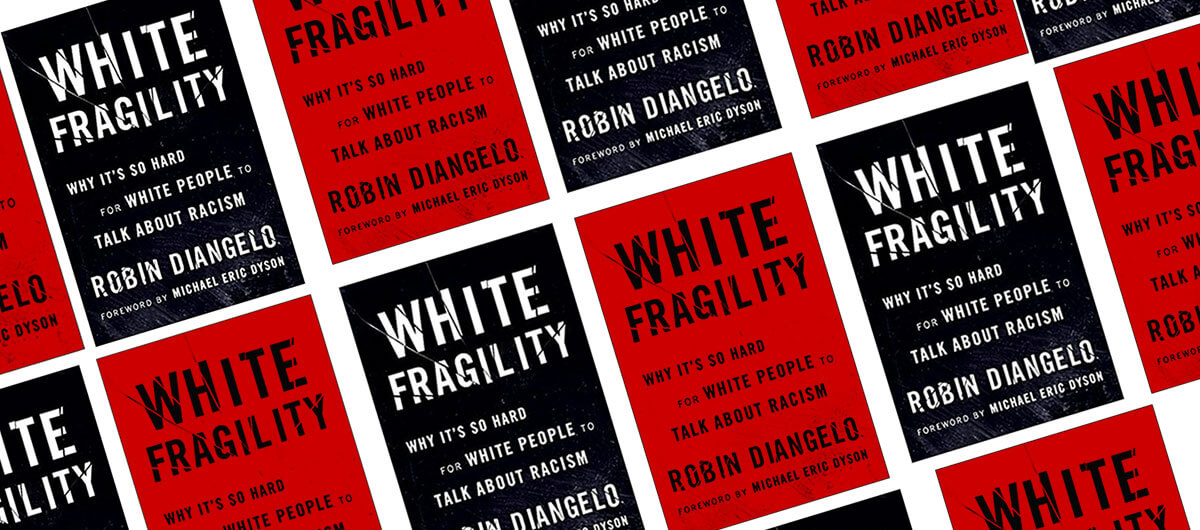
In her 20 years’ training and educating diverse groups of people on the issues of race and social justice, Robin DiAngelo has seen it all: denial, defensiveness, and rivers of white tears. For Parlour, I spoke with DiAngelo about her new book, White Fragility: Why It’s So Hard for White People to Talk About Racism, and how well-meaning white parents are among the most invested in pretending not to understand racism.
Kate Tuttle: The title of your book is White Fragility, which on its own can result in white people feeling defensive. Why do you think it’s so important for even well-meaning white people to confront our own complicity in a racist society?
Robin DiAngelo: Because I actually think that very well-meaning white people cause the most daily harm to people of color and reproduce a society in which racism continues. And that is because well-meaning white people basically don’t see themselves as complicit in any way in racism. We don’t tend to understand it as a system. We’re operating from that classic mainstream definition: individual, conscious, intent. Racist is always an individual, not a system, who consciously doesn’t like people based on race. My point here is that most bias is not conscious, but drives our behaviors nonetheless. And then, of course, you have to mean to do it—and if you don’t mean to do it, it doesn’t count. That definition exempts virtually all white people from the system that we’re in, and that we participate in, and that we reproduce. And so, because well-intentioned white people’s identities are so deeply rooted in not being racist, ironically, we are completely unreceptive to feedback that intentionally or not, we have just perpetrated racism.
Tuttle: How do you think white people can be less defensive, and be more open, brave, humble—what are the attitudes and the things we can do to be better?
Every contribution we get from readers like you allows us to keep reporting and keeps our content free and accessible for everyone. Our reporting digs deep into the important policies, issues, and cultural trends that matter most in these unprecedented times. Join now to help fund this important work.
DiAngelo: Our discomfort is not benign: It protects our position. Can you think of any other social problem where we think that the best strategy is never to talk about it? We have to fundamentally change our paradigm. We have to change what we understand racism is. I start from the premise that, as a result of literally swimming in racist water—living, breathing, working, playing, loving, in a society in which white supremacy and racism are the bedrock—I’ve internalized a racist worldview. I have racist biases. I have developed racist patterns as a result. And I have investments in the system of racism, because it’s very comfortable and it has definitely helped me with the barriers that I do face. And I also have investments in not seeing any of that, for what it would suggest about my identity, and for what it would actually require of me. Once I accept that all of that conditioning, and resultant behaviors and investments, is inevitable, I can stop defending, deflecting, denying, taking umbrage—and get to work trying to identify what does it look like specifically in my life and my relationships. The fact of it doesn’t make me guilty: it’s what I do with that fact.
Tuttle: What do you do to challenge those biases and patterns you were socialized into?
DiAngelo: I’m not going to be free of that conditioning in my lifetime. But what I strive for is to be a little less oppressive, a little less arrogant, a little less ignorant, a little more humble. There are two top questions I get when I give a presentation and one is, what do I do? And I ask back, well how have you managed to be a full functioning educated professional adult and parent, and not know about racism? Why, in 2018, would that be your question? It’s meant to push back on this narrative of innocence, which I do not buy. I think it’s a willful not-knowing, in many ways a refusal to know. For a lot of white people, merely taking the initiative to look it up as you would anything you were interested in, that is a huge breakthrough.
Tuttle: How do you think white parents ought to be interrogating ourselves? How can we work to be more actively anti-racist?
DiAngelo: White middle-class and upper-class parents are a primary barrier to equality in education. I’m just going to say, most white parents don’t want equality for all children; they want the best for their children. And if it means someone else has less, then their child doesn’t have to compete with them. I don’t think most white parents actually care about racial equality. So we have the most superficial approach: Let’s just tell our children to be nice to everybody. That’s the second top question I get from white people: How do I raise my children? Well, start with yourself. I think that white parents have to take a very deep hard and honest look inside themselves about how much they care about racial equity and what they’re going to do about it. What I see is a kind of consumer model: I want some of that, in the right doses, for my children. Everyone wants their child to go to the Silicon Valley Montessori with international classmates. But what white parents do not want is them going to a school that has African-Americans or Latino children in any significant number.
Tuttle: How do you think white parents can or should confront other white parents, challenge them to help them shift their mind-set?
DiAngelo: I think breaking with white solidarity is part of it. Be brave. You can do it by sharing your own experience, point the finger inward and not outward. I think about it as more for me than for the other person, that it’s healthy for me to break with white solidarity. I hope the other person shifts, but I want to live in my integrity.
We urgently need your help!
Covid-19 has dramatically impacted our ability to keep publishing. DAME is 100% reader funded and without additional support, we can’t keep publishing. Become a member at DAME today to help us continue reporting and shining a light on the stories that need to be told, from perspectives that aren’t heard enough. Every dollar we receive from readers goes directly into funding our journalism. Please become a member today!
(If you liked this article and just want to make a one-time donation, you can do that here)


I don’t usually pay attention to Fox & Friends, Trump’s favorite TV show, but something co-host Brian Kilmeade said back in June has stuck with me. When talking about the children being detained in literal cages, often separated from their parents—some of them likely lost forever and vulnerable to predatory adoption, as detailed in this harrowing article by Christopher Stroop—Kilmeade admitted that images of crying toddlers behind bars were difficult to look at. But, he quickly added, “like it or not, these aren’t our kids. Show them compassion, but it’s not like he’s doing this to the people of Idaho or Texas. These are people from another country.”
What do Kilmeade, and those who think like him, mean when they say these are “not our kids”? I’d especially like to ask those commentators who like to describe themselves as Christian what they think “our” means in this context. I understand these children aren’t mine in the sense that I have any say in their lives. I know they belong with their parents, siblings, grandparents who love them. But to declare them irrevocably not ours—there’s an ugliness, a lack of soul in the refusal to see in these children the same claims to humanity we see in our own. We’re just going to keep perpetuating harm until and unless we understand one simple truth: They are all our children.
As a white person, I know this is a difficult concept for many of my fellow white people.
This has been a year filled with white women, in particular, threatening or causing damage to Black children. From BBQ Becky to Permit Patty and Cornerstore Caroline, white women have made the news calling the police on Black kids and families for doing, well, just about anything. Given the terrifying record of police interactions with Black people, we know that any unnecessary call is not only ridiculous but potentially lethal.
Every contribution we get from readers like you allows us to keep reporting and keeps our content free and accessible for everyone. Our reporting digs deep into the important policies, issues, and cultural trends that matter most in these unprecedented times. Join now to help fund this important work.
I’m a white mother of a Black son, and I’ve chatted with fellow white moms who could easily be the ones calling the cops on my child as he progresses into adolescence and manhood. After all, when I’m out in the world solo, without my Black husband or son in tow, I hear enough casual, genteel racism to feel like a spy behind enemy lines. I’ve seen ample evidence that “not our kids” isn’t just a mindset found on Fox News. Sometimes white parents will smile and coo over black and brown kids when they’re young, but grow colder as the kids grow older. Sometimes the racism is coded in talk of “good schools” and “sketchy neighborhoods.” Not our kids.
Sometimes it’s nonverbal, like when a fellow white mom catches my eye, then looks meaningfully at the visiting team’s cheerleaders, who are Black and whose cheers are louder and whose dances are more intense than the white home team’s. She’s inviting me to join her in judging them. Not our kids.
Sometimes it’s even aimed at my child, who the guy sitting next to me at the basketball game didn’t realize is mine. “There he goes again,” my white fellow parent grumbled when my son took an ill-advised shot and misses. “They always hog the ball.” Not our kids.
I didn’t confront him. I just put on my headphones and tuned him out. Next game, I sat closer by the Black parents. I noticed they cheered for all the kids.
In Robin DiAngelo’s White Fragility: Why It’s So Hard for White People to Talk About Racism, she writes that white people need to confront our own biases. Even those of us who feel like we’re fairly racially sophisticated have them; they’re part of the societal DNA, baked into the cultural cake. Part of white people’s often furious denial and defensiveness around race and racism comes from our need to protect our claims of innocence. We can’t be racist, we cry, because we don’t even see race! We post on Facebook about diversity! We vote the right way. Is our school nearly all-white? We didn’t even notice.
White naïveté by itself is mostly ridiculous, but it’s dangerous when it masks and protects white indifference, white violence. This is what I need to protect my son from, and I can’t do that until I take an honest look at my own racist impulses. Here’s one: I used to cringe at how loudly Black families cheer for their children on graduation day. I never saw my reaction as any kind of racial bias—I thought it was a personal preference for understatement. I didn’t know, until I had my son, what the cheering was really for. I hadn’t felt the years of muttered insults, lowered expectations, distrustful teachers, dismal political landscape, terrifying political justice system—all the component parts of a message from white America to black and brown people that these are “not our kids.” Until I experienced life as the parent of a Black child, I hadn’t understood how necessary that cheering truly is. The great poet Lucille Clifton invited her readers to “come celebrate with me that every day something has tried to kill me and has failed.” Black parents cheer because their kids—our kids—have survived in a society that would as soon kill them as claim them.
So miss me with any definition of who “our kids” are. I’m an imperfect parent and god knows I’m still learning every day. But one day those kids—all of them—are going to be the workers and the voters and the people who take care of us. They are the parents of our grandchildren. They are ours. They are us.

“I have never known a female dining critic,” a reader wrote to me in an email. “Male critics could alway [sic] eat alone. Can you do the same? Dining out is a couples thing and it seems strange that the girl pulls out her own credit card.”
There was a lot to roll my eyes at here. Raised on Free to Be You and Me in the 1970s, I never once thought there was anything special about dining by myself as a woman. Of course, I have experienced sexism and the grip of the patriarchy—never more flagrantly than in the past two years, when our regressive administration has given the nation a blank check on misogyny—but I was raised to expect growing equality and progress, an expectation that has turned out to be naïve.
Women in the U.S. have been able to get our own credit cards since 1974, two years after my birth. That is at once a very long time and not very long at all. I do frequently pay with my own credit card, which has my name on it—the only name I’ve ever had, since I was uninterested in changing my surname upon marriage. And there have surely been hundreds of female dining critics, including my immediate predecessor at The Sacramento Bee, where I currently hold the post, not to mention such luminaries as Ruth Reichl, Mimi Sheraton, and Phyllis Richman. Besides, I almost never dine alone as a reviewer; I need to take others with me to taste a range of dishes.
This comment came at the end of an otherwise complimentary message about a restaurant review I’d written, an unapologetic pan of an overpriced downtown steakhouse. In it, I compared the restaurant to the Trump administration. I expected angry letters about that comparison, but I didn’t get any. What I didn’t expect was a response that would question my literal and figurative place at the table.
Every contribution we get from readers like you allows us to keep reporting and keeps our content free and accessible for everyone. Our reporting digs deep into the important policies, issues, and cultural trends that matter most in these unprecedented times. Join now to help fund this important work.
Women alone in public spaces have always been a vexed, threatening issue—though putting the question as an “issue” assumes a male point of view and a sidelining of women as fully equal humans, much as Virginia Woolf points out about her British Museum search for viewpoints on “women and fiction” in A Room of One’s Own. For such male thinkers, Woolf writes, “women have served all these centuries as looking-glasses possessing the magic and delicious power of reflecting the figure of man at twice its natural size. Without that power probably the earth would still be swamp and jungle.”
Such a fundamentally masculine viewpoint assumes the protection of men is a default for we ladies. To put it a different way, shifting it to my own point of view, we women have long been vexed and threatened for daring to be by ourselves, to claim solitude, to free ourselves from chaperonage and being part of “a couples thing,” as my correspondent would have it.
What does it mean to be a woman alone, both in the past (where my correspondent would seem to live) and now? In the recent past, the phrase “a woman alone” calls up one indelible image for me: the unutterably brave and solitary figure of Christine Blasey Ford, gathering her breath and courage as she stood, a sentinel for truth, in front of a panel of powerful men who doubted her and less powerful women who assured her she wasn’t alone. But in that crucial moment, she was. She endured her assault alone, more than three decades ago, while even her assaulter was with a friend, laughing at her expense. She spoke out for justice alone when she came forward, and she testified alone, treated as the one who was on trial rather than as the victim.
Women alone are always simultaneously both threatening and threatened, a strange paradox for those of us who like our solitude and feel comfortable—mostly—running, walking, going to the movies, or dining by ourselves. The idea that women—above a certain class, anyway—might be alone in public as a matter, of course, is a relatively recent one in western culture. Chaperones were de rigueur to protect the womanhood of the middle classes and up before the First World War. (Factory girls and working-class women, of course, were not considered virtuous enough to need protecting, which tells you something about how important the capitalistic element has always been to the big complex of patriarchal capitalism.)
In the early 19th century, Anglophone cultures, both British and American, considered it a scandal for even a married woman, accompanied by her spouse, simply to be in a restaurant, which was at that time mostly a dubious (if fashionable) invention of the always-suspect French. One British visitor “was certain that it was because French women had none of British womanhood’s ‘delicacy, decency, and modesty,’ that they so brazenly dined in public,” writes Rebecca Spang in The Invention of the Restaurant. And forget about pulling out a credit card, or the 19th-century equivalent: Women did not have basic property rights in Britain or America until late in the century.
Spang argues that seeing women in restaurants confirmed for Anglophone travelers what they already suspected: “domesticity was unknown in France.” In the 19th century, strict lines between public and private spheres held, at least in Britain and America, though of course there must have been times when women found time and space to be by themselves.
Those lines blurred more rapidly in the 20th century, as chaperonage fell out of favor and women demanded more independence. Changing mores and, not coincidentally, a severe shortage of men after the carnage of World War I may have spurred on these changes. To return to Virginia Woolf, a sense of the new thrill of aloneness comes through clearly in the opening pages of Mrs. Dalloway, when the lady of the house ventures out—alone—to buy the flowers herself. This act might have had particular resonance as a break with tradition given that in Victorian times flower selling was associated with sex work or at least lack of virtue—an implication that echoes through, for example, Shaw’s Pygmalion (1913) and its musical adaptation My Fair Lady. The idea that a woman by herself might just be seeking (or selling) sex—or, alternatively and yet somehow at the same time, in danger of sexual violence—is key.
Suspicion of what women might be up to, all by themselves, lingered on. The great M.F.K Fisher writes about dining alone in an essay in Serve It Forth (1937) and again in a more personal, intimate piece, “A Is for Dining Alone” in 1949’s An Alphabet for Gourmets. In the earlier essay, she writes of Lucullus and Louis XVI before settling in, rather sweetly, to the story of Biddy, a teenager who takes a tram into town, refusing to tell her mother where, and returns several hours later: “She was vaguer than usual, but seemed to be unharmed.” (Another gesture to the danger of aloneness. Biddy, it turns out, has gone to a Viennese restaurant to eat tarts and drink coffee over a four-hour breakfast, and she is thrilled and slightly defiant about her adventure. “Biddy breakfasted with Biddy, and saw in a mirror clearly, for the first of many times,” Fisher writes.
Fisher’s outlook is a bit more misanthropic in her 1949 piece. Single, she tries a long period of eating at restaurants: “I resolved to establish myself as a well-behaved female at one or two good restaurants, where I could dine alone at a pleasant table with adequate attentions,” she writes. “To my credit, I managed to carry out this resolution, at least to the point where two headwaiters accepted me: they knew I tipped well, they knew I wanted simple but excellent menus, and above all, they knew that I could order and drink, all by myself, an aperitif and a small bottle of wine or a mug of ale, without turning into a maudlin, potential pick-up for the Gentleman at the Bar.” Fisher positions herself here as a threat: by virtue (or vice) of being alone in public, the woman may signal her loose sexuality. But she is also threatened, or at least her solitude is. On the same page, Fisher brings her own experiment with frequent solitary dining out to an end: “In spite of the loyalty of my waiter-friends, wolves in a dozen different kinds of sheep’s clothing—from the normally lecherous to the lesbian—sniffed at the high wall of my isolation.” A woman alone in a restaurant was, and maybe still is, damned if she did want to pick up a man and damned if she didn’t want to be picked up.
When I was asked whether I was able to dine alone, I thought immediately of my paternal grandmother, Marjorie Matthews. Born in 1909 in the small town I later grew up in, as she turned 30 she was (unusually for her time) still single, teaching English at the local high school she’d graduated from and the holder of an M.A. from U.C. Berkeley. In the summer of 1939, she took a solo trip to England from her small California hometown, looking for adventure and literary landmarks. I have her letters home to her mother, of which a frequent theme is assuring her mother that she was meeting up with acquaintances to squire her such places as the World’s Fair in New York. (Her journal is slightly more frank about men trying to pick her up.)
As anyone dazzled by literary culture might have at the time, she stayed at the Algonquin in New York before sailing on to England. She recorded a small cut of sexism, there at the establishment Dorothy Parker had reigned over a few years before, in her diary: “The bar is small and beautifully decorated; ladies can’t sit at the bar proper—I know for I sauntered in and climbed up on a stool only to have the bartender in hushed and shocked tones ask me to remove myself to a table. ‘Young ladies didn’t sit at the bar!’ Had a good Manhattan anyhow—for 50¢.” She seems more offended by the price of the drink than by this one tiny long-forgotten indignity from a vast patriarchal system, but the incident has stuck in my mind all the same.
It would be easy to dismiss the idea that “ladies can’t sit at the bar!” and the patronizing, well-meant message from my correspondent as just out-of-touch remnants of a disintegrating system of patriarchy. I was tempted just to laugh, take the compliment from the email. After all, he said he liked my writing, albeit with a faint air of Samuel Johnson’s comparison of a woman preaching to a dog walking on its hind legs.
Probably I should just scroll on, feeling grateful the message wasn’t outright abusive, as so many responses to women writing are. “But what do I know,” my correspondent concluded, before advising me to become a feature writer. (Presumably, so I can earn some pin money? Not to worry, my man, I’m on it.) Not much, I thought to myself.
But maybe he does know something that I in my onetime adolescent assumptions of equality and progress on gender forgot about—something the past weeks and years of rampant public misogyny, shaming, and the loud brutish voices of abusers and apologists for abusers and deniers of abuse have underscored for me. The broader culture may still not know what to do with a woman alone, even in such a seemingly low-stakes setting as a restaurant. But whether we are threatened or threatening, alone or with others, at the bar or on the witness stand, patriarchy has left us very much on our own.
We urgently need your help!
Covid-19 has dramatically impacted our ability to keep publishing. DAME is 100% reader funded and without additional support, we can’t keep publishing. Become a member at DAME today to help us continue reporting and shining a light on the stories that need to be told, from perspectives that aren’t heard enough. Every dollar we receive from readers goes directly into funding our journalism. Please become a member today!
(If you liked this article and just want to make a one-time donation, you can do that here)
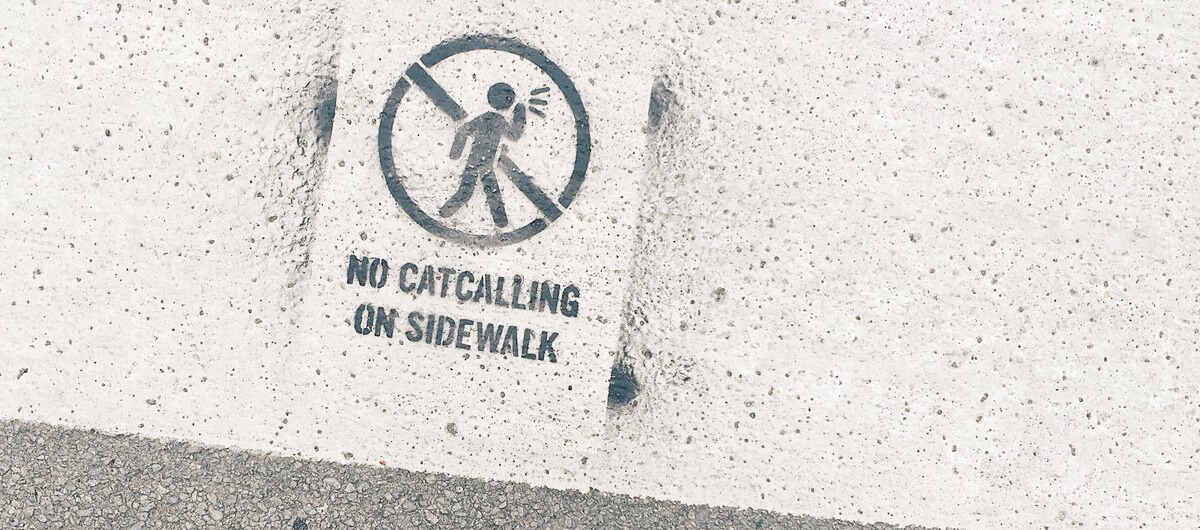
I’m sitting in a lounge, waiting for a flight, and I’m livid. Twenty minutes earlier, I was in the security line at Heathrow, going through the strange airport ritual of a usually private act: undressing. As I approached the body scanner, I removed my coat, jacket, sweater, and shoes. The screening agent standing on the other side said, “You look beautiful in black.” He was relaxed, friendly, and ebullient. I thought about telling him why this was not okay but decided it was not worth the effort, so I gave him the benefit of the doubt.
Then he erased the benefit and the doubt. As I started walking through the device, keeping my expression neutral, he told me to wait, step back, and stand still. I did this while he appraised me. Now, technically, this is his job. He also tells men to wait, stop, walk, and inspects them physically. But then, as he looked me up and down, his smile grew broader and he said loudly, “Look at that,” shaking his head back and forth, before waving me through.
I instinctively surveyed the area, aware that he’d spoken within earshot of at least ten other men—five passengers milling around behind me, one standing next to him, and four nearby screening agents. There was no other woman near me. I wasn’t in any physical danger, but this wasn’t about physical danger. It was about power, fraternity, and masculinity.
The TSA agent could have insinuated what he was thinking without uttering a word, but by speaking out loud he signaled two important things. First, that not only could he tell me what to do with my body (inherent in his job description), but also he could speak openly about what he thought of my body and do so with impunity (his masculine prerogative). He elided the two because he could. Second, he was issuing an invitation to the men around him to enjoy looking at me with him. He certainly wasn’t instructing me to “look at that.” Like a typical street harasser, he did what he did as a show for other men, a common habit in environments where men dominate.
Every contribution we get from readers like you allows us to keep reporting and keeps our content free and accessible for everyone. Our reporting digs deep into the important policies, issues, and cultural trends that matter most in these unprecedented times. Join now to help fund this important work.
Once I collected my belongings, I located his supervisors, two women. I described simply what had happened—this is what he did and said. I did not identify him; instead I suggested a clearer communication of policies prohibiting this behavior, stressing that this was not about one man, but about the entire environment in which he was so comfortable doing what he did. The more senior of the two women looked immediately agitated, and said, “One of our staff? Show me who he is.” Then, she insisted she had to get his side of the story. His side? Two sides? “There are no two sides,” I said. Commenting on women’s bodies and appearances in this context is unacceptable and harassing behavior—that’s it. She again asked me to accompany her so the man could tell “his side.” No, I said, that’s her job, not mine. That’s when she asked me, “Do you have any witnesses?”
As we stood there, a catalog of research flew through my head. I realized I was doing what most women do when confronting a sexist aggression: I was more assertive in my imagination than in actuality. Studies show that in 75 percent of cases of everyday discrimination or harassment women think about confronting their harasser, but only do so in 40 percent of cases. When women struggle to name the sexism, or to make direct challenges, it is because the problem is so diffuse. There is a slippery diffusion of responsibility, tremendous pressure to stay polite and quiet, and, almost always, a fear of retaliation. In my case, as my brain screamed, “F******G HELL, are you KIDDING ME?” my mouth said, “Pardon me, ‘witnesses’?”
“Did anyone witness what you described?” she insisted.
I went from being tired, dismayed by his behavior, worried, and disappointed by her response to adrenaline-filled, clear-thinking and physically aggressive. I put down my bag, took off my backpack, dropped my coat, stood so that I was clearly taller as I responded, “Are you serious? I am the witness. I watched him do this and then told you.”
The shift of tone was noticeable enough that another supervisor, a man, came over. They huddled around me, once again asking me to wait so we could all hear the man out. Surely, I said, I did not have to explain why people in positions of power and authority should never comment on a woman’s appearance and body. The only appropriate response was: “I am sorry this happened, we will make sure it doesn’t again.”
I’m sure the man had no idea that any of this was going on in my head as it happened. Like many men, he’d be stunned that something so minor and common could possibly matter. From this perspective, he is also among many women who welcome this kind of attention as flattery. The women’s demand that we hear him out suggested that if only he could explain, I might see that I misunderstood, and mischaracterized what he did. If I listened to him maybe I would forgive any “personal” offense and, thereby not implicate the larger culture and its tolerance for the behavior, a professional and political reality. Many conservative women I know would openly scoff at my complaint. Why, they insist, with visions of peak 1980s George Will dancing overhead, be a victim? Responses like these are predictable in the sense that they reflect beliefs about oppositional gender binaries and justify systems in which “boys will be boys” and, if a woman is hurt in the process, she must have one something to deserve it. “Victimhood” is, in this framework, also, guilt. So, take a compliment and move on. Why the fuss?
Why? Because moments like these are where the rubber hits the road and I am, like most women I know, exhausted. If I’d been a Black woman, the interaction could have easily devolved into a more invasive and even dangerous direction. I can name each time I have confronted a man acting in these ways, including in security lines. However, I have never reported what happened in an airport. So, what was the difference this time?
It was his smug fraternal signaling and the obliviousness of my fellow travelers. I’d be very surprised if even one of the ten men within our range was even minimally aware of what was going on, even as he implicated them by performing a subtle rite: making a woman uncomfortable by sexualizing her on a whim in a ritual of male bonding. The men and I were doing the same things in the same place, but having starkly different experiences.
Interactions like this one are happening in the presence of men 24/7 but, importantly, they are often happening because men are present. This harassment, for example, had less to do with me as a person than with his putting his masculinity on display for other men. That display is a key component of homosociality, in which boys are socialized to use girls and women to impress other boys. Homophobic bullying, denigrating girls and femininity using sexist humor and, notably, objectifying and harassing women are typical examples. At its most extreme, homosociality is the lever of gang rape, a fraternal bonding practice. Girls learn early to navigate the demands of homosociality on the boys and men they know and encounter.
Masculinity that is constructed this way is damaging to us all. It’s going to take a powerful rending, a transformation of life as we know it to change this. Mainly, it’s going to take a radical re-envisioning of what it means to be a boy and then a man because right now homosociality, and the sexism it sustains, are baked into dominant understandings of power and masculinity.
As a society, we are contending with what it means to seriously tackle the obvious unfairnesses of gender discrimination and violence, especially the brute force variety evident in #MeToo stories. However, the real work of ending discrimination is not in challenging the blunt, but in challenging the banal. The insidious power of microaggressions is that you look like an idiot for challenging something so common and “insignificant.” It’s like a pointillist painting: one small dot layered on top of another. No one alone represents anything that means anything, but put together over time, they make up a vivid, powerful and coherent picture. The frame that bounds our lives is one in which the performance of masculinity continues to be more important than the rights, needs, dignity and safety of girls and women. Getting angry in these moments, situations of insult, humiliation, threat and risk, is rarely an option for us, even if it is the most rational response and one that, in men, would be seen as normal and justifiable.
Acts like the one I endured from this man are hostile reminders of precarity; they chip away at women. One of the reasons it’s so hard to defend ourselves is that we are socialized to bite our words and swallow our pride. Anger is still a taboo emotion for girls and women and so we display it very cautiously. We internalize fears of being called crazy, irrational, ugly, or worse and we anticipate mockery and retaliation. Studies show that in 75 percent of everyday incidents of sexism, racism, anti-semitism or heterosexism, women think about assertive responses, but we only stand up for ourselves 40 percent of the time.
So many days I stomach the small acts of sexism that I encounter, allowing them to ripple out into the larger universe. On this day, I was unwilling to walk away. Instead, I got angry, made uncomfortable work for some women, and possibly “ruined” an “innocent man’s” day. As I left, the senior supervisor stopped me to ask what it was I wanted, if I didn’t want to file a report against him. This was the easiest part of my day: I want, I said, for no other girl or woman to have this experience again. That requires that men pay attention to how women are moving through the world, and understand why the differences matter.
We urgently need your help!
Covid-19 has dramatically impacted our ability to keep publishing. DAME is 100% reader funded and without additional support, we can’t keep publishing. Become a member at DAME today to help us continue reporting and shining a light on the stories that need to be told, from perspectives that aren’t heard enough. Every dollar we receive from readers goes directly into funding our journalism. Please become a member today!
(If you liked this article and just want to make a one-time donation, you can do that here)
We urgently need your help. DAME reports the stories that need to be told, from perspectives that aren’t heard enough. In times of crisis it is even more critical that these voices are not overlooked, but COVID-19 has impacted our ability to keep publishing. Please support our mission by joining today to help us keep reporting.
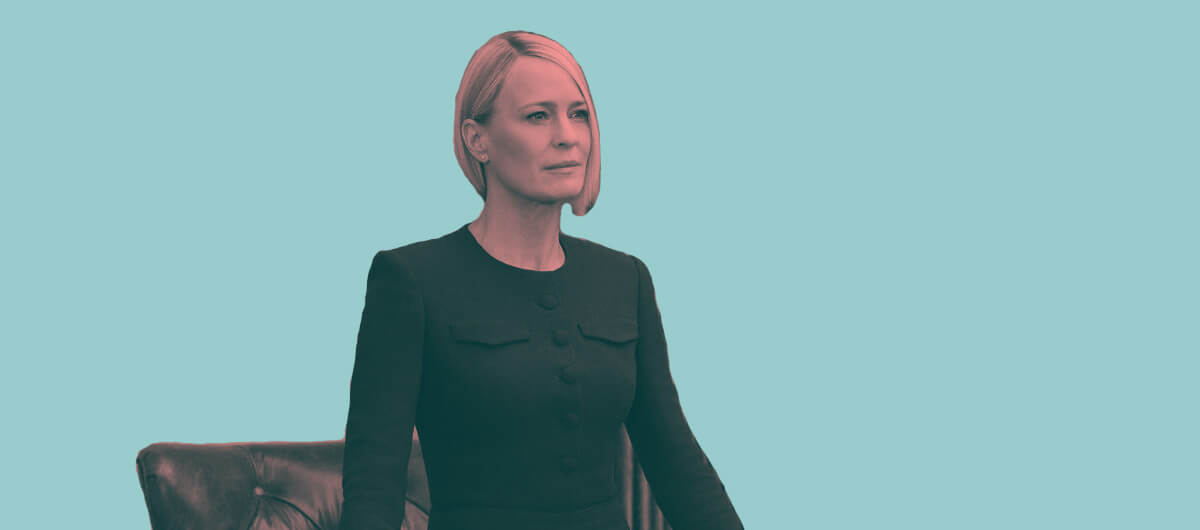
Toward the end of the first episode of the sixth and final season of House of Cards, Claire Underwood (Robin Wright) picks up her late husband’s infamous ring, the one he’d bang on his desk after one of his savage schemes (including stealing the presidency) succeeded, and slips it on her middle finger. The visceral appeal of this season is all about Claire securing her power by any means necessary (and, oh, those means are exactly and bloody) and with Francis’s vicious aplomb. The show derives its narrative momentum from seeing how low she’s willing to go to smite her enemies (which is, essentially, just as it was during Frank Underwood’s administration): One character muses aloud that Claire isn’t sure if she’s “Lady Macbeth or Macbeth.”
Yet, watching Claire plot and kill (which includes threatening nuclear war to preserve her authority), taking power because it’s there for the taking isn’t exhilarating—it’s exhausting. There’s nothing new about the idea of a Boss Bitch being incorrigible and cruel. It’s the same heavy ring, delivering the same hard knock, just on a manicured finger.
But it’s all part of a broader trend. Female rage has become all the rage. TV has been a fertile ground for women who are quick with a sarcastic quip and even quicker to hit the bottle, women who want to climb that corporate ladder even if they have to kneecap the people coming up behind them, and women who are as self-destructive, conniving, and violent as any of the celebrated male anti-heroes of Peak TV. This year alone has brought us Sharp Objects and Dietland, as well as new seasons of Jessica Jones, Orange Is the New Black, The Handmaid’s Tale, GLOW, UnREAL, and BoJack Horseman, and, soon, the lady narcissists of Crazy Ex-Girlfriend. The anti-heroines in these shows arrive at a time where women are increasingly encouraged to tap into the anger that we’ve been told to smile through and tamp down for generations.
It makes sense, then, that we’d want to watch our on-screen heroines spit in that sugar and spice and everything nice—to get as raw, as raunchy, as ugly-on-the-inside, unrepentantly selfish, and just-plain mean as male characters are allowed to be. But what seems like a cathartic curb-stomping of traditional feminine mores can have the unfortunate (and perhaps unintentional) side effect of equating being an asshole with being empowered. Of course, there’s nothing wrong with characters being that way onscreen, where assholes can make for rich, complicated storytelling. But the emergence of the Lady Asshole also speaks to a broader issue within the Strong Female Character trope as a whole: When we deem any woman character who shucks off likeability as strong or liberated, we forget that the whole point of their stories is that anger without purpose, cruelty without meaning, and unabated self-destruction are sad and terrible.
Every contribution we get from readers like you allows us to keep reporting and keeps our content free and accessible for everyone. Our reporting digs deep into the important policies, issues, and cultural trends that matter most in these unprecedented times. Join now to help fund this important work.
Jessica Jones is a Lady Asshole not because she was raped and reacted to that violation with a righteous fury, but because she directs that anger at people who don’t deserve it. She demeans her assistant, Malcolm, when he earnestly asks her to teach him the tricks of the PI trade. She ignores her best friend Trish’s excruciating spiral into a sense of powerlessness, which Jessica knows is related to Trish’s own history of sexual exploitation and abuse, until the situation can only be remedied with extreme violence. Daenerys Targaryen and Cersei Lannister of Game of Thrones are Lady Assholes not because they are ambitious enough to rule the Seven Kingdoms, but because they feel entitled to rule without proving that they’re actually capable of doing it. Camille Preaker on Sharp Objects isn’t a Lady Asshole because she needs a vodka-filled water bottle to survive the seismic echo of her traumas; she’s an asshole because she gets behind the wheel after she’s chugged that water bottle, and because she beds a grieving teenager. Diane Nguyen of BoJack Horseman isn’t a Lady Asshole because she’s drifting and depressed; she is because she’s profoundly selfish, often privileging her pain over everyone else’s feelings.
These characters’ selfishness, prickliness, and hubris, not to mention their careless regard for their own bodies and other people’s emotions, can make them riveting to watch and relatable in ways we might not want to admit. The modern-day Golden Age of Television is a brittle field of deeply angry, spiritually ugly men, but shows like Mad Men, The Sopranos, and Breaking Bad were so resonant because they deconstructed the corrosive appeal of privilege and how it made those men so angry and ugly. They depicted the systems and institutions that give men their power as a fly strip, seducing them with a promise of sweetness before snaring them in an everlasting stickiness that will never let them go—all they can do is flail against it.
Sure, men like Don Draper, Walter White, or even Jax Teller had their own dark glamour (ask any 20-something dude who’s ever made a spectacle of ordering an old-fashioned, quotes the “one who knocks” speech verbatim, or bought a used motorcycle from Craigslist only to sell it six months later), but we’re ultimately encouraged to view their destructiveness as wrong and troubling. We may want to rewatch Stringer Bell of The Wire scheme his way to the top of the towers, or Silence of the Lambs’ Hannibal Lecter assess whether some boorish fool would taste better with the red wine or the white wine, but we’d much rather have Noah Wyle’s winsome Dr. John Carter of ER, the good version of Kyle MacLachlan’s Special Agent Dale Cooper (Twin Peaks), or Sterling K. Brown’s sweet yet intense Randall Pherson (This Is Us) as our next-door neighbors. We get to choose because there’s been a greater tonal diversity in male characters. Women have, for far too often and for far too long, been relegated to love interests, or else the nagging wives and girlfriends—the Betty Drapers, the Carmela Sopranos, and the Skyler Whites who toss narrative wet blankets on our antiheroes’ ethically dubious fun. Being the wife gave them the moral high-ground (well, most of the time), but the high-ground can be a dry, plain terrain.
The rise of the Lady Asshole arguably coincides with the backlash against the ways that this period of Prestige TV reduced women to second fiddles playing the same shrill note. The woman antihero is often cut from the same id as her male counterparts: If we listen hard enough, we can hear whispers of Don Draper’s sadomasochistic brio through Camille Preaker’s or Jessica Jones’ slow process of pickling their livers, and their jaundiced, adversarial outlooks on life. Tony Soprano planted the seeds of selfishness and lustful will for dominion that have bloomed across six seasons of Orange Is the New Black, which has seen its characters grow progressively harsher: Piper goes from garden-variety narcissism to running a prison sweatshop, and in its most recent season, the show introduces a face-breaking bully named Badison who sabotages another woman’s release date just for kicks. Characters like Cersei Lannister, Dietland’s Kitty Montgomery, and UnREAL’s Rachel Goldberg embody Walter White’s advice to be “the one who knocks.” It’s easy to read these characters as a kind of “what’s good for the goose is good for the gander” approach to misanthropy.
The problem with this approach—and with the overall paucity of women’s representation across TV—is that it enables a kind of defensive You Go Girl jingoism around all women characters, even the ones who act badly. Daenerys’ feats of derring-do on dragonback, her incineration of the boorish Dothraki khals and sneering Lannister forces, has launched a fleet of listicles with titles like “The 23 Most Badass Daenerys Moments on Game of Thrones” and “13 Times Daenerys Targaryen Proved She’s a Badass Female” and “Daenerys Targaryen is a Bigger Badass Than You, in GIFS.” A Cosmopolitan write-up on Amanda Fuller, who plays OINTB’s Badison, includes a cutesy-poo poll about whether audiences “Can’t. Stand. Her.” or “Love to Hate Her! Also: She scares me.” The essays that celebrate Jessica Jones as a cathartic flash of women’s rage don’t often mention that her anger can further damage the people around her, who already carry their fair share of pain. At one point, Jessica attends an anger management class and scares the bejesus out of her classmates (including veterans with PTSD) by slamming a rubber ball through a wall—which isn’t being a badass, it’s assuming that her pain matters more than theirs.
After all, the second season of Jessica Jones is about the perils of making too nice with the devil on her shoulder. That devil comes in the form of Jessica’s mother, Alisa, whose brute powers and hair-trigger temper far surpass Jessica’s. Alisa talks a good game about the righteousness of women’s rage, even as she mangles innocent people with a bestial savagery. She functions as a kind of Ghost of Christmas Future for Jessica, a dire warning about the consequences of acting on every spark of anger, every whim to take what you want, when you want it, with abandon. There’s nothing righteous about that. The idea that Jessica is a superhero for the #MeToo age, the idea that we should praise her cynicism and her violence without looking at how the show itself interrogates both, reduce her to her most basic traits and superficially equate those traits with “being a badass.”
Like Jessica Jones, AMC’s recently cancelled Dietland packaged itself as a celebration of “angry, unlikeable” women, including an all-woman militia literally taking aim at abusive men, the daughter of a weight-loss guru dedicated to taking down her mother’s dieting empire, and a corporate executive scheming her way to the throne room of the Old Boys Club. Lamentably, Dietland’s brand of unlikeability was, well, not likable enough for summertime viewers, who seem to savor sunnier, frothier fare. Or perhaps, viewers weren’t ready for a show that was savvy enough to acknowledge that all kinds of unlikeable aren’t created equal: The all-woman militia mowed down anyone they believed to threaten their agenda, including a woman porn star who never directly hurt anyone; the diet guru’s daughter lived a comfortable, insulated life with her mother’s money; and that corporate executive, Kitty, did unto other women everything that those old boys did unto her. After Kitty is demoted by the company’s smarmy CEO, she rants to Plum, the plus-sized protagonist played by Joy Nash, about all the “assholes I had to flatter and humor and cater to.” But then, wielding one of the few HBIC powers she has left, she fires Plum, snarling, “Suck my cock.” The scene is expressly clear: Kitty may have good reason to be angry, but she’s still just another asshole who needs to be flattered and humored and catered to.
“Unlikable female protagonist” has become a brassy catchphrase adorning T-shirts, inspiring Tumblr entries, catalyzing a vast litany of think pieces, and marketing these shows through visions of unapologetic unruliness. When being “unlikable” is so popular, then the concept of “unlikability” feels somewhat meaningless—and certainly not transgressive. If anything, heroines who are more conventionally kind, compassionate, and, yes, “likeable,” feel more innovative. The women on shows like Riverdale, Jane the Virgin, Queen Sugar, and Pose are as complicated and imminently compelling as their grittier, more caustic, and violent counterparts, all without being willfully brutal to other people or to themselves. As essayist Megan Stielstra once quipped, “Somewhere along the line, nice got a bad rap.”
Throughout Riverdale’s second season, Betty Cooper fights against her “inner darkness” and her victory comes in embracing the kindness and light in being the girl next door. Her CW soul-sister, Jane Villanueva, is defined by her virtuousness—not only in the titular sense, but in the way she shows compassion and concern for other people’s feelings without forfeiting her sense of self. (Star Gina Rodriguez was even part of a “Be Kind to Each Other” anti-bullying campaign.) The Bordelon sisters in Queen Sugar may have their foibles and their squabbles, but they fundamentally love their family and their community—and that love is nuanced, rich, and gorgeously compelling to watch. Pose is a beautiful show precisely because the characters hold on to their hope and their humanity, even in the harshest circumstances. Blanca Evangelista (M.J. Rodriguez) proves that a strong female protagonist can be complex without being cruel: She balances the knowledge of her illness with her ambition to forge a legacy for herself in the ballroom scene, but above all else, she makes a haven for her family of surrogate children.
In her book Women and Power, Mary Beard writes, “You cannot easily fit women into a structure that is already coded as male; you have to change the structure.” At its shallowest, TV’s trend of unlikeable woman appropriates structures we’d rightfully call “toxic masculinity” in men without interrogating those structures or asking its heroine to move beyond them. In certain ways, these likable heroines are more transgressive than their broodier, boozier peers because they subvert the patriarchal power structures that Beard alludes to. They find their purpose in compassion and community-building. Internalizing the hostility of a deeply sexist culture is easy enough, even natural. Inflicting that hostility through sarcasm and abrasiveness may feel powerful in the moment, but what’s left when the moment’s gone? The new boss, same as the old boss. Learning to show kindness to other people, and to ourselves: That’s the harder thing, that’s the real power.
We urgently need your help!
Covid-19 has dramatically impacted our ability to keep publishing. DAME is 100% reader funded and without additional support, we can’t keep publishing. Become a member at DAME today to help us continue reporting and shining a light on the stories that need to be told, from perspectives that aren’t heard enough. Every dollar we receive from readers goes directly into funding our journalism. Please become a member today!
(If you liked this article and just want to make a one-time donation, you can do that here)