We urgently need your help. DAME reports the stories that need to be told, from perspectives that aren’t heard enough. In times of crisis it is even more critical that these voices are not overlooked, but COVID-19 has impacted our ability to keep publishing. Please support our mission by joining today to help us keep reporting.
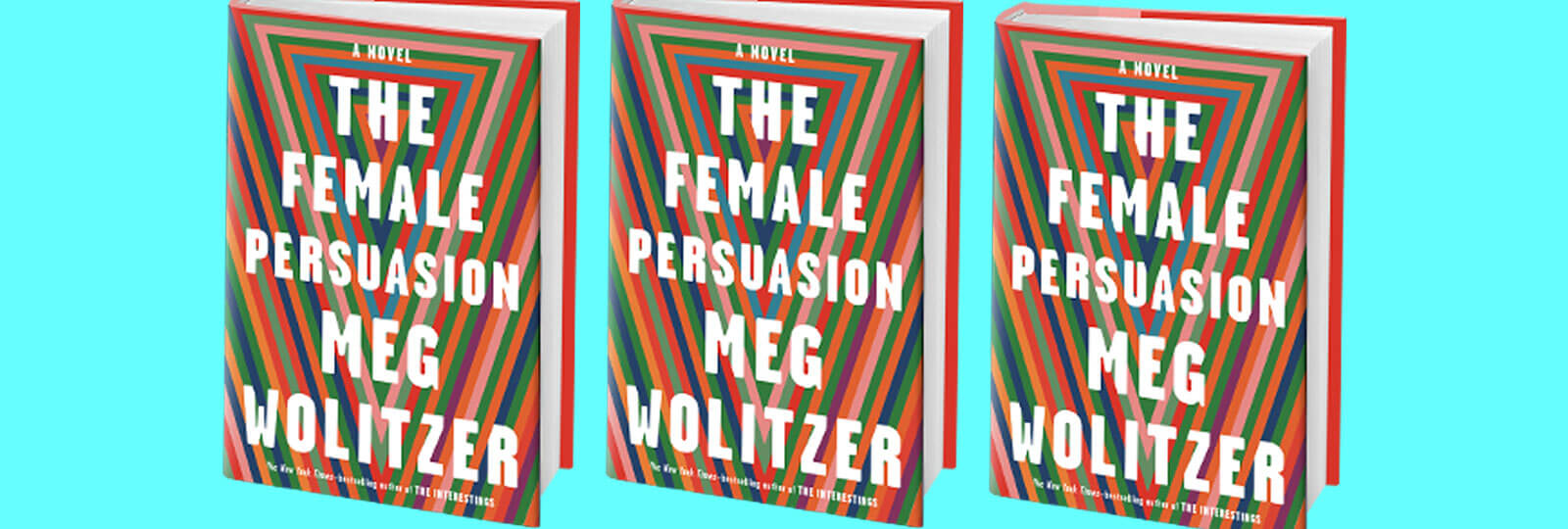
The Female Persuasion is Meg Wolitzer’s tenth novel, and by any measure it’s big (more than 450 pages) and immersive, spanning decades in the lives of its characters, pondering everything from love and sex to work, politics, and professional disillusionment.
At its center is a pair of women and the relationships they have with each other, their families, friends, and lovers. We meet Greer Kadetsky, a bright but shy college freshman, “hot-faced and inarticulate” when she rises to ask a question of the visiting lecturer, Faith Frank, who, at 63, is dashing, confident, and surprisingly kind to Greer. What begins as a kind of girl-crush on a powerful older woman unfolds as a book-long meditation on the power and complexity of female friendships—especially when they’re tested by ambition, competition, and betrayal.
An unabashedly feminist book, The Female Persuasion comes, of course, at a time of vocal #MeToo activism, set against a backdrop of institutional misogyny and threats to women’s rights. It’s difficult to read without thinking of our current political landscape, though Wolitzer wrote it before the 2016 election.
I talked with Wolitzer by phone, as she was traveling on an intense book tour, reading in a different city every day. She admits it’s as exhausting as it sounds, but adds, “There’s something about it that’s been very encouraging about readers in America. I’m finding great engagement around ideas of fiction, as opposed to despondency,” she adds. “Because people are so frightened and depressed about Trump, some people at least want to talk about things they care about, which are books.”
Every contribution we get from readers like you allows us to keep reporting and keeps our content free and accessible for everyone. Our reporting digs deep into the important policies, issues, and cultural trends that matter most in these unprecedented times. Join now to help fund this important work.
I’m fascinated by how many different kinds of relationships are in the book—friendships, romances, parents and children—but the most powerful relationship is the one between Greer and Faith. When did you decide that would be the primary relationship in the book?
My last novel, The Interestings, followed a group of friends for a really long period of time, and they were all the same age. In fact, they’re exactly my age, because I’m really bad at math, and I loathe having to figure out how old people were during a certain year! But I was very interested in the moment when you find your cohort. This time, I had been thinking a lot about the person you might meet when you’re young, who might be older—they don’t have to be, but they might be an older person—who sees something in you, and you really start to see it in yourself. And sometimes you want to please them. It’s very exciting, that sense of being seen, and maybe taking yourself seriously. I’ve been thinking about that a lot, because, as I get older—and I’m in this weird mid-place where I have kids who are now out of the house and grown—but I remember when they were young, and I remember being young, and being in that position of looking up at people. It’s sort of like seeing things in a lot of different directions, like one of those viewfinders on the side of the road that give you a panoramic view. I thought, Maybe I should listen to all of that and try to put it in a book.
How much of you is in the character of Greer? And Faith?
It’s hard to know. I don’t like to write autobiographically. I really enjoy invention. But, of course, things that happen to us are like magnetic filings: They stick to us. I’m not Greer, and I’m not like her, but I remember that heat in my face and being unable to marshal my best self, to be articulate. On the other hand, I’ve done a lot of readings and public speaking, and feel more comfortable now, and that’s a little more Faith Frankian. So, I’m not them at all, but I really think that everything you put into a character must be something you find human and understandable. And then you can apply little bits, dust from your life, to that character, to really give it a sense of what we call felt life.
Faith Frank is one of those characters who feels very real, but at the same time there’s something really iconic about her—I’m guessing I’m not the first person to see some Gloria Steinem in the character.
It’s always funny how that does happen, in any book you write. Not only famous people, but readers see some part of themselves and wonder if you knew this person … I think what fiction can do is make connections in the reader. Faith is definitely an iconic figure, but I hope she’s invented whole cloth. I love the idea of living in a world in which there are multiple famous feminists! And so I tried to create one.
The book comes at a time when we’re talking a lot about different waves of feminism—the way women across generational lines often have difficulty understanding one another. It also made me think a lot about the election and primaries, where there was tension between the idea of ideological purity and the need for compromise. How much of that was in your head when you were writing it?
I was writing it before that was taking place. I think that those ideas about young people wanting a kind of pure experience, and older people having more experience in the world, and seeing compromise that has to happen, has been something that we’ve seen played out. You know, it can reverse—it’s not only about age, it depends on the person, it depends on how they approach the world. I wouldn’t make a blanket statement about young people being one way and older people being another way. But I did start thinking about this book after I wrote The Interestings, which came out in 2013. So I’ve been wrestling with these ideas in my mind for a long time. For me, ideas and character are so intertwined in a novel, and that it’s not like I wanted to make this novel a vessel to explore these ideas. But the characters really become so rich to me as I get to know them; it’s easier to see how they wrestle with these ideas.
One of the sweetest parts of the book for me was the romance between Greer and Corey. This was such a sweet love story. Did it feel nice to write it?
I loved writing it. I love Corey, and I love writing about their falling in love. Writing about first times is something that I particularly enjoy doing. Because everything is so heightened. When we think of heightened experiences it’s also often because they’re new; they’re new, and therefore you’re not jaded or afraid, oh wait is this going to go the way that last relationship did? What if in fact you never had that before? What if you’ve never been in love before, or had sex before? So those are things that, yeah, I think that’s sweet. I’m glad you felt that way, because I definitely felt that way writing about it, too.
Is it different, writing about young romance as you get older?
I don’t want to feel like I’m on an iceberg floating away from everything! But yes, you get to a point where—it’s not like you forget those things, early sexual experiences are tremendous and they shape you in your life, I don’t forget them— but you’ve had other living experiences that are so vastly different. The deaths of people you know … all kinds of things. So I think returning to that at a later point—it’s kind of wonderful to be reminded. Especially now, everything is so fraught, to sort of say you know what, even in this shitty time, people fall in love. Young people find things out for the first time. And that’s true. That’s always been true.
One of the reviews of your book, in People, called the book “equal parts cotton candy and red meat.” That’s a strange way to look at a book. But I wondered, how much when you’re writing do you think about the way people perceive some kind of dichotomy between readability and high literary quality?
I don’t think of it from the outside. I try to think of it from my own desires when I read, and I hope to hew really close to those desires when I write. Like, I want to write the book that I want to read. And for me, more and more, it’s a book that allows you to be immersed in a world, like a deep dive into a world that feels expansive. And that’s what I crave. I just try to have the world fall away in a world that I write, if that’s at all possible.
You mention just wanting to dive into writing your books, but at the same time you want to be engaged in the world, and I know you’re a politically engaged writer. How do you write fiction at a time like this?
I was the guest editor of the Best American Short Stories, the most recent one. And in my essay at the beginning of the collection, I talk about the election, and how I had read some of the stories before election night and some of them after. [And I wrote about] how do you read fiction—and by extension write—in a moment when the world feels chaotic and frightening. At the same time, if I think about a world without fiction in it, it is so depressing and I despair at that. Novels can be like a snapshot of a moment in time. One of the things I try to do in fiction, and I think others try to do, is try to say, what is it like, what is it like? To try to explore how people live, and how other people live. That creates a society that I want to be in—one that asks those questions. So when things are very difficult it may be that that’s not the moment to read fiction, in that moment. But you will come back to it again.
We urgently need your help!
Covid-19 has dramatically impacted our ability to keep publishing. DAME is 100% reader funded and without additional support, we can’t keep publishing. Become a member at DAME today to help us continue reporting and shining a light on the stories that need to be told, from perspectives that aren’t heard enough. Every dollar we receive from readers goes directly into funding our journalism. Please become a member today!
(If you liked this article and just want to make a one-time donation, you can do that here)

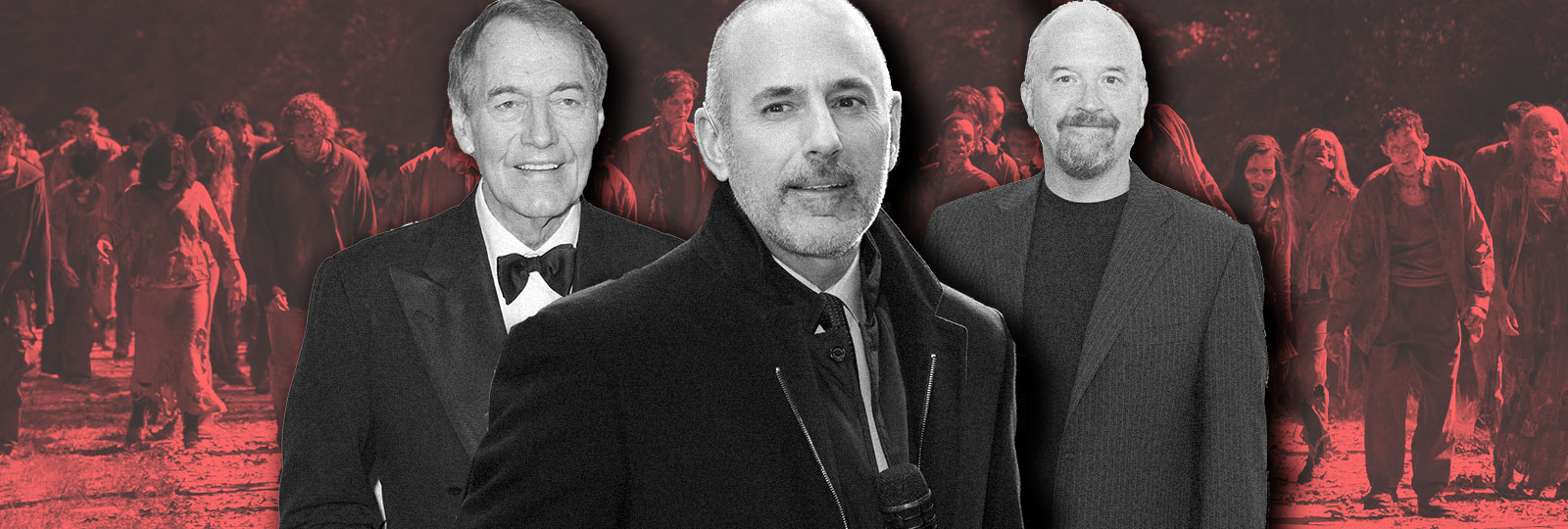
Like zombies risen from the dead, some of the men banished from public life by the #MeToo movement are reportedly preparing for their return. According to the gossip rags, Matt Lauer and Mario Batali are testing the comeback waters. Garrison Keillor is back on tour. The Hollywood Reporter profiled Charlie Rose, and suggested Louis C.K. might be able to make his return via comedy clubs. Bill O’Reilly is back on Fox, if not quite in his past role.
All of which leaves women asking: Do we really need to see you again?
Men—and especially white men— it seems, get a million chances to fail, while women are always walking on the knife-edge of permanent excommunication. We see this across nearly every realm. Bernie Sanders lost the Democratic primary but remains politically sought-after, and many of his fans hope he’ll run for president again; Hillary Clinton won the popular vote but lost the election because of antiquated Electoral College rules, and she’s more or less told to hide in a shroud of darkness and never show her face again. Sanders fans claim he lost because the system was rigged, while Clinton lost because she was a bad candidate who should have never run in the first place and now remains wholly responsible for the political tragicomedy that is Donald Trump.
Kathy Griffin made a tasteless joke about the president and had to offer a series of apologies before disappearing for a year, while serial racist Ted Nugent is frequently invited to the White House. Chris Brown beat his girlfriend and still makes hits; Anne Hathaway is one of America’s most-hated celebrities because she’s too eager to be liked. When a woman fails at something, she ends up an avatar for Women In X Industry: Margaret Thatcher was a mean-spirited conservative leader, therefore we don’t need to focus so much on women in politics (never mind that the overwhelming majority of mean-spirited conservative leaders the world over have been men); Marissa Mayer cut a work from home policy that benefited moms, which is evidence that women in leadership positions are not a panacea (an argument no one made in the first place). Women are held to a higher standard, the prominent among us carry the weight of representing all women, we are punished more swiftly if we mess up, and we are given fewer chances for recovery.
Every contribution we get from readers like you allows us to keep reporting and keeps our content free and accessible for everyone. Our reporting digs deep into the important policies, issues, and cultural trends that matter most in these unprecedented times. Join now to help fund this important work.
Defenders of the bad-man comeback are quick to argue that everyone deserves a second chance (and apparently a 302nd), and besides [insert man’s name here] is a specific kind of genius. No one does comedy like Louis C.K., or tells stories like Garrison Keillor, or interviews like Charlie Rose, or cooks like Mario Batali, or, I don’t know, does vaguely humiliating early-morning suburban slapstick like Matt Lauer. You hear this especially when folks are grappling with, say, enjoying the cinematic work of Roman Polanski, a man who anally raped a child, or Woody Allen, a man accused of molesting his child: Yes he did a terrible thing, but what would we do without him?
It’s tough to say, but maybe we would be enjoying films, food, interviews, comedy, and all sorts of other art and creation and contribution by the great many women who throughout history have been wholly unrecognized because men suck up all the air in the room. Talent does not simply become recognized where it exists in greatest quantities; those who hold some talent see it honed, developed, encouraged, funded, and otherwise supported and drawn into the public square, often by people who are moneyed, connected and powerful than the talented individual. That a hugely disproportionate number of people who have benefited from this mentorship and patronage system are men is not an outcome of men holding most of the talent, but men holding most of the money, connections and power. The question shouldn’t be whose talents we lose when we collectively decide that men who abuse or harass or assault women are unworthy of our collective support; the question should be whose talents we have been missing out on all along.
What to do, though, about the reality of badly behaved men in light of the feminist and progressive consensus that radical transformation is possible—that it must be possible if we are to continue our work? Why be a person who pushes for progress at all if we don’t believe that people do indeed change and progress? This goes double for those of us who are dedicated to criminal justice reform, and who want to see a greater emphasis on rehabilitation and reentry into the community, and less of a focus on punitive punishment, incarceration as a deterrent, and long prison sentences. As a foundational and deeply held value, I do believe in second chances—and third and fourth chances. I believe in these even for some of the worst criminals, to the point of opposing sex-offender registries and many other post-incarceration punishments.
If I can offer a second chance to a pedophile, why not someone like Louis C.K., whose seemingly compulsive habit of masturbating in front of women is equal parts predatory and pathetic? The answer comes in how we define a “second chance,” and what personal transformation looks like. What it doesn’t resemble: the hollow, PR-penned quasi-apologies too many celebrities offer up.
I have written elsewhere about what it means to extend grace to those who have done wrong, and what it means for the wrong-doers to be truly accountable. It is only from there—the taking responsibility for one’s actions—that transformation can follow. The men in question here used their fame to facilitate their transgressions. The fact of those transgressions does not mean they can never live a good life, or that they must stay hidden in the shadows forever. But true accountability does require recognizing that the fame itself must be forfeited.
Fame, after all, is not just about being particularly excellent at creating art, or cooking food, or engaging others in conversation. It is about being recognized and applauded for those things—headlining the tour, having your own TV show, putting your face on a cookbook. The “comebacks” these men may or may not make—it is, after all, largely gossip—is not about a quiet return to their personal talents, which could feed their souls, but a very loud return to their positions as publicly recognized and acclaimed talents. It is this same need for power and the prerogatives it offers that arguably enabled these same men’s bad actions toward women in the first place. That they want to recoup not the ability to enjoy their talents but the chance to again be widely applauded for those talents and the power brought by celebrity suggests they haven’t done much looking inward at all. It’s not about coming back to their gifts as such, but coming back to their previously held status.
Which suggests that they haven’t actually changed much at all.
We urgently need your help!
Covid-19 has dramatically impacted our ability to keep publishing. DAME is 100% reader funded and without additional support, we can’t keep publishing. Become a member at DAME today to help us continue reporting and shining a light on the stories that need to be told, from perspectives that aren’t heard enough. Every dollar we receive from readers goes directly into funding our journalism. Please become a member today!
(If you liked this article and just want to make a one-time donation, you can do that here)
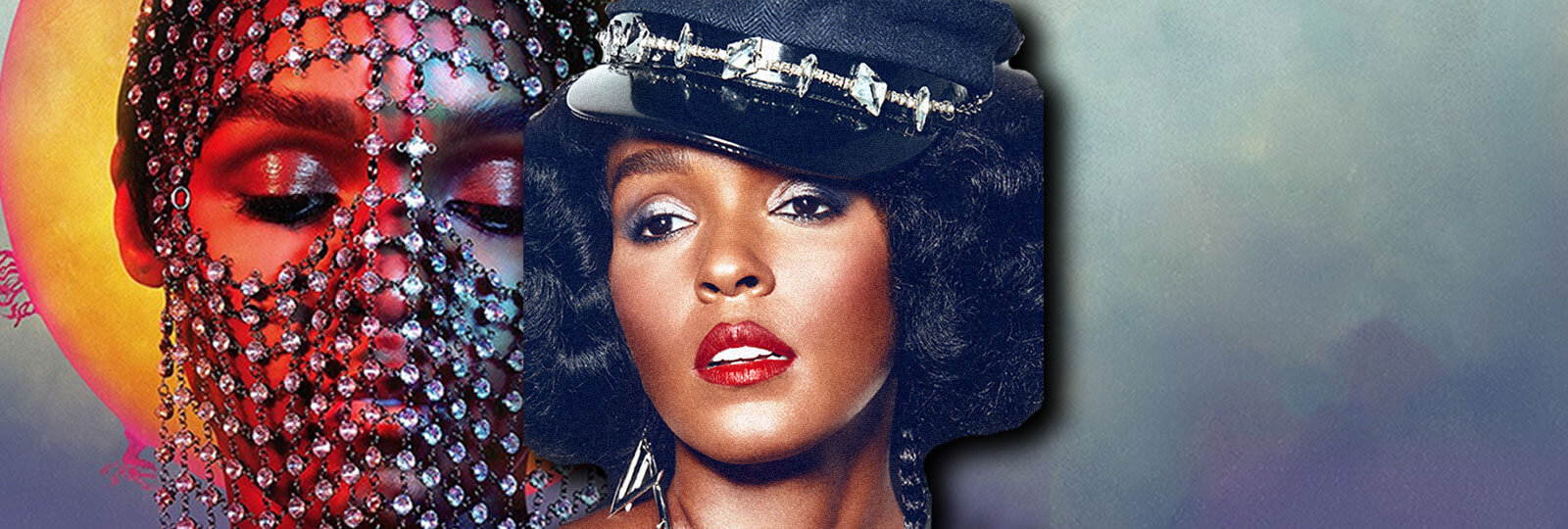
Janelle Monáe is finally ready to talk about herself.
In her new album, Dirty Computer, released today with an accompanying short film, which aired on BET at midnight, the artist perhaps as renowned for her ambiguous sexual identity as for her incredible original talent opens up about who she loves, and what she finds most empowering. The answer: women.
While the collaborators on this album are mostly men—with the exception of Canadian artist Grimes, there’s Brian Wilson, Pharrell Williams, Stevie Wonder, and Prince, who is not credited but was working on music with her before he died—Monáe clearly cites her female influences in each song’s liner notes, which span history, literature, film, and activist speech: Pecola Breedlove, the central character of Toni Morrison’s The Bluest Eye; Mary Beard’s feminist manifesto, Women & Power; Eve in the Garden of Eden; Gloria Steinem’s speeches; Naomi Wolf’s memoir, Vagina; and Dora Milaje and the women of Wakanda in Black Panther.
Dirty Computer is Monáe’s fourth solo album, coming after a span of five years. During that hiatus, her life undeniably changed. She ventured into acting and ended up starring in two Oscar-nominated films, Moonlight and Hidden Figures. She threw herself into her activism and launched the #FemTheFuture initiative to create opportunities for women to help each other succeed, a movement that would precede #TimesUp by two years. She delivered an impassioned speech and performance at the Women’s March on Washington. But just as she was beginning to work on Dirty Computer, in April 2016, her mentor and friend Prince died from an accidental overdose. The album marks an evolution of her sound, but more critically an elevated awareness of the world, and her place in it. In previous albums, Monáe filtered her messaging through a fictional character, the android Cindi Mayweather, a figure as ambiguous as herself. Now, she has become her own vessel, encouraging anyone else who has yet to use their authentic voice to do the same.
Every contribution we get from readers like you allows us to keep reporting and keeps our content free and accessible for everyone. Our reporting digs deep into the important policies, issues, and cultural trends that matter most in these unprecedented times. Join now to help fund this important work.
“Right now I’m escaping the gravity of the labels that people have tried to place on me that have stopped my evolution,” she told the New York Times Magazine. “You have to go ahead and soar, and not be afraid to jump—and I’m jumping right now … I knew I needed to make this album, and I put it off and put it off because the subject is Janelle Monáe.”
Truth is a scary thing for anyone, but especially an artist who has built a brand and image around ambiguity. This album is entirely about self-discovery. She claims her place as an American who is female, Black, and different than the status quo. She explores how the world sees her—and responds with a middle finger up and a wink. She celebrates her identity as a queer woman, which she has hinted at in her lyrics before, often using female pronouns for the objects of her desire. But this time, she’s shouting her truth. In the video to “PYNK,” which is itself a love letter to female sexuality, she and her all-female dancers wear ruffled pants that skirt innuendo: They are realistic recreations of the vulva—a gradient of pink tones, inner and outer labia, quivering, and full of life. In one scene, actress Tessa Thompson, Monáe’s rumored girlfriend, peeks out from between Monáe’s legs, and winks. In the video to “Make Me Feel,” the two women share a popsicle and move in for a kiss. And at the core of the short film’s narrative is a star-crossed romance between Monáe and Thompson.
Monáe has famously eluded questions about her sexuality, preferring to offer metaphorical answers like “I date androids,” but in a newly published interview in Rolling Stone, she finally says the words: “Being a queer black woman in America, someone who has been in relationships with both men and women—I consider myself to be a free-ass motherfucker.”
And with personal freedom comes sexual freedom. As she puts it in “Django Jane,” the album’s female-power anthem, “Let the vagina have a monologue.”
If Monáe is for once being her own character on this album, the vagina is her mascot, or perhaps her inner voice. Pussies are all over Dirty Computer and its accompanying videos—writhing on floors, grinding against other people, both men and women, sporting hot pants with messages like “I Grab Back,” and flirted with in lyrics such as these from the track, “Take a Byte”:
“Take a byte (just take a byte)
Help yourself (help yourself)
It’s alright (it’s alright)
I won’t tell (it feels so good when you nibble on it)”
And on “Don’t Judge Me,” taking a page right out of Prince’s playbook, she coos in a bedroom voice: “What if I, what if I touched you right there?”
Looking back at popular music over the years, and examining how vaginas have been talked about, the way that Monáe represents the beauty, power, and pleasure possibilities of the female anatomy is practically unparalleled. If they weren’t being denigrated on countless male-fronted rock and hip-hop tracks, they were being whispered about, suggested—but never named—with obscure metaphors that sent the message that vaginas should be kept secret, hidden, possessed. Even when women took control of the vagina narrative, they did it subtly. Cyndi Lauper wrote a revolutionary song about female masturbation, but had to give it a different name: “She Bop.” Christina Aguilera and Britney Spears offered up ambiguous self-pleasure songs in the 1990s while dancing for the male gaze. Madonna, who never shied away from sexual expression, was forced to censor herself, particularly when it came to what she did with her vagina in public—whether it was creating new censorship guidelines for her grinding performance at the 1984 MTV Video Music Awards, or getting sued for grabbing her crotch as part of her “Blonde Ambition” tour.
Even Beyoncé, who evolves her feminist messaging with every new song, album, or live performance, can’t quite get past the innuendo. In her most vagina-centric song yet, “Blow” from 2013’s Beyoncé, we get what she’s talking about when she sings, “Can you eat my Skittles, it’s the sweetest in the middle.” But it’s not quite the same as, “Pink, like your fingers in my… maybe. Pink, like your tongue going round… baby,” as Monáe sings in “PYNK.”
“PYNK” in particular allows Monáe to spread open her feelings about sexuality, and embrace feminine beauty, pleasure, self-pleasure, and same-sex pleasure set to a groove-pop melody. This is also the song most evocative of Prince. Not musically—that credit goes to “Make Me Feel,” which is an obvious sonic child of signature Prince synthesizing and guitar riffs—but in the way it celebrates female sexuality with respect, dignity, and outright adoration. In songs like “Soft & Wet,” “Come,” “Head,” and “Sugar Walls,” which he wrote for Sheena Easton, Prince places woman’s pleasure front and center. The narrative is romantic, never demanding or obsessive as in tail-chasing rock songs from the 1980s and beyond, nor is it pined over with heartsick desperation, as in nearly every R&B song you’ve ever heard. Prince made a point of empowering women’s sexuality through his own lens, and it’s clear Monáe, his protégé, took note.
There’s no maybe about it. Monáe’s latest expression is an unabashed ode to the vagina, which she clearly identifies as a power source for women. As Monáe is finally claiming that love and power for herself.
We urgently need your help!
Covid-19 has dramatically impacted our ability to keep publishing. DAME is 100% reader funded and without additional support, we can’t keep publishing. Become a member at DAME today to help us continue reporting and shining a light on the stories that need to be told, from perspectives that aren’t heard enough. Every dollar we receive from readers goes directly into funding our journalism. Please become a member today!
(If you liked this article and just want to make a one-time donation, you can do that here)

Sarah Huckabee Sanders gets up in the White House press room on a regular basis and tells outright lies about everything from policy to prostitutes to pies. And while the media has been wringing its hands since January 20, 2017 over when it’s okay to call a lie a lie, comedian Michelle Wolf stood a few feet from Sanders this weekend and called her a liar, to her face, and with real writerly flourish too: “I actually really like Sarah. I think she’s very resourceful. Like, she burns facts, and then she uses the ash to create a perfect smoky eye. Like, maybe she’s born with it; maybe it’s lies. It’s probably lies.”
This is the line that both conservative and mainstream media folks are choosing to focus on in their critiques of Wolf as unnecessarily cruel and unfairly attacking Sanders’ looks. Which they somehow manage to call out earnestly, despite having stayed mostly mum on Trump’s running commentary on women’s looks, from his comment that Morning Joe co-host Mika Brezinski looked like she was “bleeding badly from a face lift” to his tirade against former Miss Universe contestant Alicia Machadeo (calling her “Miss Piggy” and “disgusting”) to his skeevy come-ons to everyone from the first lady of France (“look at you; you’re in such good shape”) to his own daughter (“if she wasn’t my daughter…”). And that’s without mentioning the infamous pussy-grabbing comment or his numerous outbursts about Mexicans, Muslims, and so-called “shithole” countries. Trump’s comments have never drawn as much outrage from all sides as Wolf’s comparatively tame (and true) jokes. And they’ve certainly never received as much attention from the Beltway press, which has now officially been discussing Wolf’s jokes 12 hours longer than any other piece of news lasts in the current outrage-driven news cycle. Why? Access, and the desire to keep it.
Hey look, in my opinion, that Sarah lady’s eyeliner looks like a raccoon with a hangover, but that’s not what Wolf said. The smoky eye joke is a red herring. Because what Maggie Haberman of The New York Times and NBC’s Andrea Mitchell and White House Correspondents Association head (and senior Bloomberg White House correspondent) Margaret Talev, who publicly thanked Mike Pence’s press secretary for a tweet about Wolf and how her “classless” routine had ruined Talev’s hard work, are really pissed about is not that Wolf may have criticized Sanders’ appearance—and she didn’t, that was the media’s weird interpretation—but that she took solid aim at their own failings.
And she was right. Because here’s exactly what access journalism looks like, folks:
Every contribution we get from readers like you allows us to keep reporting and keeps our content free and accessible for everyone. Our reporting digs deep into the important policies, issues, and cultural trends that matter most in these unprecedented times. Join now to help fund this important work.
A fucking journalist thanking the VP’s press secretary for ripping on free speech.
Access journalism is a classy sounding term for the smarmy gentleman’s agreement that underlies political correspondents’ tendencies to gloss over certain politicians’ failings in order to maintain their access to them. So when Maggie Haberman, for example, allows Trump to ramble through various lies and half-truths in an “interview,” without questioning or pressing him in any way, or paints the story of Jared Kushner’s secret phone line with Russia in a slightly better light, that’s so the Trump clan will continue to let her in. Which she sometimes uses to the benefit of the public—noting when Trump is behaving the way he tends to before he fires someone, for example—and sometimes uses to simply butter him up again. As Haberman’s colleague Will Saletan mansplained on Twitter last year, “Reporters work with sources to gradually elicit more info. Be patient.” This is just how reporting works, guys, you have to keep your sources happy so that they will give you more info. Otherwise known as access.
One of the more insidious forms access journalism has taken in the Trump administration is when journalists downplay the seriousness of the president’s attacks on the press itself. Having the President of the United States routinely tell the public that the media is “dishonest,” that anything reported about him that he doesn’t like is “fake news,” is the classic move of the autocrat. It boggles the mind that so many mainstream journalists would go along with it, often advising the public not to take it too seriously, that, as Jay Rosen has noted, “it may look like a fight, but it’s actually a dance.” Here again, it’s likely a question of access: a journalist who lets Trump’s remarks roll off his or her back is more likely to gain access to the White House press corps than one who raises a loud or public fuss about it. Meanwhile, during the same 24 hours that brought us hundreds of tweets, interviews, and think pieces from Beltway journos concerned about poor Sarah Huckabee Sanders being mean-girled, Buzzfeed revealed that the DOJ has quietly been removing mentions of press freedom from its manuals. But hey, it’s just a dance, right?
Haberman has more access to Trump than any journalist in the country at the moment. That’s due in part to her continued, and often public, deference to Trump, his family, and his administration. She was one of the few reporters who leapt to Mike Pence’s defense back in 2016 when he was booed at a performance of Hamilton, chastising people for not showing Pence—a man who would eliminate the National Endowment for the Arts if he could, and send all homosexuals to conversion camp, but yet chose to make a grand entrance at a famed Broadway fucking musical—a “level of respect.” So it was not a huge surprise to see her rushing to suck up to Sanders after the White House Correspondents’ Dinner on Saturday, calling Sanders “impressive” for not walking out during Wolf’s routine.
Many in the public, on the other hand, think it’s “impressive” that Haberman and her cohort have not yet walked out when Sanders starts blatantly lying to them in a press conference. Surely we should be at least as concerned about the norms being flouted by the president and his staff as those being ignored by a comedian at the WHCA dinner, no? Also “impressive” is the way Haberman’s fellow NYT White House correspondent Mark Landler managed to tuck his balls entirely inside his anus in order to pen this spineless love letter to Melania Trump last year. Anyway, I digress. Wolf articulated the problem with access journalism precisely:
“There’s a ton of news right now; a lot is going on, and we have all these 24-hour news networks, and we could be covering everything. But, instead, we’re covering like three topics. Every hour, it’s Trump, Russia, Hillary. You guys are obsessed with Trump. Did you used to date him? Because you pretend like you hate him, but I think you love him. I think what no one in this room wants to admit is that Trump has helped all of you. He couldn’t sell steaks or vodka or water or college or ties or Eric, but he has helped you. He’s helped you sell your papers and your books and your TV. You helped create this monster, and now you’re profiting off of him.”
Zing. That’s what the Habes is habing about. And look, I get it. I mean, first, who the fuck am I to be questioning Maggie Haberman? She’s covered presidential campaigns since 2008 and I live in the middle of the mountains and spend easily half my time cleaning up the poop of various species. I also know exactly how hard it is to get any politician or public figure to agree to an interview, let alone behave like an actual human and not a robot pre-programmed with talking points in that interview. If you make a celebrity look stupid in a story, their publicist will never work with you again and it’s more or less the same with politicians. But the difference between celebrities and politicians, and yes this also goes for celebrities-turned-politicians, is that telling the truth about the latter actually matters to the public and, not to get too highfalutin about it, to the health of our democracy.
So while journalists have been worrying about whether it’s really fair that they call a non-truth coming out of Trump’s mouth a lie when they can’t know whether he was being intentionally misleading or not, what they ought to be focused on, if they’re doing the actual job they’ve been hired for—you know, informing the public, holding the powerful accountable and all that—is whether it’s fair that they sugar coat the things they are seeing and hearing, that they present the opinions of the very people they’re reporting on as unbiased input from “anonymous sources familiar with the story,” that they keep sitting there taking notes and pretending like this is all normal when Sanders, or Trump for that matter, flat-out lies to them in a press conference.
The argument can be made, of course, and has been made, that access is also important for informing the public. That if Trump were to stop talking to anyone in the press tomorrow, that would also be a problem. Would it, though? With a White House that leaks like a sieve and a ton of truly talented investigative journalists digging tirelessly for the truth?
It seems more likely that being searingly truthful about Trump and his administration would hurt the careers of journalists who have made their bones on the back of his rise. Here’s a question: Where would Maggie Haberman be if Trump had lost? Would she be the best-known reporter at The New York Times, or would she be just another faceless campaign reporter, gearing up to cover whatever schmo she’d been assigned to follow for the midterms? Would Katy Tur have a book deal? Would CNN and MSNBC be posting record ratings and actually hiring people for the first time in years?
As much as I love to see so many people consuming the news these days, recounting, wild-eyed, the latest Trump gaffe or bizarre policy reversal, I have to wonder: at what cost?

Twelve years ago, I watched the movie adaptation of RENT in my dormitory lounge with my friends, and our resident director, who also served as the assistant pastor on campus. During a particularly poignant scene when Tom and Angel share a romantic kiss, one of my friends turned to the pastor and asked, “Is it alright if I’m uncomfortable with that?” The pastor nodded yes, and we went back to watching our movie.
People expressing casual homophobia like that was a regular occurrence at a private Christian college in the middle-aughts—and I’m sure it extended beyond religious-school campuses.
But at the time, I frequently incorporated these views into my blogging, citing long-disproved and transphobic or homophobic studies. I argued about how gay men are promiscuous and prone to AIDS, and talked about how bisexual women are just playing around to be sexy (which was also a sin).
Again, that was 12 years ago.
Every contribution we get from readers like you allows us to keep reporting and keeps our content free and accessible for everyone. Our reporting digs deep into the important policies, issues, and cultural trends that matter most in these unprecedented times. Join now to help fund this important work.
This past Saturday, my girlfriend and I walked around a public zoo, holding hands and exchanging brief kisses in the Japanese gardens. I’ve come a long way since the conservative homophobia of my youth—homophobia that was still by and large acceptable in many parts of the mainstream, despite the ongoing work that LGBTQ activists were doing to normalize acceptance and love. I am glad that my posts from back then are hard to find, and not under my own name.
MSNBC host Joy Reid has not been so lucky. In December, following Reid’s criticism of Bernie Sanders, a cohort of people on Twitter dug into her past, posting alleged screenshots of her old blog posts from the early to mid-aughts, rife with homophobic and transphobic commentary. Reid, upon reading the comments and not recognizing them as something she wrote, called in computer security experts to see if something could have been manipulated to cast her in such a light. In an apology on Saturday, she explained that while she did not recognize that person who wrote those posts, that, ultimately is a good thing: She is a different person from who she was 12 years ago, five years ago, and even one year ago.
It remains undetermined whether Reid’s posts were manipulated or hacked. To be honest, “I was hacked” is a bit of a cop-out, even as she says she believed she did not write those words. Alongside the blog posts, however, were several transphobic tweets she did write, and commentary that reflected an unacceptable homophobia and transphobia.
But I don’t care if she wrote these things because the real question we need to be asking is: Why are we even talking about it?
The current ways in which we handle social media and progressive activism within those spaces have flattened both our humanity and our sense of people’s ability to change. Rather than looking at a person’s current opinions, current views, and current activism, we dredge up a long list of past problematic comments, assemble a long, indelible record of how they’ve failed to live up to being the Perfect Progressive, and hold it over their head indefinitely. And all too often, this scrutiny tactic is aimed at women. Because of the seven months she spent working as a foreclosure attorney, reproductive-rights lawyer Imani Gandy gets harassed every few months by leftists repeatedly—they love to dredge it up. Hosts of the leftist podcast, Chapo Trap House, have a long history of going after women. Felix Biederman, one of the four hosts, has mocked rape survivors for being fat and told a mother her week-old infant shouldn’t exist.
Women in the media already face a sexist institution to get their careers where they are. Even now, simply being willing to call themselves Democrats or Hillary supporters means facing the ongoing scrutiny of Glenn Greenwald and his horde of angry-white-boy followers. There is a particular loud faction of the left—dubbed “The Dirtbag Left” or the “Alt Left” by the hosts of Chapo Trap House and taken up by many on the left—that insists any past indiscretion is reason enough to not trust them now—and the loudest of them are white men: Glenn Greenwald, Biederman, and Matt Bruenig.
Joy Reid has now entered the realm of being dubbed “problematic,” alongside such pop culture and feminist heroes as Chimamanda Ngozi Adichie who misspoke about transgender people and or Ani DiFranco, who chose a former slave plantation for a songwriting retreat. Unfortunately “problematic,” is a label from which there is little escape. Despite an apology and the work she’s doing now, Reid will always be judged by a group of people who will always look at her work askance, remembering the time, back in 2006, when she was homophobic.
But just as the Dirtbag Left declared that Hillary’s support for the LGBTQ community was only playing politics and not a genuine change, it seems Reid must be beholden to who she was a dozen years ago, rather than who she is now. Indeed, the furor over Reid’s past actions has been enough that PFLAG actually rescinded an allyship award she was slated to receive—an award, presumably, based on current actions, not past blog posts.
And yet, the Dirtbag Left argues that the Joy Reid who was slated to receive an allyship award and the Joy Reid who called Ann Coulter a man are one and the same. The Hillary Clinton who helped with the passage of the Defense of Marriage Act and the Hillary Clinton who campaigned for the rights of the queer community in 2016 must be one and the same. There is no capacity for change in the eyes of the Dirtbag Left. You are who you are, and each statement, past or present, is merely more evidence that you are hiding a dirty, dirty secret of racism, homophobia, and bad politics.
The Dirtbag Left preys on the fear that our heroes could be terrible people. They take advantage of the idea that we want to ensure people are not being abused, and plug it into the outrage machine, churning up to a frothy leftist anger about any past imperfections. But words are different than actions.
We’ve forgotten that most people possess a near-miraculous capacity to learn and evolve into better people. After all, this is a driving progressive principle: that people can and will change their minds and hearts, that seeing other people as humans who can make mistakes and that those mistakes are not the end-all, be-all of a person’s humanity.
But we haven’t been acting on our principles. Instead, we hold a person to things they said years ago, as though they are incapable of change or grace or empathy. We’ve flattened the timelines of people’s lives, failing to look at the advocacy they are doing in the here and now that refutes their past missteps.
Many of us have undergone some kind of transformation to get to the politics we now possess. Middle America is chock full of people who grew up in conservative households who now profess liberal, even leftist politics. The world as a whole has changed and progressed toward equality and justice largely because of the ability of individuals to change and progress and evolve on issues. And in evaluating that change, we must believe in who they show themselves to be now. We’ve been there. And so with each person who gets dragged for something they said prior to a socio-political evolution, many of us have to wonder, who next will be called out for being “problematic”?
We urgently need your help!
Covid-19 has dramatically impacted our ability to keep publishing. DAME is 100% reader funded and without additional support, we can’t keep publishing. Become a member at DAME today to help us continue reporting and shining a light on the stories that need to be told, from perspectives that aren’t heard enough. Every dollar we receive from readers goes directly into funding our journalism. Please become a member today!
(If you liked this article and just want to make a one-time donation, you can do that here)
We urgently need your help. DAME reports the stories that need to be told, from perspectives that aren’t heard enough. In times of crisis it is even more critical that these voices are not overlooked, but COVID-19 has impacted our ability to keep publishing. Please support our mission by joining today to help us keep reporting.
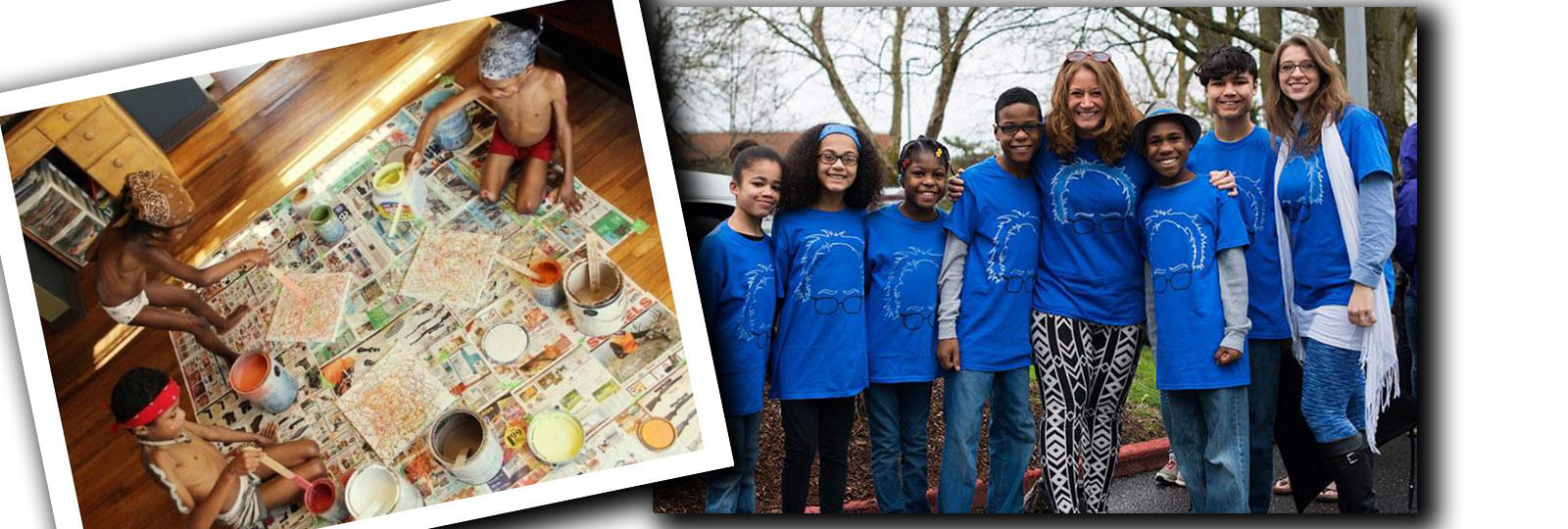
Last week, dozens of pages of reports from child-welfare officials were released that offer harrowing details of the abuse that six Black children suffered at the hands of their adoptive white parents, Jennifer and Sarah Hart, in Washington State. A drunken Jennifer drove them all off a 100-foot cliff in Northern California in the family’s SUV. Markis, 19, Jeremiah, 14, Abigail, 14, and Ciera, 12, are all confirmed dead; Devonte, 15, and Hannah, 16, remain missing, but are feared dead.
But while the report provides a lot of disturbing details about the degree of physical and emotional abuse, it poses more questions than offers answers, and paints a gruesome portrait of the parents, who beat and starved and gaslighted their children before murdering them all, and committing suicide.
The child-welfare reports revealed that officials in Minnesota, Oregon, and Washington State recorded incidents of neglect and abuse, and people in their communities noticed there was something off. The children were malnourished and were described by neighbors as behaving “like trained robots” and “like little soldiers”; they were forced to raise their hand before speaking; they were punished for laughing at the table and for “stealing” pizza from the fridge when they were hungry. In 2011, Sarah Hart shoved banana and nuts into her daughter Hannah’s mouth after the girl had told the school nurse she hadn’t eaten, and then Sarah said she was “playing the food card” and to just give her water. School officials witnessed this. Neighbors. Friends. They’d seen the kind of meticulous, orderly and punitive unlivable environment they’d set up for their six beautiful Black children, whose souls they were trying to crush.
Rather than face the consequences of their actions, they chose to flee and kill themselves and their whole family just as they were being pursued by the Department of Social and Health Services, who showed up at their door on March 23, in Washington, to find an empty house. They came, incidentally, following a call it took a neighbor six months to make, after Hannah jumped out of a second-story window at 1:30 a.m. and scrambled into her home home asking to be hidden, and telling the neighbor that her racist parents whipped her with belts and begged her not to make her return to the Hart household.
Every contribution we get from readers like you allows us to keep reporting and keeps our content free and accessible for everyone. Our reporting digs deep into the important policies, issues, and cultural trends that matter most in these unprecedented times. Join now to help fund this important work.
I honestly don’t know what could motivate a parent to exact such abuse on children. And I can’t tell whether these women were trying to, consciously or not, fulfill some deranged modern-day plantation narrative or live out a Blind Side fantasy, but regardless, their position as the racial superior, be it as the slave master or the white savior, was all but assured. They were raising young Black children to be beholden to them, to worship them, to submit to them.
Many people are still trying to make sense of this nightmare. While some of their friends continue to defend the mothers, this case reveals a lot of discomforting truths about race in America. One: Why are their friends still defending them? Two: Why, when there were members of the children’s own family availing themselves to care for them, did the system insist on placing the children with the Harts? And after so many citations in so many states, why didn’t anyone intervene and sooner?
The complicity of systems that conspired to keep these children in these women’s care is as violent as the household in which they were enslaved. These pages of documents can attest that these children were far from safe. That this could have been stopped before it was literally too late.
The Hart children are not an isolated incident either: Cassandra Killpack, Michael Tinning, Hannah Grace-Rose Williams, Lydia Schatz, Timothy Boss, Hana Williams, Ahmad King are Black adoptees murdered by their white adoptive parents. You wonder why. Why did these parents take in these children and kill them? And why were they not screened carefully? Why was no one paying attention to allegations of abuse?
Officials hope that by releasing these documents on the Hart case, much can be learned to prevent future tragedies like this. Just a few highlights from the child-welfare reports paint a portrait of a perfect storm of narcissism and twisted white imagination. A portrait of a white couple who gained control over threatening Black child bodies and changed the way they experienced themselves as white liberal women.
These women could not successfully live out the experience of transforming a brood of Black teens into things that white people could control, that they could experience salvation from, and gain social credibility. I have to ask, why were these two white women posting photos of their Black children in their underwear on social media? Why did they post a late-night video of Devonte dancing in his briefs in a dimly lit living room on YouTube? I think as a culture, folks have long been comfortable with seeing nude and half-nude bodies of Black children. It’s so normalized that people don’t see it as exploitative or fetishistic or pornographic.
But they’re children. They’re minors. They don’t have agency in the matter. They’re being put on display for the enjoyment of strangers. We see photos of them being offered up for free hugs to white people— police officers no less—and to a white male singer, who is fondling Devonte’s head. Black people are very sensitive about strangers touching their children’s heads and hair—especially white people.
White people have a long history of sexualizing Black children under the guise of anthropology; in pediatric literature; in the circulation of consumer goods imbued with pedophilic themes. In medical literature, doctors crudely examined and graphically described Black children’s genitals. They’ve done this sexualization in ways that makes it seem like they aren’t. The ultimate catnip high for some white liberals is to get sexual and social gratification by their proximation to Black bodies and Black life.
Amid the intimacy of an abusive transracial adoptive home, I feel the Harts were rendering their kids vulnerable by posting videos and photos of their half-nude bodies onto social media for others to fetishize them.
And then there are the new photos that emerged on social media last week. They show some of the kids wearing underwear, looking gaunt and malnourished, with swollen bellies, and bones protruding through their skin.
Why did they starve these children?
The kids’ skin and bones reminded me of starving kids from foreign countries in crisis. You starve people to weaken them, and indeed that’s just what they were doing to their children—weakening them physically, breaking them emotionally, to stunt their growth and to maintain their savior narrative. They wanted their Webster and Diff’rent Strokes children because white people have long feared growing and maturing free Black bodies in their midst—and don’t want to risk the possibility of insurrection or revenge. They created their carnival freak show that would allow these six kids to be infantilized forever so they wouldn’t grow up to be a threat to them, to white society, or to fulfill their potential as full autonomous Black adults.
One witness told authorities that the mothers staged photos of the children smiling and looking happy. After the photos were taken, the kids would go back to being listless and the mothers acted disinterested in the children. Even in the photos of the children at play their bodies seemed very ordered and controlled. In their moments of “play,” the kids appeared organized, lined up, kept into place. Regardless of who set up these play areas, the meticulous play areas evoke a level of anxiety that is common among abused kids, who tend to play this way because they feel the world around them is so chaotic—and, but also because their abusers need to craft a façade of orderliness, as if that somehow undermines or distracts from any suspicions or allegations of abuse.
While local and national media outlets that analyzed these reports noted how tragic and disturbing these details are, they all stopped short of going deeper on the racialized sadism that jumps off the pages and harkens back to the slavery era when white plantation mistresses, America’s first transracial adopters, meted out brutal treatment against enslaved Black children. The way Sarah and Jennifer were controlling these children—starving them, keeping them in line in this creepy way, humiliating them, calling them liars and gaslighting them—reeks of racialized control, amusement, and ownership.
White people also have a long history of fetishizing racial Others that they fear. Sarah and Jennifer would give every indication of having had a deep and unspoken inherent fear of Black people.
But … but … but they adopted Black kids, people say.
Which is supposed to absolve them of what, exactly? Is the Duck Dynasty family any less racist for having adopted a black baby? I believe the Harts’ fear of blackness made them desperately desire a relationship with Black bodies they could touch, control, manipulate, and work over in ways that could be hidden. Perhaps some of the abuse the Harts meted out onto their children was subconscious. Maybe they imagined or could only see themselves as kind and good parents. Which is why anyone who disagreed with that self-assessment was consistently removed from their lives or why they constantly moved from state to state. So much of what they did—their social activities, especially—seemed focused on maintaining this magnanimous façade.
But this falls into a textbook case of narcissism. They needed to be seen the way they saw themselves. Anything that threatened that would have been unbearable. If their kids could tell the truth or break the façade they crafted for themselves they would have to die too—and so they did. Narcissists only see other people as extensions of themselves, not as whole, independent people with their own purposes and lives.
Their supporters saw on the most superficial level two white liberal ladies who “saved” two sets of siblings who might have otherwise been separated by the system, bounced from foster home to foster home or worse, and implicitly and wrongly trusted them. They manipulated and subverted that trust for their own sick purposes. Sarah and Jennifer might not even have been fully aware of what motivated them, or even realized their racism. These are the types of white liberals who psychologically haven’t dealt with their shit and are in denial (I couldn’t be racist! I’m a liberal!). They are much more destructive because it’s all subconsciously driven as opposed to outright racists who can be spotted, whose moves are obvious and can be countered.
These six precious children were never human to these women. What folks can’t reconcile is that Sarah and Jennifer Hart were people who were functional in polite society and were also cruel to their Black children. But this is not an anomaly. These were not just bad people who made a mistake. These are completely functional white people in white supremacist America who sought to commodify and abuse Black bodies.
Yes, child-welfare officials are right: It is absolutely critical that we learn everything we can about what went wrong in the Harts’s household. We need to keep talking about this case; about the role of white saviorism in transracial adoptions. The friends who missed the warning signs of abuse and remain in denial about the fact that they didn’t see anything because they probably didn’t see these Black children as fully human either. We need to talk about how to protect children who are homeschooled and don’t come into frequent contact with mandated reporters. We also need to talk about how the courts too quickly removed the children from their biological families and how social services agencies weren’t able to track the Harts from state to state.
And we must discuss the intersections of race and parenting.
We talk a lot about intergenerational race trauma from the standpoint of the victims, which we should. But rarely do we interrogate and examine the other side of that coin—the passing down of intergenerational white sadism. What the Hart tragedy shows, and the scores of cases of children of color who’ve been killed by their white adoptive parents proves, is that we need to keep turning the gaze back onto whiteness in all its funhouse-mirror forms.
We urgently need your help!
Covid-19 has dramatically impacted our ability to keep publishing. DAME is 100% reader funded and without additional support, we can’t keep publishing. Become a member at DAME today to help us continue reporting and shining a light on the stories that need to be told, from perspectives that aren’t heard enough. Every dollar we receive from readers goes directly into funding our journalism. Please become a member today!
(If you liked this article and just want to make a one-time donation, you can do that here)