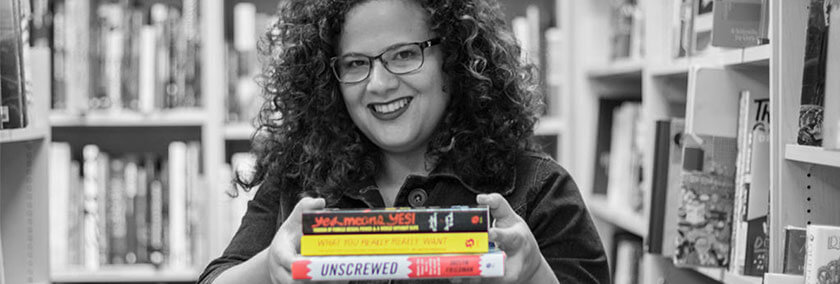
The 'Unscrewed' author talks with DAME about "fauxpowerment" and Hugh Hefner, the fate of Roe v. Wade, and the inevitability of the current brutal backlash.
We urgently need your help. DAME reports the stories that need to be told, from perspectives that aren’t heard enough. In times of crisis it is even more critical that these voices are not overlooked, but COVID-19 has impacted our ability to keep publishing. Please support our mission by joining today to help us keep reporting.
In her work as an activist and writer, Jaclyn Friedman has already taken on issues of rape and rape culture (Yes Means Yes: Visions of Female Sexual Power and a World Without Rape) and female pleasure (What You Really Really Want: The Smart Girl’s Shame-Free Guide to Sex and Safety), as well as helping to force Facebook to change its standards for sexist language and images. She’s spoken on college campuses, television and radio shows, and her own podcast, Unscrewed, about issues of sexual liberation. In her new book Unscrewed: Women, Sex, Power, and How to Stop Letting the System Screw Us All, Friedman tackles all of it—the whole tangled web of entrenched, systemic sexism and all its modern iterations. The book ranges from pop culture (i.e., how empowering is it to post nude selfies?) to the seriously political (how close is the religious right to overturning Roe v. Wade?).
DAME talked with Friedman by phone.
Every contribution we get from readers like you allows us to keep reporting and keeps our content free and accessible for everyone. Our reporting digs deep into the important policies, issues, and cultural trends that matter most in these unprecedented times. Join now to help fund this important work.
I just finished reading your book, and I have to say, it covers so much ground! Did you know, before you began working on it, what a big job it would be?
I did an enormous amount of research even for the book proposal. This was a really hard project for me. When I sat down to do it, I had several months’ writer’s block. I figured, if I’m going to untangle or at lest map out all of the systems that are hemming in our sexual freedom, where does it take me? As you can tell, it takes you a lot of places! I was in fear I was going to leave out something important. It’s just very sensitive material, and very complex, and I hope that I have adequately wrapped my arms around it.
Your first chapter talks about the idea of “fauxpowerment,” a kind of easily consumed empowerment message that you say is essentially fake. What do you mean by that?
There’s a lot of focus, when we talk about women and sex and power, on the idea of sexual empowerment, and it’s a very individualistic idea that focuses on an individual woman’s choices and behaviors. Even in its most benign iterations, it misses the forest for the trees. Women need actual access to power; we don’t just need to feel happier about ourselves. There’s a story in the book about a young woman who was having body image issues and a friend encouraged her to get a boudoir shoot, a sexy photo shoot, to help her feel better about herself. And it worked! And she felt better enough about herself that she shared it with her boyfriend. And that’s great—that’s the empowerment happy ending, right? But the actual story goes, they broke up, and he published the photos on the internet without her consent and she was deluged with rape threats and became suicidal and didn’t want to leave her house. So she’s not actually being made free by taking those photos, even though they made her feel good about herself in the instance. She’s not actually free until we live in a world where men don’t feel free to completely disregard women’s consent, and where women aren’t shamed for that kind of sexual expression.
You talk about Hugh Hefner as a kind of poster boy of fauxpowerment; that Playboy offered this version of female empowerment that rested on women posing naked for male gratification. But empowerment means nothing if you don’t actually have power.
What do you make of Roy Moore and his statement about how he only “dated” teen girls with their mother’s permission, and that they were “good girls”? There’s a lot to unpack there about good girls, bad girls, and religion and sex.
It actually reminds me of something Hugh Hefner said once about who the ideal Playboy Playmate was: He talked about her being a simple, natural girl, a “girl next door” type, and he contrasted her with this imaginary sophisticated woman, who has filthy thoughts and wears fancy underwear. And I thought it was so revealing because the male analog to the woman he describes who is the opposite of desirable for him is actually his male customer, who’s sophisticated and probably wears fancy underwear! And so the idea is that the good girl is one who is pliable and unsullied, and I think that’s what Roy Moore is saying, too. Roy Moore doesn’t have any trouble sullying them himself—because in Moore’s worldview, for certain, any kind of sexual contact dirties a woman. It’s very Biblically old-fashioned, and that’s not surprising. He comes out of an Evangelical movement that really does see women as sexual property in a very literal way. It’s the most extreme expression of that that we have in modern American culture.
You have a chapter in the book about how religious fundamentalism affects societal views of sexuality. It really feels lately like we’re in being dragged backwards by these views. Am I crazy, or has there been a pretty big retrenchment in the last few years on things like contraception, which didn’t used to be considered controversial?
There’s no doubt that we’re in a time of backlash. I think a lot about Susan Faludi’s book The Terror Dream, about how in times of war and fear the culture becomes more socially conservative and how that reflects in a post-9/11 world. And it’s also a response to the idea of progress that Obama symbolized—how much he actually enacted it we can discuss—but Obama symbolized a very radical progress to some people in a way that they felt uncomfortable with. And it made some folks feel like they have to “make America great again,” which is all about nostalgia for an imagined past in which everybody basically knew their place. And that has to do with women and contraception and sexuality just as much as it has to do with race and class.
But then on the other side we’ve got women using their sexuality as if it’s their only route to power.
I don’t know that there’s a left/right paradigm, but I do think there are two narratives that are both flawed. One is that girls and women should empower themselves by being as sexy as possible: That’s the Kim Kardashian school of empowerment, when she posts a naked selfie and says “this is empowerment.” I have no concern about her posting a naked selfie, if that makes her happy; that’s her business. I literally have no judgment of that. But I don’t think it’s giving women any power to be consumed as a naked image. It’s not very revolutionary. And there are also the folks—you hear them on the right, but you also hear them on the left, like in Ariel Levy’s work—who say women shouldn’t participate in sexualizing ourselves, we need to not participate in being so sexy. But both of those arguments are focusing on individual women’s choices. What I’d like to see is a world where I can post a naked selfie or not post a naked selfie and no one’s going to abuse me either way, and it’s genuinely a choice I get to make based on my personal expression, and doesn’t have to do with social stigma, and I don’t have to worry about violence and reprisal. That would be actual power.
The heart of your book is you talking to a number of people who are trying to get us closer to that world. One chapter visits the project headed by Tani Ikeda, with young women of color making videos about their lives. Is it stuff like this that gives you hope?
I take hope from those young women, absolutely. But I also take hope from Loretta Ross, who has seen and made enormous change in her lifetime. Things are far from great now, but they are a lot better than when she started in the 1970s. I take hope from all of us—that’s the point of including the multiplicity of stories of folks that are doing good work to make the sexual culture better. That hope can take a million different forms: it can be a pastor training clergy to defend reproductive justice using the Bible, or it can be a bunch of queer kids in a basement in Harvard Square. I take hope from the fact that we’re all still working on it.
I think a lot about Cherisse Scott, the Memphis pastor who runs Sister Reach, who’s working on repro justice from a Christian perspective. As a Jew, I didn’t know a lot about that world—I didn’t even know that it doesn’t mention abortion in the Bible, which you certainly wouldn’t know from modern American discourse. Here’s this woman, this bisexual woman of color who came up in the church and had her own incredible struggles, both within the church and outside of it, in terms of sexual violence and her own identity, and who’s found her voice and her place. And she’s just refusing to cede Christianity to the folks who want to use it to control and instrumentalize women. And I think that’s profoundly revolutionary.
I was really freaked out reading that chapter, just imagining the chair with the towels on it, and the porn You also describe growing up in a family that relentlessly tried to keep you safe from boys and sex. And that you grew up feeling like you liked sex but not knowing how to have an orgasm. How much do you think that played into your interest in the subject?
I came to this subject originally as an anti-rape activist, through my experience of being sexually assaulted in college. I was already a feminist activist on campus when it happened. But it certainly radicalized me, and made me a lifelong activist on the issue of sexual violence. And the more I did that work from a bunch of different angles, the more I began to understand that you can’t address sexual violence without addressing the sexual culture. And I think that realization inspired me to unpack a lot of my own history. I didn’t write about this in the book, but after I was sexually assaulted, I felt like I had to reconstruct my sexuality from square one. All of my assumptions about how I was in my body were violated. So I really had to start over, I questioned everything about my sexuality. And I think that put me in a good position to start thinking bigger thoughts about the sexual culture as well. I’m always reluctant to talk about that because I never want to make it sound like it was a good thing I was sexually assaulted, but I have made an enormous amount of meaning from that horrible experience.
So where do you think feminism goes now? Your book walks us through second- and third-wave feminism, Riot Grrrls, and Slut Walks. Do you think there’s a new era of feminism dawning, or a new way we need to approach how we think about feminism?
I do think there’s a lot of feminist energy this year, not just the Women’s March, but women at the head of Indivisible and Black Lives Matter. This past month has been extraordinary in terms of feminist activism. We are in season of feminist rage. I don’t really love wave theory, I think it only holds so far, but there could be a feminist renewal happening right now. And my hope is that we go back to thinking about systems, and to resisting the idea that feminism just means being nice to other women, that whatever women do is empowering. Feminism is not a sorority. Feminism is a social movement that stands for things. Feminism isn’t concerned about whether you wear lipstick or not, or whether you take pole-dancing classes or not. You should be free to do those things, but that doesn’t make that feminist acts. Feminism is concerned with the society standing of women, and our social freedom, and whether or not women get to be perceived ultimately as three-dimensional full human beings, citizens of the world. And I feel like feminism is like digging deeper again, and that makes me really happy.
We urgently need your help!
Covid-19 has dramatically impacted our ability to keep publishing. DAME is 100% reader funded and without additional support, we can’t keep publishing. Become a member at DAME today to help us continue reporting and shining a light on the stories that need to be told, from perspectives that aren’t heard enough. Every dollar we receive from readers goes directly into funding our journalism. Please become a member today!
(If you liked this article and just want to make a one-time donation, you can do that here)

I was young and naïve, but not stupid. The powerful editor held the key to my career. I sent him a pitch and clips, and to my surprise, he said yes, please send more pitches. I met him in person, and we hit it off. I was so excited, a door that had been closed to me before was now open. I sent the pitch, long and detailed, and he sent me a long, detailed response, and then I wrote back, and we did this again a few times, back and forth.
But it felt a little too … intimate, these emails. They felt like flirtation, like courtship. I had been warned by a few female publicists about the editor, and I had brushed them off. I didn’t want to believe that I was only getting a shot because the editor thought I was hot. I wanted to know that it was my talent that had opened the doors.
The women who came forward this week with allegations of inappropriate sexual advances on the part of powerful political reporter Glenn Thrush and Charlie Rose are also probably wondering, “Did he only talk to me so he could hit on me?” In a Vox exposé, Thrush is being accused of getting drunk with women and making advances, and then allegedly starting a whisper campaign that compromised the younger female reporters’ reputations, by insinuating that it was them, not him, who made the advances. He issued a statement to the New York Times where he has been suspended while the paper investigates the allegations. “The encounter was consensual, brief, and ended by me,” he said of Laura McGann, who wrote the Vox article. “She was an editor above me at the time and I did not disparage her to colleagues at Politico as she claims.”
The other women at Politico either looked askance, or brushed it off because Thrush, one of the hottest political reporters in the world right now, could mentor them, could offer them introductions to powerful editors, give them notes on their stories and reporting tips.
Every contribution we get from readers like you allows us to keep reporting and keeps our content free and accessible for everyone. Our reporting digs deep into the important policies, issues, and cultural trends that matter most in these unprecedented times. Join now to help fund this important work.
The Rose allegations in the Washington Post are even more outrageous—he allegedly Weinsteined his assistants and underlings, coming out of the shower half-naked, making sexual passes in cars, and allegedly retaliated in passive aggressive verbal abuse. (Rose issued statements apologizing for his indiscretions and claimed that he had misread the situations as being consensual).
But the thing is: There are Roses and Thrushes working in your office right now, editing the stories you are reading, getting pitches from men and women, and giving them mostly to other men. To any woman who’s ever been 20 and new to journalism, a guy like Thrush is a dime a dozen. That’s because journalism is still dominated by men, especially at the top.
Women’s Media Center reported in its 2017 study that “20 of the nation’s top news outlets, men produced 62.3 percent of news reports analyzed during a studied period while women produced 37.7 percent of news reports.”
Julie Burton, the president of the Media Center, wrote in the introduction to the report: ”Too many male CEOs, producers and editors remain in their comfort zones and default to hiring and promoting those who are like them. Male executives must be willing to intentionally chart a different course, expand the talent pool without trepidation and develop a more concerted and, perhaps, radical strategy for equally sharing power with women.”
VIDA, a “non-profit feminist organization committed to creating transparency around the lack of gender parity in the literary landscape, has been tracking the number of women published in high-end literary magazines and journals such as the New Yorker, the Atlantic, and N+1, finds that there is more work to do: in 2016, there was “a decrease in women’s share of the pie overall from last year. In 2015, 58% of counted publications demonstrated gender parity, while this year, only 48% of counted publications published as many bylines by women writers as men, or more.”
What happened to me and thousands of women before me, and thousands of women after me, and is still happening now, is upsetting on several levels. This behavior is insidious, it’s institutional, and it’s not even acknowledged as a problem, because that would mean burning the entire thing down.
It might have been both. But what’s most upsetting is that no male writer would ever have to question whether or not they got an opportunity based on their looks. They might have gotten opportunities based on their ability to bond with the male editor, or the fact that they went to the right school, or gotten hired through nepotism, but most men don’t even realize that those things also get them through the door. They are so self-assured of their own power and intelligence. That’s male privilege, undoubting, unquestioning of their rightful place in the world. The irony is this male editor was instrumental in giving a lot of female writers a shot in an arena that was male-dominated—whether for the same reasons as he gave me mine or not, it was hard to say.
The male editors (they were almost exclusively male) were ten or twenty years older, better paid, higher ranking, and they were always very interested in what I had to say … perhaps over dinner, perhaps drinks. Maybe it was nothing, just a nice introduction into the new world of media that I had entered, a friendly, collegial meeting of the minds. But, I think about it now, I don’t take any young writers out for drinks, male or female, I don’t take them to dinner to talk about their future. Maybe I should. But, me 27 years old, pretty, ambitious, it happened over and over.
The male editor I pitched at the big glossy magazine was undeniably flirtatious but was also discussing a big story over drinks in a crowded bar. We sat close to each other as we dissected the possible angles and the pitch. I wanted that story, it would jump my profile up a notch, but I was confused by the energy. Was he hitting on me? Was my story good? Was I being strung along for attention? People around me thought he was flirting with me, that we were flirting with each other. My excitement for the possibility of a big break, granted by this man, had me flush with excitement. They didn’t realize we were having a business discussion. The story floundered, and the editor disappeared from my view.
Another editor, another magazine, a meeting of minds, over dinner, which felt like a date. But we clicked, the same way you do on a date, but the underlying subtext of attraction flowing in one direction felt like an undercurrent, pulling like the tide. The thing about journalism is that it’s a collaboration. Any writer who says, “I loved that editor, they never touched a word,” is a coward, afraid to learn how to get better, afraid of their ego being bruised. So, as a writer, you look for that editor who really gets you, the first sign is how you hit it off when you are bouncing those ideas around. And when there’s a good edit, oh, it’s like digging a Q-tip into your ear after a shower, getting a good scratch on a part of your back that you can’t reach. And relief that you have found someone who can make you better.
And because so many editors are men, most of them are older than you, that “click” can be confusing.
There are those who will insist this date-like dynamic is impossible to escape when men and women have intimate conversations over drinks. This is a preposterous idea that’s not only heterosexist but also demonstrably wrong. When I was in my mid-20s, I interned at the Village Voice for Frank Owen, a loud British journalist with long, glossy black hair who had a penchant for wearing pink and getting into political arguments. He was a former music journalist who had started covering the seedy underworld of nightlife, breaking news on murders, drug rings, and the Mafia. He took me everywhere with him as he made the rounds at various clubs. He took me to meetings and interviews, introducing me as his associate, never his intern. It was a sign of respect, and he gave me real tasks, and never asked me to fetch coffee or open his mail. We shared a byline on a cover story about female DJs, an idea of mine that we had executed together, and that he wrote. I sat with him during the editing process, watching Richard Goldstein nimbly edit the story. I interviewed DEA agents for him, I listened to him conduct interviews, and factchecked his stories. At the time, I was acutely aware of how different Frank was‚ how he was never creepy or inappropriate, and I was grateful, and still am.
And, to be sure, these tactics employed by men like Thrush had worked on some women in the media. There are a few women I know who’ve slept with the harassing boss to get a leg up, literally and figuratively, whose careers saw a real boost from their exchange of sex for power. And the media perpetuates the notion that pretty female journalists all sleep with their bosses and/or sources—see also: House of Cards, Newsroom, Trainwreck. These women are not the norm, but the exceptions. Most of us did everything in our power to make sure that we were not sleeping or flirting with the boss or editors, or our subjects and sources. We needed our work to be taken at face value, to know that our worth as journalists, our talent, was valid. It’s ironic that in the male-dominated media landscape, we still needed male validation, albeit of a different kind.
It’s no surprise, then, that the best editing experiences I’ve had in my career are with other women. There is no confusion. They like your writing. They like you. They have been where you are, they want to lift you up. They want to help. They want you to be better. You click.
The conversation about diversity in media is more than just filling in the Xs and Os to meet the diversity standards. It is about how people who are from similar backgrounds and lifestyles, similar genders and races, can often see eye to eye more easily than not. An all-white-male upper-class newsroom naturally engenders more all-white-male reporters and editors who pursue stories that reflect their interests and points of view. In a job market where it’s almost entirely “who you know,” the cycle is never broken.
I’m still friends with most of those male editors from my youth. They are all good people. But I’ve never told them that I felt our original interactions were compromised by power and an imbalance of attraction. I’ve never told them that they made me feel uncomfortable instead of valued for my ideas. I don’t know that they meant our interactions to feel that way or were even aware of their actions. Over the years, that awkward interaction has faded as I’ve gotten older, as they’ve moved on, as I’ve grown into my own power. But sometimes I will wonder if I am where I am because someone thought I was pretty enough to fuck.
We urgently need your help!
Covid-19 has dramatically impacted our ability to keep publishing. DAME is 100% reader funded and without additional support, we can’t keep publishing. Become a member at DAME today to help us continue reporting and shining a light on the stories that need to be told, from perspectives that aren’t heard enough. Every dollar we receive from readers goes directly into funding our journalism. Please become a member today!
(If you liked this article and just want to make a one-time donation, you can do that here)
The big piece of chicken went to the breadwinner of the house: her husband, Charles. Estelle, my spiritual teacher made that point clear as family and church members piled into the kitchen for Sunday dinner. She hustled about the stove, serving spoonfuls of her culinary labor. She routinely wiped messy spills from the countertops. For several hours, she stood on her feet and barely sat down to eat. By night’s end, her own half-eaten meal was scraped into the trashcan with most of the day’s waste. Her swift pace slowed. Her shoulders were weighted down by fatigue as she hunched over a kitchen sink filled with pots and pans. I offered to clean the dishes to which she politely declined. When I grabbed the broom to sweep the floor, she swiped it from my grasp and shooed me along with a lazy wrist. I asked Estelle why she refused my help.
“She thinks she’s an ARMY all to herself—let her be all she can be, ” said her husband, interjecting in our conversation as he sat at the kitchen table, munching on the biggest piece of chicken. He poked fun with his snarky two cents, but he pretty much spoke the truth.
It wasn’t the first time I watched Estelle hog the responsibility. I witnessed and shared in her overzealous self-appointment whenever she helped and rescued so many other people in her life. That was how she was. And yet when it came to her own life, she approached her challenges passively. Charles divorced Estelle. He up and left her—high and dry—after 40 years of marriage and her dutifully serving him. She was forced to piece together an individual life and fend for herself. Alone and financially strapped, not once did she call in a favor, a loan, a shoulder to cry on. No matter how overwhelming her situation became, she shunned even the slightest overtures to help. Therein lies the issue, the difficulty some women have of receiving—especially in a time of need.
John Amodeo Ph. D., MFT says, in Psychology Today, that “being receptive is tricky,” and connected it to a number of mental and emotional factors that many people want to avoid, like the exposure of vulnerability. He says being subjected to criticism, rejection, and the breach of confidentiality is not worth the risk involved.
Every contribution we get from readers like you allows us to keep reporting and keeps our content free and accessible for everyone. Our reporting digs deep into the important policies, issues, and cultural trends that matter most in these unprecedented times. Join now to help fund this important work.
Women who devote their lives to being of service, yet remain resistant to fulfilling their own needs, not only do so for the reasons Amodeo mentions. They do it because women are socialized to do so. As young girls, many of us learn from our caregivers, and the environment in which we inhabit, that taking care of others and sacrificing ourselves is all for the greater good. In her youth, Estelle learned from her mother, whom she watched cook, clean, shop, shake hands, kiss babies, and balance bills. Beyond earning a paycheck and taking out trash, very little was required of her father. Chores between Estelle and her older brother were unequally doled out, and assigned by traditional gender roles: Estelle would take on the domestic chores like babysitting, ironing, laundry while her brother would take out the trash.
Estelle had ambitions well beyond the domestic realm—she longed to study law. But her father merely praised her good housekeeping and ability to get things done all on her own, while her mother encouraged her to marry because her “talents were in the home.” So she married at age 19, and assumed the role of homemaker and caregiver to her community. As we strive to be good, our giving is internalized as spirit work, as a shiny badge of honor—denying ourselves is often the golden cherry on top. But this idea instilled in us diminishes our personal value. Women come to associate giving with good deed and getting with selfishness. And not many of us want that title. Estelle, like many women, who do the most and unselfishly give of themselves, are in thrall to this skewed moral compass that have wanting women donning do-it-all bangles and Wonder Woman capes for others while leaving themselves out of the equation.
I am well acquainted with these feelings.
During my fifth-grade graduation, my boy crush gave me a peck on the hand and a beaded glass bracelet with shiny gold clasps. I rushed home and thrust my bedazzled wrist in my aunt’s face. I shared the enthusiasm I had receiving the gift. My aunt listened—then advised, “Take it off and give it back.”
For an hour, she preached against accepting things from boys because ulterior motives—because control—because sex. I was embarrassed by her projections—more so embarrassed than when I was forced to return a Christmas necklace I received from my bestie, and the almost-new Sergio Valenti jeans she gave me for my birthday, and the three dollars I borrowed for food, because I forgot my bag lunch on a school bus. I was scolded for each incident and told to relinquish, return, or payback anything gifted me—because I was nobody’s charity case, because receiving portended some unreasonable exchange down the line—because she said so. I understood three things: that I did not deserve goodwill, that gifts from boys had different connotations and consequences that pervert their benevolence, that wanting both—in someway—perverted me. I grew up guarded in friendships and romantic relationships. I shot down accolades, compliments, and love. I believed they weren’t for me, but rather to get something from me. Intimacy was a challenge because I could not receive. It would be years before I shed my impaired perspective.
Atlanta-based psychologist Nadine Josephs encounters these issues with many woman clients, but confirms that not-receiving is particularly prevalent among the African-American women she counsels. She adds that Black women’s struggle with asking and receiving is linked to generational resilience and traumatic events, which cause them to become hypervigilant about self-sufficiency. Josephs identifies these patterns most in patients who were raised by high social achievers and in matriarchal families, where grandmas, mothers, and aunties shared stories of broken trust, abandonment, and financial negligence—where the mantra was “Have your own.” In those families, falling anywhere short of that goal is a major blow to a woman’s ego. Receiving is not an option. Women from those backgrounds, tie self-worth to receiving. They don’t think they deserve—thus, they don’t ask—thusly, they don’t receive. Josephs believes there are ways for women to overcome these challenges and it all begins with self-love. She says it is important for women “to believe we’re worthy in all phases of our lives, be open to alliances, and honest with ourselves about the fact that we can’t always do it alone. If we don’t, she says “we combust internally and externally.”
Being a steward to others is a labor of love not to be confused with self-denial—especially when in need. While living in a society that goes hard to reinforce sexist ideology, women must be mindful of perpetuating these ideas onto themselves. Too, it is equally important that women reject toxic messages, which convey that wanting and needing are not okay. They are—suffering in silence is not. Receiving is a courageous act, one that women in general—but particularly those who pour themselves into others—should be amenable to. We must be vocal. Voice is agency. Closed mouths do not get fed.
We urgently need your help!
Covid-19 has dramatically impacted our ability to keep publishing. DAME is 100% reader funded and without additional support, we can’t keep publishing. Become a member at DAME today to help us continue reporting and shining a light on the stories that need to be told, from perspectives that aren’t heard enough. Every dollar we receive from readers goes directly into funding our journalism. Please become a member today!
(If you liked this article and just want to make a one-time donation, you can do that here)