
Thanks to World Land Trust funding, habitats around the world are being preserved and endangered species, from the spectacled bear to South American coati, are being protected
-
1 Rainbow cuckoo wasp (Chrysis mionii)
A rainbow cuckoo wasp visits a flower. Just like a cuckoo bird leaves its eggs in the nests of other birds, these wasps lay their own eggs in the nests of unrelated host species. This family of spectacular wasps share the Latin name Chrysis, which means ‘gold-embroidered dress’, referring to their metallic exterior. They are most likely to be found in desert regions, such as in the Renosterveld Cape Floral Kingdom in South Africa, which is funded by the World Land Trust (WLT).Photograph: Odette Curtis Scott/Overberg Renosterveld Trust
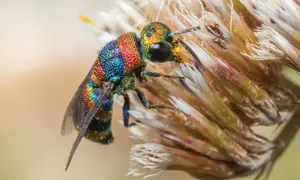
Rainbow Cuckoo Wasp (Chyrsididae). Credit Odette Curtis Scott -
2 Amazon river dolphin/pink dolphin (Inia geoffrensis)
It’s dinner time as a pink dolphin catches a fish in its long, narrow beak. A freshwater cetacean, it’s memorable for its rosy hue. Sadly it is now found in only three river basins in South America, endangered by fishing, hydroelectric dams, the dumping of mercury in waterways, and toxins released by algae. But WLT partner Nature and Culture International is working with local and indigenous communities to create a protected area in Ecuador’s Orellana province, across 750,000 hectares.Photograph: G&M Therin-Weise/Getty Images/imageBROKER RF
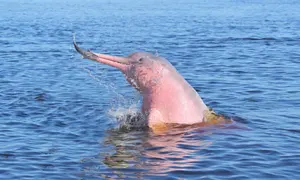
Hunting Amazon River Dolphin or Pink Amazon Dolphin (Inia geoffrensis), Rio Negro, Manaus, Amazonia State, Brazil -
3 Spectacled bear (Tremarctos ornatus)
Mother keeps an eye out as her cub nuzzles for comfort. The spectacled bear, or Andean bear, is the only bear that comes from Peru, so we may safely assume these endearing creatures inspired the fictional Paddington Bear. Another clue – Paddington’s penchant for marmalade might be inspired by the spectacled bear’s own eating habits – it is vegetarian, usually dining on fruit, leaves, and honey. Numbers of these bears have fallen rapidly due to hunting and loss of habitat, but WLT-funded projects in South America are working to protect them.Photograph: Getty Images
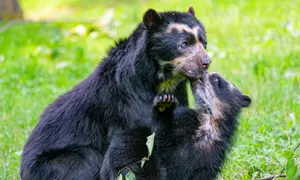
Spectacled bears, mother with youngA cute action shot between son and mother spectacled bear! -
4 Albino Bell’s false brook salamander (Isthmura bellii)
What’s missing from this photo? Some might say this false brook salamander is lacking its iconic dark black colour and fiery orange spots. This curiously pale albino salamander was found a few years ago by a local teacher on the pavement in Pinal de Amoles, in the WLT-funded Sierra Gorda Biosphere Reserve, Mexico. They contacted Roberto Pedraza Ruiz at WLT’s partner, GESG – who drove for more than an hour to photograph it. It was safely released into the forest, and described as the first known record of albinism in tropical salamanders.Photograph: Roberto Pedraza Ruiz/Grupo Ecologico Sierra Gorda (GESG)
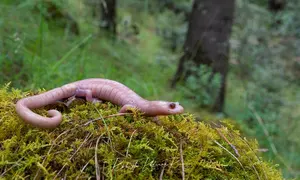
Credit Roberto Pedraza Ruiz. Albino Bell s False Brook Salamander -
5 South American coati (Nasua nasua)
Cosy moments between two coati, members of the raccoon family. The name ‘coati’ comes from the Native American words cua, meaning belt, and tim, meaning nose, and refers to the manner in which they tuck their noses into their soft, fuzzy bellies while sleeping. The South American coati lives in forests from Colombia all the way down to northern Argentina, but is under threat from hunting and forest fragmentation. It is protected by WLT projects in Brazil, Paraguay, Argentina, Bolivia and Ecuador.Photograph: Andrea Ferreira
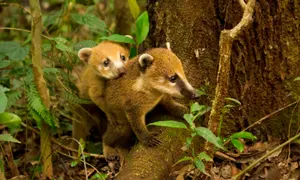
Coati from World Land Trust - Credit Andrea Ferreira. Credit Marko Nara -
6 Aardwolf (Proteles cristatus)
A sprinting aardwolf (‘earth wolf’) is photographed mid-stride as it gallops through the shrubby plains. Though it may look like a hyena – and is even sometimes categorised as one – the aardwolf is in fact an insectivore, and uses its sticky tongue to catch and eat harvester termites. In South Africa’s Renosterveld – one of the most threatened habitats on Earth due to agriculture and cattle operations on its fertile soil – they share the landscape with caracals, aardvarks and black harriers, and are protected through WLT-supported reserves.Photograph: Fabian Plock/Shutterstock
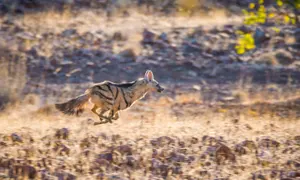
Rare nocturnal Aardwolf running or fleeing in golden afternoon light -
7 Hamerkop (Scopus umbretta)
After scanning the shallow waters hungrily, a hamerkop clutches a freshly snatched fish in its bill. Its Latin name, Scopus umbretta, comes from the Latin for ‘umber’, or ‘dark brown’, a nod to its shady brown plumage. Found across sub-Saharan Africa and south-west Arabia, the species is protected in several WLT-funded project areas. Hamerkops build enormous domed nests near wetlands of all kinds, but they are remarkably tolerant of humans, and often nest close to villages too, if suitable.Photograph: KvdB50/Getty Images
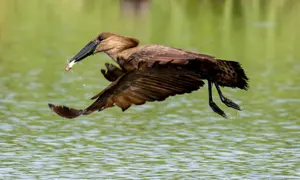
The hamerkop (Scopus umbretta) flying over water finding frogs -
8 Golden poison frog (Phyllobates terribilis)
One of the planet’s most poisonous animal species considers its next move. Endemic to a small tropical rainforest in western Colombia, this frog carries 1,900 micrograms of poison – enough to kill 10 people or two elephants. Even the deadliest of species aren’t safe from the threat of extinction. Logging, gold mining, deforestation for agricultural development, illegal crop planting and pollution from crop spraying all pose serious dangers. Since 2012, WLT has supported the Rana Terribilis Amphibian Reserve, to protect this frog and its home.Photograph: ProAves
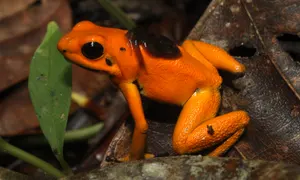
Golden Poison Frog (Phyllobates terribilis) Credit ProAves -
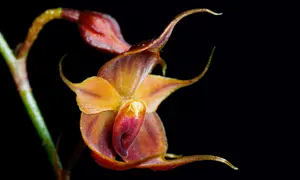
9 Puro orchid (Teagueia puroana)
A newly discovered orchid species survives frozen conditions in the eastern Andes of Ecuador. This species was found on the Puro Reserve by researcher Lou Jost, and is one of the rarest orchids there, growing on the low branches and trunks of isolated and small trees. The puro orchid is named after Puro coffee, which is a corporate supporter of WLT. The orchid joins the new species of Puro frog (Pristimantis puruscafeum), which also inhabits the area and has a distinctive marking on its skin reminiscent of a roasted coffee bean.Photograph: Lou Jost
Credit Lou Jost. Teagueia puroana orchid -
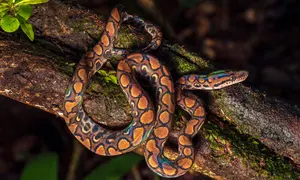
10 Rainbow boa (Epicrates cenchria)
The iridescent scales of a rainbow boa glisten as it encircles a wet branch in humid woodlands. These snakes are non-venomous, and due to their iconic oil slick sheen are highly sought-after for the pet trade. This, along with deforestation, means that numbers are dwindling. But a WLT-supported reserve in the Nangaritza valley, known locally as Maycú, now preserves a vital forest corridor – good news for these mesmerising serpents.Photograph: Thomas Marent/Minden/naturepl.com
Rainbow Boa (Epicrates cenchria) juvenile, Amacayacu National Park, Leticia, Colombia -
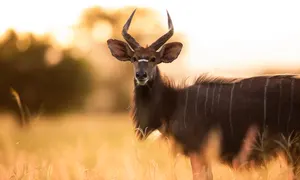
11 Nyala antelope (Tragelaphus angasii)
A male nyala antelope stands alert in golden grasslands. His chalky white markings make for surprisingly effective camouflage, confusing a predator’s ability to clearly distinguish shape or direction. Prey to lions and leopards, they’re known for their exceptional hearing, sense of smell and sight – if they sense danger, they will alert others with a high-pitched bark. In South Africa’s KwaZulu-Natal, they’re an important symbol of fertility in Zulu folklore, and their habitat is protected by the WLT-funded Wild Tomorrow Greater Ukuwela Nature Reserve.Photograph: Chantelle Melzer
Nyala Credit. Chantelle Melzer 2 -
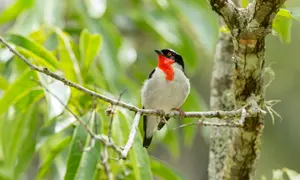
12 Cherry-throated tanager (Nemosia rourei)
Quiet moments of peace as this striking little bird perches on a branch in Brazil’s Atlantic forest. Once feared extinct, the cherry-throated tanager wasn’t spotted for half a century – and now, somewhere between 25 to 50 remain. Preserving Brazil’s most threatened biome is important in bringing it back from the brink of extinction, as these birds depend on insects that live under lichen and mosses encrusted on to the branches of old-growth trees. WLT is supporting a project to extend the Kaetes Reserve by 351 hectares in order to help this mission.Photograph: Gustavo Magnago
Cherry Throated Tanager. Credit Gustavo Magnago


