Apart from Leia Organa — and, to a lesser extent, Mon Mothma — the Rebel Alliance we see in the original Star Wars trilogy appears to be something of an old boys’ club. Aside from the ion cannon crew commander on Hoth in The Empire Strikes Back, in the original trilogy, we only see women in a domestic setting (Aunt Beru) or overtly objectified (Oola, the ill-fated dancer at Jabba’s palace).
That didn’t have to be the case. Deleted scenes and archival footage show that we could have seen three women flying starfighters in Return of the Jedi's climactic battle. In the end, we caught only a glimpse of one — and a man's voice speaks her one line.
So, what happened?
The Lost Rebel Heroines
Actresses Vivienne Chandler, Poppy Hands, and Ann Murray recorded scenes for the film in 1982 at Elstree Studios outside London. The performers were in moving A-Wing and X-Wing cockpit mock-ups, wearing recognizable Rebel pilot gear. They repeat lines, read by an off-screen voice, suggesting the scenes were envisioned as part of the Rebel assault on the second Death Star over Endor.
Of the three, only Hands wound up on screen in the final theatrical release — with her only line, “Got it!” dubbed over by a male American actor before her character falls to a TIE fighter. Although Chandler reportedly attended a screening that included her scenes, she, like Murray, was absent from the theatrical release.
The clips of Murray and Hands appear in deleted scenes released with the Star Wars: The Complete Saga Blu-Ray boxed set in 2011. You can also find it on Disney+ under “extras” for Return of the Jedi. The 2013 digital edition of J.W. Rinzler’s book The Making of Return of the Jedi included Chandler’s footage as bonus content. A 2021 video by YouTube user 70sSciFiBoy combines all three clips.
No one has ever offered an official explanation for the decision to cut the scenes. At least one writer speculated that it might have been due to their accents — two actresses were British, and one was French. In the original trilogy, most Rebels featured distinctly American accents. But that reasoning sounds a little thin, especially considering Sir Alec Guinness as Obi-Wan Kenobi. Even if that was the rationale, the logic hasn’t aged well, given Rey’s English accent as the sequel trilogy’s main protagonist.
A more believable explanation for cutting the women's scenes is that at least two appear to die in the battle. Creators or studio executives may have believed, the reasoning goes, that seeing women dying violently on-screen would have been too intense for audiences.
Of course, that concern runs close to the line of thought that kept women out of combat roles in our own universe for a long time.
That’s not to imply that George Lucas or Richard Marquand were necessarily consciously sexist. Rather, it acknowledges that they made the film in a different time. It’s worth remembering that even though we still have a long way to go, society continues to evolve. While women have been military pilots since the dawn of aviation (for example, another princess — Eugenie M. Shakovskaya of Russia — flew as an artillery and reconnaissance pilot in World War I), it wasn’t until 1993 that the U.S. ended its combat restriction against women.
Small Consolation
Sharp-eyed viewers might notice at least one woman pilot preparing for the Battle of Endor. Actress Lynn Hazelden takes a seat right in the front row of the briefing room aboard the Rebel cruiser. A tweet from the official Star Wars account includes a picture that suggests she survives to celebrate the victory.
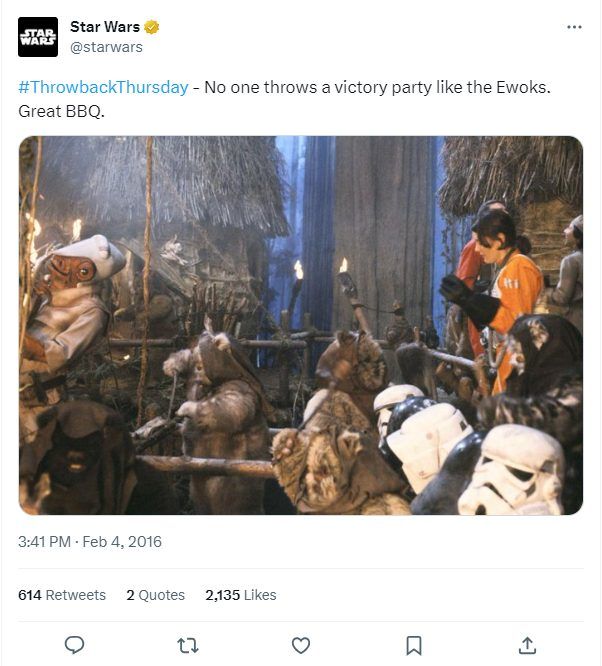
Don’t blink, though, or you’ll miss her in the briefing room, and that shot used in the tweet doesn’t seem to be in the version of the film currently on Disney+. A pilot who might be her appears briefly behind an Ewok drummer, but their face is out of frame.
Despite the editing decision, the franchise didn't completely forget about these women pilots. In the finest Star Wars tradition, Vivienne Chandler, Poppy Hands, and Lynn Hazelden’s characters all had names and appear, albeit briefly, in other media, such as games and reference books, where they get backstories to varying degrees. Amy Richau led off her coverage of the deleted scenes for Return of the Jedi’s 40th anniversary with the women pilots.
Lost Legacy
Of course, that’s not the same thing. Brief glimpses of a background character and appearances in less well-known media hardly make up for the lost opportunity to see brave women pilots helping take down the second Death Star. Even the most ardent book reader would be hard-pressed to say that these appearances carry the same weight as noticeable screen time in a feature film.
I was seven when I first saw Return of the Jedi, and as a little boy, it wasn’t hard to imagine myself in an X-Wing cockpit of my own; in fact, I’d end up making my first career in military aviation. I’m not saying it was because of seeing Star Wars as a kid, but I’m also not saying it wasn’t. After all, not too long after my younger self realized neither X-Wing pilot nor Jedi Knight were feasible career aspirations, another movie introduced me to the fact that there were jobs that involved flying jets from big boats.
I digress — my path isn’t the point other than to highlight the influence the Star Wars franchise has, especially on young minds.
What kind of impact might it have had on a young girl to see women pilots on the big screen as part of the Rebel Alliance?
It’s hard to argue that either 1979’s Buck Rogers in the 25th Century, with Erin Gray as Colonel Wilma Deering, or 1988’s somewhat forgettable Iron Eagle II had the same reach.
Even if it was a product of the early eighties’ social mores, the decision to cut the footage was regrettable. Besides, it seems that the writing could have accommodated those sensitivities without lowering the stakes of the battle or cheapening anyone’s sacrifice. After all, we, the audience, don’t see what happens to one of Jabba’s dancers, but we know what happened. We don’t need to see every pilot immolated to realize they’re lost.
Like much of pop culture, Star Wars still has a long way to go regarding representation. Nevertheless, it’s worth looking back to appreciate the progress made over the past 40 years.
I am grateful to Hillary Mueri and Lauren Trimeloni for their valuable time, insights, and perspectives.
This article originally appeared at wealthofgeeks.com