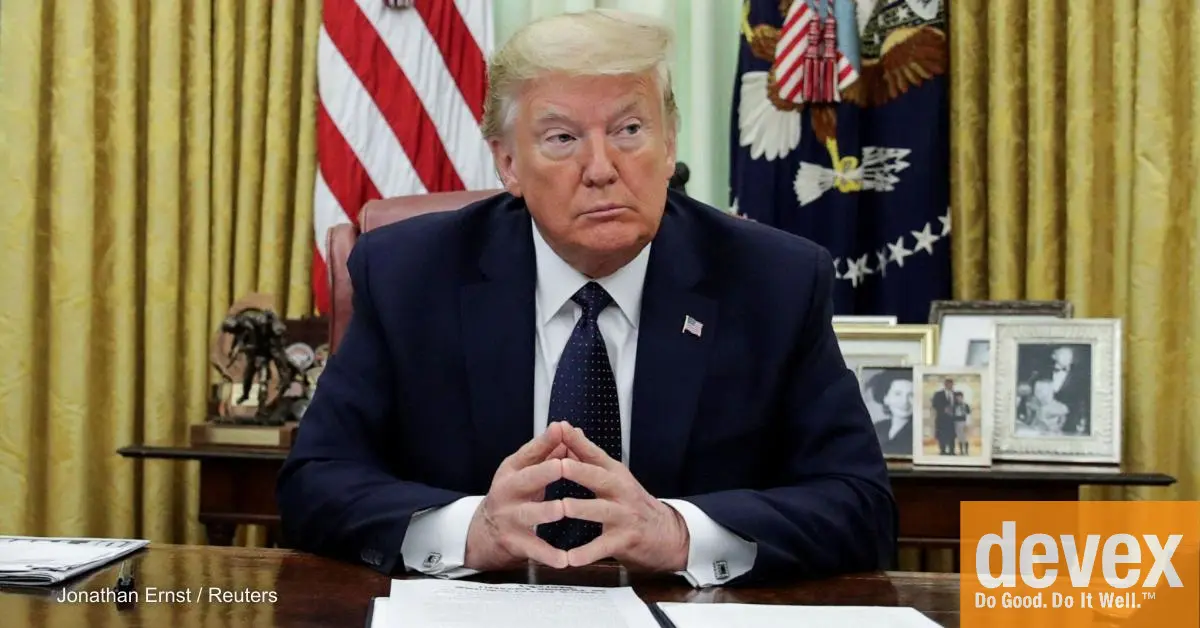
Since being sworn in as United States president on Jan. 20, Donald Trump has left global development professionals scrambling to digest a flurry of decisions that are quickly impacting the sector.
He issued unprecedented orders to freeze U.S. foreign aid and slash funding to the United Nations. Since then, USAID has been shuttered, tens of thousands of people have been laid off, and many billions of dollars of awards have been canceled.
Here, Devex is tracking the impact on development as the new U.S. administration continues its efforts to realign government policies and priorities with Trump’s “America First” agenda.
Feb. 11, 2025 — A new lawsuit pushing back against the U.S. foreign aid funding freeze was filed Monday by a pair of nonprofit organizations that receive funding from USAID and the State Department.
The plaintiffs are the AIDS Vaccine Advocacy Coalition, or AVAC, a New York-based nonprofit that works to end HIV/AIDs, and the Journalism Development Network, or JDN, a Maryland-based nonprofit. The suit seeks to end the enforcement of the executive order that paused foreign aid funding and the stop-work order that discontinued most existing programs.
About 40% of AVAC’s budget came from USAID, and the organization has had to lay off seven of its 46-person team. JDN has lost 29%, leading to a 20% reduction in its staff, as well as decreased salaries and hours for its existing workers.
Regarding last week’s lawsuit that temporarily prevented 2,200 agency staff from being placed on administrative leave, the next hearing will be held tomorrow. More lawsuits are expected to be filed soon, including one that includes USAID contractors.
Tracking staff cuts and impact across USAID partners. Devex Business Editor David Ainsworth pulled together data from various sources to get a sense of the damage that has already been inflicted on development organizations and their staff.
A Devex study of USAID’s largest partners found that roughly a fifth of their income has been lost. Some lost more than 80% of their revenue overnight. Another survey of 568 implementing partners by the Global Aid Freeze Tracker found that around half of all respondents had lost half their income.
This has led to widespread staff cuts across NGOs dependent on US aid funding, with many more expected. The exact total numbers are unclear for now, but thousands have been laid off or furloughed based on reporting, including at the following organizations:
• Chemonics International: More than 600 U.S. workers furloughed.
• DAI: Nearly 400 U.S. workers furloughed.
• Credence Management Solutions: Nearly 400 workers were laid off.
• FHI 360: More than 200 U.S. workers furloughed.
Elsewhere, Catholic Relief Services staffers were told last week to expect layoffs among its workforce of around 5,000. The Norwegian Refugee Council also said yesterday that it has been forced to suspend U.S.-funded work in nearly 20 countries and lay off aid workers without specifying how many.
The website usaidstopwork.com, which has surveyed 67 organizations so far, estimates more than 50,000 jobs could be lost in the US and 100,000 worldwide.
Feb. 10, 2025 — Devex was first to report that USAID's “former” Washington D.C. headquarters building will remain closed, despite the reinstatement of agency staff members over the weekend who were about to be placed on administrative leave.
Some staff members who showed up today were denied entry. The Associated Press later reported that USAID had been stripped of the building’s lease, which it was able to confirm with the Trump administration.
In happier news, the World Food Programme will be able to resume in-kind food aid purchases and deliveries that it carries out with USAID funding. WFP had previously been hit with stop-work orders despite a waiver issued by the State Department for emergency food assistance. An uproar from several Republican members of Congress from agricultural states soon followed.
Feb. 9, 2025 — A USAID team lead has called on staffers to “refuse to comply” with the Trump administration’s stop-work order. Devex was first to report on comments made in a speech to internal staff.
“We must refuse to be ordered to throw our oaths of office in the trash by an unelected oligarch or his cronies,” the team lead said during yesterday’s all-hands meeting with staffers, the first since a federal judge issued a temporary restraining order blocking 2,200 employees from being forced to go on administrative leave.
Feb. 8, 2025 — After a judge's ruling temporarily blocked USAID from placing 2,200 employees on administrative leave yesterday, these employees were notified today that they had been reinstated until Feb. 14.
As a result, these employees will not be evacuated from their host countries and “no additional employees shall be placed on administrative leave” until the 14th, according to the internal email viewed by Devex.
“The ruling is a crucial first step in halting a reckless assault on USAID and in supporting the dedicated professionals who serve our country,” Tom Yazdgerdi, the president of the American Foreign Service Association, said in a statement. The union is one of two that sued USAID, the State Department, and U.S. President Donald Trump.
Despite the ruling, much remains uncertain about what happens next. According to The New York Times, the case is expected to go to the U.S. Supreme Court, meaning a final verdict could be many months away.
Feb. 7, 2025 — The Trump administration moved ahead with its plan yesterday to dismantle USAID, initially announcing a staff reduction of more than 95%. This would have left around 290 people employed by what is left of the agency. This figure was updated to 600 today.
According to the original plans viewed by Devex, 78 staff members would remain in the agency’s Bureau for Humanitarian Assistance, 77 in its Bureau for Global Health, 75 on its management team, 21 focused on the Middle East, 12 assigned to Africa, 10 focused on Europe and Eurasia, eight working on Asia, and eight focused on Latin America and the Caribbean.
Whether or not some of these expected layoffs are final could depend on the outcome of a lawsuit filed late Thursday on behalf of the unions representing USAID employees. The lawsuit argued that the Trump administration’s actions to shutter the agency were unconstitutional and sought an injunction to stop the administration’s actions. These actions include placing the agency’s remaining direct-hire staff on administrative leave at 11:59 p.m. ET today.
Feb. 6, 2025 — The damaging effects beyond the mere loss of work are emerging in the wake of Tuesday’s order placing the majority of USAID’s staff on administrative leave.
Devex’s Sara Jerving reported on the human toll of the agency’s global recall. One worker shared her fears of being able to bring her new baby into the world safely amid the intense stress of being uprooted from her station abroad. “The stress of this entire environment is making that pregnancy complication much worse,” she said. “God forbid this leads to the loss of a pregnancy.”
Back in the U.S., backlash against the Trump administration's dismantling of USAID is intensifying, with thousands gathered outside the American Capitol on Wednesday to protest. Democratic lawmakers, USAID staff, and family members of those affected were among those voicing their outrage.
“To have that sacrifice, and the decades that he spent overseas serving the American people and just trying to help others, being denigrated by our own government is really just devastating,” said Megan Foley, whose father was a former USAID staffer killed by al-Qaida while on a USAID assignment in Jordan.
In terms of concrete actions being taken to fight back against what many deem to be illegal actions to eliminate USAID, congressmembers are pushing five lawsuits forward, including one focused on protecting federal workers like those at USAID. Other lawmakers spoke of putting a “blanket hold” on President Donald Trump’s State Department nominees.
Staff cuts expected at DFC, and budget concerns hitting U.N. agencies.
Meanwhile, the ripple effects of the U.S. aid freeze continue to hit organizations outside of USAID’s orbit. Devex’s Adva Saldinger was first to report on staff cuts expected to hit the U.S. International Development Finance Corporation, or DFC.
Staff members were informed yesterday that all probationary employees would be terminated soon and that other staff reductions are likely to follow.
Some speculated before Trump’s inauguration that DFC might be one of the few bright spots in the sector during his second term, given its establishment and the immense growth it experienced during his first term. However, DFC officials said the agency was responding to the general guidance on reductions of the federal workforce taking place across various agencies.
We’re also learning more about how U.N. agencies might be affected by the aid freeze, thanks to new funding data analysis by Devex’s Colum Lynch and David Ainsworth. A U.N. survey obtained by Devex shows how the order is already impacting the World Food Programme, UNICEF, the World Health Organization, and others.
So far, 19 U.N. agencies reported having received stop-work letters, while six had not. Another 13 were unable to confirm. Of the entities surveyed, 74% said they expected a moderate or severe impact on their budget.
Devex has previously reported on a hiring freeze being enacted at the WHO and unexpected disruptions to UNFPA programs due to U.S. aid being cut off.
Feb. 5, 2025 — The Trump administration’s attempt to gut USAID reached a climax last night with the news that nearly all USAID direct hires will be placed on administrative leave on Friday, Feb. 7.
There are exceptions for “designated personnel responsible for mission-critical functions, core leadership, and specially designated programs,” a message posted on the agency’s temporarily revived website stated. Staff members who fit into this category will be notified by Feb. 6 at 3 p.m. ET.
USAID staff members currently posted outside the United States will be pulled from these countries. The Department of State is "currently preparing a plan” for employees’ return trips to the U.S. within 30 days.
The State Department will also “provide for the termination” of institutional support contractors and personal service contractors “that are not determined to be essential.” These workers were already notified of their termination, but several told Devex that they received no warning, information, or notice before being locked out of all USAID systems.
Staff skeptical of buyout offers
Earlier on Tuesday, USAID staff received another email offering government pay and benefits until Sept. 30, 2025, for anyone who voluntarily resigned “without any expectation of performing work.” It has added another layer of confusion and skepticism to what has been a head-spinning two weeks of communications from those who have taken over the agency.
“People don’t trust it,” one USAID staff member told Devex. “Everything I’ve read says it’s not legal, and I think that’s giving everyone pause if they were considering it.”
Feb. 4, 2025 — USAID missions around the globe are being “urgently” required to tally the number of their U.S. staff, Devex’s Elise Miolene reported. Devex’s Elissa Miolene reported. One USAID staffer called this a “pre-emptive gutting of USAID’s ground presence while defying Congress.”
“It’s just crazy that they are operating without sharing any information about what they’re trying to accomplish except from what we see in Elon Musk’s tweets,” one former mission director said. “People are under a siege mentality.”
This news came as USAID’s headquarters was shuttered for a second consecutive day. It became a battleground on Monday, with agency staffers clashing with Elon Musk's Department of Government Efficiency team, lawmakers being denied entry, and protests materializing outside.
Amid the chaos, with the Ronald Reagan Building and the USAID Annex closed, those who are still working for USAID must do so remotely, based on a communication seen by Devex.
Hundreds gathered outside USAID headquarters on Feb. 3 to protest the dismantling of the agency, including a dozen Democratic lawmakers who were barred from entering the building and meeting with agency staff members. They were told that it would be “best to contact” the U.S. Department of State instead.
The Trump aid freeze is also having more profound and immediate effects on some U.N. agencies than many anticipated. Devex’s Column Lynch reported how the United Nations Population Fund, or UNFPA, has been caught off guard by its inability to spend money that was already appropriated and in the pipeline. This wasn’t the case during Trump’s first term, as the agency was, at the time, allowed to spend money that was already appropriated before funding was stopped.
Several of the agency’s U.S.-funded projects are now in jeopardy, including a program that employs more than 1,700 female health workers in Afghanistan. Under the current freeze, these workers will have to be let go.
Feb. 3, 2025 — All USAID personnel were notified via email Sunday that the agency's headquarters would be closed down on Monday. Devex obtained the message, which stated that those “normally assigned” to work at the Ronald Reagan building in Washington, D.C., “will work remotely tomorrow, with the exception of personnel with essential on-site and building maintenance functions individually contacted by senior leadership.”
This comes after a weekend of widespread speculation that the Trump administration was moving fast to place USAID under U.S. State Department control, with the agency’s website going offline and its X account removed. U.S. Secretary of State Marco Rubio did nothing to suggest otherwise after telling reporters in Panama today: “I am the acting director of USAID but I’ve delegated that authority to someone and I’m in touch with him.”
Meanwhile, without notice, at least 1,000 more USAID contract workers have been locked out of the agency’s internal systems. For staff in conflict zones, this means no access to the United States embassy or USAID colleagues and zero guidance for how to get back home.
“We were all completely blindsided, including our agency leadership here at the mission who came into my office in tears this morning because they have no idea what’s going on either,” one PSC told Devex this morning from a mission in the Middle East.
Feb. 2, 2025 — USAID’s director of security, John Voorhees, was placed on administrative leave. This came after he refused to allow officials from the Department of Government Efficiency, or DOGE, access to the agency’s sensitive compartmented information facility.
Devex reported that as of Sunday morning, between 40 and 100 staff members of USAID’s legislative and public affairs team have been placed on administrative leave. However, the exact numbers were still unknown.
Feb. 1, 2025 — PEPFAR was granted “a limited waiver to implement urgent life-saving HIV treatment services” as part of the broader humanitarian assistance waiver, according to a memo sent to PEPFAR implementing agencies and country coordinators on Saturday. This comes after days of confusion and anxiety about what exactly was covered under the waiver.
During the 90-day pause on foreign aid, HIV care and treatment services — “inclusive of HIV testing and counseling, prevention and the treatment of opportunistic infections” including tuberculosis, lab services, procurement, and supply chain for commodities and medicines — can continue, according to the memo, which was obtained by Devex.
PEPFAR implementing agencies should continue to pause other activities not covered by the waiver until the Trump administration’s review of all foreign aid or further guidance, the memo said.
Jan. 31, 2025 — Significant layoffs may be hitting the U.S. Capitol in the coming days. DT Global’s CEO told staff members that he expects sector-wide job losses of between 2,000 and 3,000 development professionals in Washington, D.C., by next week.
“Many of our competitors, most of our competitors — and I know this because I've met with their CEOs individually and collectively to share thoughts and approaches — are literally furloughing (leave without pay), or retrenching, 80%, 85% of their staff,” Torge Gerlach also said to his Asia-Pacific staff on Friday.
Meanwhile, USAID staff received some guidance regarding how operating expenses are to be handled during the Trump administration’s foreign aid freeze and stop-work order.
The good news is that operating units may fund “on a temporary basis, salaries, benefits and related administrative expenses, including travel for U.S. direct hire employees,” acting administrator Jason Gray communicated via email yesterday. But this attempt at clarity has also raised new questions about whether USAID partners’ expenses are also covered.
“Every day there are just more questions than there are answers,” one USAID staffer told Devex.
Jan. 30, 2025 — Is PEPFAR covered in the humanitarian aid waiver? Also, what counts as “life-saving humanitarian assistance?” Here’s what we know and don’t know:
• Despite some media reports that the waiver seems to allow for PEPFAR to distribute HIV medications, sources tell Devex this hasn’t been confirmed, and PEPFAR itself is unclear on the waiver’s implications.
• Emergency humanitarian assistance that is covered can continue throughout the three-month review period and implementers of existing programs should continue or resume work if they have stopped.
• The waiver will not apply to activities that involve abortion; family planning conferences; diversity, equity, and inclusion programs; transgender surgeries; or other nonlifesaving assistance.
The waiver confusion has been whiplash-inducing for PEPFAR partners. Andrew Kambugu, the head of the Infectious Diseases Institute in Kampala, Uganda, tells Devex contributing reporter Andrew Green that IDI has already pulled employees from districts across Uganda in response to the stop-work order they received on Sunday. He’s received no guidance from USAID or PEPFAR on whether work related to delivering ARVs to those with HIV can resume.
Jan. 29, 2025 — USAID has issued a blanket stop-work order to all its implementing partners unless a waiver has been granted, which is a major shift in how they were initially handled. Implementing partners had been notified on a case-by-case basis if they needed to halt their work, and now they are required to pause all USAID-funded activities on their own and report back to the agency.
Meanwhile, furloughs are hitting 500 contractors in the Bureau for Humanitarian Assistance, or BHA. This accounts for up to 40% of the bureau’s workforce. Those affected include those working on risk mitigation, information management, and operations.
The furloughed staff members were informed via an email sent by Credence Management Solutions, a company that partners with USAID. “Due to the Stop Work Order, you are not permitted to perform any BHASC [Bureau for Humanitarian Assistance Support Contract] work,” it stated. There was no mention of payment, benefits, or other details.
The cuts have also put thousands of jobs at risk at the International Organization for Migration, the Geneva-based U.N. agency.
IOM has ordered an immediate freeze to its U.S. resettlement program and is preparing the groundwork for up to 5,000 job cuts.
But there has been some good news. U.S. Secretary of State Marco Rubio has approved a waiver for emergency humanitarian aid. It exempts “life-saving humanitarian assistance” programs — although there has been confusion over exactly which programs have been given the green light.
Jan. 28, 2025 — Several USAID employees have been placed on administrative leave for allegedly not complying with recent executive orders. These include 60 senior executives, plus select senior foreign service officers, deputy assistant administrators, and eight of the agency’s general counsel. The employees will receive full pay and benefits “until further notice.”
Devex also reports that several institutional support contractors have already been, or will be, let go. This would affect more than 50% of the global health bureau’s workforce.
Jan. 27, 2025 — Some USAID implementing partners have begun receiving notices to stop work. Dexex obtained copies of two orders sent to organizations based in Africa, which direct the organizations to immediately “stop, cease, and/or suspend any work” performed under the USAID funding agreement.
The stop-work orders are creating panic throughout the aid sector. Karl Goodsell, CEO and co-founder of the nonprofit Positive Change for Marine Life, tells Devex that since the order was implemented, he and his team are “very anxious about what the future holds” and are focused on developing worst-case scenario contingency plans.
Meanwhile, Devex reports on the fallout from Trump’s reinstatement of the so-called global gag rule. This blocks U.S. federal funding not just to INGOs that provide abortion services but also those that offer information about abortion. Several reproductive health clinics closed under this policy during Trump’s first term.
Jan. 26, 2025 — An internal memo obtained by Devex has made clear to USAID staff that its pause on all foreign assistance “means a complete halt” and “every program will be thoroughly scrutinized.” It also clarifies that the only exceptions to the pause are for “emergency humanitarian food assistance and for government officials returning to their duty stations.”
Jan. 25, 2025 — USAID staff have received guidance on how to implement Trump’s orders shutting down DEIA programs and pausing foreign aid.
An internal memo obtained by Devex details the implications on DEIA work, including:
• DEIA employees will be placed on paid administrative leave or reassigned.
• DEIA-related training and contracts must cease immediately.
• DEIA metrics in performance management guidance will be removed.
Regarding the aid freeze, standards for reviewing paused foreign aid programs will be set within 30 days. The memo also makes clear that all new program-funded obligations and sub-obligations are on pause, with the following exceptions:
• Funding for emergency food assistance, including administrative expenses and salaries.
• Temporarily, salaries and administrative expenses, such as travel for certain positions.
• Legitimate prior expenses under existing awards or those tied to stop-work orders.
• Other exceptions can be approved by the director of foreign assistance.
Jan. 24, 2025 — USAID staff have received some troubling clarity on what the 90-day pause on foreign aid means, receiving a memo detailing a stop-work order for existing grants and contracts and an immediate pause on new foreign aid spending.
A memo first obtained by Devex details some exemptions from the aid pause. Employee salaries and most expenses will not be affected, at least for now. Funding for “emergency food assistance” and “foreign military financing for Israel and Egypt” will continue, but not excluded are global health programs such as PEPFAR, the U.S. flagship global HIV program.
These new details struck many as more disruptive and extreme than expected. “It effectively halts almost all foreign assistance. And sends USAID into a tailspin along with its partners,” a former senior USAID official tells Devex.
Meanwhile, the U.S. decision to exit the WHO has led to a hiring freeze and other cost-cutting measures. Staff received an email from Director-General Tedros Adhanom Ghebreyesus, who cited the departure as making the agency’s financial situation “more acute.”
The email told staff to expect a review of its activities to identify what to prioritize given the “reduced financial envelope” and detailed the following moves to reduce costs:
• Recruitment will be frozen “except in the most critical areas.”
• Travel expenditure will be “significantly” reduced, with targets established and monitored.
• Replacing IT equipment will be limited, and “major contracts” renegotiated.
• “Office refurbishments, expansions and related capital investments” will be suspended.
Jan. 23, 2025 — USAID has lifted an order preventing any public communication but maintained a ban on discussing four executive orders that relate to USAID, Devex exclusively learned. The four orders are:
• A 90-day pause in disbursements of foreign aid.
• A federal hiring freeze.
• A requirement to end DEIA programs.
• A mandate for federal employees to return to the office, as opposed to working remotely.
USAID employees have been issued a communication telling them that they must report any efforts to conceal DEIA programs.
A memo threatening disciplinary action instructs staff members who are aware of efforts “to obscure the connection between the contract or grant and DEIA or similar ideologies” made since the U.S. election on Nov. 5 to report these to the email address DEIAtruth@opm.gov within 10 days.
Development professionals have been left concerned about their future by the rapid changes. Those workers must look at what skills they have and what they can deliver, and focus on building new networks, a career coach advises.
Jan. 22, 2025 — USAID partners and staff are still digesting the implications of the 90-day pause on foreign aid, in an effort to understand what it might mean. The Professional Services Council, a trade association that represents U.S. government contractors, says it has asked USAID for clarification and is still waiting for a response, while a current senior USAID official tells Devex that the agency’s lawyers are still reviewing the order to pause funding.
Meanwhile, the first set of firings at USAID began: Two days after his return to office, Trump ordered that all federal employees focused on diversity, equity, and inclusion be placed on leave the following day, including more than 25 such employees at USAID.
Trump’s pick for ambassador to the United Nations identifies a number of agencies likely to be affected by funding cuts. She voices strong support for the World Food Programme and UNICEF, but is critical of UNRWA and UNFPA.
Jan. 21, 2025 — The Republican administration under Donald Trump follows up its pause on new foreign assistance with an order to USAID employees not to talk about it. Agency staff tells a partner organization that they have been ordered to pause all public communications.
Meanwhile, there are rumors of an expanded role for DFC under the new administration, according to a report from Bloomberg.
Jan. 20, 2025 — On the first day of his second term, U.S. President Donald Trump has issued several executive orders hitting various development work sectors:
• An executive order pauses all foreign development assistance for 90 days, and the new administration will review each program to determine which ones will continue or end. Programs related to issues that don’t align with Trump’s Republican agenda are likely targets, such as family planning and climate change, one expert speculates.
• The U.S. will also withdraw from the Paris Agreement, which will take a year to complete, but will mean that the U.S. is no longer bound by promises to tackle climate change. Trump has promised to “drill, baby, drill.”
• The U.S. has also withdrawn from the World Health Organization with significant negative impacts. The U.S. currently contributes 15% of all WHO funds.
• Another executive order calls an effective halt to all work on diversity, equity, inclusion, and assistance, otherwise known as DEIA.