

Role: Senior Digital Editor, Travel | The New York Times
Target audience: Global news consumers and travel enthusiasts; B2C
Challenge: Evergreen journalism wasn’t being fully leveraged across platforms to drive sustained engagement.
Objective: Increase reach while improving depth, loyalty, and repeat engagement.
Context & Goal
As Senior Digital Editor for Travel at The New York Times, I was responsible for growing and engaging audiences for one of the Times’ most visible lifestyle desks.
The challenge wasn’t producing strong journalism — it was maximizing the long-term value of that journalism across platforms. Much of Travel’s content was evergreen and highly shareable, but distribution, recirculation, and audience touchpoints weren’t yet working together as a system.
The goal was to:
- Increase overall audience reach and pageviews
- Improve engagement and reduce bounce rate
- Strengthen social and newsletter performance as repeat engagement channels
- Build durable growth not reliant on one-off traffic spikes
Strategy
Rather than chasing virality, I focused on structural audience improvements that could compound over time across three core channels:
- Evergreen-first content strategy. Treat Travel journalism as an ongoing asset, not a one-day event.
- Social platforms as engagement engines. Use Facebook and Twitter not just to distribute links, but to test framing, spark conversation, and identify what resonated most with readers.
- Newsletters as loyalty drivers. Use email to build habit, deepen engagement, and reinforce Travel as a destination readers returned to regularly.
Execution
Evergreen & on-site optimization
- Repackaged and resurfaced high-performing evergreen Travel stories
- Introduced a related-content promotion and internal cross-linking strategy to guide readers deeper into coverage
- Used Google Analytics to compare performance over time and refine strategy
Social engagement strategy
- Built a structured Facebook and Twitter posting cadence
- Reframed stories with no platform-native language and visuals to drive interaction
- Used engagement signals (likes, shares, retweets, clicks) to inform which stories received extended promotion
- Supported major editorial franchises with coordinated, high-frequency social rollouts
- Experiment with new social-only content, such as Facebook Live streaming video
Newsletter growth & performance
- Oversaw and refined Travel Dispatch, positioning it as a high-value, habit-forming newsletter rather than a simple content roundup
- Focused on clarity, strong framing, and reader utility to drive opens and clicks
Results & Impact
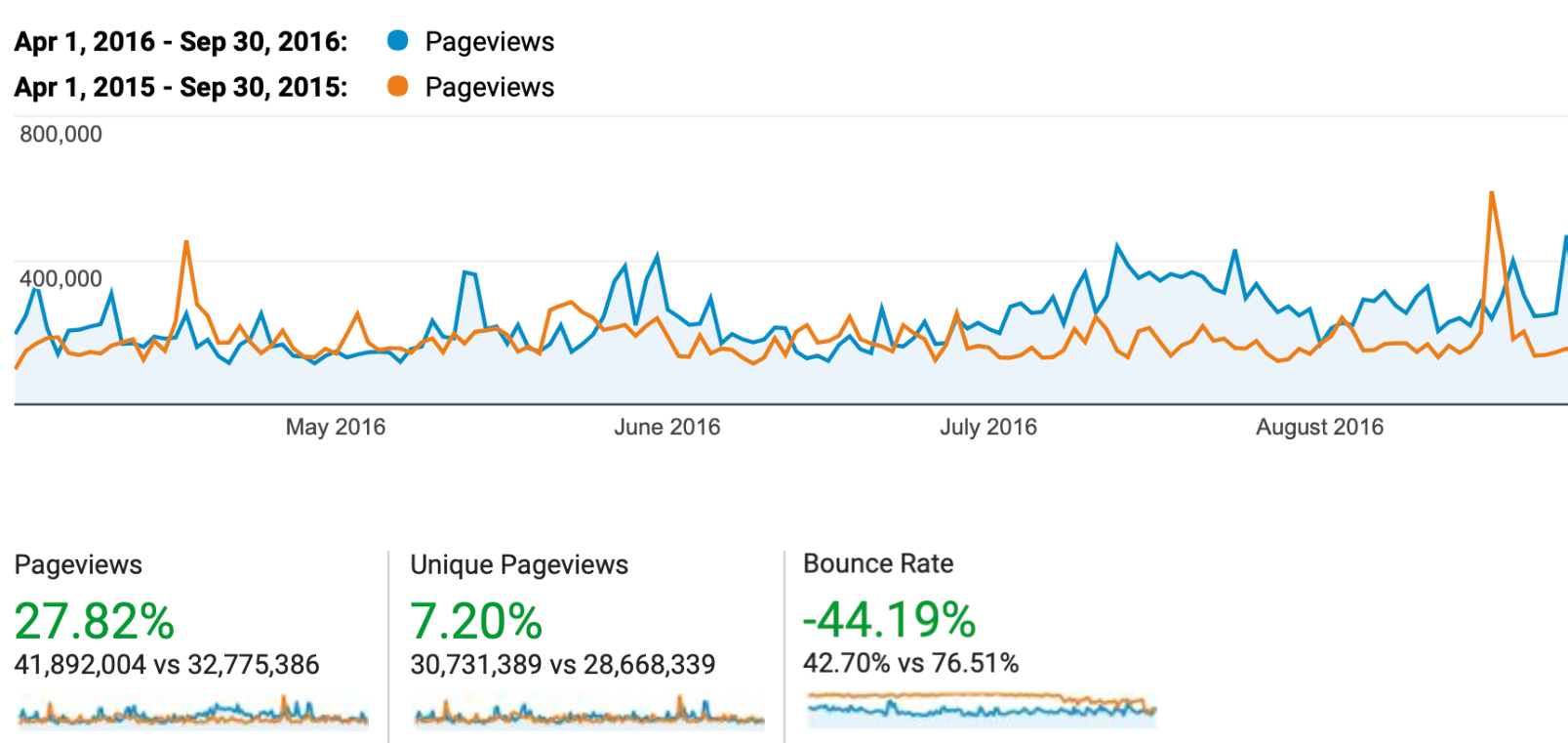
Website engagement
Comparing year-on-year metrics over a six-month span, results included not only higher traffic but also deeper reader engagement and recirculation.
- 41.9M pageviews (+27.8%)
- Bounce rate reduced to 42.7% (–44.2%)
Newsletter performance: Travel Dispatch
Travel Dispatch significantly outperformed both industry benchmarks and the New York Times newsletter average, demonstrating strong audience loyalty and relevance.
Travel Dispatch (Oct 2015 – July 2016)
- Open rate: 56.7%
- Click-through rate: 13.8%
All New York Times newsletters (Oct 2015 – July 2016)
- Open rate: 36.7%
- Click-through rate: 7.8%
Social engagement: Franchise & platform growth
52 Places to Go — Twitter (@nytimestravel)
Year over year, 52 Places to Go social content, particularly on Twitter, saw meaningful gains in both total and per-tweet engagement, reinforcing its status as a globally resonant Travel franchise.
From the project’s launch in early January through the end of February, 52 Places to Go tweets received over 200,000 clicks, a 28% in increase overall and a 16% increase per-tweet versus the previous year. Retweets were also up by 12%.
New York Times Travel — Facebook
Comparing year-on-year metrics over a three-month span, Facebook engagement more than doubled across key interaction metrics, alongside nearly 3× fan growth, reflecting stronger resonance and improved content framing.
July–September
- Likes: 21,826 (+11,201 | +105% YOY)
- Comments: 2,449 (+1,344 | +122% YOY)
- Shares: 6,930 (+1,035 | +18% YOY)
- Fan growth: +10,398 (+193% YOY)
Why this matters
This case study demonstrates my ability to:
- Drive audience growth at scale across site, social, and newsletters
- Use social engagement as signal, not just distribution
- Build high-performing newsletters that significantly outperform benchmarks
- Support major editorial franchises with sustained, multi-platform engagement strategies
It shows how audience growth at the New York Times Travel desk resulted from deliberate systems and strategy, not isolated wins.