So much for ‘Invisible’ Indonesia: Joko Widodo will be inaugurated as the new president of Indonesia on October 20, carrying with him the hopes of his nation and the world
[ This article was originally published on the ISLAMiCommentary website, which is now only available via the Wayback Machine. Here is a direct link to this article: https://web.archive.org/web/20141103120257/https://islamicommentary.org/2014/10/big-expectations-human-rights-challenges-ahead-for-indonesias-new-president/ ]
by JULIE POUCHER HARBIN for ISLAMiCommentary on OCTOBER 17, 2014
On Monday October 20, populist governor of Jakarta, Joko Widodo, will be inaugurated as Indonesia’s next president — taking over from a former Army general Susilo Bambang Yudhoyono (2004-2014), and having beaten Prabowo Subianto, also a former general and the son-in-law of former dictator Suharto.
It will be the first time that Indonesia will have experienced a transfer of power from one popularly elected president to another. And it looks like the transition will be peaceful.
Indonesia is the world’s third most populous democracy and largest Muslim-majority nation. A secular state, its motto is “United in Diversity.” The Indonesian population is 87% Muslim, about 10% Christian, 1.7 % Hindu, and 1% other including Buddhist and Confucian. More than 580 languages and dialects are spoken in a country separated by seas and clustered on five major islands and 30 groups of islands spanning 3,200 miles from east to west.
Nearly sixty percent of the country’s population lives on the island of Java, the country’s power center. (Much of Indonesian history took place here, including powerful Hindu and Buddhist empires, Islamic sultanates, the core of the colonial Dutch East Indies, and the Indonesian struggle for independence during the 1930s and 40s.)
This is where Widodo (commonly known as Jokowi), and all Indonesian presidents as it turns out are from. But similarities to past presidents stop here.
Observed former Reuters journalist Elizabeth Pisani in an interview with National Geographic about her new book Indonesia Etc: Exploring the Improbable Nation:
“Jokowi won out in the popular vote — on the basis of a record of curbing the bureaucracy, introducing meritocracy, and actually delivering services to people. And that’s pretty much unheard of in Indonesia.”
Expectations loom large.
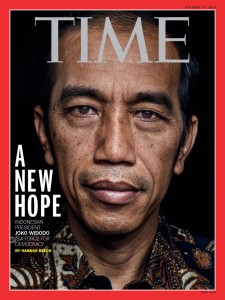
Time magazine has put the furniture maker who studied forestry in college on the October 27 cover, calling him “A New Hope” and a “force for democracy.”
Ahmady Meuraxa, a journalist and human rights activist based in Indonesia’s Aceh province, says Jokowi “is very unique.” He’s not in the military and he doesn’t come from a political clan in Indonesian politics. A million people volunteered, unpaid, in his campaign, Ahmady said, “because we need Jokowi.”
“People think that we (the Indonesian people) are very close to Jokowi’s style. He’s down to earth. He can feel what the people feel, about the government, about the situation whatever.”
Jokowi started his political career in a local party called the Indonesian Democratic Party- Struggle (PDI-P), of which his father was also a member. In 2005 he was elected mayor of Solo (also known as Surakarta); successfully marketing the city as “The Spirit of Java.” He held that office until 2012, when he ran for governor of Indonesia’s capital Jakarta. It was the first time in history, said Ahmady, that someone not from Jakarta had become governor there:
“When he was a governor in Jakarta (2012-2014) he showed the people how to be a good leader. I think he’s the only governor in Indonesia who’s popular with blusukan – meaning coming to the people … and communicating with the people directly. This never happened (before).“
Ahmady had a chance to meet and interview then-governor Jokowi this past April as part of an East-West Center fellowship.
“He said that he only spent 2 or 3 hours a day in the office. That’s a time to sign documents, to have a meeting with civil servants. Most of his time was spent meeting with the people in the rural area, in the slum area, in all areas of Jakarta asking people ‘What happened in the field ?’, ‘What do you feel about the situation?’. So he got, directly, input from people at the grassroots. So he’s very popular and humble… He’s never escorted very tightly,” said Ahmady.
He’s so much ‘of the people’ in fact that the group of international journalists, including from India and China, that Ahmady was assembled with outside Jokowi’s office this April, didn’t recognize the man himself when he came to greet them “in a very simple shirt and very simple shoes,” and in an atmosphere that seemed “countrified.” This meeting was before Jokowi had declared his run for the presidency. (Watch video below for Ahmady’s colorful story; at timecode 10:00)
Ahmady made these observations while on a visit to Duke University last month. He met informally with Duke University professors, and visited classes on the Duke and UNC-Chapel Hill campuses. And he had the chance to sit down for an hour-long taped conversation with UNC -Chapel geography professor and Indonesia expert Christian Cunningham Lentz at Duke’s John Hope Franklin Center studio.
Part of ISLAMiCommentary’s “Field Reports” series, the two discussed the election, Sharia in Aceh, the upcoming 10th anniversary of the tsunami, human rights, and the hopes and prospects for the long overdue establishment of an Aceh Truth and Reconciliation Commission (TRC).
‘Invisible Indonesia’
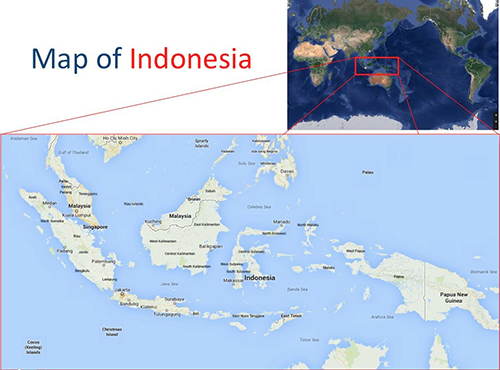
“When Americans think of Islam generally they often think of the Middle East and few Americans know in fact that Indonesia is the world’s largest Muslim country,” said Lentz leading off the taped conversation with Ahmady. “The problem is compounded by what a political scientist here in the United States has called “Invisible Indonesia.” Many Americans can’t find it on a map, don’t know much about the country, and it certainly doesn’t grab headlines like other countries do. (The 2004 Tsunami excepted)
The current Indonesian nation was born out of Dutch colonial rule; gaining it’s independence from The Netherlands in 1949. Then, according to the CIA Factbook, “A period of sometimes unruly parliamentary democracy ended in 1957 when President Sukarno declared martial law and instituted “Guided Democracy.” After an abortive coup in 1965 by alleged communist sympathizers, Sukarno was gradually eased from power. From 1967 until 1988 President Suharto ruled Indonesia with his “New Order” government. After rioting toppled Suharto in 1998, free and fair legislative elections took place in 1999.”
Abdurrahman Wahid, an Indonesian Muslim religious and political leader went on to win that election, but was impeached in 2001. Megawati Sukarnoputri (Sukarno’s daughter) then became Indonesia’s first female president (she was vice president at the time). Former army general SBY (Susilo Bambang Yudhoyono) defeated Megawati during the 2004 presidential elections. His rule lasts until Monday, October 20, 2014.
Islam, Aceh & Human Rights
Now, with a spotlight on Indonesia and its energetic new leader, Ahmady is hoping that the world will pay closer attention to Indonesia and the human rights issues in Aceh that still need to be resolved. He believes that Jokowi and his vice president Jusuf Kalla are up to the challenge.
Ahmady said that according to what he has read, Jokowi spent two years living in Aceh working for a coffee company in Gayo after he graduated from Gadjah Mada University. While there Jokowi helped the people in the area to build a small local mosque.
“That’s the emotional relationship between Jokowi and Aceh,” Ahmady said, though he’s not sure how much Jokowi knows of Aceh history, including the history of conflict there.
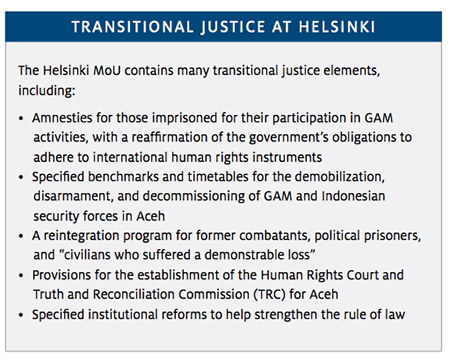
But Ahmady is reassured by the fact that Jusuf Kalla, when he was a vice president in the SBY era, was an initiator of the peace process that ultimately, in the Helsinki MOU of 2005, ended a near 30 year conflict between the rebel Free Aceh Movement and the Indonesian government. The Free Aceh Movement disarmed and government troops withdrew. EU monitors stayed on until after local elections were held in December 2006.
“I’m sure Jusuf Kalla will respect and will care about what’s demanded by the Aceh people,” said Ahmady.
And by this he includes the establishment of an Aceh Truth and Reconciliation Commission (TRC) under the umbrella of a national TRC — which was both a provision of the Helsinki MOU, and required by the Law on the Governing of Aceh passed by the Indonesian Parliament a year later.
A 2006 decision of the Indonesian Constitutional Court, however, to annul the national TRC law that had passed in 2004, resulted in deadlock on the matter.
In an op-ed for The Jakarta Post last year, Ahmady wrote that the Constitutional Court annulled the TRC law “because of the provision of amnesty to perpetrators of human rights abuses.”
Ahmady spoke to Duke Sanford public policy students last month attending a class on “Human Rights and Conflict,” taught by Visiting Professor Catherine Admay, JD.:
“We had a conflict in Aceh for 30 years between separatist groups in Aceh and the Indonesian government,” he explained. “During the conflict there were so many kinds of human rights abuses that have been done by Indonesian military in Aceh … including extrajudicial exclusion, murder, rape, and kidnapping.”
Though there was a huge influx of cash from the government for development in Aceh following the peace agreement, Ahmady said the Acehnese can’t be bought off; there needs to be a real investigation into the crimes committed by the Indonesian military.
“Since we signed the agreement in Helsinki between GAM (the Free Aceh Movement) and the Indonesian government (in 2005), Aceh has been in a transition situation from military authoritarianism to a democratic system,” he said, adding that while “democracy in Aceh is running better,” there are still traumatized victims and victims’ families. “Peace without reconciliation means nothing. That’s why the TRC is very important for Aceh.”
As he warned in The Jakarta Post op-ed: “On the surface, it appears the Aceh peace process has evolved smoothly. But dig a little deeper and you’ll discover anger is still raging. A small incident could easily light the fuse and trigger a renewed conflict.”
Ahmady hopes that Jokowi and Kalla will get on with pushing the stalled TRC process forward.
“We are still negotiating with Jokowi. We have our GAM representative talking to Jokowi,” he told the class.
Ahmady, in conversation with professor Lentz later in the day, urged the international community to put pressure on the government as well. “It’s about human rights, its about abuses, it’s about abuses of power, it’s about pride of the victim and I think this is a universal issue.”
“Sometimes referred to as “Mecca’s Verandah,” Aceh is widely considered the place where Islam first entered Southeast Asia. Located on the northwest tip of the island of Sumatra, Aceh was a natural landing place for Islamic traders traveling the Strait of Malacca. By 800 A.D. their faith had taken hold within the region. Islam later spread throughout much of Indonesia and eventually became the dominant religion.” — Human Rights Watch
In 2001 the Indonesian government gave Aceh special authority to implement Sharia law — widely seen as an attempt by the government at finding a political solution to the fighting. It’s the only Indonesian province legally permitted to implement Sharia. Aceh’s population is more than 98% Muslim and mostly Sunni.
As part of the 2006 Law on the Governing of Aceh, Aceh was granted “special autonomy” status, but, as Ahmady observed, it’s not clear what kind of “special autonomy” Aceh has exactly.
How much control does the central government of Indonesia have over Aceh? What kinds of issues can it involve itself in? What kind of Sharia law should be implemented in Aceh? Does Aceh’s provincial government have the power to enforce Sharia on the province’s non-Muslim population? These are all matters under discussion in Aceh today.
“Maybe for me, the meaning of Sharia law is different from the ulama. Because I think Islam has developed. Islam has progressed. And some of the ulama say the Sharia that was implemented a long long time ago during our Prophet era, is the same now — like people being whipped, caning, stoning,” Ahmady said. “Maybe a long long time ago that’s a rule, that’s a law because people didn’t have a good knowledge of human rights, but I think now it’s not good to implement it. So the meaning of Sharia law, it’s still debatable.”
Late last month, the Aceh provincial parliament approved the Principles of the Islamic Bylaw (drafted by parliament) and the Islamic Criminal Code (drafted by the Islamic Affairs office), reported Human Rights Watch, “which created new discriminatory offenses that do not exist in the Indonesian national criminal code (Hukum Pidana).”
According to Ahmady, under Indonesian law, bylaws passed by the Aceh Provincial Parliament need to be reviewed by the Ministry of Home Affairs within 60 days. The Ministry of Home Affairs has the right to refuse to approve the regulations or cancel them if they aren’t in line with National Law.
These new bylaws, says Human Rights Watch, “extend Sharia, or Islamic law, to non-Muslims, which criminalize consensual same-sex sexual acts as well as all zina (sexual relations outside of marriage). The criminal code permits as punishment up to 100 lashes and up to 100 months in prison for consensual same-sex sex acts, while zina violations carry a penalty of 100 lashes.)”
“It also contains provisions that allow Islamic courts to dismiss charges against rape suspects who take sumpah dilaknat Allah (an Islamic oath), asserting their innocence. The Islamic oath provision allows rape suspects who declare their innocence up to five times to be eligible for automatic dismissal of charges should the court determine an absence of incriminating “other evidence.””
Commented professor Lentz, in an email exchange with ISLAMiCommentary this week: “The extension of Sharia to non-Muslims and the criminalization of sexual behavior threaten fundamental freedoms of expression, privacy, and religion. Corporal punishment for alleged sex crimes only adds to these basic human rights violations. It is also worrisome that rape suspects who agree to take an oath (sumpah) may escape charges and win a case dismissal.”
On the matter of the Principles of the Islamic Bylaw, Human Rights Watch says it “violates the right to freedom of religion enshrined in the Indonesian constitution and international law by requiring all Muslims to practice the Sunni tradition of Islam.”
“The bylaw imposes the Sunni school of Shafi’i as the province’s official religion, while permitting three other major Sunni traditions – Hanafi, Maliki, and Hambal – only on the condition that their followers promote “religious harmony, Islamic brotherhood and security among Muslims.” The law excludes Aceh’s sizable Shia and Sufi minorities as well as the Ahmadiyah Muslim community.”
“The 'Principles of the Islamic Bylaw' also impose ambiguous, excessive, and discriminatory restrictions on the content of published materials and broadcasts in Aceh that will undermine media freedom throughout the country. The bylaw obligates the media, including those that originate elsewhere in Indonesia, to ensure that their content is “not contrary to Islamic values.” The bylaw also authorizes the provincial government to establish “ethical guidelines” for media.”
(For more information on this read here and for additional background read HRW’s 2010 Policing Morality report)
Ahmady, through his work with the Aceh NGO Coalition for Human Rights, wrote (in an email exchange with ISLAMiCommentary this week) that after he got back from his North Carolina trip he was actively engaged in meetings on the draft bylaws before they were passed in late September.
He wrote that his group noticed that they “contain a number of human rights violations and demonstrate intolerance,” including “regulations that force non-Muslims to be obedient to the regulations.” He noted that non-Muslim religious leaders expressed to the group their concerns, especially concerning the Islamic Criminal Code.
“They object, because they think the Qanun Jinayah (Islamic Criminal Code) was lacking a respect for diversity. Non-Muslims could be punished based on Islamic law. And caned in public,” he wrote.
“We (at the Coalition) pointed out to some members of the Aceh parliament, the intolerance and human rights issues reflected in the new bylaws and ask that they be revised,” wrote Ahmady. “ Some of our proposals were agreed to. But the points related to human rights issues and intolerance were rejected. They insisted that the bylaws be applied to non-Muslims as well. We failed.”
Ahmady’s group is now lobbying the Ministry of Home Affairs in Jakarta to revise the bylaws. Human Rights Watch is asking that “abusive bylaws” be repealed entirely.
“Indonesia’s incoming president should treat Aceh’s abusive new bylaws as an opportunity to demonstrate a commitment to human rights, and have them repealed,” said Phelim Kine, HRW’s deputy Asia director . “People in Aceh should enjoy the same rights and freedoms as all Indonesians.”
“This is a potentially serious violation of human rights in Aceh,” said professor Lentz. “The bylaws in question also raise a fundamental question regarding Acehnese autonomy in Indonesia. To what degree can Aceh exercise home rule? As the (Human Rights Watch) article and Ahmady both suggest, Aceh’s proposed amendments are still subject to review by the Ministry of Home Affairs in Jakarta. In other words, autonomy still has limits, or checks and balances, set by the national government. We can only hope that the national government acts in the interest of tolerance and human rights and exercises its prerogative to restrict Aceh’s proposed extension of criminal law.”
Great Expectations
Along with the aforementioned challenges that Jokowi has been urged to take on, he has promised to battle corruption, slash fuel subsidies to cut the budget deficit, and promote access to healthcare and educational services.
“Perhaps his greatest security headache may be in dealing with repercussions from Islamic State’s success in Iraq and Syria and the potential for a revival of terrorism at home,” warned Temple University Japan history professor Jeff Kingston in an op-ed for The Japan Times.
Australia National University’s Ariel Heryanto told The Times that there are two areas in which Jokowi could shine: promoting religious tolerance and hitting the reset button on Jakarta’s failed policies toward Papua” where attacks on religious minorities have escalated.
“One of the ways we can link the colonial project with a nation that formed out of that experience, is the difficulty of ruling such an enormous nation as one has not gone away,” said Lentz.
Jokowi, man of the people, has his work cut out for him.
Ahmady’s visit to Duke was sponsored by the Asian Pacific Studies Institute at Duke University, the Duke Islamic Studies Center/ISLAMiCommentary, the Duke-UNC Rotary Peace Center, and the Duke University Center for International Studies.
Ahmady, an Aceh native, has reported on the separatist conflict in Papua, ethnic conflict in West Kalimantan, as well as on national politics in Jakarta, economic development, and the environment. In 1994, he was a reporter at the DeTIK Weekly in Jakarta when it was banned by the Suharto regime. In 2004, when Aceh was under martial law, Ahmady collaborated with human rights activists in Jakarta to publish Aceh Kita, a biweekly magazine focusing on the conflict in Aceh. He returned to Aceh after the 2005 signing of the Aceh peace agreement in Helsinki (known as the Helsinki MOU) to work as an editor for regional media and was directly involved in Aceh’s reconciliation and democratic transition process, including conducting research for international organizations such as the United Nations Development Program and the International Organization for Migration on the election process, post-conflict violence, and recovery following the 2004 Indian Ocean tsunami. Currently working as a program manager and researcher for the Aceh NGO Coalition for Human Rights, he continues to write opinion pieces in Aceh media and elsewhere in Indonesia and has authored 5 books about human rights, conflict and peace building.
Christian Lentz is an Assistant Professor of Geography at the University of North Carolina at Chapel Hill. He has also been a visiting scholar of sociology at Duke University (2007-2011), and worked as a seminar interpreter (Indonesian) for the U.S. Department of State (1998-2002). His research and many publications bring classic themes of social inquiry such as nationalism, state formation, and agrarian political economy into dialog with concepts of history, space, and social difference (e.g., racial and ethnic formations) in Southeast Asia. His current project focuses on the hinterlands of Vietnam and the processes through which its peoples and places were made Vietnamese, sometimes against their will. His next project explores hunger as an analytic, or a social condition that indicates and generates spatially uneven power relations, through comparative work in Vietnam and Indonesia.
—
This article was made possible (in part) by the Transcultural Islam Project, an initiative launched in 2011 by the Duke Islamic Studies Center — in partnership with the Carolina Center for the Study of the Middle East and Muslim Civilizations and the Oxford Centre for Islamic Studies — aimed at deepening understanding of Islam and Muslim communities. See www.islamicommentary.org/about and www.tirnscholars.org/about for more information. The Transcultural Islam Project is funded by a grant from the Carnegie Corporation of New York. The statements made and views expressed are solely the responsibility of the author(s).
Other web sites and print publications may re-publish this article as long as there is source attribution (author and ISLAMiCommentary) and a link back to ISLAMiCommentary.
Related Posts:
- Scholars Size Up Indonesia’s Presidential Election
- Jeremy Menchik: New York Rabbi’s Awful Award to Indonesian President
- BOOK: Indonesia’s Transition to Democracy (by Donald Horowitz)
Tags: 2005 Helsinki MOU, Abdurrahman Wahid, Aceh, Aceh NGO Coalition for Human Rights, Aceh Truth and Reconciliation Comission, Ahmady Meuraxa, blusukan, Christian Lentz, CIA Factbook, Duke University, East-West Center, Elizabeth Pisani, featured, Free Aceh Movement, http://www.koalisi-ham.org, human rights, Human Rights Watch, Indonesia, Indonesia Buddhists, Indonesia Christians, Indonesia Constitution, Indonesia Constitutional Court, Indonesia Etc: Exploring the Improbably Nation, Indonesia Hindus, Indonesia Muslims, Indonesian Democratic Party-Struggle (PDI-P), Indonesian parliament, International Center for Transitional Justice, Jakarta, Java, Joko Widodo, Jokowi, Jusuf Kalla, Law on the Governing of Aceh, National Geographic, Phelim Kine, Prabowo Subianto, Sharia, Solo, Suharto, Sukarno, Sumatra, Surakarta, Susilo Bambang Yudhoyono, The Jakarta Post, The Japan Times, The Netherlands, Time, UNC Chapel Hill
Category: Americas, Asia, Europe, History and Anthropology, Human Rights & Gender, i-Comment, Islamic Theology & Law, Law, Muslim Life & Culture, Politics & Current Events, Regions, Security & Civil Liberties