[ This article was originally published on the ISLAMiCommentary website, which is now only available via the Wayback Machine. Here is a direct link to this article: https://web.archive.org/web/20170214032510/https://islamicommentary.org/2015/09/why-im-joining-the-military/ ]
by ERIC B. CHRISTOPHERSON for ISLAMiCommentary on SEPTEMBER 29, 2015
curated and edited by Julie Poucher Harbin, Editor, ISLAMiCommentary
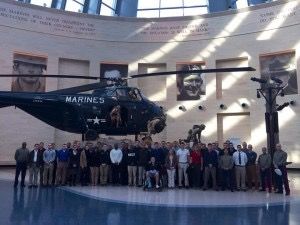
The conflicts to which military personnel are deployed are becoming continually more convoluted and paradoxical. What motivates young men and women to join the military in a world that is everything but stable?
I was recently asked to author a piece on why I am joining the military given the current state of the world. In theory, this is an objective question, but I’ve been assaulted with similar questions before and it is usually accompanied by shock and disbelief that a well-educated individual with prospects for well-paying and fulfilling civilian employment would want to subject themselves to the dangers and discomforts of military life.
It should not be surprising that someone like me with a Masters degree or anyone else with a degree from a top university is joining the U.S. Marine Corps! The military needs the most intelligent members of American society to successfully accomplish their mission of serving the American people.
The American people and the U.S. military’s ability to engage in conflicts in the future rests on a foundation of understanding the cultures of foreign states and the complexities of the world today.
My insistence on this comes from a life growing up with a (retired) military father and diplomat mother. Living in Ghana for 4 years as a teenager and as a university student in the Netherlands, plus time in Germany, the U.S., Australia, and Taiwan, conditioned me to appreciate different cultures more than most people. Unfortunately, I was only able to visit the Middle East once — on a trip to Jordan in 2013. My degrees are in business with some law and culture courses, but no formal military education outside of the one to two books I’ve been reading each month for the last year-and-half on military experiences, history, and doctrine, including the U.S. Army/Marine Corps Counterinsurgency Field Manual. I still have a lot to learn about the world and modern conflict.
This is what I do know. The world today is just as dangerous and scary as it has been for centuries. Marine officers, commissioned and non-commissioned, have been plagued by the same fears across their 239-year history: getting their Marines home safely, not letting anyone down, and not succumbing to the fear of their own mortality. Although our service members are subject to the same fears of the past, the world in which they operate has become much more complex. According to the U.S. Army/Marine Corps Counterinsurgency Field Manual and other studies on modern combat, like Learning to Eat Soup with a Knife:Counterinsurgency Lessons from Malaya and Vietnam by John A. Nagl, we know that a young leader on the modern battlefield makes more strategic decisions in a week than most of his or her rank equivalents made during a whole year in World War II.
Securing even a small village in Syria today quickly becomes a daunting task involving tactics, politics, ethics, and socioeconomics, with 3rd order effects of seemingly miniscule decisions. The Defense of Jisr al-Doreaa, a book written by two U.S. Army Officers, discusses a number of possible scenarios — such as whether to arrest the village elder, who was illegally stockpiling weapons, or let him off the hook so that you are not shunned from the weekly local council meetings. What would you do? One prioritizes the rule of law today (a very American notion of equality under the law), while the other prioritizes your influence in the village’s council.
The US military is often deployed as a type of international police force, with the task on the ground a balancing act between showing strength and being a resource to those in need.
These leaders will be taught what they need to know by the military, but intelligent people are needed to begin with — problem solvers and thinkers. Those with more subject-matter knowledge, a more extensive culture upbringing, and/or a top civilian or military post-secondary education enrich the pool of recruits and candidates greatly.
We need military personnel that can make competent decisions to move us forward, but American society’s perception of the military seems to have devolved to viewing military service as a backup option or place for youths who are not fit for college. In 2012, Brigadier General Loretta Reynolds, then Commander of Eastern Recruiting Region, argued differently, explaining on CNN Dialogues in 2012 that the “[military] needs smarter, faster, and sharper kids because of the way we operate.”
We need “sharper kids” because the wars of the future are only becoming more complex. Take, again, the Syrian civil war as an example, where service members would have to distinguish between Syrian Rebels, ISIS fighters, Assad-loyal government troops, local militias, and civilians. Then they would have to use their judgment and broad policy directives to determine a course of action on a case-by-case basis: Which groups do you trust to have weapons and should a neighborhood militia protecting their homes be disarmed? How do you solve an escalation between civilians and rebels, who you may want to be working together? While strategists in the Pentagon often attempt to cover these situations, most of these scenarios, according to the U.S. Army/Marine Corps Counterinsurgency Field Manual and other sources, require decision making on the ground by Corporals, Sergeants, Lieutenants, and Captains. This is the nature of modern conflicts.
With all this considered, the current state of the world does not deter me from military service, it attracts me. I’m joining the Marine Corps — shipping to training January 17, 2016 — because I want to be the first contact that American forces make with our enemies and our allies, as it is the most impactful. I don’t expect it to be easy, and that is one of my main motivations – I don’t want easy!
Other officer candidates and enlisted poolees that I’ve trained with give me great hope for the Marine Corps’ ability to continue winning America’s battles. But we as a society must also understand what military involvement means. If there is such a thing as “just war” let’s make sure that the military and the American people can stomach the fight to achieve our goals.
Eric B. Christopherson is a Marine Corps Officer Candidate waiting to ship to training in Quantico, VA through the Raleigh Officer Selection Office. He has a B.Sc. International Business from Maastricht University and he completed his M.Sc. Strategic Management in 2014 at Duke University’s partner school, the Rotterdam School of Management (in the Netherlands), which included an exchange at the Duke University Fuqua School of Business. Mr. Christopherson came to the attention of ISLAMiCommentary during his participation in a Q&A session of a public forum held at Duke on September 14, 2015 : “Truck 71: Europe and the Refugee Crisis” Connect with him via Twitter: @BrianOnTheMove
ISLAMiCommentary is a public scholarship forum that engages scholars, journalists, policymakers, advocates and artists in their fields of expertise. It is a key component of the Transcultural Islam Project; an initiative managed out of the Duke Islamic Studies Center in partnership with the Carolina Center for the Study of the Middle East and Muslim Civilizations (UNC-Chapel Hill). This article was made possible (in part) by a grant from Carnegie Corporation of New York. The statements made and views expressed are solely the responsibility of the author(s).
Other web sites and print publications may re-publish this article as long as there is source attribution (author and ISLAMiCommentary) and a link back to ISLAMiCommentary.
Tags: Brigadier General Loretta Reynolds, CNN, Duke University, Emory University, Eric Christopherson, FUQUA, ISIS, John A. Nagl, Syria, Syria civil war, Syria refugees, The Defense of Jisr al-Doreaa, U.S. Army/Marine Corps Counterinsurgency Field Manual, US foreign policy, US Marines, US military
Category: Americas, Ethics, i-Comment, ISIS, Middle East and North Africa, Muslim Life & Culture, Politics & Current Events, Security & Civil Liberties, Student