[ This article was originally published on the ISLAMiCommentary website, which is now only available via the Wayback Machine. Here is a direct link to this article: https://web.archive.org/web/20141207153732/http://islamicommentary.org/2014/09/jean-pierre-filiu-on-gaza-a-history-book-q-a/]
Column » ‘By the Book’ with JOSEPH PREVILLE and JULIE POUCHER HARBIN for ISLAMiCommentary on SEPTEMBER 18, 2014
“Both Fatah and Hamas, the main Palestinian parties, have forged over the years a self-celebrating militant narrative, intimately linked to Gaza, and any academic research has to deconstruct this narrative before addressing the core issues of the historical process.” — Jean-Pierre Filiu
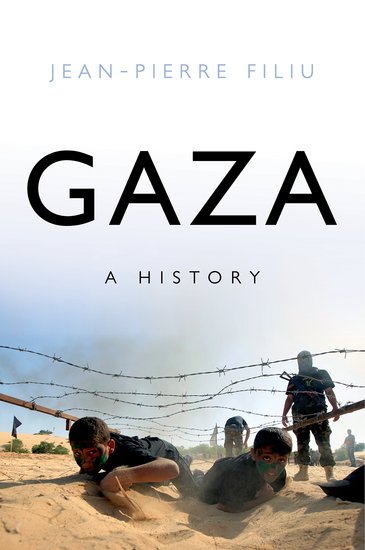
How can history help heal the wounds of Gaza? Jean-Pierre Filiu answers this question in his ambitious new book, Gaza: A History (Oxford University Press, 2014), the first comprehensive history of Gaza in any language. “It is necessary,” he states “to re-examine Gaza’s history in order to open a vista beyond today’s devastation and grief and to bring into view a new horizon for the future.” Gaza’s past is a long story of conquerors, crusaders, and captives. Filiu hopes that the next chapter in the story of Gaza will begin with a lasting peace between Israel and Palestine: “Peace between Israel and Palestine can assume neither meaning nor substance except in Gaza, which will be both the foundation and the keystone.”
Filiu is a noted expert on politics and the Arab world. A former career diplomat, he is Professor of Middle East Studies at Sciences Po, Paris School of International Affairs (PSIA). He was previously a visiting professor at Columbia University and Georgetown University, and he has lectured as a guest speaker at the Harvard Kennedy School and The James A. Baker III Institute for Public Policy at Rice University in Houston, Texas. He is the author of many books, including Apocalypse in Islam (University of California Press, 2012), The Arab Revolution: Ten Lessons from the Democratic Uprising (Hurst, 2011), and Best of Enemies: A History of U.S. and Middle East Relations, Part One: 1783-1953 (Abrams, 2012). Jean-Pierre Filiu discusses his new book in this interview.
Why is it important to study the history of Gaza?
I have been following the Palestinian issue for the past three decades and I was struck by the fact that Gaza was always dealt with as a sideshow for the main battlefield, either in Jordan, in Lebanon or in the West Bank. I wanted to challenge that trend and put Gaza at the very center of my research. But I never dreamt about uncovering so much new material that enabled me to get a fresh look at Palestinian history as a whole.
Could you discuss the three generations that have grown up in the Gaza Strip? What are their similarities and differences?

The so-called “Gaza Strip” was created through the 1948-49 Israeli-Arab war; its borders the ceasefire lines agreed, at the time, between Israel and Egypt. Until today, two thirds of the population of this territory is made up of refugees who fled to Gaza in 1948-49 and their descendants.
The collective trauma of war and misery has been shared by three generations that have lived in the Gaza Strip. But I underline the fact that the first generation (1948-67) was the “generation of mourning,” because of the enduring shock of the loss and expulsion. The following generation (1967-87) was the “generation of dispossession,” that faced two decades of direct Israeli occupation and settlement. Then came the “generation of the intifadas” (1987-2007); the first being the non-violent uprising (intifada) that triggered the peace process between Israel and the PLO, and the second, an armed uprising in 2007 that led to the split between Hamas-controlled Gaza and the PLO-run West Bank in 2007. I therefore consider Gaza to be now living in “the generation of impasses.”
Gaza has historically been something of a pawn of regional and international actors. How’s it different now?
Gaza was historically a thriving oasis that served as a springboard for any power in the Middle East wishing to conquer Egypt. In a reverse way, any ruler of Egypt who wanted to break through the Levant had to dominate Gaza first. This was the case as late as 1917 when the United Kingdom fought in Gaza three bitter battles for Palestine with the Ottoman Empire, before finally conquering it. This pattern changed totally with the foundation of the state of Israel and the subsequent creation of a “Gaza Strip” in 1949. This territory was the only part of historical Palestine that had been neither absorbed by Israel, nor annexed by Jordan. This is why Gaza became so central in the contemporary history of Palestinian nationalism, and lost most of its interest as a pawn between regional powers. It became instead a key focus for the conflict between Israel and the Palestinian factions.
What challenges did you face in writing your book?
There were of many kinds. First, there are very little organized archives because of the various round of conflicts (for instance, Israel stole the Egyptian archives in Gaza in 1967 and they are now off-limits for academic research). Second, the access to the terrain is arduous and fraught with security problems that one has to handle on a day-to-day basis. Third, both Fatah and Hamas, the main Palestinian parties, have forged over the years a self-celebrating militant narrative, intimately linked to Gaza, and any academic research has to deconstruct this narrative before addressing the core issues of the historical process. Fourth, oral testimonies are crucial to fill up the many blanks of this complex history, but a strict methodological approach has to be followed to discriminate between the actual facts and the reconstructed memories.
How will your book advance and enlarge the field of Palestinian historiography?
I would be honored if my book could stimulate vocations of researchers and scholars to study deeper into the history of Gaza. There are numerous fields that are nearly uncovered. I am thinking for instance of the history of the major families of the territory, the Shawa, the Abdel Shafi or the Sourani, to name only a few. Monographies of Gaza localities and of refugee camps could shed a very welcome light on the sociological process that led to major turning points in the history of the territory, like the armed resistance to the Israeli occupation in 1967-71 or the two intifadas of 1987 and 2000. Civil society in Gaza, a complex network of unions, NGOs and associations, has yet to be studied. I wanted in my research to contribute to the collective endeavor of a people’s history of Gaza. I am aware this contribution remains modest, no matter how hard I tried to resist the attraction of “old history,” whether political or diplomatic. This is why I am so hopeful about coming research and projects in that regard.
How important a role would the opening up of trade —the lifting of the economic siege — play in Gaza’s demilitarization and the normalization of relations between Gaza and its neighbors?
It has been now more than seven years that the Gaza Strip came under siege by Israel, with a significant collaboration of Egypt to that siege in Gaza’s southern border. This siege is a collective punishment and an act of war that are both condemnable. But the tragic irony of that blockade, enforced on 1.8 million women and men, was that it strengthened Hamas’ grip on the territory instead of weakening it – contrary to what Israel, Egypt, the USA and the European Union wished to achieve. The siege directly fosters smuggling in order to supply basic commodities to the local market. But the heavy investments needed for building the smuggling tunnels can only become profitable through arms and explosives trafficking. So Hamas benefits from the siege by taxing the smuggling, while every round of hostilities proves the enhancement of its military capacity. Last but not least, the siege is a main reason for an appalling level of unemployment in Gaza, which drives a significant proportion of unqualified manpower to the militias. So the lifting of the siege is not only a moral issue, it is key to the demilitarization of the Gaza Strip.
How can Gaza become “the foundation and the keystone” for peace between Israel and Palestine?
As I just tried to explain, with the relation between the lifting of the siege and demilitarization, Gaza could become the showcase for a “win-win” deal between Israel and Palestine. There are no Israeli settlers left in Gaza since 2005, the year that the Israeli army “unilaterally” disengaged from the territory. But the occupation continues in a different form, one that could be described as “remote-control” through the tight control of land access, along with air space and territorial waters. However, there is no border issue at stake there; no religious site to be disputed.
Israel and Palestine just have to find a way to coexist peacefully, which implies the establishment of a full-fledged Palestinian state that includes the West Bank and Gaza.
I am aware that this seems out of touch with a violence-ridden actuality, but this summer’s Israeli war on Gaza proved that nothing durable could be achieved through sheer military power. Peace is the only option and it should start in Gaza.
Joseph Richard Preville is Assistant Professor of English at Alfaisal University in Riyadh, Saudi Arabia. His work has appeared in The Christian Science Monitor, San Francisco Chronicle, Harvard Divinity Bulletin, Tikkun, The Jerusalem Post, Muscat Daily, Saudi Gazette, and Turkey Agenda. He is also a regular contributor to ISLAMiCommentary.
Julie Poucher Harbin is Editor of ISLAMiCommentary
—
This article was made possible (in part) by the Transcultural Islam Project, an initiative launched in 2011 by the Duke Islamic Studies Center — in partnership with the Carolina Center for the Study of the Middle East and Muslim Civilizations and the Oxford Centre for Islamic Studies — aimed at deepening understanding of Islam and Muslim communities. See www.islamicommentary.org/about and www.tirnscholars.org/about for more information. The Transcultural Islam Project is funded by a grant from the Carnegie Corporation of New York. The statements made and views expressed are solely the responsibility of the author(s).
Other web sites and print publications may re-publish this article as long as there is source attribution (author and ISLAMiCommentary) and a link back to ISLAMiCommentary.
Other web sites and print publications may re-publish this article as long as there is source attribution (author and ISLAMiCommentary) and a link back to ISLAMiCommentary.
Tags: 1948 war, Alfaisal University, Fatah, Gaza, Gaza history, Gaza unemployment, Gaza: A History, Hamas, Israel, Israeli-Palestinian conflict, Israeli-Palestinian peace process, Jean-Pierre Filiu, Jordan, Joseph Preville, Lebanon, Operation Protective Edge 2014, Oxford University Press, Palestine, Palestinian history, Sciences Po Paris School of International Affairs (PSIA), two-state solution, unemployment, West Bank
Category: Books, By the Book, History and Anthropology, i-Comment, Middle East and North Africa, Muslim Life & Culture, Politics & Current Events, Security & Civil Liberties