
[This article is included in The Washington Diplomat's May 2011 Diplomatic Pouch e-newsletter. The original link was http://www.washdiplomat.com/DPouch/2011/May/0511news.html or https://web.archive.org/web/20111114065921/http:/www.washdiplomat.com/DPouch/2011/May/0511news.html via The Wayback Machine) A PDF of the entire May. 2011 Diplomatic Pouch issue is also accessible below.]
Special to the Diplomatic Pouch by Julie Poucher Harbin
On April 6, Ambassador of the Democratic Republic of Congo Faida Mitifu, who has served in Washington for the past 12 years, was honored as an "Outstanding Diplomat" by Howard University and the Women Ambassadors Foundation -following her fifth speaking appearance at the 16th annual Women Ambassadors Conference.
"This has always been an important event for women ambassadors, as despite progress made, we're still a minority in Washington," said Mitifu, who shared her experience as a female ambassador and the history of women in Congolese politics with an audience of mainly students at Howard University - some of whom had helped to organize the conference.
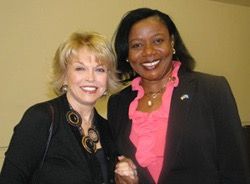
"Despite progress made in many places around the world, people in general, both men and women, still cannot associate a diplomat job with a woman. Diplomacy remains a man's job," the seasoned envoy said. "How many times have our husbands or companions been greeted as ambassadors even after we have introduced ourselves as such? Society does not process the idea of a woman ambassador. Diplomacy is linked to the ability and art to negotiate, which in turn is confused with physical strength."
Mitifu along with a corps of fellow female ambassadors often speak publicly about their unique roles in the nation's capital - roles that have gotten increased visibility in recent years both because of their efforts and because of the growing number of women leaders, in Washington and around the world. With an influx of female envoys from countries such as Tanzania, Costa Rica and Zambia, the number of female ambassadors in Washington has ballooned to more than 25. Yet that's still a tiny fraction of the total number of ambassadors in the D.C. diplomatic corps.
Which is precisely why Mitifu and her colleagues from Bahrain, Liechtenstein, India, Singapore and elsewhere are frequently found on the events circuit stressing that for women, the job is far from over when it comes to achieving career equality (also see "Women Political Leaders Still Minority" in the July 29, 2010, news column of the Diplomatic Pouch).
Many of those familiar faces joined Mitifu at the Women Ambassadors Conference, which featured speeches by Ambassadors Houda Nonoo of Bahrain, Elena Poptodorova of Bulgaria, Amelia Matos Sumbana of Mozambique, Mwanaidi Sinare Maajar of Tanzania, and Tebelelo Seretse of Botswana. The charge d'affaires of the Embassy of Croatia spoke on behalf of Croatian Ambassador Kolinda Grabar-Kitarovic, another popular female ambassador who is preparing to leave Washington this summer to take up the post of assistant secretary-general of public diplomacy for NATO.
Likewise, the women at the conference have enjoyed wide-ranging and, in many cases, pioneering careers. Bahraini Ambassador Houda Nonoo, for instance, who has spoken about women's issues since coming to Washington in 2008, was a founding member of a human rights society, ran a business with her husband, served in parliament, and was ambassador to Canada, Brazil and Mexico. She now counts herself as the first female Jewish ambassador from the Arab world.
Mitifu is the third woman to be appointed ambassador in the history of the Democratic Republic of Congo (the two others served in the 1960s and 1980s) and the first female ambassador to Washington, where she represents a country with a notoriously poor human rights record - especially when it comes to women.
Although Congo's last civil war ended in 2003, after millions had died, the resource-rich country continues to be racked by violence, poverty, lawlessness and human rights atrocities - earning it the dubious distinction as the rape capital of the world.
In 2009, according to the State Department, more than 1,100 women and girls were reportedly raped each month in the east alone, although the true figures are undoubtedly much higher. The United Nations Population Fund estimates that 200,000 Congolese women and girls have become victims of sexual violence since 1998, with relatively few prosecutions.
While many of the armed rapes occur in the east, sexual and gender-based violence is pervasive throughout the Congo, according to the State Department, which has sought to raise awareness of the issue by working with the United Nations, women-led NGOs and the Congolese government itself.
Congo, equal in size to the United States east of the Mississippi, has made some strides. In 2006, the country held its first democratic, multiparty elections in more than 40 years - electing President Joseph Kabila, as well as a National Assembly and provincial legislatures. The next national elections are scheduled for November 2011.
"This is a very young democracy that needs to be strengthened and we pray and we hope that everything will go well and that it's going to be a precedent for many African countries," Mitifu said. "But for a post-conflict country like my own that has newly embarked on the path of democracy, economic recovery and sustainable peace, breaking with a past that has been burdened by years of corruption and dictatorship, breaking with a culture that has always stigmatized the role of women in politics, is a daunting task."
She added that the willingness and ability of women to participate in mainstream political life was "so limited and definitely not mirrored in our electoral list in 2006."
Mitifu said that although the notion of gender equality was embraced in the new constitution that passed by referendum in 2005, women were not successful in introducing the concept into the electoral law. They demanded 50-50 representation on all party lists (a "zebra stripeslist") to give women equal footing during the elections, but, she said, men coined the term "leopard list" to mock their demands.
For now, Mitifu explained, women's participation in the political process is mostly confined to informal activities - as active members or founders of women's associations and NGOs, for example.
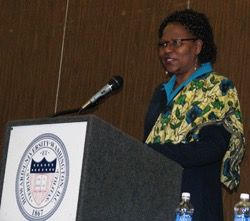
For Amelia Matos Sumbana, the ambassador of Mozambique, NGO involvement was the perfect entre into government.
A founding member of the Mozambique Red Cross, member of parliament, and minister of education and culture, Sumbana became politically active at the age of 13 when she joined a student organization that she said helped bring independence to Mozambique 10 years later.
"I was privileged because I had the opportunity to be born in a family that cared about education for girls and boys. We were educated by my parents," Sumbana, a first-time ambassador, said. This was not the common situation, she explained, in a country where 56 percent of the women are illiterate.
Mozambique's parliament though has fairly high female representation, with 40 percent composed of women - and a national requirement that 35 percent must be filled by women. And although Sumbana said she had to fight to become a member of parliament, once she won the position, she viewed it as "a platform from which I could fight for other women."
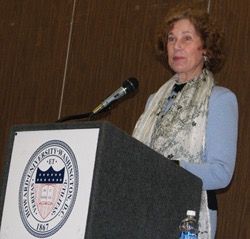
Elena Poptodorova, who is now on her second tour as Bulgaria's ambassador to Washington, also served in her country's parliament, but she took issue with the notion of gender quotas in politics - something the other female African ambassadors in the room clearly support.
"Do we want to be in a certain position, just because we happen to be women? I don't think we want that. We want to be able to compete on the basis of our own qualities, our own advantages, which are far beyond the way we were born. So that's the big battle of today I think," she said.
Mwanaidi Sinare Maajar, the first female ambassador to the United States from Tanzania, responded that quotas are important "to first get the numbers ... so young girls will see them and say, aha, I can also be there." Tanzania achieved a 40 percent female representation rate in last year's parliamentary elections, and the speaker is a woman.
Ambassador of Botswana Tebelelo Seretse, the self-described "new kid on the block," having been appointed ambassador in February 2011, echoed Maajar's sentiment. "When we have the numbers, we will worry about the quality," she said. "If you empower a woman you can empower a nation."
For her part, Congo's Mitifu agrees that the idea of a woman ambassador is unfortunately still a novelty around much of the world, including her own country. She recalled that when it was announced on national television in 1999 that she had been appointed ambassador to the United States, the news sent shockwaves.
"As you know Washington is the most important capital in the world. Who was this woman, people were asking. How could the president appoint a woman as ambassador? To the most important capital of the world?" she said, noting that critics urged the president to send some strong muscle to Washington, instead of a "delicate and fragile" woman, especially because at the time the country was in the midst of civil war. "The president's answer was, 'I love her style and she's doing a great job.'"