[ This article was originally published on the ISLAMiCommentary website, which is now only available via the Wayback Machine. Here is a direct link to this article: https://web.archive.org/web/20170214024718/https://islamicommentary.org/2014/04/duke-students-create-their-own-arab-spring-graffiti-on-campus-as-part-of-class/index.html]
by EDWARD CHEN, ElIZA WARNER, and JOHN VILLA for ISLAMiCommentary, APRIL 2014
curated and edited by Julie Poucher Harbin, Editor, ISLAMiCommentary
EDWARD CHEN: The short-term impact of street art during the Arab Spring is clear: it helped proliferate revolutionary messages on public consciousness against oppressive regimes by utilizing a medium that was hard to censor: walls and buildings. It also helped artists and revolutionaries band together to spread a common message that contributed to the coordination of uprisings. The long-term effects of the street art during the Arab Spring was the cultural impact.
Countries like Egypt that had been considered lost in the past few years experienced an art boom. Artists grew famous for their work on the street, gaining recognition around the world and encouraging youths to take interest in the movement (The Culture Trip). Scholars around the world also took notice of the art and began to study it; which is why I ultimately had to opportunity to try my hand at imitating the graffiti style.
Graffiti at Duke plays similar roles of political activism and more prominently advertisement. Though graffiti is banned from most places on campus, it is allowed on the wall under a bridge on the outskirts of East Campus. There, student groups can go to paint murals advertising events or proudly representing their various groups.
For example, when the Zeta Tau Alpha sorority wanted to advertise for its annual car smash charity event for breast cancer, it took a portion of the wall and painted it. Much like revolutionary graffiti, the artwork doesn’t always have to be advertisement and can instead be a form of expression.
Another example was this past Easter, when a Christian group painted a large portion of the wall white and displayed the simple words “Christ has risen”. This form of expression generates awareness of certain issues and beliefs.
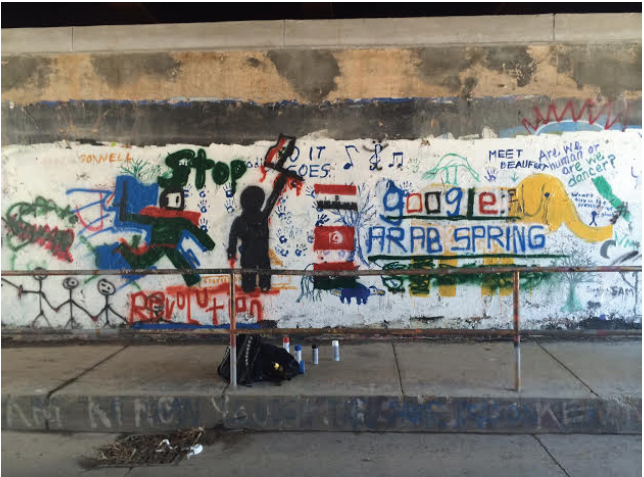
I did my own piece of artwork under the bridge (above). My purpose going in was to try my hand at revolution artwork while also capturing the attention of people who are not yet aware of the issue. The Mona Lisa Battallion’s endeavors influenced me in their use of the Internet to spread the word and their use of revolutionary messages. My art’s audience (American college students) is vastly different than those of the Arab Spring but it hopes to inspire people to learn more about the Arab Spring through the use of revolutionary images on the Duke Campus. After hours of spray painting under the sultry sun, my artwork was finished. My piece was inspired the revolutionary art depicting violence and using symbolism for representation of the issues that I am trying to portray.
My mural is divided into two parts. The first part on the left depicts a faceless black silhouette figure proudly raising a Syrian flag with unyielding posture. The faceless figure is meant to be a representation of all of the disgruntled citizens who were under oppression in the Syrian countries. The figure is holding the flag in its right hand proudly and is the highest point in the mural. This was done purposely to show that the might of the people’s will stands taller than any form of oppression. Blood is dripping from this figure, pooled up from the ground with the figure emerging from it. This depicts the violence and oppression caused by the regime. Another figure depicting a guard with a helmet on is drawn running towards the silhouette. There is more color in this second figure, with its armor and uniform drawn on. It is holding a nightstick in a motion as if about to beat down upon the protestor. Above it are huge letters yelling stop. This is meant to depict the regime and oppressors who are trying to stop the revolution. Also in the mural are a couple dozen uniform handprints. These also represent the oppressed people and how there are many of them, more numerous than the repressors.
Three other prominent Arab Spring countries’ flags are drawn to the side of the action. Each flag represents the uprisings of the other countries. There is a flag dedicated to Egypt, Tunisia, and Libya. They are drawn of equal size to remind the viewer that the country’s struggles are all similar.
The second part of my piece shows the simple words “google Arab Spring.” Part of this is a representation of the prominent role that the Internet has played in generating awareness for the events of the Middle East. The Internet search giant, along with Facebook and YouTube, spread images of the violence, and the messages of those who wished their voices to be heard. It shows how globalized the world is, especially because it puts something as prevalent as google next to military violence that is unheard of in the U.S.
Edward Chen is junior at Duke University double majoring in international comparative studies and economics. The graffiti art is part of Chen’s final project for Duke’s “The Arab Spring” class (PolySci 222). Other students from the class are also contributing their graffiti art at the bridge. Check it out if you are in the area. See below for more images and explanations from Eliza Warner and John Villa.
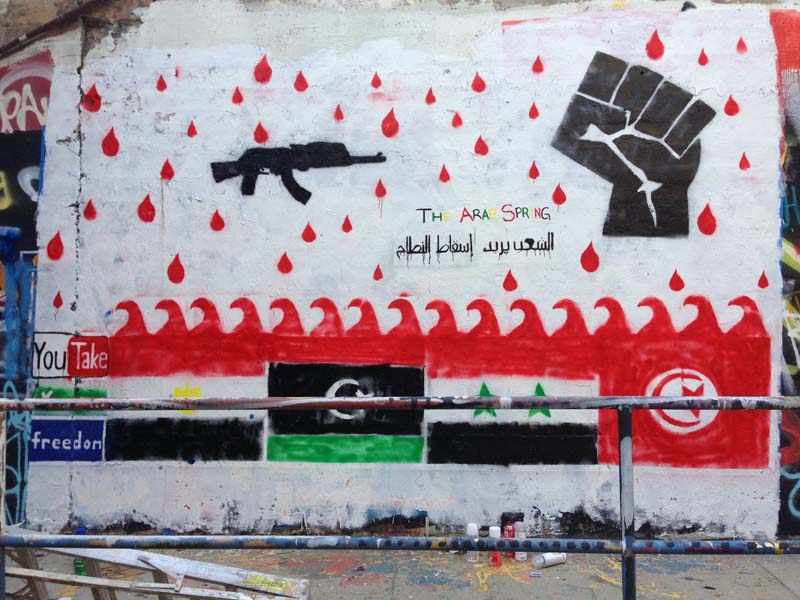
ELIZA WARNER: The graffiti I painted (above) at the east campus bridge was inspired by the events occurring in the Middle East since 2010. In “The Arab Spring” (PoliSci 222), a course covering the developing issues in the region taught by Duke professors Abdeslam Maghraoui and Ellen McLarney, we have recently been discussing the role that artwork and particularly graffiti has been used to give the protesters a voice.
Repressive regimes restricted almost all avenues of speech and the protesters took to the streets. Graffiti art was just another way to claim the streets as their own domain. In my piece I chose to depict the four flags of the countries we studied in the course: Egypt, Libya, Syria and Tunisia. Above the flags I have shown a fist — an image commonly used in Arab Spring graffiti art to represent the protesters. On the other side I painted an AK-47, the weapon of choice of military regimes. In graffiti art it is representative of the repressive tactics of the states in question.
In the center is a slogan for the Arab spring written in Arabic and means “the people want to bring down the regime.” This slogan was a rallying cry for many protesters. The phrase I added reads, “You take your own freedom.” My rendering of YouTake is styled like “YouTube,” and freedom is written like “facebook.” I chose these to emphasize the role that social media played in the uprisings. The final aspect of the piece comes from the raindrops, intended to appear like blood flowing into the flags of the countries at the bottom. The “rain” that is flowing into them shows the suffering and loss the countries are going through to gain freedom.
Eliza Warner is a sophomore at Duke University majoring in political science with a minor in Arabic. The graffiti art is part of Warner’s final project for “The Arab Spring” class (PolySci 222).
Other students from the class are also contributing their graffiti art at the bridge. Check it out if you are in the area. See below for another image, from student John Villa.
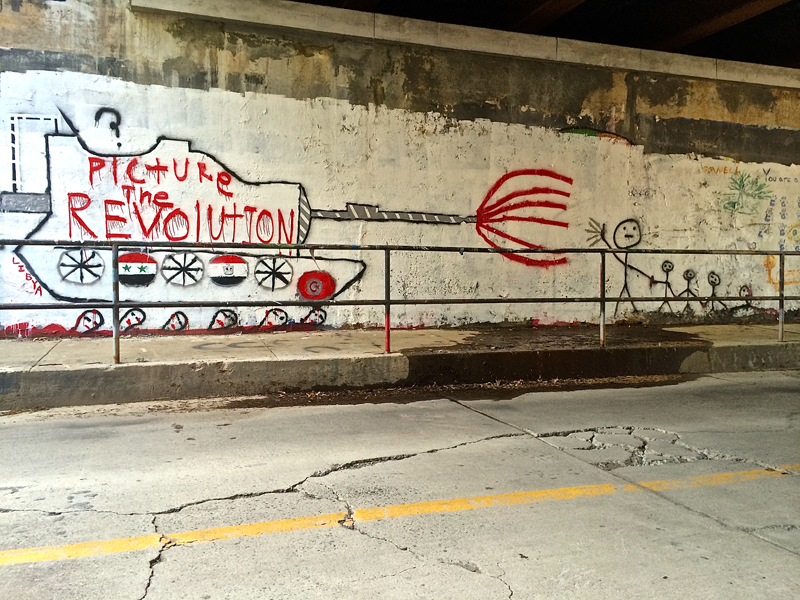
JOHN VILLA: First, I would very much like to thank both of my professors, Abdeslam Maghraoui and Ellen McLarney for opening my eyes to such an enthralling topic as the Arab Spring. The piece itself was inspired by two main factors, the first being a painting of a tank on the wall surrounding the American University in Cairo, and the second being a plea by a man in Tahrir Square to keep the news cameras on as he stated that they were the only thing keeping the protesters alive. Thus, the combination of media as a means of protection for those protesting during the Arab Spring, and the graffiti on the streets of Cairo, were the basis for my project.
The piece itself is rather simple in that it depicts a tank firing on a protester who is returning fire via the flash on his or her cellphone camera. The graffiti is a microcosm of the Arab Spring — the brute force used by the regimes and the use of media as a means of defense for those protesting. The name of my piece comes from the double meaning of the word picture in that one can view the revolution through this artwork, but also the idea that many protestors used a picture to defend his or her self in times of trouble.
John Villa is a freshman majoring in international comparative studies with a focus on the Middle East and Political Science. The graffiti art is part of Villa’s final project for “The Arab Spring” class (PolySci 222). Other students from the class are also contributing their graffiti art at the bridge. Check it out if you are in the area. See above for other images, including from classmates Edward Chen and Eliza Warner.
--
This article was made possible (in part) by the Transcultural Islam Project, an initiative launched in 2011 by the Duke Islamic Studies Center — in partnership with the Carolina Center for the Study of the Middle East and Muslim Civilizations and the Oxford Centre for Islamic Studies — aimed at deepening understanding of Islam and Muslim communities. See www.islamicommentary.org/about and www.tirnscholars.org/about for more information. The Transcultural Islam Project is funded by a grant from the Carnegie Corporation of New York. The statements made and views expressed are solely the responsibility of the author(s).
Other web sites and print publications may re-publish this article as long as there is source attribution (author and ISLAMiCommentary) and a link back to ISLAMiCommentary.
Related Posts:
- Frances Hasso: Alternative Worlds at the 2013 World Social Forum (Tunis)
- miriam cooke: Inside Dissident Syria
- Obama’s Record in Muslim World: Strides, Setbacks
- Abdeslam Maghraoui: On the Current Anti-American Backlash in the Muslim World
- Abdeslam Maghraoui: Morocco —The King’s Islamists
Tags: Abdeslam Maghraoui, Barbara Boxer, cell phone, Duke University, Edward Chen, Egypt, Eliza Warner, Ellen McLarney, Facebook, freedom, Google, John Villa, Libya, mobile phone, repression, Syria, Tunisia, youtube
Category: Americas, i-Comment, Middle East and North Africa, Politics & Current Events, Science, Tech, Media & Social Media, Security & Civil Liberties, Student