[ This article was originally published on the ISLAMiCommentary website, which is now only available via the Wayback Machine. Here is a direct link to this article: https://web.archive.org/web/20170213221027/https://islamicommentary.org/2015/08/frances-muslim-problem-in-postwar-comics/index.html ]
Column » Comics & Dialogue: Islam in Graphic Novels by A. DAVID LEWIS for ISLAMiCommentary on AUGUST 19, 2015
curated and edited by Julie Poucher Harbin, Editor, ISLAMiCommentary

According to the French Council for the Muslim Religion, France saw a four-fold increase in anti-Muslim violence and threats in the first half of this year — roughly the period since the January attack by militant Islamic extremists on the headquarters and staff of the Charlie Hebdo satirical newspaper.
Charlie Hebdo, which continues to publish, is known for its provocative depictions of many different sacred figures, especially Islam’s Prophet Mohammad.
Negative depictions of Muslims in French-language comics have had a long history in France. Eliza Bourque Dandridge, a doctoral student at Duke University with two Masters Degrees (one in European History and the other in French) has combined her many specialties to focus on researching these depictions in bandes dessinées (BD), French-language comic books, circa the 1950s and 1960s. Some of these comics are even enjoying a resurgence and reaching new audiences.
“Comics and Dialogue” had the timely opportunity to speak with Dandridge about the inception of her studies and peek into her remarkable dissertation work.
CD: Let’s talk about your background, first. You detailed an impressive number of fields of study — two Master’s degrees, even! — and yet you’ve journeyed into more recent doctoral work with continued zeal. How are you envisioning or plotting your academic career?

EBD: I knew as an undergraduate at the College of William & Mary that I would continue on to grad school – only I wasn’t ready to settle on just one discipline, field, or department. I have a BA in a self-designed, interdisciplinary field called Literary & Cultural Studies, and for a brief moment, I also considered government work using my languages and experience living abroad. Instead of making an immediate decision, though, I went into writing, editing, and web design, where I stayed through the dot com and into the dot bomb years (super fun!). But grad school was calling, so I went back for a terminal master’s in a joint program in History and Foreign Languages, and then on to the doctoral program in Romance Studies (French/Francophone Studies) at Duke because of its interdisciplinarity. As for my trajectory, I’m on the tenure-track path, absolutely, despite the tough market.
CD: Why France as your focus? (Of course, there’s nothing at all wrong with France, but why that country and not, say, Sweden or Norway?)
EBD: My choice to study France/French/the Francophone world was more accident than intention, initially. My father’s family a few generations back spoke French, but my path has a lot more to do with what was offered in my high schools. I lived in Germany for a few years and took German. When I got back to the States, I had to switch to French because my high school didn’t offer German. I had kept up with Spanish since elementary school but chose to do a Study Abroad year in France because William & Mary had a great program there. That context and language became my primary study area soon after. I lived near the Mediterranean, though, in Montpellier, a city with a high non-Franco-French population, so “France” for me has always been a larger, more complicated, and more interesting object of study than just mainland France.
CD: If I understand correctly, your work has led you to French comics as a way of understanding or gaining insight to what you call “the last decades of the French empire.” What is it about the comics (and magazine) medium that allows for, for lack of a better term, “scholarly access” to the culture of the period? Or, rather than comics having a distinct power/trait that is of benefit, was this medium used to showcase a particular ugliness of the postwar era?
EBD: Great question! Comics, or rather bandes dessinées (BD) – comics written in French by usually French or Belgian authors and sold in French-speaking Europe and the (former) French-speaking empires – were regulated by a French censuring body from 1950 on, similar in some ways to the Comics Code Authority established in the United States in 1954. In France at the time, BD was a phenomenon for children and adolescents (bandes dessinées for adults didn’t really emerge in the twentieth century until the late 1960s). In the aftermath of war, and with rising juvenile delinquency rates, the interests of politicians, educators, and religious groups converged around the issue of youth and their “moral” education.
CD: This is the subject, I believe, of Drawing France: French Comics and the Republic by Joel E. Vessels, if I’m not mistaken.
EBD: Yes, but it goes far beyond just that. The other side of the equation was the sheer number of comics magazines and later albums in circulation between 1945 and 1968 (France’s broader decolonial period, and the focus of my research). By some estimates, over a million boys (and girls) aged 7 to 15ish encountered bandes dessinées each week. The censure law of July 1949 stipulated that comics for kids model “ideal” behaviors and impart a sort of practical advice to young readers growing up in a rapidly modernizing, decolonizing, Cold War world. So regulating what kids read outside of school on their own time was widely seen as a way of molding new generations into global citizens.
EBD: What bandes dessinées and their magazines offer the researcher, then, is a glimpse into the prevailing ways of thinking at the time about France, society, Europe, America, empire, and war. Ugliness? You bet. Racist caricatures of the (colonized) other were certain BD genres’ bread and butter. But the picture is more complicated, with quite a few popular bande dessinée series – adventures, in particular – exploring what was happening in and to France in shades of gray, not black and white.
CD: When and how did images of Islam and Muslims first enter your research, incidentally?
EBD: I became aware of narratives and images of French Muslims and of North African Muslims in France during my stay in Montpellier, which coincided with the massive strikes and demonstrations of 1995, complete with looting, rioting, sit-ins, tear gas, and no city garbage pickup for days! I was attuned then to what it meant (and clearly didn’t mean) to go on national strike and was frankly shocked at the force used to counter the strikers, and particularly the looters. I was in Italy during the 2005 banlieue (suburbs) riots and again saw French law enforcement in action, this time on television. These experiences and impressions all focused my attention in graduate school on legacies of empire and colonialism in the (formerly) French-speaking world, and on what (Duke scholar) Laurent Dubois and others call “global France.”
CD: What, in your experience with this literature, characterizes the Muslim stereotype? This is not to imply you approve, naturally: rather, what were the signs and symbols that were ascribed to practitioners of Islam? Do you feel many/any of them continue today, either outside of France or in other media?
EBD: French stereotypes of Muslims are deeply rooted, obviously, in the places and encounters of the Mediterranean basin, from Spain to North Africa, the Levant, and the “Near” East – or, broadly, what was understood as the “Orient” in France at various moments in history. The decolonial wars at mid-century, though, brought stereotypes of the colonized Maghrebi “Arab” to the forefront of collective imaginations. BD (French comics) across the period recycled and circulated Muslim stereotypes ad nauseum, despite a 1954 addendum to the law of 1949 prohibiting “harmful” depictions of ethnic others.
CD: I imagine this aspect of the law wasn’t as carefully policed, necessarily, than other more “domestic” aspects of it.
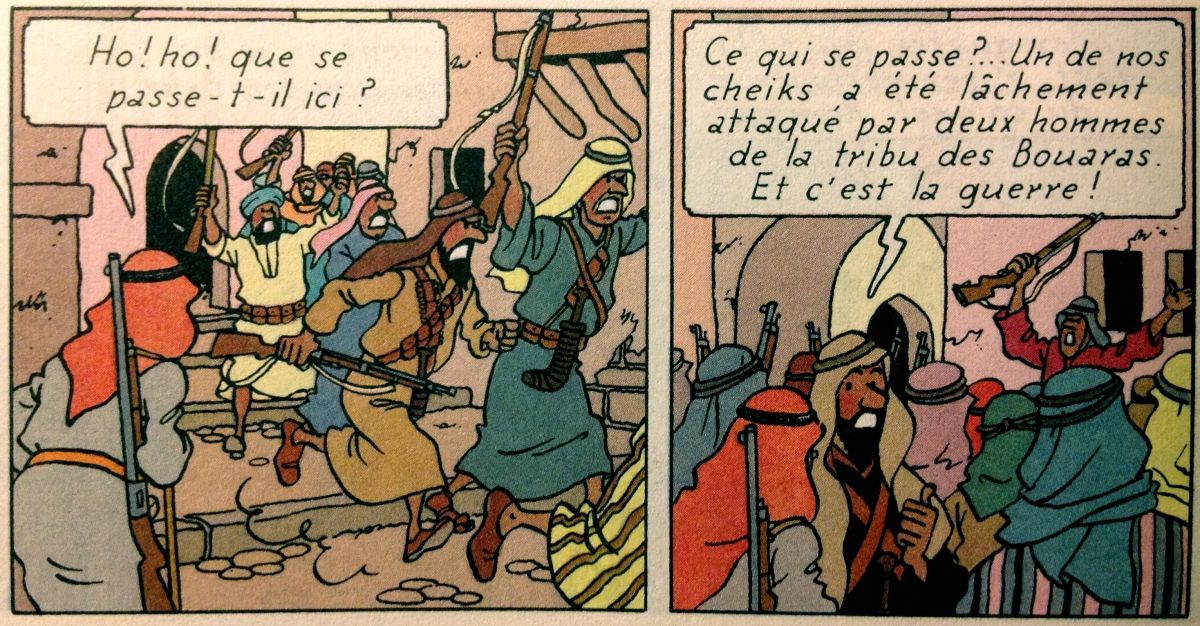
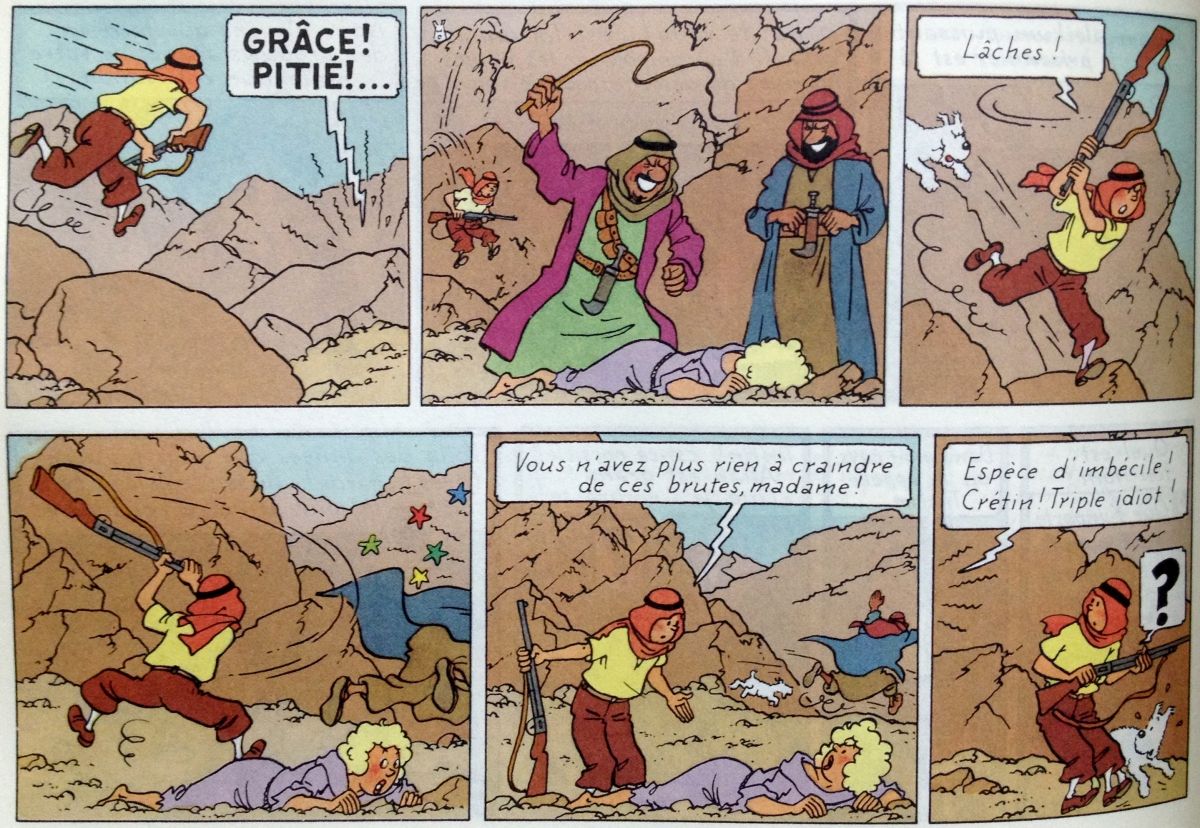
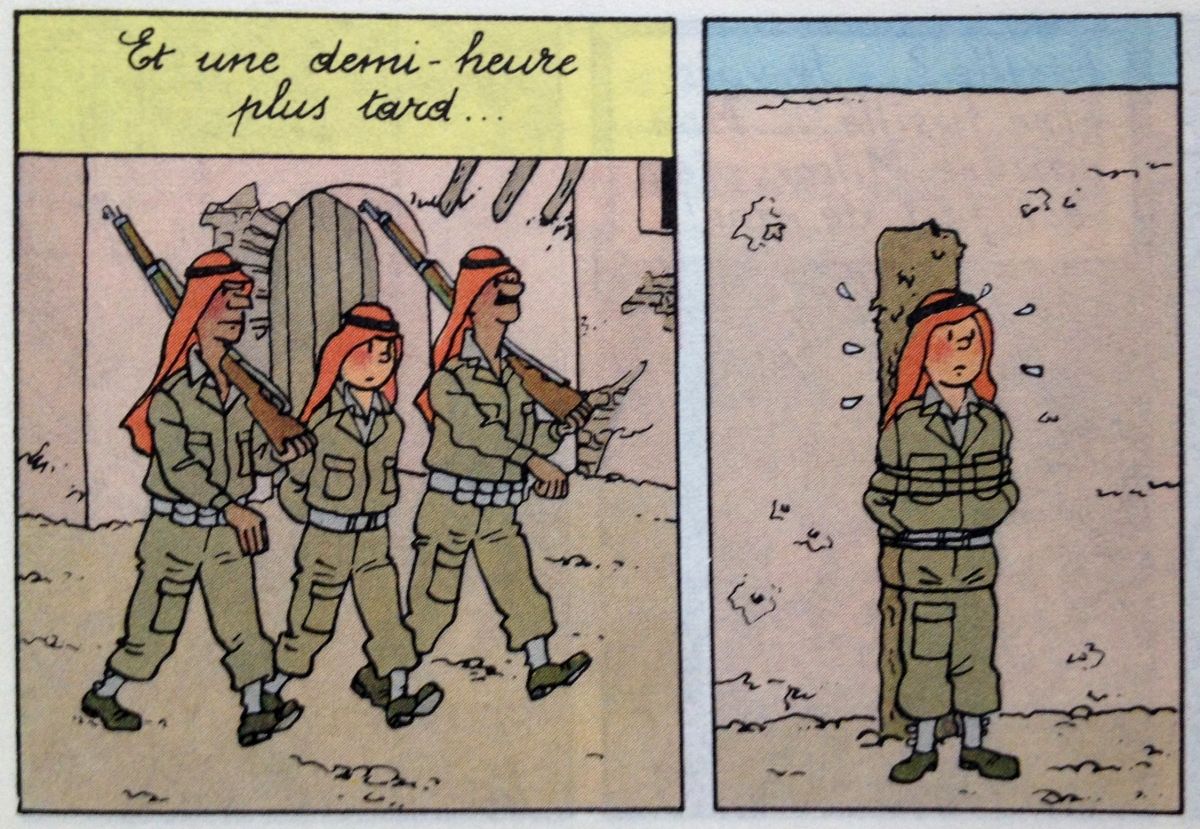
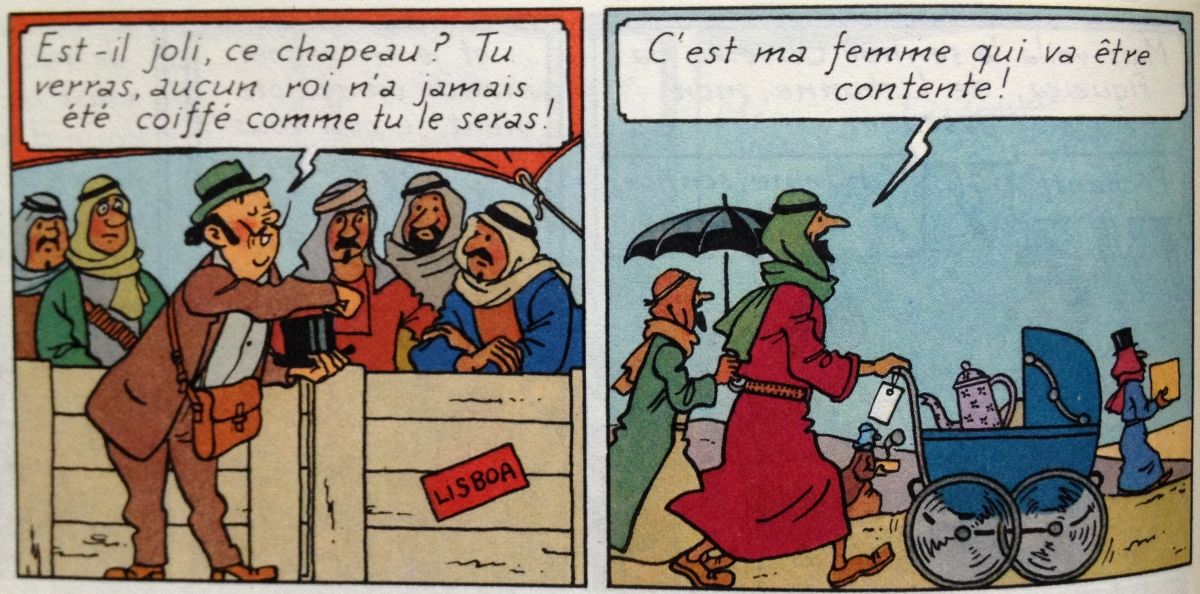
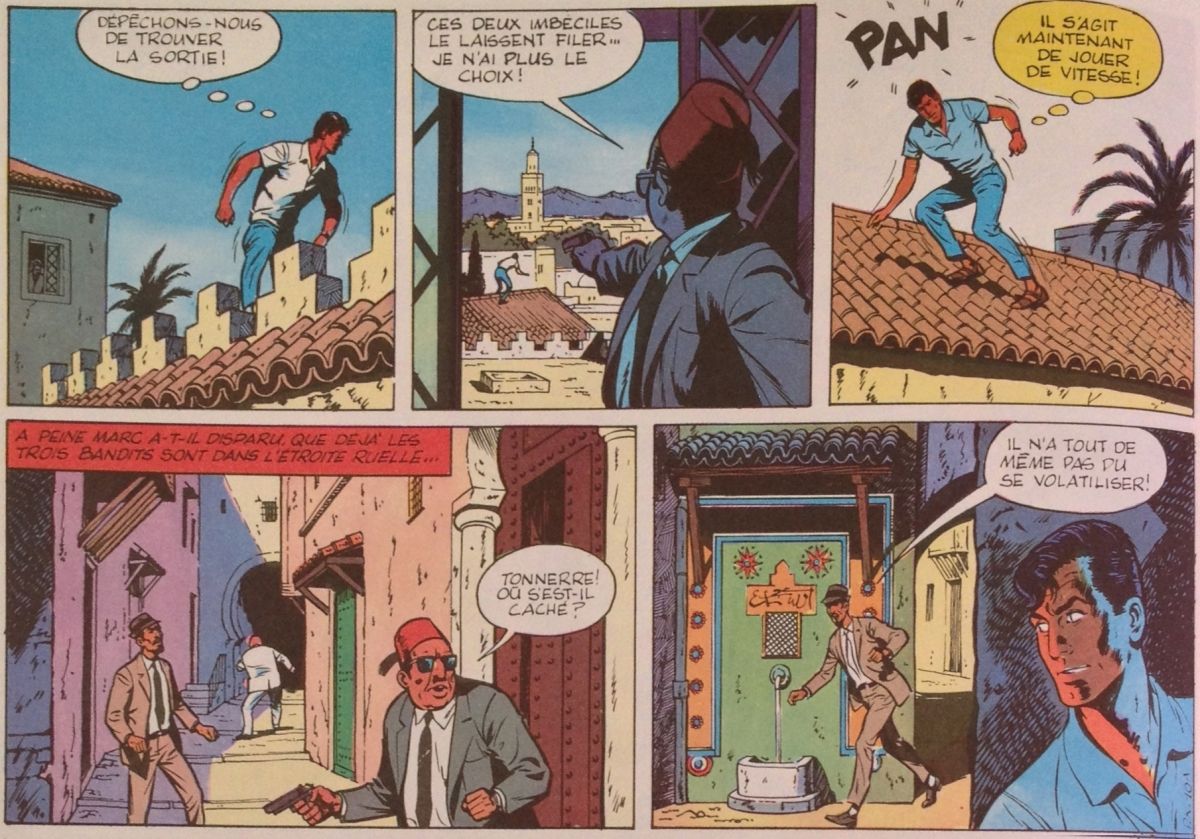
EBD: Muslim characters, not surprisingly, appeared most frequently in comics organized around “away” travel, such as the exotic adventure or colonizer tale, rather than in stories of domestic or “home” (mis)adventures. And also not surprisingly, it was generally the more conservative or religiously affiliated magazines, like Hergé’s Le Journal de Tintin, that specialized in away adventures and Muslim encounters.
EBD: For the most part, Muslim characters held one of several narrative “occupations.” They were rarely protagonists or co-protagonists, nor were they generally on-going sidekicks. They could be helpers: local leaders offering their protection, those conveying necessary information at crucial junctions or assisting with operations, guides through the wilderness, or translators/interlocutors for the heroes. They could also be donors appearing briefly in the narrative with a gift to bestow, such as a key or a map or an address or a vehicle. They could hinder the hero’s quest as a block.
Antagonists also included regional leaders (often “caïds”) who kidnap the hero, rebels hiding behind rocks setting up an ambush, angry mobs that had to be placated with money or gifts, and local (corrupt) law enforcement opposed to the hero’s initiative and intervention. Muslim characters could also perform the role of the rescuer, sweeping in before the finale to save the hero from unforeseen danger. Rescuers often doubled as donors or helpers, so that the hero’s earlier goodwill-building among the natives paid off at the end. Rarely were Muslim characters the central villains of the story, although many occupied various positions of collaboration, resistance, and betrayal. In short, Muslim characters were subordinated to the reason, justice, intelligence, and strength of the (white European) hero.
CD: How did reader-viewers recognize a Muslim character?
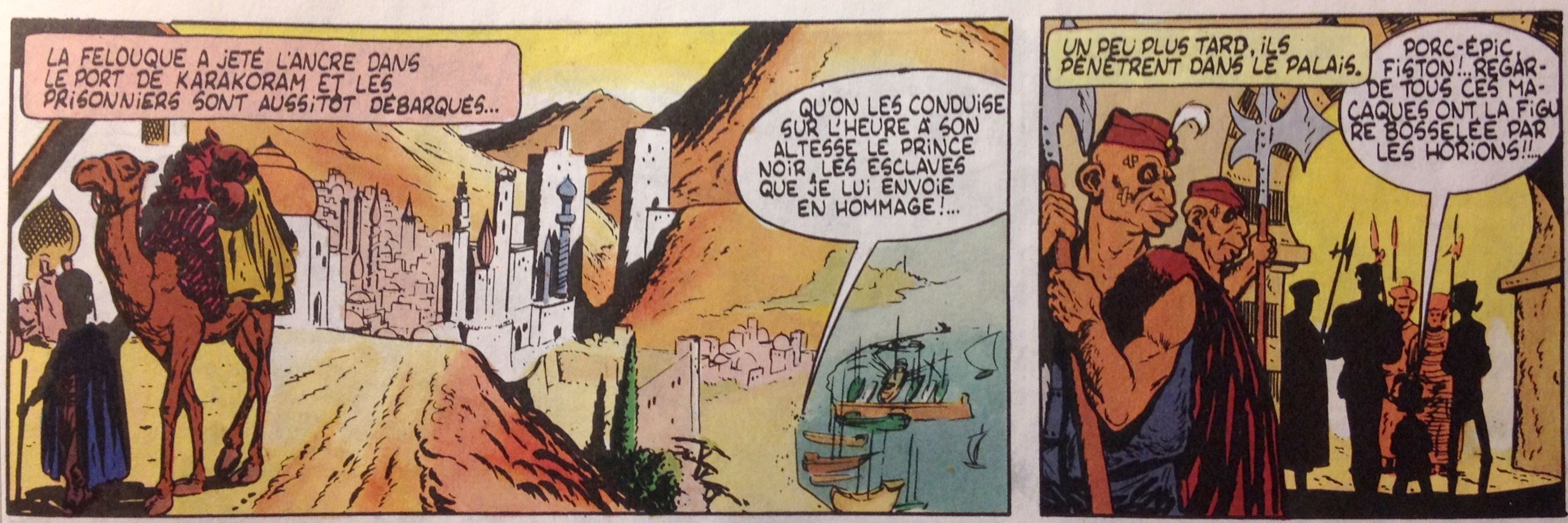
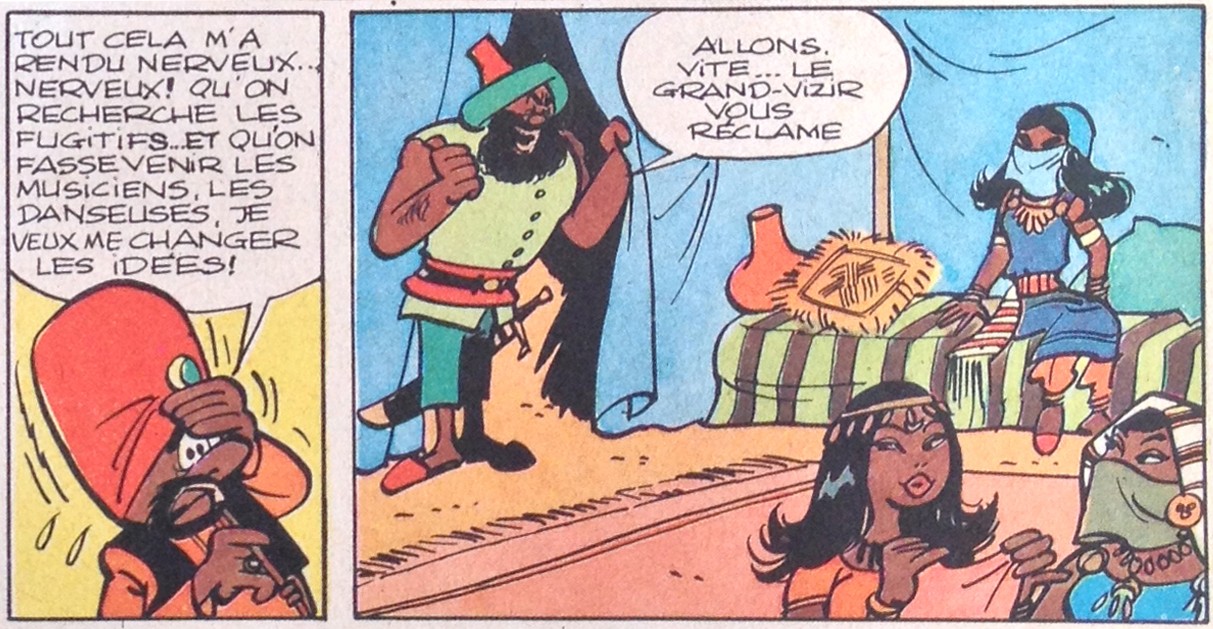
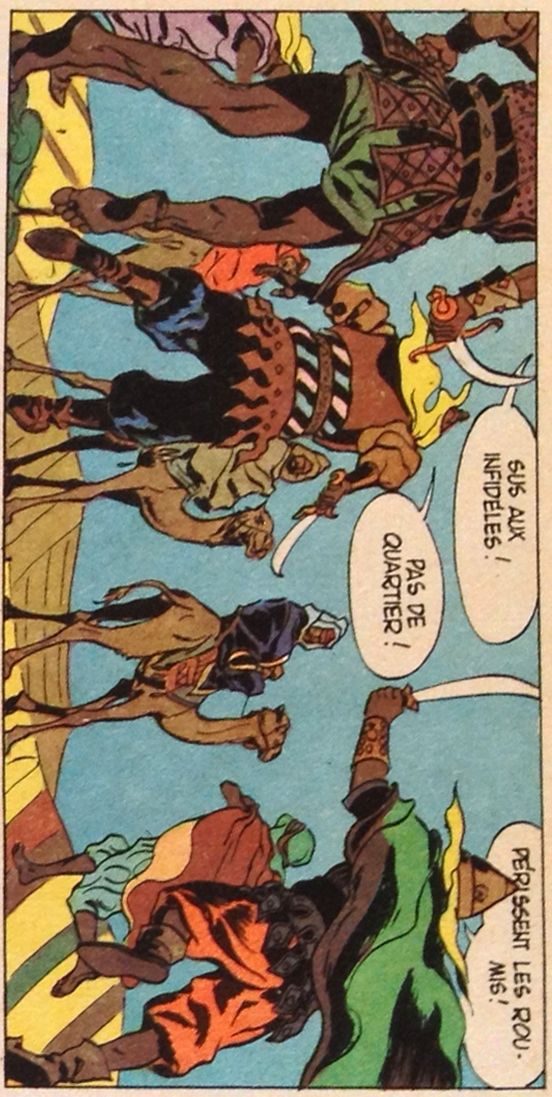
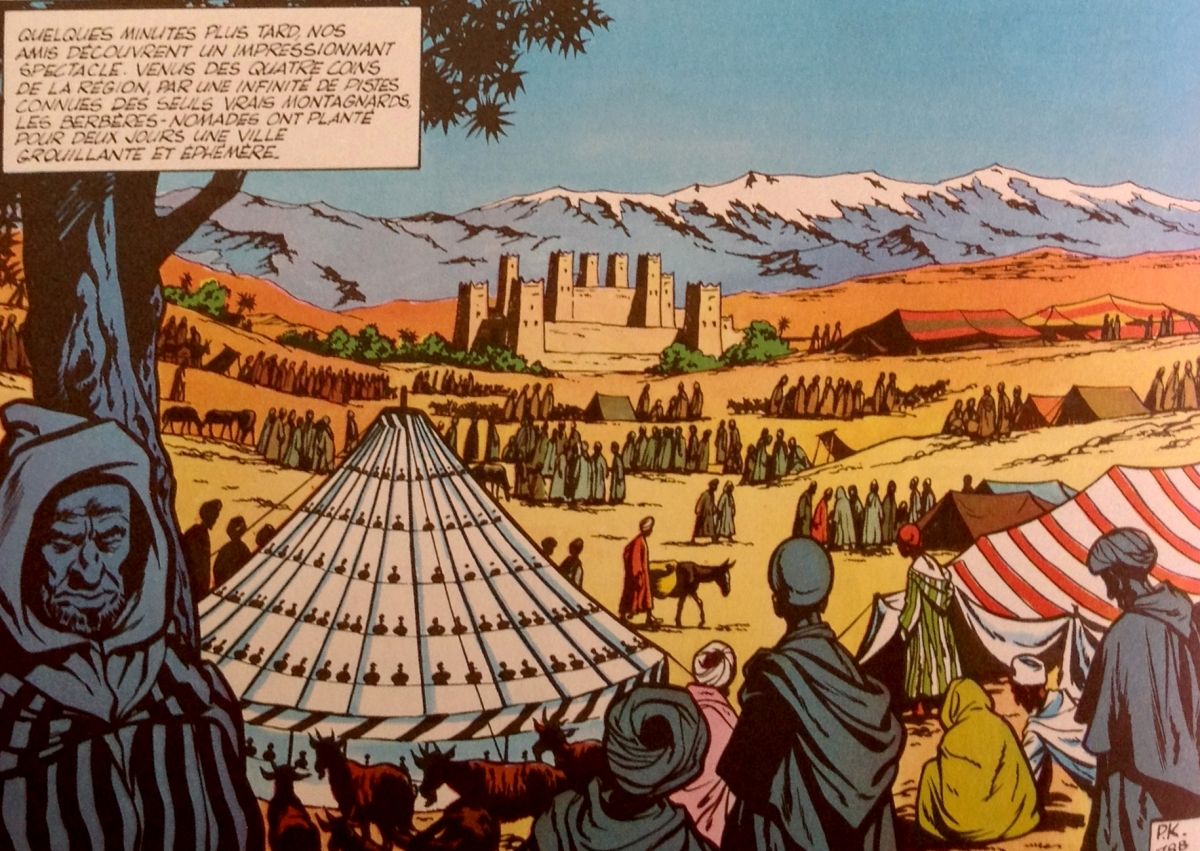
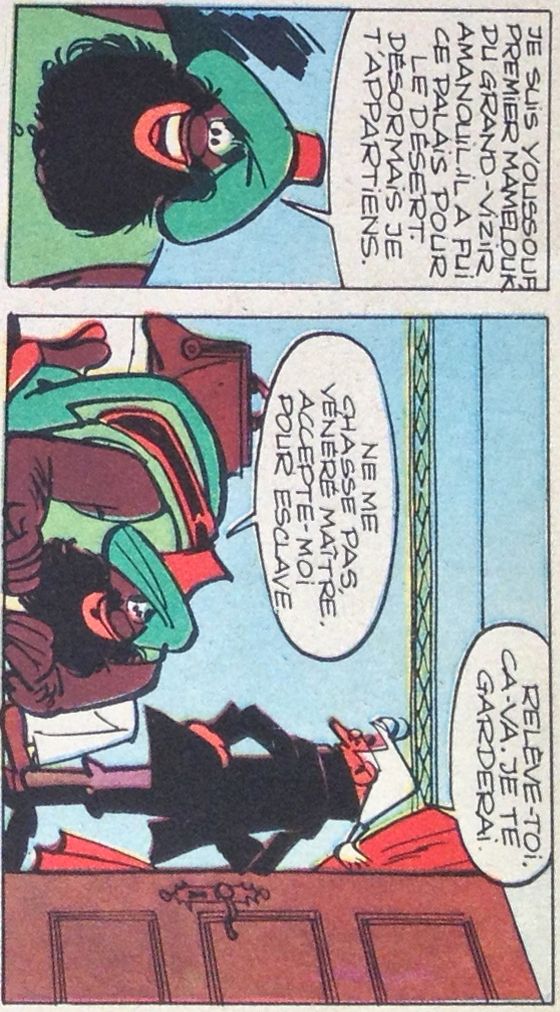
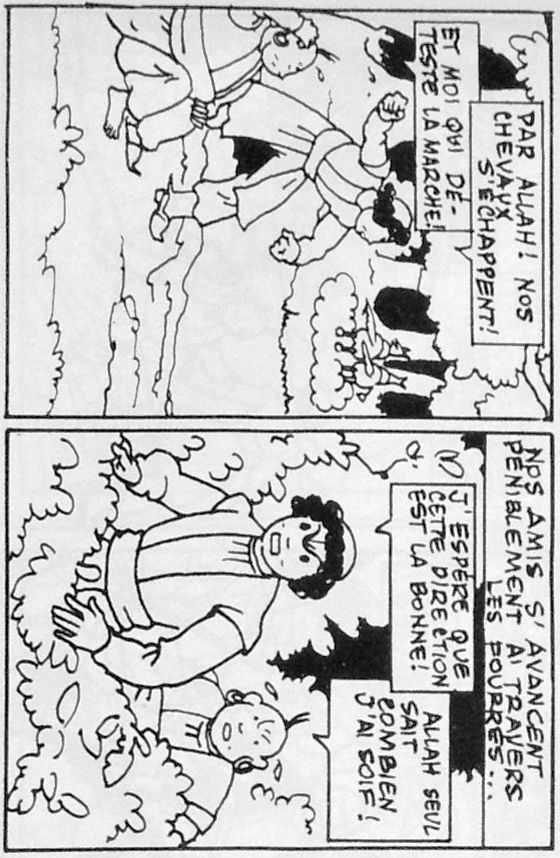
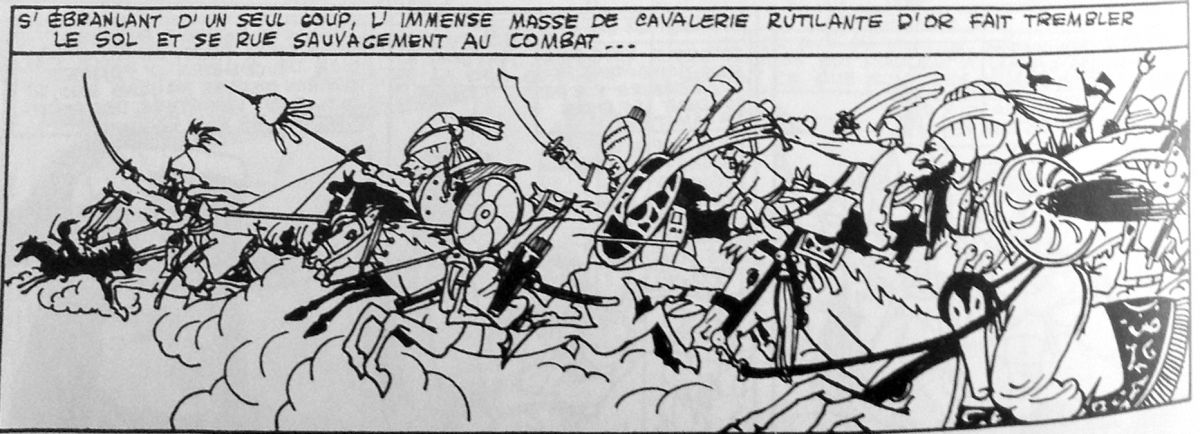
EBD: Usually by the presence of head gear (e.g. headscarf, fez), long robes, weaponry, “poetic” speech, opulent surroundings, camels, horses, deserts, casbahs, and, in many cases but certainly not all, darker complexions than the hero, as well as caricatural features, such as hook noses or pointed beards. The text would often provide confirmation with a well-placed “Par Allah !”
EBD: Given the diversity of roles and settings and scenarios, no one stereotype of the Muslim emerged across BD – say, of the warring rebel nomad, or the docile, childlike villager (both of which stereotypes persist today in the West). Muslim characters could be highly educated city dwellers, international travelers, villagers, peasants, bandits, etc. Authors could – and often did – deprive them of a voice, but others spoke grammatically correct French, and others still communicated in various kinds of pidgin, pseudo-native tongues, and, rarely, indigenous languages. They could be assimilated into French (colonial) culture, resistant to it, or anywhere in between. They could exist in the narrative as a critique of colonialism, or as its raison d’être.
CD: You’ve poured over scores of Francophone comics and series. Notably, you’ve looked at a few different genres, such as Historical Adventures and Westerns. In theory, different genres would imply different audiences (or audiences with varied expectations). Does the image of the Muslim change greatly depending on the genre? In your sampling of titles, do any genres push stereotypes in this period more heavily than others?
EBD: I would argue that the majority of the popular BD series during the decolonial period fall into a single genre category: that of the adventure. Within the adventure, you’ll find Viking tales, detective thrillers, pirate stories, safari adventures, Westerns, police narratives, war chronicles, etc. What makes them all adventures first and foremost? They all feature faraway travel (usually continent-hopping), a hero born of courage and mettle, dangerous encounters in frontier landscapes, and cyclical heroic triumph. Based on my research so far, Muslim characters appeared in certain subgenres of the adventure and in episodes set for the most part in North Africa (the Maghreb and Egypt) or in a phantasmal “Orient.”
EBD: Now if we talk about mode instead of genre, we can see differences in representations of Islam and Muslims between series and stories. In the 1940s, adventure authors were generally paid by the page and cranked out comics with less concern for story and character arcs, historical realism, or verisimilitude with daily life. Adventures were meant to deliver thrills and entertainment – and to sell magazines.
EBD: The law of 1949 pressured authors to consider the pedagogical utility of their scripts and illustrations. Across the 1950s, as the precious baby boom readership entered middle school, more and more authors and artists embraced documented realism. Places became locations, characters became representations of peoples, backgrounds became cultural geographies, landscapes became geologies. Magazines vaunted the precision and accuracy of their BD staff. Certain series began to make appearances on school curricula, or at least on classroom walls.
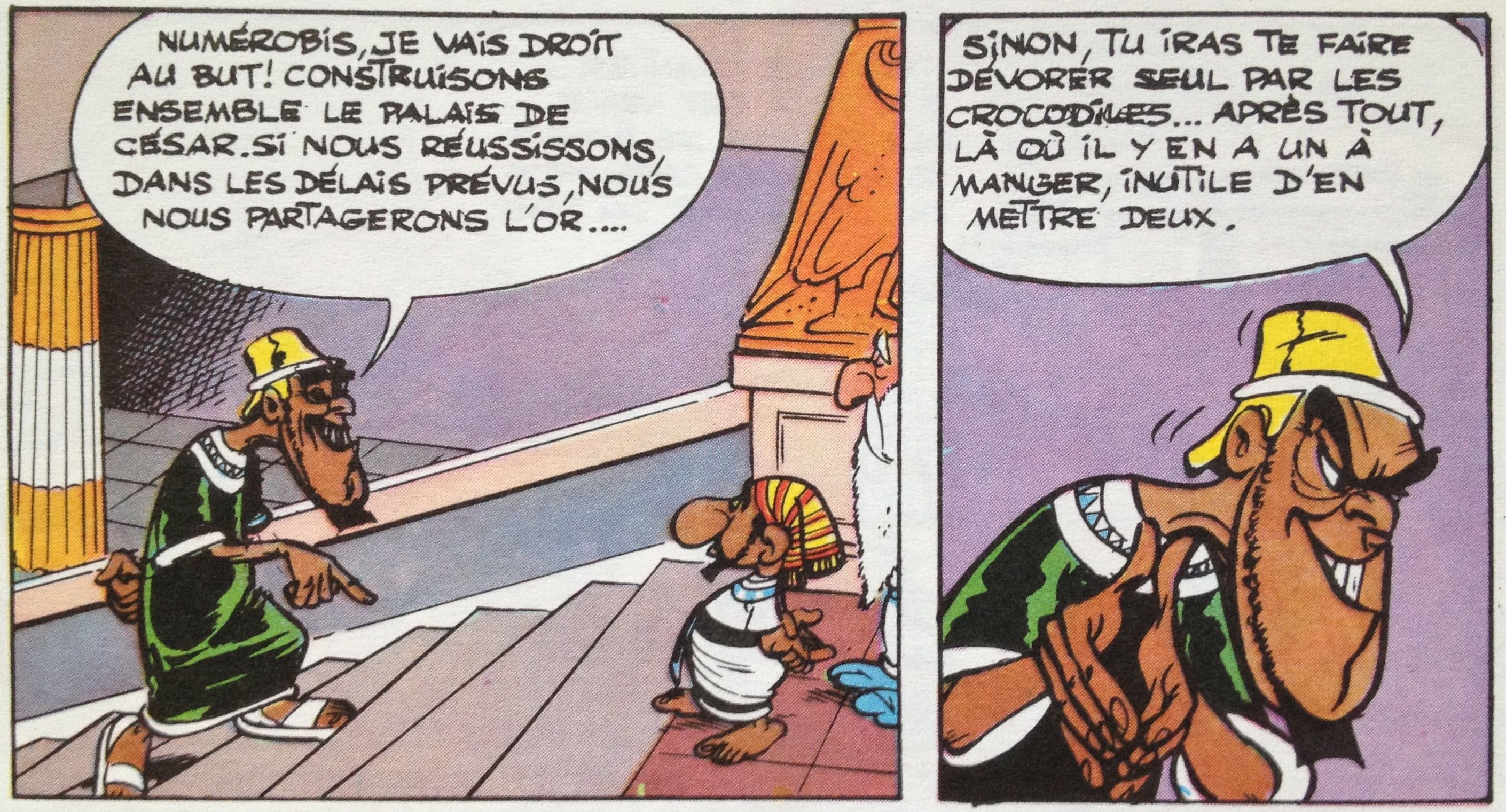
EBD: Moving into the 1960s, mores began to shift again, and the earnest documented realism of the grand adventure moved aside to make room for humor and caricature. And the caricatural adventure comics, like the Astérix series, founded its humor on the ethnic stereotype pushed to its limits, or really to its barest bones. Caricatural cartooning, because it exaggerates and distorts “reality,” history, physiognomy, etc. for laughs, usually blunts the historiographical or pedagogical “utility” of the story. Should we get our Roman history from the Astérix series?
CD: Probably not?
EBD: Probably not.
(More images below from the slideshow that appeared on the original ISLAMiCommentary post; images that Eliza Bourque Dandridge has been researching )
###
Eliza Bourque Dandridge, who holds two Masters degrees — one in European History and the other in French — is pursuing her doctorate in Romance Studies (French/Francophone Studies) at Duke University, where she specializes in questions of empire, memory, war, and colonialism. Her work also engages with Visual Studies, Comics Studies, Indigenous Studies, and American expansion. She has been a Research Fellow with Duke University’s Council for European Studies (CES) Society of Scholars for the past three years and has served as group coordinator for the past two years.
A. David Lewis is the founding member of Sacred & Sequential, a collective of religious studies and comics studies scholars. He currently teaches at MCPHS University and has previously lectured at Northeastern University, Bentley University, Boston University, Tufts University, Merrimack College, and Georgetown University. He is the co-chair for the American Academy of Religion’s “Death, Dying, and Beyond” Group. His latest book is American Comics, Literary Theory, and Religion: The Superhero Afterlife (Palgrave Macmillan, 2014). He is also co-editor of Graven Images: Religion in Comic Books and Graphic Novels (Bloomsbury Academic, 2010), co-author of Some New Kind of Slaughter from Archaia Entertainment, and co-editor of Digital Death: Mortality and Beyond in the Online Age (Praeger, 2014), a winner of the Ray and Pat Brown Award for “Best Edited Collection.” He was nominated for a Will Eisner Comic Industry Award in the Best Scholarly/Academic Work category for American Comics, Literary Theory, and Religion: The Superhero Afterlife (Palgrave Macmillan, 2014). You can follow him on Twitter @ADLewis.
———-
ISLAMiCommentary is a public scholarship forum that engages scholars, journalists, policymakers, advocates and artists in their fields of expertise. It is a key component of the Transcultural Islam Project; an initiative managed out of the Duke Islamic Studies Center in partnership with the Carolina Center for the Study of the Middle East and Muslim Civilizations (UNC-Chapel Hill). This article was made possible (in part) by a grant from Carnegie Corporation of New York. The statements made and views expressed are solely the responsibility of the author(s).
Other web sites and print publications may re-publish this article as long as there is source attribution (author and ISLAMiCommentary) and a link back to ISLAMiCommentary.
Tags: A. David Lewis, Asterix, bandes dessinees, banlieues, College of William & Mary, Comics & Dialogue: Islam in Graphic Novels, Comics Code Authority, Duke University, Eliza Bourque Dandridge, France, France history, France Muslims, French comics, French Empire, historical realism, Laurent Dubois, North African Muslims, Tintin
Category: Comics & Dialogue: Islam in Graphic Novels, Europe, History and Anthropology, i-Comment, Middle East and North Africa, Muslim Life & Culture, Student, Sub-Saharan, East, and West Africa