
Special to the Diplomatic Pouch by Julie Poucher Harbin
The wall of glass opening onto the woods, complete with autumn leaves turning color, is the perfect backdrop for the latest artistic offering hosted by the Finnish Embassy. Visitors to “The Loveliest Girl in the World” photography exhibition, after descending the embassy’s grand hanging staircase, can expect to enter a reception hall flooded with light and inspiration.
Using a film camera, Finnish social worker and artist Miina Savolainen accompanied ten girls from a Helsinki children’s home — one at a time, and at various times in their lives — to some of Finland’s most beautiful, haunting and remote locations.
Billed as “the most successful Finnish photography project of all time,” the exhibition is a culmination of the decade (1998-2008) she spent traveling about 200,000 kilometers by car, on foot, and via snowshoe and rowboat. She began the project when she was just 24.

Whether a smoky forest floor, a Lapland snowstorm, a frigid lake, a hollow tree, an autumn field, a cityscape, an abandoned house, or a sea cave of sorts, Savolainen’s landscapes are arguably as eye-catching as her human subjects.
“The landscapes are stunning, but in every picture you are drawn to the girls because they are being themselves,” said Meri Siirala, a local Finnish opera singer who helped facilitate the D.C. showing.
Savolainen has come up with a unique way of mixing social work and art. Through “empowering photography,” a concept she developed while doing this project, the photograph is transformed into an instrument of self-discovery.
“They hadn’t been looked at in a loving way before,” Savolainen explained to me in a private tour of the exhibition now on display as part of Kids Euro Festival and FotoWeek D.C. “They’ve seen a chaotic and cruel world.”
Through these photography journeys, she said, “they could see the world as beautiful, and see themselves another way — as beautiful, valuable and precious.” As it says on the “Loveliest Girl in the World” banner, “Everyone is entitled to feel precious and beloved.”
Most of the girls were abandoned by alcoholic mothers. They were at the children’s home, not because they were orphans, but because their living parents couldn’t take care of them.
Some of them had spent time in foster care, but perhaps because they were difficult to handle, it didn’t work out. Some came to the children’s home when they were already teenagers; too old to find a foster family to take them in.
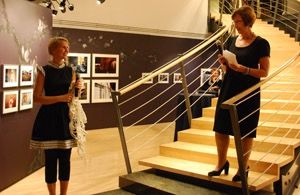
Finland’s first female ambassador to the United States, Ritva Koukku-Ronde, who assumed her post this September, hosted a private reception ahead of the October 19 opening. In comments included in the exhibition leaflet she said Savolainen’s “perceptive photography beautifully illustrates young women’s passages to adulthood and self-acceptance.” “The exhibition also highlights gender equality and women’s societal roles in subtle, innovative ways.”
Each girl chose where and how she wanted to be photographed. Their personal reactions to the project were displayed alongside their photos at the exhibit.
One pregnant in a bridal gown, but with no prospect of a groom. Another wearing a crown. Another adorned with faerie wings...
“Using a fictional element we realize the emotional truth,” explained Savolainen.
Was it role play?
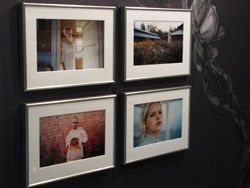
Paula, photographed four times between age 14 and 24, chose to pose in an abandoned house in one of her photos.
She said this: “I don't see any role play in these photos. I only see an inexperienced little girl who has in fact experienced more than anyone would have expected. The atmosphere is like a fairytale, because in the photos there is love and tranquility, which are hard to find in real life.”
According to Mona, who was photographed by Savolainen four times between the ages of 17 and 22, “Role play? Not at all. On the contrary in fact. I think that our picture shows for the first time in my life who I really am. My soul is in these pictures.”
One of the photos on display shows Mona lying down in cold water pooled at the bottom of a rowboat that is floating in shallow water. Savolainen said, “It was freezing. She wanted to be in the water. She wanted a new start.”
“At first she found the pictures terrible. She could see in them her inner world and it might have been painful to look at the picture. Then at the end the pictures were meaningful to her.”
Petra, Savolainen’s youngest subject, was first photographed at age nine and last photographed at 19. She wanted to have wings, so in her first photo, which is part of the exhibition banner, she is wearing them.
Jenna was photographed three times between the ages of 14 and 21. At 14 she is standing in a spring forest carpeted with little white flowers that Finnish girls traditionally give to their mothers. At 21, she is in a storm in Lapland.
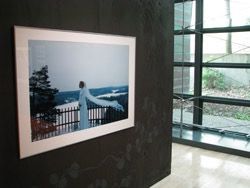
When she was first photographed, Savolainen said that Jenna felt “it was scary and oppressive to be the center of attention.” Then, when Jenna was 21, she looked at her pictures and said “I feel whole and strong.”
Tiina, a single mom who became pregnant while still a teenager, was photographed before she was pregnant, while she was pregnant, and then, later, with her baby.
Though she was not engaged, she wanted to be photographed in a wedding dress while she was pregnant. Savolainen gave her her mother’s 1960s wedding dress to wear for the picture.
“At first looking at the photos felt pretty scary, but later it was quite wonderful. It was important to see that you are good enough just the way you are,” was Tiina’s reaction.
Milla, who graces the cover of “The Loveliest Girl in the World” exhibit book, was photographed five times between the ages of 14 and 22. She was first photographed sitting in an autumn field with pinecones on her lap and a golden crown, given to her by her nurse at the home, on her head.
“She was born in autumn,” Savolainen said. “It’s important her head is averted. She thinks it’s telling about her shyness and sensitivity, looking at pinecones in a very gentle way.”

“In the photos every one of the girls has been accepted just the way she is, as the princess of her own life. Everyone is entitled to think about herself that way.”
In her final photo, taken at age 22, Milla is on an island by the sea in a rocky place that’s usually underwater.
“Milla had a dream she’s walking on the water,” Savolainen said, explaining the choice of locale.
The rocks were slippery so Milla and Savolainen had to take care. In this, one of the most striking photos of the exhibit, she has to lie on a blanket so she doesn’t fall off, but the blanket is not visible in the photo.
“It’s mythical in nature. Sheltering the inner child. Womblike,” Savolainen said. “She (Milla) understood she could replace her missing mom’s and dad’s loving eyes by loving herself.”
According to Milla, “It meant a whole lot to me to see myself beautiful. In the children’s home I didn’t get the parental attention I needed. It has left a hole. I thought that anyone could abandon you, but not your own mother. And yet, that’s just what happened. After losing so much you try to live so that you don’t lose again. You live frugally.”
Savolainen said Milla’s mother saw that text — which is part of the exhibition as well as in the exhibition book — and “she was hurt.” Milla’s mother has since passed away from complications of alcoholism.
Many of the girls are still in contact with their mothers, but their mothers are very needy, so the child’s and parents’ roles have now been reversed.
“Many of the girls are now caring for their parents,“ she said. “They were children just learning to love themselves… Mostly they have found their own way now.”
Savolainen said there was “a lot of adventure” on these trips, and often the act of warming up in a cold place was comforting — drinking warm drinks and wearing winter coats, hats and multiple hidden layers of clothes. Of course there was also the individual attention and the carmraderie of a road trip. She showed me some candid, joyful, behind-the-scenes pictures on display. Savolainen did not take any assistants or drivers with her.
Most places were hard to reach, which makes them especially exotic. Savolainen said she will not disclose the exact locales despite inquiries. She doesn’t want anyone to ruin the magic. (“Someone might want to do a shampoo commercial there.”).
Book sales are the biggest source of financing for the traveling exhibition, though she has received some funding from the Finnish Cultural Foundation.
The artist developed all the film herself in a darkroom.
After it leaves D.C., the exhibition, which was most recently in Ottowa, Canada, will continue on to New York, Mexico City and Santiago de Chile as part of its first international tour outside Europe.
Savolainen is currently teaching this method of empowering photography back home in Finland. She most recently did a project on fatherhood and is currently working on a project about gender identity.
This is the last weekend to see the “The Loveliest Girl in the World” exhibition in D.C. It is free-of-charge and open to the public from 11 a.m.-4 p.m., Friday Nov. 11 through Sunday Nov. 13. Embassy of Finland. Finland Hall. 3301 Mass. Ave. N.W., Washington, DC. For more information see: Official web site and Facebook.
Front page and fifth photo: Milla, who graces the cover of “The Loveliest Girl in the World” exhibition book, was photographed five times between the ages of 14 and 22. Here she is at 14.
Photo: Miina Savolainen
Top photo: Nina is photographed in the hollow of a tree. All of the young women photographed by social worker and artist Miina Savolainen resided in a children's home in Helsinki.
Photo: Miina Savolainen
Second photo: Finnish Ambassador Ritva Koukku-Ronde, right, welcomed artist Miina Savolainen at a private reception at the embassy to launch the D.C. showing of "The Loveliest Girl in the World" exhibition.
Photo: Embassy of Finland
Third photo: Paula, photographed four times between age 14 and 24, chose to pose in an abandoned house in one of her photos. Photos of her, taken by Miina Savolainen, are on display as part of "The Loveliest Girl in the World" exhibition at the Finnish Embassy.
Photo: Julie Poucher Harbin
Fourth photo: Tiina, a pregnant teen, wanted to be photographed as a bride. Her photo, taken by Miina Savolainen is part of "The Loveliest Girl in the World" exhibition at the Finnish Embassy in D.C. that runs through Nov. 13.
Photo: Julie Poucher Harbin
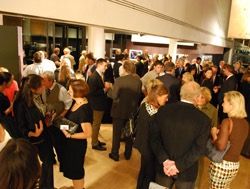
Bottom photo: The Embassy of Finland is hosting "The Loveliest Girl in the World" exhibition through Nov. 13. Finnish Ambassador Ritva Koukku-Ronde (at left holding a purse) welcomed guests to the exhibition at a private reception.
Photo: Julie Poucher Harbin
[This article is included in The Washington Diplomat's Nov. 2011 Diplomatic Pouch e-newsletter, and was preserved by Julie Poucher Harbin via Evernote. The original link is: http://www.washdiplomat.com/DPouch/2011/November/1011lifestyle.html]