[ This article was originally published on the ISLAMiCommentary website, which is now only available via the Wayback Machine. Here is a direct link to this article: https://web.archive.org/web/20170214164935/https://islamicommentary.org/2014/03/morocco-steps-up-leadership-in-religious-and-security-affairs-in-w-africa/index.html ]
by ANN WAINSCOTT for ISLAMiCommentary on MARCH 16, 2014
curated and edited by Julie Poucher Harbin, Editor, ISLAMiCommentary
Morocco’s recent involvements in West African religious affairs — as in the case of Mali, ostensibly to promote tolerance and participate in the country’s “physical and spiritual reconstruction” — are better interpreted as a new foreign policy strategy in West Africa. Morocco is, in fact, increasing its religious collaborations as a means towards taking a stronger leadership role in regional security matters.
Until recently, the Moroccan monarchy’s management of religious affairs had been primarily focused internally. The Moroccan monarchy has long regulated religion in order to shape a distinctly Moroccan form of Islam. The present king’s father, Hassan II, had built a new institution of Islamic higher learning, Dar al-Hadith al-Hassaniya, in 1975 in the capital city of Rabat to compete with the historically rebellious and influential Qarawiyyin University in Fez.
A terrorist attack in Casablanca in 2003, which targeted Jewish and European sites and killed thirty-three civilians, was the impetus for a host of reforms that strengthened state control of Islamic institutions. Referencing the War on Terror, the monarchy called for a number of religious reforms, including tightening its control over Moroccan Islam. The monarchy defended these reforms as a means to prevent the inculcation of extremist ideas through politicized modes of Islamic education.
[PHOTO SOURCE: King’s Four-Nation Tour Deepens Morocco’s Partnerships in Africa: More Than 80 Agreements Signed for Economic, Social Cooperation (Morocco on the Move, Mar. 12, 2014)]
These reforms included changes to councils for religious scholars as well as reforms to the religious education curriculum for the public schools. The Ministry of Islamic Affairs installed flat screen TVs in mosques to broadcast the state’s religious programming, created the first positions of female Islamic authority (murshidat) in the Arab world, and incorporated (male) Imams into the state’s religious bureaucracy. Taken together, these actions can largely be summarized as a process of bureaucratizing religious authority in order to monitor and control it.
Recently, Morocco began to project this policy of religious regulation externally; first taking advantage of the opportunity created by a 2012 coup that plunged Mali into conflict and instability. Although Morocco’s role during Mali’s 2012-2013 civil war was limited, it publicly expressed support for the French intervention against jihadist groups in early 2013, and increased its involvement in Mali following the restoration of the country’s territorial integrity.
In late September 2013, this increased cooperation was formalized in an agreement signed by the Moroccan Minister for Islamic Affairs Ahmed Toufik and the Malian Minister for Territorial Administration Moussa Sinko Coulibaly. In the agreement, reportedly a response to Malian requests for assistance, the Moroccan government agreed to train 500 Malian Imams at Moroccan institutions of higher learning.
The training, which began when 90 Malian Imams arrived in Morocco last November, was expected to be broad and include subjects such as Malian history, geography and institutions in addition to human rights, media and religious topics.
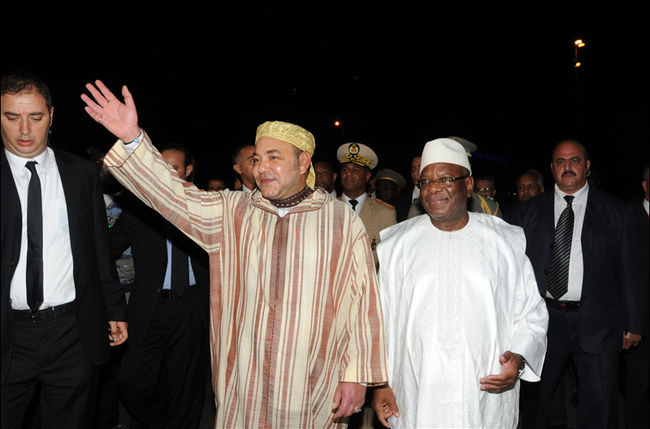
At the investiture ceremony for Mali’s new president, Ibrahim Boubcar Keita, on September 20, 2013, the Moroccan King Muhammad VI, discussed the agreement : “Any coordinated international action which does not attach the necessary importance to cultural and religious aspects will be doomed to failure.”
His statement echoed the rhetoric he used to defend his response to domestic terrorism in 2004 — suggesting that efforts to counter terrorism that do not include spiritual renewal cannot succeed. By referencing “coordinated international action” the comment explicitly tied the king’s policy of religious regulation to regional efforts on security.
The Moroccan King’s influence over religious affairs in the region was further institutionalized with the signing of a religious affairs cooperation agreement with Mali on November 20, 2013. The agreement focused on collaboration in both the fight against religious extremism and the promotion of a tolerant Islam. The agreement is expected to result in a number of future meetings attended by both countries where issues of mutual concern will be discussed.
Mali’s warm reception of Morocco’s policy of projecting religious leadership can be largely explained by the widespread perception that religious practice in Morocco and in West Africa is similar. Muslims from Morocco, West Africa and the Sahel follow the Maliki school of Islamic law, which accommodates a range of religious interpretations including Sufism or Islamic mysticism.
Additionally, West African Muslims have tremendous respect for the Moroccan monarch, who claims descent from the prophet Muhammad. Mosques across West Africa already offer Friday prayers in his name as a show of respect for his position of religious leadership. Beyond respect for the king, members of the most powerful Sufi brotherhood in Senegal, the Tijaniyya, visit the tomb of the brotherhood’s founder, Si Ahmed Tijani, which is located in Fez, on their way to Hajj. Such pilgrimages form the foundation for a network of relationships between West African and Moroccan religious leaders.
Security and the Sahara
Morocco’s policy of religious leadership comes at a time when interest in cooperation on regional security matters is increasing. Just days after the signing of the religious cooperation agreement between Mali and Morocco in November, ministers representing nineteen countries from the Sahel and West Africa signed a different agreement, focused on cross-border security, called the Rabat Declaration. In addition to Morocco, who hosted the event, the security summit included representatives from Libya, Algeria, Tunisia, Egypt, Sudan, Chad, Niger, Mali and Mauritania. The summit followed up on a similar event from March of last year. The Rabat Agreement calls for the creation of a joint border security training center, possibly to be based in Rabat. The event was attended by leading regional and international organizations such as the Maghreb Union, the Arab League, NATO, ECOWAS as well as US officials. Their participation demonstrates that both regional and international actors are interested in increased cooperation on security matters.
Morocco’s increased involvement in religious affairs thus far has been largely unquestioned by an international community concerned with the growth of extremism in Mali and generally eager to ignore the Moroccan monarchy’s less savory policies in exchange for an ally in the “War on Terrorism.”
The international community should be wary of the motivations behind Morocco’s pursuit of tighter ties with West Africa. Despite public shows of cooperation, Morocco’s security interests diverge with those focused on the general security situation of the Sahel. Morocco is hoping to win support for one of its biggest security concerns — its territorial claim to the “Moroccan Sahara;” a claim that is disputed by the Algeria-backed Polisario Front.
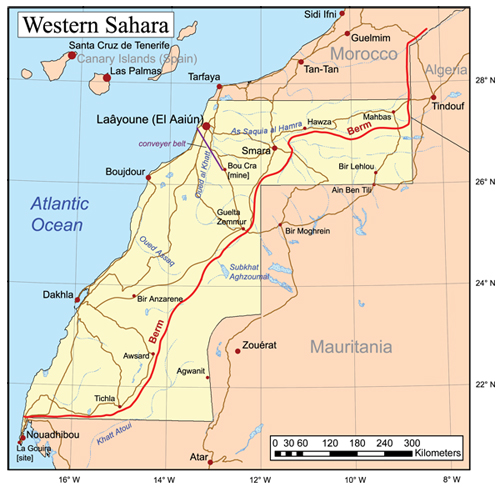
Morocco and the Polisario Front waged the “Western Sahara War” between 1975 and 1991 over this disputed territory (called “Moroccan Sahara” or “Western Sahara” depending on one’s political position), which ended in a ceasefire but with no territorial agreement. The territory —bordered by Morocco, Algeria, Mauritania and the Atlantic Ocean — is mostly controlled by Morocco, but inland parts are governed by the Sahrawi Arab Democratic Republic and managed by the Polisario Front. A large number of Sahrawis from the disputed territory live in refugee camps along the Algerian border south of the Algerian city of Tindouf. Morocco continues to claim (and administer) the territory, which is desirable because of its lucrative fishing and phosphate industries whose combined annual revenues are estimated at 450 million Euros.
For Morocco, the role of regional religious leader is part of its strategic offensive to increase its role in regional security – and its increased stature as a counterterrorism partner could be an asset in shifting the stalemate with Algeria over the disputed Saharan territory in its own favor. For those concerned with stability in the Sahel, however, such a shift could infuriate Algerian leaders who are significant partners in regional security concerns.
Given the uncertainty surrounding Algeria’s upcoming presidential elections — as the ill and 77-year-old incumbent President Abdelaziz Bouteflika seeks a fourth term despite widespread opposition — Morocco’s actions seem perfectly timed to take advantage of its regional rival’s weakness.
Recent events indicate that Morocco’s strategy of increasing regional leadership in order to build support for the land conflict is working. Though Algeria was the main site of negotiations between Tuareg rebels and the Malian government throughout the 1980s and the 1990s, Morocco is suddenly building relations with Tuareg leaders, welcoming the chief of the National Movement for the Liberation of Azawad (MNLA) Bilal Ag Acherif in January of this year (with the new Malian president’s blessing) after the group quit UN-sponsored negotiations hosted in Algiers. And in February, the Moroccan monarchy began a West African tour, visiting not only Mali but also Guinea, Gabon and Cote d’Ivoire. Following the king’s visit to Mali, The Economist reported that the Malian president’s language suggests he has revoked the country’s recognition of an independent state in the Western Sahara.
It is difficult to untangle the strengthening of relations between Morocco and Mali, their increased religious cooperation, and the change in the Malian position on the disputed territory.
Proceed with Caution
The main obstacle to strong relations with Morocco’s West African neighbors is Morocco’s harsh policies toward sub-Saharan immigrants, recently detailed in a Human Rights Watch report. Though somewhat improved since the announcement of a new immigration policy in September of last year, the continued use of force against Africans could weaken the king’s image as a friend and leader in West Africa.
Despite these reports of mistreatment of sub-Saharan African immigrants, Moroccan intervention in regional religious affairs will likely increase over the coming year, in response to calls from Guinea, Senegal, Libya, and Tunisia for Moroccan programs to train their imams. On his recent trip in West Africa, the king signed multiple agreements to that effect. It seems inevitable then, that Morocco’s move to employ religious leadership as foreign policy will soon shape its relationships with other North and West African countries.
Going forward, policymakers and interested observers should proceed cautiously. The Moroccan monarchy has long been a strong partner on a host of issues, including counter-terrorism efforts, but the escalation of tensions between Algeria and Morocco could deadlock growing regional cooperation on border security. Given Algeria’s attendance at and participation in a number of conferences and initiatives related to regional stability, the Moroccan monarchy’s efforts to build support for its position in the disputed Saharan territory could distract from or discourage cooperation on the region’s more urgent security challenges.
Ann Wainscott is a Visiting Assistant Professor at St. Louis University in the Department of Political Science, and a consultant on security matters in the Maghreb, West Africa and the Sahel. Her research focuses on the politics of public religious education, including an examination of the politics of public religious education in Morocco in the post-independence period. Her current project examines the impact of War on Terror discourse on Islamic education in the Moroccan public schools. More details are available at her website.
—
This article was made possible (in part) by the Transcultural Islam Project, an initiative launched in 2011 by the Duke Islamic Studies Center — in partnership with the Carolina Center for the Study of the Middle East and Muslim Civilizations and the Oxford Centre for Islamic Studies — aimed at deepening understanding of Islam and Muslim communities. See www.islamicommentary.org/about and www.tirnscholars.org/about for more information. The Transcultural Islam Project is funded by a grant from the Carnegie Corporation of New York. The statements made and views expressed are solely the responsibility of the author(s).
Other web sites and print publications may re-publish this article as long as there is source attribution (author and ISLAMiCommentary) and a link back to ISLAMiCommentary.
Tags: Algeria, Ann Wainscott, Arab League, Bilal Ag Acherif, Chad, counter-terrorism, ECOWAS, Egypt, Fez, Guinea, Hajj, Human Rights Watch, Ibrahim Boubcar Keita, Libya, Maghreb, Maghreb Union, Mali, Mauritania, MNLA, Moroccan Sahara, Morocco, Morocco monarchy, Muhammad VI, National Movement for the Liberation of Azawad (MNLA), NATO, Niger, Polisario Front, Rabat Decelaration, Sahel, Sahrawi Arab Democratic Republic, Senegal, Si Ahmed Tijani, St. Louis University, Sudan, Tuareg rebels, Tunisia, UN, West Africa, Western Sahara
Category: i-Comment, Islamic Theology & Law, Middle East and North Africa, Muslim Life & Culture, Politics & Current Events, Religion, Security & Civil Liberties, Sub-Saharan, East, and West Africa