Columbia University graduate student Sarah Wall interned this summer at a youth center in Indonesia where sexual education and reproductive services were administered to at-risk teens
[ This article was originally published on the ISLAMiCommentary website, which is now only available via the Wayback Machine. Here is a direct link to this article: https://web.archive.org/web/20170214042150/https://islamicommentary.org/2014/09/lets-tweet-about-sex-frank-talk-about-teen-health-lgbt-rights-and-family-planning-in-indonesia/ ]
by SARAH WALL for ISLAMiCommentary on SEPTEMBER 16, 2014
curated and edited by Julie Poucher Harbin, Editor, ISLAMiCommentary
Would you be surprised to see a devout Muslim female coworker tenderly embrace a transgender woman in a green, sparkly hijab before a weekly Qur’an lesson at an Indonesian youth center?
For the staff at the PKBI Youth Center, it’s all in a day’s work. And their work is an extension of their religious beliefs, not a conflict of interest.
PKBI is short for The Family Planning Association of Indonesia, Jogyakarta, and a branch of Indonesia’s International Planned Parenthood Association member organization. Its Youth Center supplements the organization’s health clinics with advocacy and outreach programs, and houses Lentera Sahaja (Youth School), the Community Organizing Program (LGBT, sex worker, and street youth) and two supporting programs, the Center for Sexuality Studies, and the Media Training Division.
“We provide sexual education so that marginalized communities can make better health choices and protect themselves from the risks of sexual disease,” explains Gama Triono, a community organizer with PKBI’s youth center. “Everyone we come into contact with is marginalized. All of the people and communities we work with are underserved.”
Its mission lines up with his Muslim faith, but it wasn’t always this way.
“At first, it was difficult to fight for something that many see as ‘banned’ by my religion. But I never lost my faith in Islam, and I do not find a conflict between my work and my religion,” said Triono. “Islam is a religion of acceptance that supports helping all individuals despite their differences and ensuring that all Muslims are protected from risk. The work of PKBI is in line with my Muslim values.”
Jogja (short for Jogyakarta) sees a lot of the same at-risk youth groups found in America — LGBT youth, sex workers, and teen mothers — but the challenges here are compounded by poverty and a host of cultural dynamics that push these groups even further to the fringe.
Extortion, expulsion from school, or being labeled mentally ill, are common fears among the kind of youth PKBI typically serves. Provincial laws are often misapplied; used by local officials to abuse the youth and extort money from them. For example, during my first week at work, a group of transgender youth were arrested just for being a “public disturbance.” While some had enough cash on them to pay the fine, the rest spent the night in jail.
To confront some of these challenges, PKBI is creating a nation-wide youth alliance that will unite at-risk youth communities to address common concerns.
At a recent PKBI forum, participants from the gay youth contingent explained that their community lacks internal support. Some attend unity events just to meet a hook-up, while others go just to gossip about one another’s personal lives. PKBI believes that change starts with LGBT youth feeling supported within their own community.
In Indonesia, the world’s most populous Muslim majority nation, just talking about sex in public is considered taboo. There are no anti-discrimination laws related to the LGBT community and polls show 93% of the country believes homosexuals should not be accepted in society. Few gay young people feel safe enough to come out to their peers or to coworkers as a result.
Many youth in Indonesia turn to the internet to learn about sex.
Founded in Jakarta in 1957, PKBI has long advocated for comprehensive sexual education in schools. They train peer educators who provide sex-ed at 75 schools in Yogyakarta and sexual health counseling both at their clinics and through a telephone hotline. PKBI works in partnership with a number of other local organizations on promoting reproductive health and family planning .The National Population and Family Planning Board, a PKBI partner in its schools program, advocates for a comprehensive approach to sexual education aimed at preventing teenage pregnancies.
It can be an uphill battle at times.
“Indonesian people are more comfortable receiving information from the perspective of their religious beliefs,” explained Purwantining Tyas FK, from PKBI’s Center for Sexuality Studies. “It is difficult for us to present sexual education from a human rights perspective and have people accept it the way they would if it came from religious teachings.”
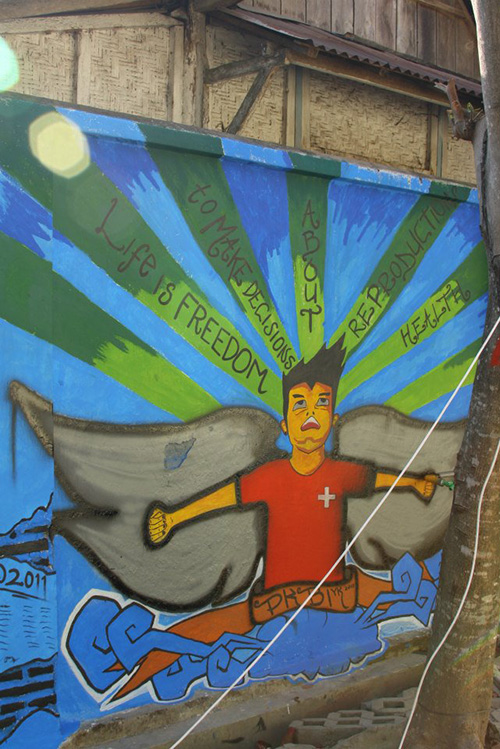
To get its message to a wider audience, community organizers at PKBI’s Youth Center have turned to street art and to digital forums like Facebook, SMS and Twitter. In a country with more than 30 million Twitter users, most of them young people, tweets in Bahasa have become an effective way to share sexual health information related to HIV/AIDS, encourage acceptance of LGBT youth, and to build a wider community of supporters.
“We use Twitter because it has already been very successful as a way to organize young people,” said Triono. “Twitter is useful because we can not only spread information about issues and services, but also get feedback from youth and encourage them to engage in the advocacy movement.”
There are serious consequences when young people don’t get the health information they need. This is particularly true when it comes to birth control. Children under the age of 16, for example, are prohibited from marrying without parental consent, but due to unplanned pregnancies, child marriages are common with 22 percent of Indonesian women being married by the age of 18. Pregnant girls often find they are barred from taking exams required to advance in school.
There is also a strong correlation between child marriages and a high infant mortality rate connected with very young mothers. The mothers typically marry the father once they find that they are pregnant.
It is my understanding that both PKBI and the National Population and Family Planning Board hope that better reproductive education will address this.
Through two local clinics and a mobile clinic that travels to remote villages, PKBI provides direct sexual health services — condoms, oral contraceptives, IUDs, and safe abortions. These services matter in a country with one of the highest maternal mortality rates in Southeast Asia, accounting for 359 reported deaths for every 100,000 live births in 2012.
Legally, only married women are allowed access to contraception and family planning services and only with the consent of their husbands. Abortions are illegal except in the case of rape or if the mother’s life is threatened.
More than 2,000 people receive sexual health services at PKBI’s main clinic annually (based on 2012 numbers), and PKBI Youth Center staff say they work amicably with the Indonesian government and local authorities.
As an intern with the youth center this past summer, I helped design a monitoring and evaluation framework to help the center better understand the effectiveness of their programs. To say that its programs are difficult to capture in an input to outcome matrix, would be an understatement.
In this my final year as a graduate student, I have a renewed passion to enter the field of international development and continue to work alongside everyday heroes who are bringing much needed services to marginalized groups in the most difficult circumstances. My internship presented me the unique opportunity to meet people who come from a completely different social, religious, and ethnic background from my own, and I was surprised that what continually stood out to me was how much we had in common rather than what divided us.
Sarah Wall is a graduate student at Columbia University pursuing a Master in International Affairs with a focus on Economic and Political Development. Her internship at PKBI in Jogjakarta, Indonesia was arranged through America’s Unofficial Ambassadors (AUA), an initiative that builds people to people partnerships between America and the Muslim World through volunteer service. By placing volunteers in NGOs that address key development issues like education, the environment, and human rights, that cut across borders, volunteers help create a better future while learning more about each other. Unlike other international volunteer programs, America’s Unofficial Ambassadors is the only initiative that mobilizes volunteers to build better relations between Americans and the people of the Muslim World, specifically.
Nearly all of the images that previously appeared with this article disappeared after ISLAMiCommentary was archived in 2016.
--
This article was made possible (in part) by the Transcultural Islam Project, an initiative launched in 2011 by the Duke Islamic Studies Center — in partnership with the Carolina Center for the Study of the Middle East and Muslim Civilizations and the Oxford Centre for Islamic Studies — aimed at deepening understanding of Islam and Muslim communities. See www.islamicommentary.org/about and www.tirnscholars.org/about for more information. The Transcultural Islam Project is funded by a grant from the Carnegie Corporation of New York. The statements made and views expressed are solely the responsibility of the author(s).
Other web sites and print publications may re-publish this article as long as there is source attribution (author and ISLAMiCommentary) and a link back to ISLAMiCommentary.
Tags: Abortion, America's Unofficial Ambassadors (AUA), Association of Campus Muslim Chaplains, birth control, child marriages, civil society, Columbia University, Dian Interfidei, education, Facebook, family planning, global health, Indonesia, interfaith, international development, Jogyakarta, LGBT, maternal mortality, PKBI, Planned Parenthood, Quran, rape, reproductive health, Sarah Wall, sex education, sex workers, sexuality studies, teen pregnancy, teens, Twitter, youth, youth centers
Category: Asia, Health & Environment, Human Rights & Gender, i-Comment, Islamic Theology & Law, Muslim Life & Culture, Religion, Science, Tech, Media & Social Media, Security & Civil Liberties, Student, Surveys & Studies