Real Life Lessons from 2011’s “Aaron and Ahmed: A Love Story” Set in Guantanamo Bay
[ This article was originally published on the ISLAMiCommentary website, which is now only available via the Wayback Machine. Here is a direct link to this article: https://web.archive.org/web/20170213221153/https://islamicommentary.org/2015/01/can-we-handle-the-truth-about-torture/index.html ]
Column » Comics & Dialogue: Islam in Graphic Novels by A. DAVID LEWIS for ISLAMiCommentary on JANUARY 23, 2015
curated and edited by Julie Poucher Harbin, Editor, ISLAMiCommentary
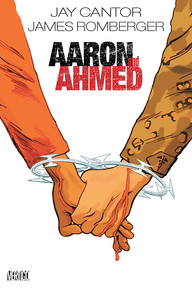

In his 2011 review of the graphic novel Aaron and Ahmed: A Love Story, set in the Guantanamo Bay detention camp, comics reviewer Greg Burgas called it “an unsettling book.” And that was three-and-a-half years before the Senate Intelligence Committee’s report on CIA torture came out — confirming that some of the outrageousness we saw in the book was likely, horrendously, close to the truth. In 2011, Aaron and Ahmed may only have been unsettling fantasy; now it could be looked at as subtly prescient.
Are we better than this? We would like to think so. President Obama has promised to shut down GITMO after all, and says he’s prohibited torture. In his State of the Union speech this week he said “as Americans, we respect human dignity, even when we’re threatened, which is why I have prohibited torture… It’s why we speak out against the deplorable anti-Semitism that has resurfaced in certain parts of the world. It’s why we continue to reject offensive stereotypes of Muslims, the vast majority of whom share our commitment to peace.”
Sadly, US values of religious freedom may not have precluded us from using religion as a tool of coercion. Let’s mark where we are today: This week’s U.S. Supreme Court decision that Gregory Houston Holt (aka Abdul Maalik Muhammad) had his rights violated when Arkansas Corrections prohibited him from growing the beard that he believes his religion – Islam – requires stands as a Pyrrhic victory for religious rights against the revelations of years of systematic oppression, humiliation, and degradation of the suspected detainees held at Guantanamo Bay.
The very fact that religion (i.e. Islam) plays such a small role in the 500-page summary of the 6700-page full torture report leaves one wary, particularly when what it does say contradicts statements publicly made by CIA Director Michael Hayden that “enhanced interrogation” was only used “for a week or two” to “help[…a] religious zealot to get over his own personality and put himself in a spirit of cooperation.” The detainee was encouraged to feel free of any religious obligations, claims Hayden and Gitmo officers.
Theology professor Michael Peppard’s interviews with former detainees, detail extensive, religion-based coercion and violations as “Gitmo’s secret weapon.” So, Holt can have his beard, says the highest court in the land, but detainees may still be forced to prostrate themselves to Satanic shrines or, like Jumah Al-Dossari, be smeared in menstrual blood.
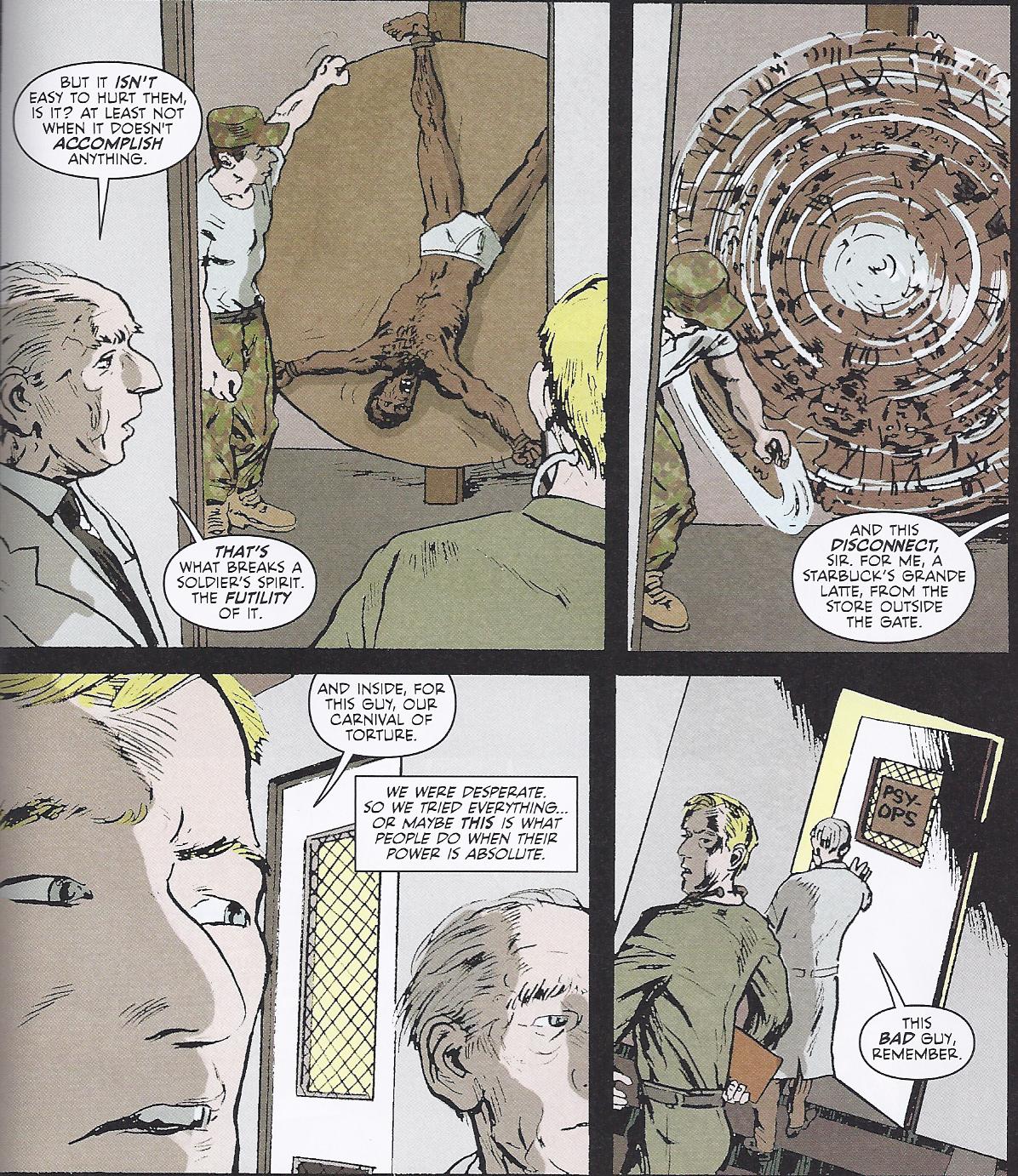
There were similar horrors found in Aaron and Ahmed by MacArthur Genius Fellow Jay Cantor. It was difficult reading this “fiction” — difficult both to observe (even through the stylized art of James Romberger) and to accept. In the novel there were images of men being caged like dogs, being water-boarded, being hung from their ankles, even being spun on a medieval wheel.
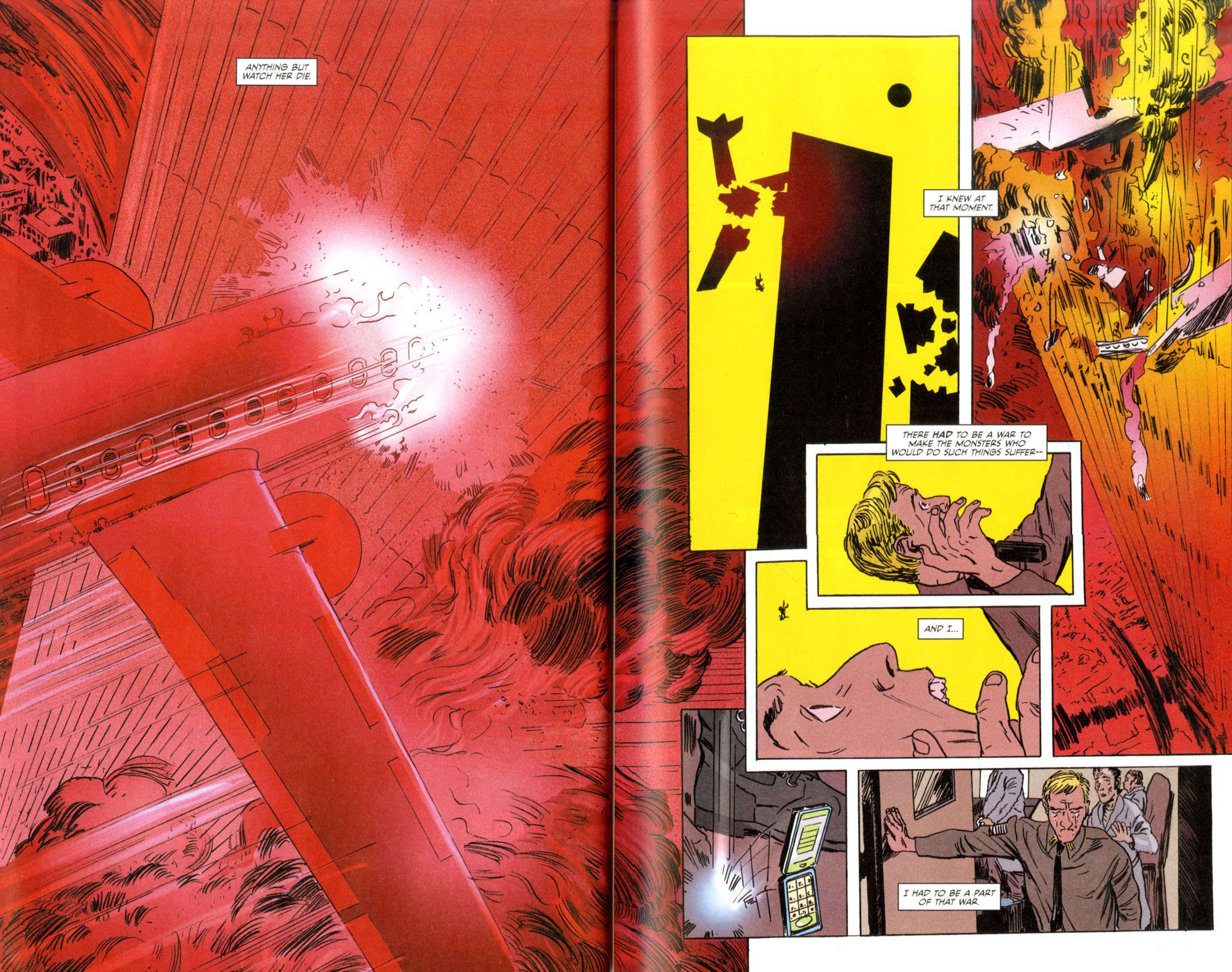
It was a challenge not only to accept one of the torturers, psychologist Aaron Goodman, as the protagonist but also to view the relationship he establishes with “Prisoner Fourteen,” Ahmed, as genuine. The loss of Aaron’s fiancée aboard one of the flights that struck the World Trade Center Towers on 9/11 had compelled him to lend his skills in psychiatry (much like real-life doctor James Mitchell) to innovating new “enhanced interrogation” techniques. Chillingly, one technique tried on Ahmed was to lace prisoner food with drugs, “a hormone cocktail,” so that the subject would feel love for the interrogator. “Then,” says Goodman, “I can really fuck him over.”
The plot sounds fantastical, especially as the two ultimately ‘escape’ Gitmo together so that Aaron can, under deep cover, infiltrate the Pakistani terror camp in order to learn how they program their suicide bombers.
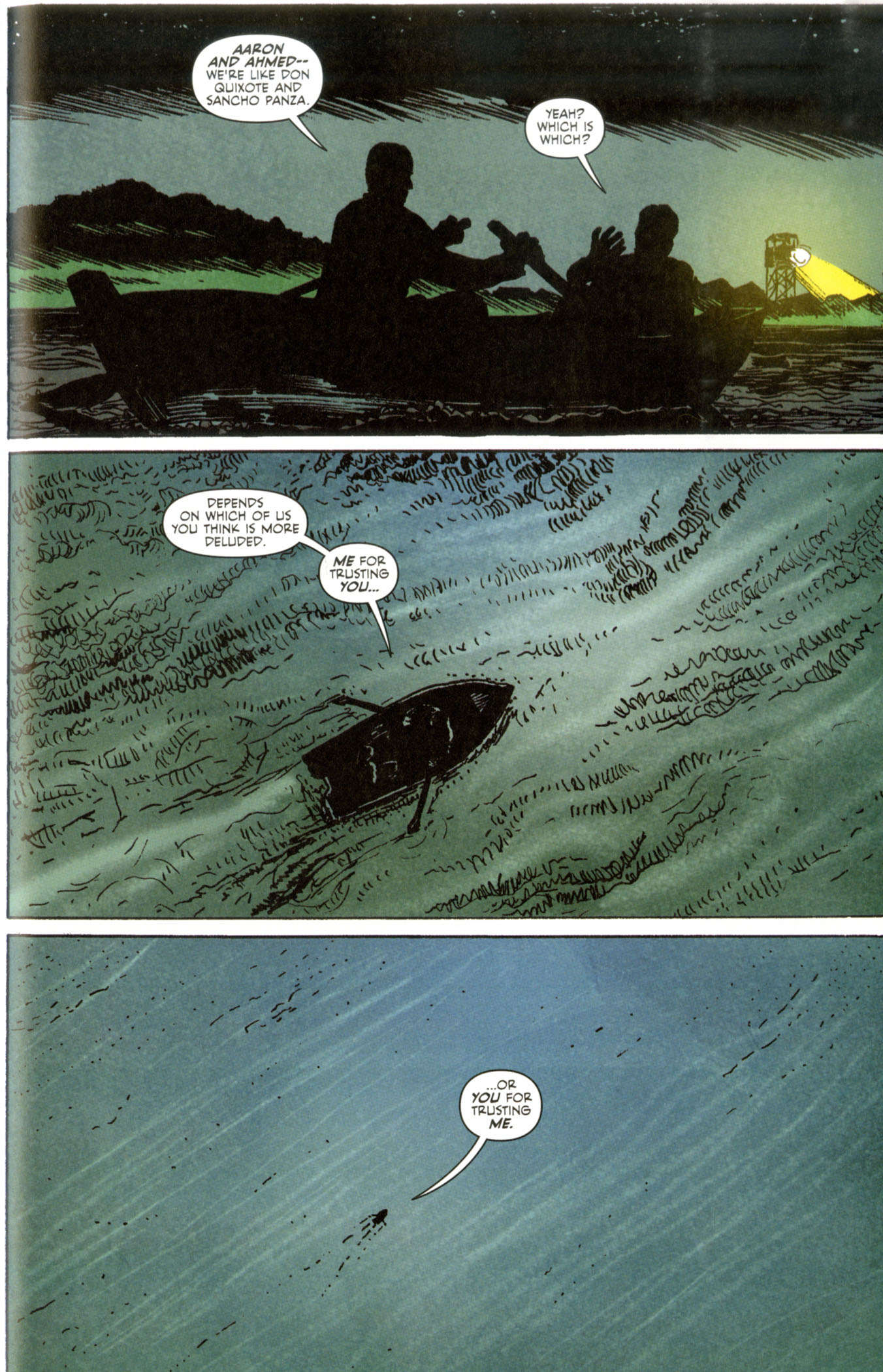
And it’s far easier to dismiss Aaron and Ahmed as a mish-mash of Cantor’s various ideas and musings than as a relatable fiction. Henry Chamberlain, writing for Geekweek in 2011, called Aaron and Ahmed “detached and academic and so be it,” offering it mild praise for its headiness. Similarly, Jim Martin writing for BlogCritics, scoffed at the book’s subtitle, saying,
Their friendship blossoms into an almost love affair, which besides a kiss that was more for shock is never fully played out. And that is ultimately the problem with the book. It never plays out any of its ideas. It has many good ideas in the book about religion, tolerance, what is right and wrong, how culture and society dictate to man, but it never gets to the heart of the matter. It never gets down to looking at why certain people have decided the only way to express their anger and aggression is via terror.
Martin said Aaron and Ahmed didn’t answer any of its own questions, and Burgas agreed.
I’ve read Aaron and Ahmed twice and find it difficult to really write about it, not because I hated it but because it teases so much and fails to deliver. I used it before, but “dispassionate” is the best word to describe the entire comic. Cantor is writing about a raw time in American history and some disturbing concepts that came out of that time, but the book just never feels “real.” It’s a missed opportunity, and that’s too bad.
Burgas and Martin’s compulsion was to toss the whole book away: the relationships don’t ring true, the ideas are outlandish, and the torture is unacceptable. It didn’t feel real—certainly not the reality most readers care to recognize. And both its current selling price on Amazon.com for used copies at one cent, and its discarded place in the back bins of comic shops suggest audiences agree.
But this is where Cantor earns that “genius” status from the MacArthur Foundation: Aaron and Ahmed was meant to befuddle and be set aside. Like the planned obsolescence of a computer for yet a newer model, Aaron and Ahmed should not solely be read as a straightforward graphic novel but, instead, as a stealth good: to be purchased, consumed, and disposed of quickly. Why? Because only in that way— in an indirect, burrowing fashion — can its ideas truly take hold.
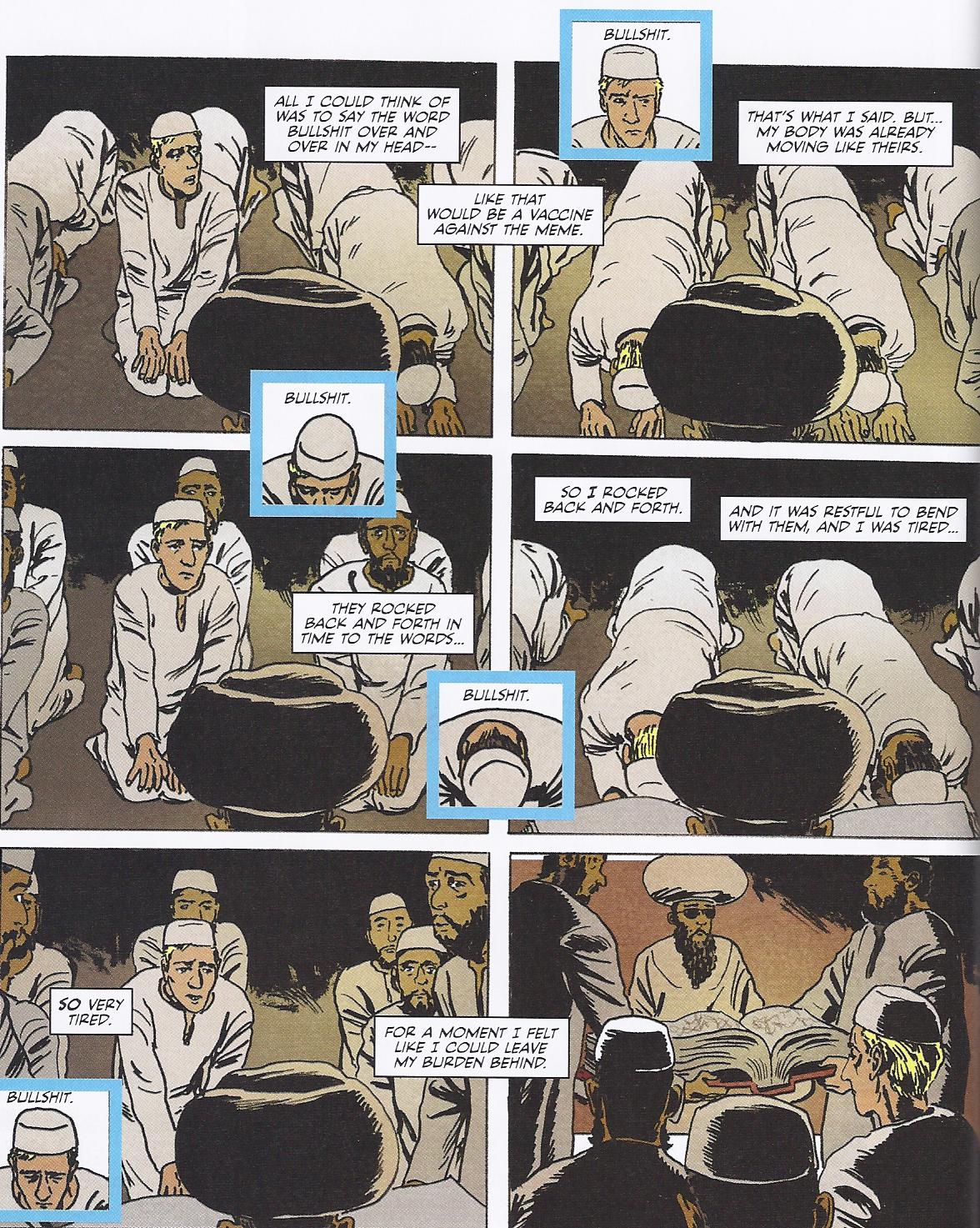
When the Aaron character sets off to infiltrate the radical Islamists in Pakistan, he does so armed with the “meme theory” introduced to him at Gitmo by Dr. Negroponte (perhaps as unsubtle an allusion to U.S. Director of National Intelligence John Negroponte in the same way that Aaron’s last name is “good man”). A “meme,” invented in real life by Richard Dawkins, is a unit of cultural transmission, or imitation and replication. The theory is that ideas are infectious: that the right words can take hold of a person and compel him or her into action. Usually, this theory is used to explain zealous religious belief, unabashed consumerism, or extreme patriotism. In Aaron and Ahmed, though, Cantor managed to repurpose it on several levels.
Cantor made his character Aaron such a believer in meme theory that the notion itself was infectious to him. That is, Aaron was willing to risk everything to determine if the radical Islamists were using it to program their suicide bombers.
On a more subtle level, though, meme theory is as applicable to the ugliness of radicalism, commercialism, and jingoism as it is to a far more divine notion: love. It is possible, after all, that Aaron and Ahmed, by exchanging the words and ideas that they did, truly came to love each other, isn’t it? The hormones, the indoctrination, quasi-Stockholm syndrome as they were on the run—all of these are no more plausible than a compulsion that gripped these two individuals, that of genuine affection.
At its deepest level, perhaps Aaron and Ahmed itself should be seen as a meme. The graphic novel is a story, a notion, planted in readers minds and then, in most cases discarded. But its effects might still be there, waiting to be triggered. Can we come to accept the nastiness of those who would control us? Can we acknowledge the degrees of control they already have in our lives? And, most of all, can we seize upon what may be one of greatest memes of all — love between and across all manner of belief — to survive all the others?
Works like Aaron and Ahmed can prime us. News of real-life atrocities can trigger us. But the actions we take thereafter don’t have to be in service to anyone but those we love and those we only have yet to love. When we learn of torture, of injustice, or of suffering, a book like Aaron and Ahmed may be directing us to benevolent action and rededication to peace in a world that otherwise feels so bereft of it. It may never be clear where Aaron or Ahmed’s loyalties truly lie, but Aaron and Ahmed as a graphic novel allies itself with compassionate, Qur’anic justice — all the more reason to let it infuse us.
A. David Lewis, Ph.D. is the co-editor of Graven Images: Religion in Comic Books and Graphic Novels as well as Digital Death: Mortality and Beyond in the Online Age. He is also co-creator of the graphic novels The Lone and Level Sands and Some New Kind of Slaughter, both from Archaia Entertainment, and a founding member of Sacred & Sequential, a collective of religious studies and comics studies scholars. He currently teaches as a Faculty Associate at MCPHS University,and has previously lectured at Boston University, Tufts University, Merrimack College, and Georgetown University. He is a steering committee member for the American Academy of Religion’s “Death, Dying, and Beyond” Group as well as editor for Palgrave Pivot’s “Contemporary Religion and Popular Culture” book series. You can follow him on Twitter @ADLewis. Continue to watch this space for his ISLAMiCommentary column “Comics & Dialogue: Islam in Graphic Novels.”
—
ISLAMiCommentary is a public scholarship forum that engages scholars, journalists, policymakers, advocates and artists in their fields of expertise. It is a key component of the Transcultural Islam Project; an initiative managed out of the Duke Islamic Studies Center in partnership with the Carolina Center for the Study of the Middle East and Muslim Civilizations (UNC-Chapel Hill). This article was made possible (in part) by a grant from Carnegie Corporation of New York. The statements made and views expressed are solely the responsibility of the author(s).
Other web sites and print publications may re-publish this article as long as there is source attribution (author and ISLAMiCommentary) and a link back to ISLAMiCommentary.
Tags: 9/11, A. David Lewis, Aaron and Ahmed, Abdul Maalik Muhammad, Arkansas, BlogCritics, CIA torture, Comics & Dialogue: Islam in Graphic Novels, enhanced interrogation techniques, Geekweek, Greg Burgas, Guantanamo, Henry Chamberlain, Holt vs. Hobbs, James Mitchell, James Romberger, Jay Cantor, Jim Martin, Jumah Al-Dossari, memes, Michael Hayden, Michael Peppard, Obama, Pakistan, Quranic justice, religious freedom, Richard Dawkins, State of the Union 2015, Stockholm Syndrome, Supreme Court, US Senate Report on CIA Detention and Interrogation (2014)
Category: Americas, Comics & Dialogue: Islam in Graphic Novels, Ethics, Human Rights & Gender, i-Comment, Islamic Theology & Law, Muslim Life & Culture, Politics & Current Events, Psychology & Sociology, Security & Civil Liberties