
Special to the Diplomatic Pouch by Julie Poucher Harbin
By 2025, two-thirds of the world's population will live in areas facing moderate to severe water stress, including more areas within developed countries, according to the United Nations.
Despite some progress, 1.1 billion people worldwide still lack access to safe drinking water and 2.6 billion have no access to basic sanitation.
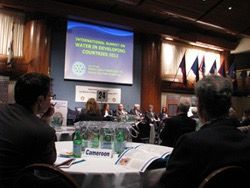
The world's water crisis was brought into sharp focus this spring in Washington, D.C., at a variety of forums that kicked off with World Water Day on March 22.
"The water crisis is a health crisis, it's a farming crisis, it's an economic crisis, it's a climate crisis, and increasingly, it is a political crisis. And therefore, we must have an equally comprehensive response," said Secretary of State Hillary Clinton at the "Water for the Future"event at the World Bank Headquarters, where she signed a memorandum of understanding between the U.S. government and World Bank to collaborate on water-related areas.
A few weeks later on April 15, the Rotary Club of Washington, D.C., and Rotary Club Paris Academies hosted a "Water is Life: International Summit on Water in Developing Countries 2011" to discuss meeting the U.N. Millennium Development Goals (MDGs) intended to halve the proportion of people without sustainable access to safe drinking water and basic sanitation by 2015.
"As we are generating new water sources at a very rapid rate around the globe. At the same time we're failing miserably as far as sanitation is concerned," said Samuel Lee Hancock, president and executive director of the nonprofit group EmeraldPlant."It's hard to imagine that people are actually out drinking mud in order to survive in many countries."
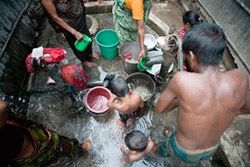
Indeed, the reality of water scarcity isn't a pretty picture, and has more far-reaching effects than most people realize. More than 5,000 people die each day from causes linked to unsafe water, sanitation, and hygiene - the majority of whom are children. The World Health Organization estimates that diarrhea alone causes 1.5 million deaths per year.
Women and girls are also disproportionately affected. For example, millions of women and girls walk for hours every day to collect water for their households, putting their lives at risk in areas where sexual violence is rampant. Or they spend so much time trying to collect water that there's little time left for education. Widespread studies have confirmed that when there's access to water and sanitation, school attendance skyrockets.
Water touches nearly aspect of development, as Maria Otero, U.S. undersecretary of state for democracy and global affairs, recently pointed out:"The bottom line is this: If we are serious about improving child health, achieving universal primary education, ensuring gender equity, and stimulating economic development, we need to be serious about providing safe water, sanitation, and hygiene education in schools."
Otero was among many government officials who joined a range of policy experts, diplomats, and representatives from international NGOs and businesses at the Water is Life summit, where despite the dire predictions, the overall tone of the discussions was one of cautious optimism, highlighting implementable, real-world solutions to a brewing crisis of water shortages - that in turn can spark resource-related conflicts.
Otero, for instance, noted that 265 river basins worldwide are shared by two or more countries, and that "without collaboration, these can become points of tension and even security threats."
These threats can also exacerbate divisions in hotspots where tensions already run high. For example, the 2011 Water Stress Index, developed by the British-based global risk advisory firm Maplecroft, has rated Mauritania, Kuwait, Jordan, Egypt, Israel, Niger, Iraq, Oman, the United Arab Emirates and Syria as the top 10 nations at "extreme risk" for water stress.
Water stress in the Middle East and North Africa (MENA) region is not surprising, according to Maplecroft, as it only receives 1 percent of the world's precipitation and countries rely on trans-boundary water supplies. For example, the Jordan River, which provides 25 to 30 percent of Israel's water and 75 percent of Jordan's, has long been a source of friction between the two countries.

Water security has also become an issue in Central Asia, where "water wars"are threatening to erupt over individual countries' irrigation and power generation needs.
Abdujabbor Shirinov, Tajikistan's ambassador in the United States, told water summit attendees that while his country is water-rich - 60 percent of the region's fresh water comes from inside the country - it is fossil-fuel poor. Tajikistan also suffers from numerous power cuts during cold winters and needs to build more dams for more energy production, but its neighbors are worried.
"There is rising tensions about using this water because for example our neighbors, Uzbekistan, Turkmenistan, Kazakhstan, they hold some feelings that the construction of hydropower stations by upstream countries will cause the lack of water in irrigation season in downstream countries," explained Shirinov.
To compound the water problem, Central Asia's five main rivers depend on glacial melt, which Kyrgyz Ambassador Muktar Djumaliev said is being threatened. He noted that by 2025, the glaciers will be reduced by 30 to 40 percent, which in turn will sap the volume of the main rivers by 25 percent - with no glaciers in Central Asia by 2100. Kyrgyzstan, a fellow upstream country, is also keen to build more hydroelectric stations.
Meanwhile, Uzbek Ambassador Ilhomjon Tuychievich Nematov stressed the importance of agriculture to his country's economy. Despite access to rivers, lakes and ground water, Uzbekistan saw a decline in water resources since independence that has forced them to slash cotton production by 50 percent.
"Uzbekistan was never against constructing any power station, but all power stations should be constructed in the interest of all regional countries, and of course after the appropriate expertise in terms of ecological, technical, security," said Nematov.
Interestingly, developed countries aren't immune to future water shortages. The Maplecroft study also rated Australia (19) and the United States (51) as "high risk" because in parts of each country, water demand exceeds the total renewable water resources by 80 percent.
In fact, a report released in late April by the Department of Interior warned that climate change was likely to diminish already scarce water supplies in the western United States. Annual flows in the Colorado, Rio Grand and San Joaquin river basins - which provide water to eight states as well as parts of Mexico - could decline by as much as 8 percent to 14 percent over the next 40 years.
"What are we going to do about western water?" Sen. Tom Udall (D-N.M.) asked the crowd attending an Institute for Education-sponsored public policy roundtable in early April that touched on climate change and water issues facing the American Southwest. "The Colorado River, which is the biggest river in the west, supplies upper basin states and lower basin states. We now believe there's going to be 20 percent less water on a permanent basis. So you can imagine the conflict [between] these states that have been relying on this water."
Africa is another part of the world confronting water scarcity. Junaid Kamal Ahmad, the World Bank's sector manager for water and sanitation on the continent, said that 30 countries in Africa are on track to meet the U.N. Millennium Goals with a significant rise in access to clean water in Senegal, Uganda and Burkina Faso.
"I walk away after 15 to 20 years in this business being optimistic, because I would not have predicted the changes in Africa," he said. "Water service in Uganda moved to 24-hour systems. Not one city in South Asia has 24-hour water systems. In Africa I can give you 10 countries that have 24-seven water systems."
Boubaca Moussa Rilla, economic counselor at the Niger Embassy in Washington, was not so optimistic. Niger, which depends on outside sources for 90 percent of its water needs, ranks sixth in the world on Maplecroft's Water Stress Index.
Rilla said that with recurring droughts, declining rainfall, desertification and a population growing at more than 5 percent annually - the fastest in Africa - Niger is facing a crisis. Indeed, according to the U.N. Food and Agriculture Organization, undernourishment is widespread in Niger and the majority of the rural population doesn't have access to safe drinking water. Most in fact rely on pond water that is often contaminated with guinea worms, animal waste and chemicals.
Rilla made a plea to the international community for help, while urging his own recently elected government to make water a priority. "With such a growing population water is a need. More than a need, water is a necessity. Without water, no one can survive."
Some countries though are joining forces to combat the problem. For example, Cape Verde has partnered with Costa Rica, Iceland, Singapore, Slovenia and the UAE to create a "green group" that highlights the link between climate change and water, as well as the importance of improved water management in successfully addressing the impact of climate change.
Maria de Fatima Lima da Veiga, Cape Verde's ambassador here, told summit attendees that her island nation grapples from irregular rainfall, periodic droughts and related food shortages.
"People are surprised that Cape Verde has been suffering from water shortages and drought for decades," said da Veiga. "People normally tend to equate islands with abundance of water and vegetation.... Despite being surrounded by water, water scarcity has always impacted the life of the Cape Verde people and the island's environment."
She said her government has taken steps to boost water supply, including increasing the production of desalinated water and drip irrigation, starting the construction of 17 dams, introducing hydroponics, and increasing government loans and technical training for farmers.
Nations around the world have pursued community-based, low-tech solutions such as rooftop rainwater collection as well as high-tech innovations - an approach the "Water is Life" summit advocates to alleviate water shortages and improve sanitation.
Arthur Keys, president and chief executive officer of International Relief and Development (IRD), pointed out that in Zimbabwe, IRD is training people how to collect water on their rooftops to expand household and agricultural water use while cutting back on the need for women to walk far distances to collect water.
These micro-solutions are gaining credence over large-scale projects such as hydro-dams, as illustrated by Morocco, another water-scarce country.
"We started our policy in building dams in the 1950s [to generate hydro-electric power]. Now in some places we have enough dams, but these dams depend on the rainfall, and rainfall is limited," explained Abdeslam Zefri, economic counselor at the Embassy of Morocco in Washington.
So Morocco has employed technologies such as drip irrigation, well-digging and artificial precipitation, according to Zefri. The country has even assisted Senegal and Burkina Faso with artificial rain technology.
And while government agencies, the World Bank, Rotary and various international NGOs are providing critical assistance and clever thinking to help nations tackle their water shortages, Ahmad of the World Bank stressed the importance of community involvement for any program to ultimately work.
"If you want to change the flow of water, change the flow of money," he said. "Do not fix the pipes. Fix the institutions that fix the pipes."
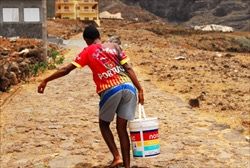
Front and bottom photo: A boy carries water in Cape Verde's capital city Praia. Water is a precious commodity in the island country, which has suffered for decades from water shortages and drought.
Photo: Larry Luxner
Top photo: The Rotary Club of Washington, D.C., and Rotary Club Paris Academies hosted an international summit called "Water is Life" on April 15. Some of the panelists, from left, included Director of the Department of International Cooperation at the Embassy of Uruguay Paola Repetto, Ambassador of the Kyrgyz Republic Muktar Djumaliev, Ambassador of Tajikistan Abdujabbor Shirinov, and Ambassador of Uzbekistan Ilhomjon Tuychievich Nematov, as well as moderator Lisa-Marie Monsanto.
Photo: Julie Poucher Harbin
Second photo: Children collect water in Kallayanpur slum, an urban slum in Dhaka, Bangladesh. More than 1.5 million children die each year as a result of diarrhea caused by poor water.
Credit: UN Photo/Kibae Park
Third photo: From left, Ambassador of the Kyrgyz Republic Muktar Djumaliev, Ambassador of Tajikistan Abdujabbor Shirinov, and Uzbekistan Ambassador Ilhomjon Tuychievich Nematov pledge cooperation in the management of water resources at the "Water is Life" summit. They are trying to strike a balance in the management of water resources for both irrigation and power generation.
Photo: Julie Poucher Harbin
(This article is included in The Washington Diplomat's May 2011 Diplomatic Pouch e-newsletter. Original: https://web.archive.org/web/20111114065921/http:/www.washdiplomat.com/DPouch/2011/May/0511news.html)