[ This article was originally published on the ISLAMiCommentary website, which is now only available via the Wayback Machine. Here is a direct link to this article: https://web.archive.org/web/20170213223631/https://islamicommentary.org/2013/10/al-haj-u-aye-lwin-religion-security-and-co-existence-in-myanmar-an-islamic-perspective/index.html ]
by AL HAJ U AYE LWIN on OCTOBER 1, 2013
curated and lightly edited by Julie Poucher Harbin, Editor, ISLAMiCommentary
EDITOR'S NOTE Below is the text of a paper presentation, delivered on October 1 by Al Haj U Aye Lwin at the “Interfaith Academic Conference for Security, Peace and Co-existence” — a meeting jointly organized by the Institute for Global Engagement (IGE) and Sitagu International Buddhist Missionary Association (SIBMA) at the Sitagu International Buddhist Academy Yangon campus, Myanmar. Lwin is Chief Convener, The Islamic Centre of Myanmar; Chairman, Islamic Development Bank Counterpart Organization/Program Implementation Committee, Myanmar; and founding member, Religions for Peace/Inter-religious Council, Myanmar. He shared the full text with ISLAMiCommentary and TIRN and it was subsequently lightly edited for clarity by ISLAMiCommentary editor Julie Poucher Harbin for publication.
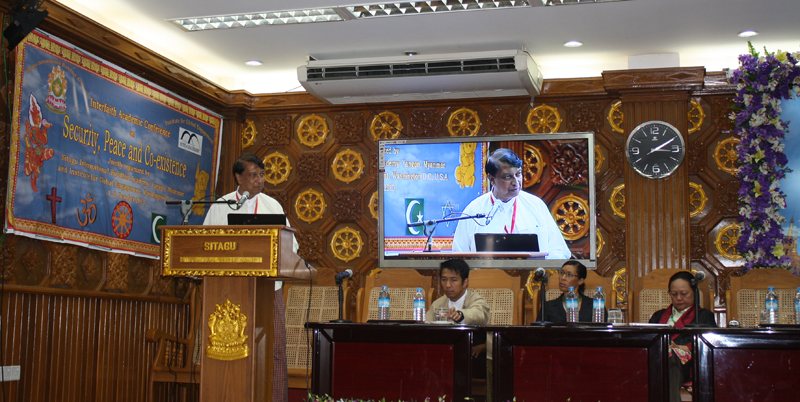
It is indeed an honor for me to participate in this august forum with the aim and vision to comparatively examine the inter-relationships between and among education, religion, and security in the context of co-existence. I would like to thank the Almighty for giving me this opportunity to present a paper on Islamic perspective. My thanks also goes to the organizers the Sitagu International Buddhist Missionary Association and the Institute for Global Engagement.
It is an established fact that Myanmar’s beauty is enhanced because of its unity in diversity. No religion originates from Myanmar and all the ethnics races existing in Myanmar migrated from different parts of the world at different times.
Myanmar which is a multi-ethnic and multi-religious pluralistic society is the shining example of people of different nature co-existing for centuries. Being different is not a crime or a sin. The only thing is we need to manage the difference. Diversity is never a threat on the contrary it is indeed strength. It would be an overstatement if one tries to paint a rosy picture and say that Myanmar never experiences any social disputes amongst its cosmopolitan populace. There were problems, however Myanmar regarded them as individual quarrels, arguments, disagreements or even violent fights. The conflicts were never branded as religious or racial.
With the rapid speed of globalization, the world is getting smaller and shrunk to the size of a village. This process is countered by nationalist movement in different forms and manifestations all over the world and gives rise to ultra nationalist movements. Myanmar is not an exception to this natural phenomenon. There is nothing wrong with protecting ones nation and nationalities against the onslaught of foreign domination. Nevertheless, if the noble spirit of nationalism is translated as hatred towards others, it will certainly breed racism, which is against all the religious teachings of the world and the norms of the civilized world.
The recent disturbances in Myanmar are not Religious Conflict. On the other hand, we have to admit that there are attempts made by anti-social elements with hidden agenda and vested interest to transform the incidents into all out religious conflict. Religion has been hijacked to serve their purpose. Ordinary social disputes that are happening in Myanmar, just like in any other part of the planet earth, where human beings inhabit, are being exploited as religious or communal crisis. We must not let this happen.
The roles of the religious leaders are very crucial in this regards. Therefore, I would like to present some thoughts regarding Religion, Security and Co-existence from Islamic perspective. I would first like to quote some relevant verses from the Holy Quran relating this matter.
Say, “The truth is from your Lord”: Let him who will believe, and let him who will, reject (it): (18:29)
Nor take life – which Allah has made sacred – except for just cause (17:33)
if anyone slew a person – unless it be for murder or for spreading mischief in the land – it would be as if he slew the whole people: and if any one saved a life, it would be as if he saved the life of the whole people.(5:32)
Nor can goodness and Evil be equal. Repel (Evil) with what is better: Then will he between whom and thee was hatred become as it were thy friend and intimate! (41:34)
Then will he be of those who believe, and enjoin patience, (constancy, and self- restraint), and enjoin deeds of kindness and compassion.(90:17)
Let there be no compulsion in religion: Truth stands out clear from Error: whoever rejects evil and believes in Allah hath grasped the most trustworthy hand-hold, that never breaks. And Allah heareth and knoweth all things.(2:256)
If it had been thy Lord’s will, they would all have believed,- all who are on earth! wilt thou then compel mankind, against their will, to believe! (10:99)
We did aforetime send messengers before thee: of them there are some whose story We have related to thee, and some whose story We have not related to thee. It was not (possible) for any messenger to bring a sign except by the leave of Allah: but when the Command of Allah issued, the matter was decided in truth and justice, and there perished, there and then those who stood on Falsehoods.(40:78)
The same religion has He established for you as that which He enjoined on Noah – the which We have sent by inspiration to thee – and that which We enjoined on Abraham, Moses, and Jesus:(42:13)
To thee We sent the Scripture in truth, confirming the scripture that came before it, and guarding it in safety: so judge between them by what Allah hath revealed, and follow not their vain desires, diverging from the Truth that hath come to thee. (5:48)
Invite (all) to the Way of thy Lord with wisdom and beautiful preaching; and argue with them in ways that are best and most gracious: for thy Lord knoweth best, who have strayed from His Path, and who receive guidance.(16:125)
Revile not ye those whom they call upon besides Allah, lest they out of spite revile Allah in their ignorance. (6:108)
(They are) those who have been expelled from their homes in defiance of right,- (for no cause) except that they say, “our Lord is Allah”. Did not Allah check one set of people by means of another, there would surely have been pulled down monasteries, churches, synagogues, and mosques, in which the name of Allah is commemorated in abundant measure. (22:40)
Fight in the cause of Allah those who fight you, but do not transgress limits; for Allah loveth not transgressors.(2:190)
If one amongst the Pagans ask thee for asylum, grant it to him, so that he may hear the word of Allah; and then escort him to where he can be secure. That is because they are men without knowledge.(9:6)
But if the enemy incline towards peace, do thou (also) incline towards peace, and trust in Allah: for He is One that heareth and knoweth (all things).(8:61)
O ye who believe! stand out firmly for Allah, as witnesses to fair dealing, and let not the hatred of others to you make you swerve to wrong and depart from justice. Be just: that is next to piety: and fear Allah. For Allah is well-acquainted with all that ye do.(5:8)
O ye who believe! stand out firmly for justice, as witnesses to Allah, even as against yourselves, or your parents, or your kin, and whether it be (against) rich or poor: for Allah can best protect both. Follow not the lusts (of your hearts), lest ye swerve, and if ye distort (justice) or decline to do justice, verily Allah is well- acquainted with all that ye do. (4:135)
These teachings are actually applied by the Muslims throughout history.
Caliph Umar and entourage once visited Jerusalem in 638, where they were welcomed by the Christian patriarch, who invited the conquering caliph to pray in the Church of the Holy Sepulchre. Umar declined the invitation, choosing instead to pray at a rock just across from the church. The patriarch was surprised-and perhaps a bit offended- but Umar was firm in his decision, knowing that if he prayed in Christian church, his followers would do likewise, and eventually the church would become a mosque.
At the start of the twenty-first century, religion is associated by some with intolerance, violence and breeding radicalism: it is regarded in some quarters as the cause for extremism and human rights violations. None of the world’s religions is impervious to fomenting conflict, but Islam has often been singled out as particularly and intrinsically violent. Critics associate it with extreme intolerance and claim that it breeds radicalism. It is easy to see where the criticisms come from : With the combination of late twentieth-century fundamentalist movements, Islamist politics, al-Qaeda radicalism, Iran’s theocracy, and attacks by Islamist groups against civilians across the world, it is impossible to discuss contemporary Islam without referring to the subject of violence.i
The correct meaning of jihad is expounded by Dr. Seyyed Hussein Nasr, a professor of Islamic studies at Georgetown: To wake up in the morning with the name of God on one’s lips, to perform the prayers, to live righteously and justly throughout the day, to be kind and generous to people and even to animals and plants one encounters during the day, to do one’s job well, to take care of one’s family and of one’s own health and well-being- all require jihad… Because Islam does not distinguish between the secular and religious domains, the whole life cycle of a Muslim involves a jihad, so that every component and aspect of it is made to conform to divine norms.ii
Allow me to quote some historical facts from a book “Common Ground between Islam and Buddhism” by Reza Shah Kazemi. Throughout Islamic history, Buddhists- together with Hindus and Zoroastrians, not to mention other religious groups- were regarded by Muslims not as pagans, polytheists, or atheists, but as followers of an authentic religion, and thus to be granted official dhimmi status, that is, they were to be granted official protection by the state authorities : any violation of their religious, social or legal rights was subject to the ‘censure’ (dhimma) of the Muslim authorities, who were charged with the protection of these rights.
It is instructive to glance at the roots of this Muslim appraisal of the religio-juridical status of Buddhism. One of the earliest and most decisive encounters between Islam and Buddhism on the soil of India took place during the short but successful campaign of the young Umayyad general, Muhammad b. Qasim in Sind, launched in 711. During the conquest of this predominantly Buddhist province, he received petitions from the indigenous Buddhist and Hindus in the important city of Brahmanabad regarding the restoration of their temples and the upholding of their religious rights generally. He consulted his superior, the governor of Kufa, Hajjah b. Yusuf, who in turn consulted his religious scholars. The result of these deliberations was the formulation of an official position which was to set a decisive precedent of religious tolerance for the ensuing centuries of Muslim rule in India. Hajjaj wrote to Muhammad b. Qasim a letter which was translated into what became known as the ‘Brahmanabad settlement’.
The request of the chiefs of Brahmanabad about the building of Budh and other temples, and toleration in religious matters, is just and reasonable. I do not see what further rights we can have over them beyond the usual tax. They have paid homage to us and have undertaken to pay the fixed tribute (jizya) to the Caliph. Because they have become dhimms we have no right whatsoever to interfere in their lives and property. Do permit them to follow their own religion. No one should prevent them.
The Arab historian, al-Baladhuri quotes Muhammad b. Qasim’s famous statement made at Alor (Arabised as ‘al-Rur’) a city besieged for a week, and then taken without force, according to strict terms : there was to be no bloodshed, and the Buddhist faith would not be opposed. Muhammad b. Qasim was reported to have said :
The temples [lit. al-Budd, but referring to the temples of the Buddhists and the Hindus, as well as the Jains] shall be treated by us as if they were the churches of the Christians, the synagogues of the Jews, and the fire temples of the Magians. It is thus not suprising to read, in the same historian’s work, that when Muhammad b. Qasim died, ‘The people of India wept at the death of Muhammad, and made an image of him at Kiraj.iii
The same historical point is mentioned in ‘The Decline of Buddhism in India’ by K.T.S. Sarao: Communalization and distortion of Indian history began with the administrator-historians of the British Raj many of whom had a hidden agenda. In order to legitimize their colonial rule and to win the allegiance of the Indians, they tried to show that their policies were more humane than the previous “Muslim” rulers. Working with such an agenda as a guideline, temples in ruins were shown as having been demolished by Muslim fanatics and missing treasures or statues as either having been looted by Muslim raiders or as having been hidden by the Hindus and Buddhists for fear of Muslim aids. Even when a Muslim ruler gave permission for the repair of a temple, it was explained away as having been earlier destroyed by Muslim armies.iv
Considering the above scriptural and historical facts one can easily realize that Religion is a solution and not part of the problem facing our world today.
With that note I would like to conclude my presentation. May Peace be upon you all.
Footnotes
i Ul Huda,Q. CRESCENT And DOVE(Peace and Conflict Resolution in Islam). Washington, DC, 2010.
ii DANIEL, B. The Search for Truth about Islam(A Christian Pastor separates fact from fiction). Kentucky, 2013. iii Kazemi ,RS. Common Ground between Islam & Buddhism. Louisville,2010.
iv Sarao,K.T.S. The Decline of Buddhism in India. India, 2012.