[ This article was originally published on the ISLAMiCommentary website, which is now only available via the Wayback Machine. Here is a direct link to this article: https://web.archive.org/web/20170214154651/https://islamicommentary.org/2015/08/turkey-the-kurds-the-syrian-conflict-an-analysis-by-kubilay-arin/index.html ]
by KUBILAY YADO ARIN for ISLAMiCommentary on AUGUST 2, 2015
curated and edited by Julie Poucher Harbin, Editor, ISLAMiCommentary
According to the Turkish military, two Turkish soldiers were killed today and 31 wounded in a suicide attack in eastern Turkey near the border with Iran, reported major news outlets. The military blamed Kurdish militants from the PKK for the attack.
Last weekend, as Turkish and U.S. officials reportedly worked on a plan to create a safe-zone by sweeping Islamic State (IS) militants from a section of northern Syria along the Turkish border, Turkey opened up a second front — on PKK sites in Northern Iraq. Turkish Prime Minister Ahmet Davutoğlu declared at the time that a “new process” (süreç) has started. The old “process” — a peace process with the Kurdistan Worker’s Party (PKK) — had ended.
Turkish airstrikes on PKK targets were in response to the killing of two Turkish policemen by PKK militants a few days before. The PKK claimed responsibility for the revenge killing; they blamed lax Turkish security measures for an IS suicide bombing that left 32 leftist youth activists dead in the Kurdish town of Suruc. (In the PKK’s eyes, Turkey looked the other way when IS bombed Kurdish interests)
The revenge killing by the PKK and subsequent aerial attacks by Ankara broke the fragile ceasefire between Turkey and Kurdish separatists brokered in 2013. In a landmark message on February 28, 2015, Abdullah Öcalan, the imprisoned and nominal head of the Kurdistan Workers’ Party (PKK), had urged the separatists to take a “historic” decision to lay down arms. That’s unlikely to be his message now.
While the “safe zone” plan is still in limbo, establishing such a zone is in Turkey’s interest for reasons other than keeping Islamic State (IS) away from its border with Syria. Ankara fears the Syrian Kurdish militia (the PYD) could conquer the whole territory along the Turkish-Syrian border and connect and enlarge all Kurdish-populated areas.
A “safe zone” would inhibit this possibility of a Kurdish-controlled ‘corridor’ in the border region and would also prevent the establishment of an autonomous Rojava (Syrian Kurdistan) under PYD rule which Turkish officials see connected to the PKK, its own enemy.
The “safe zone” would doubtless offer the Kurds any protection. Under the Saddam Hussein regime in Iraq, neither the no-fly zone nor the buffer zones in the north and the south of that country protected the Kurds and the Shi’ites from Saddam’s ground troops.
Turkey’s Syria War Resolution, passed by parliament in 2014, gives Turkey the legal justification to intervene in Syria in case of an imminent threat to its national security. (Between Turkey and Iraq there exists an agreement on hot pursuit of terrorists in case of cross-border attacks.)
In the minds of the Turkish government’s opposition, this argument for a ‘just war’ cannot veil Ankara’s nationalist, militarist and imperialist ambitions.
Ankara has become increasingly concerned that gains made by Kurds in Iraq and in Syria could encourage its own Kurdish minority to seek independence, and sees Kurdish ambitions for autonomy as perhaps a greater threat than IS.
Kurdish rebels released a statement on July 25, 2015 following the airstrikes that the conditions for observing the truce had been “eliminated.” The PKK’s military wing, the HPG, denounced this “aggression of war” by Turkey and vowed “resistance”. It described the bombings in northern Iraq as the “most serious military and political error” by Turkish President Recep Tayyip Erdoğan and his ruling Justice and Development Party (AKP). And the organization threatened to take up arms in Turkey should Turkey and the US establish this “safe zone.”
In response to Turkish attacks on PKK targets last weekend, the White House said that Turkey has the right to defend itself against terror attacks. U.S. National Security Council spokesman Alistair Baskey strongly condemned the recent terrorist attacks by the PKK, and said the organization should renounce terrorism and resume talks with Ankara. Pentagon spokesman Maj. James Brindle urged “de-escalation by both sides and encourage[d] everyone to remain committed to the peaceful ‘solution process’ to bring about a just and sustainable peace for all Turkish citizens.”
NATO and the EU also reaffirmed Turkey’s right to defend itself against ‘terror attacks’ while insisting that measures taken by Ankara should be “proportionate.”
While the West, interested in Turkey remaining strong militarily and in one piece, has voiced support for Ankara’s struggle against the PKK, officials have repeatedly warned that a military approach was unlikely to solve the Kurdish question, and have urged Ankara to consider political concessions, such as the granting of cultural and language rights, to its Kurdish minority.
Turkey’s offensive against the PKK is now hampering the U.S.-led fight against the IS. Without Ankara’s full cooperation in both arms and spirit, it is hard to envision the American Kurd strategy against IS working. The U.S. has relied on Syrian Kurdish fighters (the PYD) affiliated with the PKK in making gains against IS. Turkey’s Western partners have encouraged Turkey to continue the peace talks, as they expect the PKK to renounce violence.
Last Tuesday Erdoğan said that Ankara could not continue the peace process with the Kurds amid continuing attacks against Turkish targets, and announced that the pro-Kurdish People’s Democratic Party (HDP) must “pay the price” for links to “terrorist groups.” Stopping short of outlawing the party, he declared that legal immunities of HDP politicians should be lifted.
On Friday, July 31, HDP Co-chair Selahattin Demirtaş called on Ankara to restart to the peace process, reported Today’s Zaman: “Keep your hands off the trigger, for the sake of Turkey, to end the violence. You should call for a return to the negotiating table that took so much trouble to be formed. If you disrupt the channels [of negotiations], you cause violence.” Demirtaş told Germany-based ZDF TV network that the party has “always kept our distance from any kind of violence” and called on the PKK to abandon violence against members of the Turkish Armed Forces (TSK), police officers and burning of construction vehicles.
The HDP — whose constituents include not only Kurds but socialists and other leftist factions, as well as minority groups including women, the poor, the unemployed, non-Muslims, gays and the disabled — has some power. The party won a surprise 13 percent of the vote in the June 7 general election; helping to deprive Erdoğan’s AKP of a parliamentary majority.
The HDP demands no less than the recognition of the Kurds as an ethnic minority, of Kurdish as an official language in the country’s constitution, and broad autonomy for the Kurdish East — a ‘democratic autonomy’ (demokratik özerklık) in which Kurds could govern themselves in internal domestic affairs but be connected to the center (Ankara) on the level of foreign affairs.
The Kurdish side’s ultimate goals should be finding a political solution to the problem. Despite skepticism about the sincerity of the AKP’s commitment to the peace process, many Kurds still believe that reforms and a lasting peace are possible.
Part of the reason that the ruling AKP lost votes in the last election was because Erdogan denied the existence of the Kurdish question. His rhetoric was seen as pandering to far-right Turks, and it incensed Kurds who still seek a resolution to the long-stalled peace process with the PKK, amnesty for militants, and inquiries into abuses during decades of counterinsurgency.
But Turkish nationalists, who have the ear of the AKP, have defended Turkish use of hard power, asserting that Ankara needs to act unilaterally more frequently; that Turkish forces should only be deployed to protect vital interests; that Turkey should limit itself to the threats from Syria, Iraq and maybe Iran; and leave the burden of humanitarian interventions to others. A political rearrangement, such as concessions to Kurdish autonomy, appears to Turkish nationalists and the military as high treason. They are determined that Turkey will defeat the terrorists — whether IS or the PKK — at any price. Democracy and minority rights could break up the nation state, they argue.
In appealing to nationalist Turks, the AKP is using air strikes on IS and Kurdish targets as a ‘rallying around the flag’ moment to regain votes in possible early elections (with the aim of a single-party government) to avoid going into coalition with the Kemalist CHP (Republican People’s Party) or the neo-fascist MHP (Nationalist Movement Party).
The abandonment of peace talks could be far-reaching. HDP’s sister-party, the Democratic Regions Party or DBP, may start practicing “de-facto autonomy” in the southeast in response to being left without representation. There’s a real risk that Kurdish popular support might shift from the HDP to more radical elements of the Kurdish movement; enforcing a state of war within Turkey. If the HDP can’t successfully mediate peace talks between the Ankara and the PKK, an independent Kurdish parliament may form in Diyarbakir, the unofficial capital of Kurdistan.
The need for political compromise to solve Turkey’s long festering Kurdish issue, for many reasons, has never been more pressing.
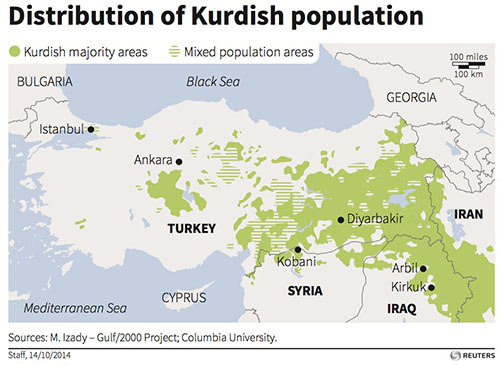
The Kurds in Turkey, Syria, and Iraq are being drawn ever deeper into the Syrian conflict. While they defend themselves against attacks from Islamic State extremists, they don’t desire to play a larger part either on the side of the Assad regime or on that of the rebels. They have once again become victims of power-politics, and are dying at the hands of the barbaric IS.
If complete autonomy is the way to resolve the Kurdish question in Iraq and Syria, in Turkey the path to conflict resolution is more along the lines of a federalism model.
Kurds make up nearly 20 percent of Turkey’s population of 77 million.
As part of the Ottoman Empire, they lost their privileged de facto autonomous territorial rights during the 19th century. Their political and cultural rights were compromised by the Ottomans and then the Republic of Turkey.
Rejecting the artificial borders of the nation state that divided them, they sought to protect and develop themselves within their traditional eshir (tribal) and Islamic norms and values which were embedded in Kurdish society.
For much of the past century, Kurds often endured widespread discrimination at the hands of a Turkish state that did not accept their ethnic identity. Mustafa Kemal, the founder of Turkey, did not regard Turkey’s Kurds as a minority and saw any assertions of separate Kurdish identity as an attempt to divide the country along ethnic lines; government policy was the “assimilation of all the country’s citizens to Turkish culture.”
In a drive for ethnic homogeneity, Kemalists denied the existence of the Kurdish minority, which was excluded from Turkish politics because of its ethnic foreignness for decades. The poverty of the East was exacerbated by deliberate neglect and assimilation policies; state lands in the region, for instance, were given to immigrants from the Balkans rather than to poor Kurdish peasants.
Since the founding of Turkey in 1923, there have been numerous Kurdish rebellions that aimed to rid the country of exclusionary ethnic politics and inhumane treatment of Kurdish citizens. The last Kurdish rebellion (from 1984 to 2012) cost more than 45,000 lives after a 30-year armed conflict between the PKK and Turkish military.
Turkey still refuses to grant minority status to the Kurdish nation. Speaking Kurdish was illegal in Turkey until 1991 when the European Union demanded that Turkey grant increased minority rights. In a state where Kurds were not long ago imprisoned for hearing music in their mother tongue, and were named ‘mountain Turks’ to prevent any mention of their origin, the teaching of Kurdish in private schools as of 2014 is now permitted.
Erdoğan (then prime minister) initiated in 2009 an unprecedented reform process designed to ease the cultural oppression of Kurds, including allowing the broadcasting of Kurdish TV and radio. This so-called ‘Kurdish opening’ has stalled since then.
A stalemate in Turkey’s EU accession bid effectively did away the necessity of democratizing Turkey. A ‘New Constitution’ could address democratization reforms demanded especially by Kurds.
While a 10 per cent electoral threshold (the minimum share of the vote which a political party requires to secure any representation) has restricted the electoral opportunities of pro-Kurdish parties, in recent decades Kurdish nationalist parties have gotten around that by forming electoral alliances with leftists. One such alliance took place before the 2014 presidential elections, when the Kurdish nationalist Peace and Democracy Party (BDP) changed its name to the Peoples’ Democratic Party (HDP) to encompass smaller leftist parties under a larger umbrella. In the meantime, the opposing camps are almost as hardened as in the dark 1990s.
Turkey faces hard power threats from the IS, the PKK, Iran, and Syria simultaneously, while struggling to reassess its relationship with the Free Syrian Army (and the other Syrian rebels battling Assad) as the conflict intensifies.
Critics have questioned Ankara’s commitment to the West’s (and its Arab partners) war with IS; blaming Ankara for not taking responsibility to assist the U.S. and its allies in the air campaign against IS. Earlier this month Turkey did upgrade its authorization for the United States to use the Incirlik Air Base for armed drones, a forward operating base in the war on IS, after a visit on July 7 by General John Allen, Obama’s special envoy for the global coalition to counter IS, and Christine Wormuth, under secretary of defense for policy.
But it was only when the IS bombing of leftist youth targets in the Turkish Kurdish border town of Suruc sparked fears of the Syria conflict spilling onto Turkish soil, that the prime minister’s office stated the country would take all necessary steps to protect national security.
Ankara and Washington have different priorities as regards intervention in Syria. Turkey and the United States signed an agreement in February 2015 to train and arm Syrian rebels fighting the Islamic State group. However, while the US has said the goal is to go after the Islamic State group, Turkish officials have suggested that the trained rebels should also target the Syrian government of President Bashar al-Assad.
Arms supplied by Turkey to rebels in Syria could trigger the the Assad regime to line up in support of PKK rebels as in the days of Hafez-al-Assad, the father of the current Syrian head of state.
Erdoğan demands the exit of Assad as key to any solution to end the violence in Syria, and is frustrated that Washington’s anti-Assad stance has been diverted or even softened by the rise of IS, which the US now seems to consider a greater threat.
The question of power and influence within Turkish politics is the subtext for a debate about what kind of ‘new’ Turkey the world will need in the future: a power constrained or a power magnified?
The AKP government might have to rethink its shift to a hard-line, hawkish stance, if the Turkish public doesn’t allow it. Public support for the AKP’s neo-Ottoman foreign policy approach — expansion of Turkey’s influence on and regional appeal to successor states of the Ottoman Empire — has certainly lessened as a result of the Syrian civil war. Most Turks wish peace with their neighbors. The party cannot ignore public opinion on critical foreign-policy questions as easily as the military rulers who previously dominated Turkish foreign-policy decision-making could.
The party’s marginalization of the Kemalists, for example, has granted the AKP leadership unprecedented civilian oversight and influence over the course of Turkish foreign policy. Kemalists are fervent advocates of Turkey’s integration with the EU and dislike its neo-Ottoman drive to become a leader in the Muslim world. And it has now become clear that the AKP, Turkey’s ruling party for the past 13 years, has not acquired the power to influence the direction of developments in the region that it envisioned.
To promote the ‘Turkish model’ in the Middle East, never mind achieve its aspirations for EU membership, Ankara must first guarantee democratic rights at home to Kurds and others, including freedom of speech and press, minority rights, and freedom of — and from — religion. In this regard, it still needs the West, one of the anchors of liberal democracy in Turkey.
Turkish military inaction in Kobane (under siege by IS from September 2014 through January 2015) and the culture wars between the Gulenists and the AKP has also put a strain on the relations between Ankara and Brussels.
Turkey’s foreign policy based on ‘Zero Problems with Neighbors’ — to achieve economic prosperity while increasing its influence on and attraction for the region’s Islamic societies — has not been especially effective, particularly with regard to Syria.
Initial improvements in diplomatic relations with the Arab world have stalled. Turkey now has no ambassadors in five Middle Eastern countries, among them Israel, a former friend, Syria, Lebanon, Libya and Egypt. Turkey’s alliance with Sunni states Saudi Arabia and Quatar helps to fuel sectarian violence in Syria and Iran. Turkey’s behavior cannot be characterized as that of a good neighbor.
While Ankara may reap some short-term gains — for example from the transfer of Iraqi Kurdish oil through its territory — it also risks losing its land access to the Arabian Peninsula by angering Baghdad.
The three principles of international stability — according to the principle of international law called Westphalian sovereignty — are that power should be vested in states, that states must recognize one another as equals, and that states should not interfere in others’ internal affairs. It’s also important to remember the Westphalian ban on mercenaries set up precisely the distinction that makes terrorists illegitimate and state armies legitimate.
‘The toppling of Assad’ has become a justification for the arming of foreign extremists against his regime. Western interventions in the former Yugoslavia, Afghanistan, Iraq, and Libya were also justified by the presumption that state sovereignty was no license to conduct atrocities against one’s own people. But these so-called ‘humanitarian interventions’ the West has pursued since the 1990s exchanged Westphalian principles of national sovereignty for human rights and democratization.
Ankara is complicit in violating Westphalian sovereignty. Turkish officials should adhere to the principle of non-intervention into the domestic affairs of a foreign country. By upholding the principle of good-neighborliness, Ankara could avoid being drawn ever deeper into the Syrian quagmire.
The stabilizing power of the UN may help mediate a peace between all parties in a future Geneva III conference to settle the Syrian civil war.
Kubilay Yado Arin is a Visiting Scholar at Duke University’s Middle East Studies Center (July 2015 – June 2016). A Kurdish scholar, his research focuses on conservative think tanks in the US and Turkey, US-Turkish relations, EU and US foreign policy towards the Middle East. Previously he was a Visiting Scholar at Middle East Technical University and Portland State University (PSU). In January and February 2015 he started postdoctoral research on his current book project “Think Tanks in Turkish Foreign Policy” at UC Berkeley and at PSU, which he plans to continue at Duke’s Middle East Studies Center. This year I.B. Tauris will publish his book on “Turkey, the US and the EU: The New Foreign policies.” If interested in these and other of his publications, visit https://duke.academia.edu/YadoArin.
###
ISLAMiCommentary is a public scholarship forum that engages scholars, journalists, policymakers, advocates and artists in their fields of expertise. It is a key component of the Transcultural Islam Project; an initiative managed out of the Duke Islamic Studies Center in partnership with the Carolina Center for the Study of the Middle East and Muslim Civilizations (UNC-Chapel Hill). This article was made possible (in part) by a grant from Carnegie Corporation of New York. The statements made and views expressed are solely the responsibility of the author(s).
Other web sites and print publications may re-publish this article as long as there is source attribution (author and ISLAMiCommentary) and a link back to ISLAMiCommentary.
Tags: AKP, Alistair Baskey, Bashar al-Assad, Christine Wormuth, Erdogan, EU, Gen. John Allen, Incirlik Air Base, Iran, Iraq, Iraq Kurds, IS, Kemalists, Kobane, Kubilay Yado Arin, Kurdish history, Maj. James Brindle, Mustafa Kemal, NATO, neo-Ottomanism, Ottoman Empire, People's Democratic Party (HDP), PKK, PYD, Rojava, Selahattin Demirtaş, Syria, Syria civil war, Syria War Resolution, Syrian Kurdistan, Turkey, Turkey Kurds, Turkish Armed Forces (TSK), Turkish model, US foreign policy, US military, US National Security Council, Westphalian sovereignty, ZDF TV
Category: Americas, Education, Eurasia, Europe, History and Anthropology, Human Rights & Gender, i-Comment, ISIS, Middle East and North Africa, Muslim Life & Culture, Politics & Current Events, Security & Civil Liberties