[ This article was originally published on the ISLAMiCommentary website, which is now only available via the Wayback Machine. Here is a direct link to this article: https://web.archive.org/web/20170214031426/https://islamicommentary.org/2015/11/guilty-buildings-and-innocent-objects-by-annabel-jane-wharton/]
by ANNABEL WHARTON for ISLAMiCommentary on NOVEMBER 23, 2015
curated and edited by Julie Poucher Harbin, Editor, ISLAMiCommentary
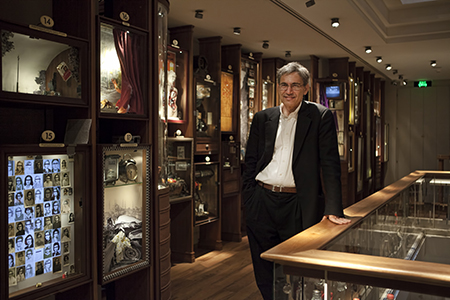
The Nobel Prize-winning author, Orhan Pamuk, published a novel titled Museum of Innocence in 2008 and opened a museum of the same name in Istanbul in 2012. The novel was conceived as a kind of museum catalog of common objects—soda bottles, earrings, photographs, cigarette butts — collected by the author as representative of Istanbul between 1975 and 1984. These objects are identified in the narrative with the lost love of the wealthy protagonist, Kemel Bey. The museum and the novel were concurrent projects, but texts are more readily brought to fruition than are buildings.
In a recent panel discussion devoted to these works, Pamuk was asked, “What is innocent about museums?” The author’s lyrical, compelling response engaged complex ideas contrasting the ideological programs of great state institutions with the more intimate projects of private foundations. Museums, he concluded, might well be guilty, but, “after all, objects are innocent.”
I certainly agree that museums are guilty. In Architectural Agents: The Delusional, Abusive, Addictive Lives of Buildings, I have gone so far as to accuse The Cloisters in New York City of murder. Museums are not, of course, the only structures that act pathologically. Some buildings try to hide their bloody histories in order to attract unsuspecting occupants. Other spaces, perhaps most notably virtual ones, promote forms of slaughter to sell themselves. Las Vegas’ casinos, like the digital slot machines that occupy them, programmatically cue addictions. Sports arenas promote hysteria and even mob violence. Studies suggest that particularly violent buildings can be identified. “The fact that domestic homicide cannot be predicted does not detract from our excellent ability to predict less lethal violence among chronic couples…. Chronically violent buildings can also be identified with seventy-two per cent accuracy,” writes Lawrence W. Sherman, in “Preventing Homicide through Trial and Error” (Homicide, 1993).
It is not so surprising that buildings can be bad as well as good. They are in their bodies and their biographies not so different than humans. Each one is unique because each one occupies a particular physical site; they are born, they mature, they decay, they die. Buildings are agents that are independent of their human producers and users—after all they affect birds, roaches and the ecological landscape as well as people.
So it seems that buildings can be guilty. But are objects really so innocent? Certainly the U.S.’s National Rifle Association believes so. After all, as they say, “Guns don’t kill people; people kill people.” But Bruno Latour famously argues that tools have the capacity to transform their users: “What does a gun add to the shooting? In a materialist account, everything: an innocent citizen becomes a criminal by virtue of the gun in her hand. The gun enables, of course, but also instructs, directs, even pulls the trigger…. Every artifact has its script, its potential to take hold of passersby and force them to play roles in its story.” (Pandora’s Hope: Essays on the Reality of Science Studies, Cambridge MA: Harvard University Press, 1999, p. 177).
Objects, like buildings, are autonomous agents. Of course they don’t exert their agency self-consciously. Like chemical agents, they have an effect on proximate objects without any consciousness or intentionality. But both buildings and objects certainly act in the world. And sometimes they act badly. Objects, like buildings, are not always innocent.
Annabel Jane Wharton, William B. Hamilton Professor of Art History, Duke University, received her Ph.D. at the Courtauld Institute, London University. In 2015, she was the Vincent Scully Visiting Professor of Architectural History at the Yale University School of Architecture. She has received major fellowships from Dumbarton Oaks, the ACLS, The Center for Advanced Study of the Visual Arts at the National Gallery in Washington, D.C., and the National Humanities Center. Initially her research focused on Late Ancient and Byzantine art and culture. Her works from her early career included “Art of Empire” (Penn State), “Tokali Kilise” (Dumbarton Oaks/Harvard); and “Refiguring the Post-Classical City” (Cambridge). With “Building the Cold War: Hilton International Hotels and Modern Architecture” (Chicago, 2001), she began to investigate the effects of modernity on ancient landscapes. She has combined her pre-Modern and Modern interests in her latest books, “Selling Jerusalem: Relics, Replicas, Theme Parks” (Chicago, 2006) and “Architectural Agents: The Delusional, Abusive, Addictive Lives of Buildings” (Minnesota, 2015). Continuing to investigate the agency of things, she has begun work on a new book project treating models—conceptual and material, analog and digital, tentatively titled “Manipulating Models: Diagnostic, Phenomenal, Architectural.”
Tags: Annabel Jane Wharton, art history, Bruno Latour, Duke University, Istanbul, Lawrence W. Sherman, Museum of Innocence, Orhan Pamuk
Category: Americas, Art and Architecture, Eurasia, i-Comment, Middle East and North Africa