[ This article was originally published on the ISLAMiCommentary website, which is now only available via the Wayback Machine. Here is a direct link to this article: https://web.archive.org/web/20160702052719/http://islamicommentary.org/2013/05/carl-ernst-islamophobia-in-america-the-anatomy-of-intolerance-book/]
by JULIE POUCHER HARBIN, EDITOR, ISLAMiCommentary, on MAY 3, 2013
“Islamophobia is the name given to the virulent anti-Islamic prejudice that has been hyped by the news media and seized upon by cynical politicians. Five essays by six specialists on Islam in America provide important insights into Islamophobia as a conflict over American identity during a time of crisis. The authors clarify the way that differences of religion, race, and gender have been used to portray Muslims as threatening “out-groups,” just as other minorities (Catholics, Jews, blacks) have been attacked in the past. The result is a valuable and thought-provoking analysis of the tactics for denying full citizenship to a minority religious group.” — Islamophobia in America: Anatomy of Intolerance, edited by Carl Ernst (Palgrave-Macmillan, 2013)
Last month, during a public discussion on American Muslims, UNC-Chapel Hill Islamic Studies Professor Carl Ernst spoke about the history, in America, of “minorities being targeted by irrational hatred.”
“This is a deep well of bitterness,” he told a mixed crowd of nearly 100 scholars, students, and locals from inside and outside the Muslim community who had gathered at Duke University to watch a WRAL-TV documentary about North Carolina Muslims and engage in Q & A afterwards. “People are generally not willing to come out in very overt ways to acknowledge this, but it’s clear that racial prejudice against blacks, anti-Semitism directed against Jews, and other forms of prejudice are still extremely strong and this (prejudice against Muslims) is joining the roster. I don’t think you can blame it necessarily on economic causes or anything like this.”
For the audience, Ernst, and his fellow panelists — Amna Baloch (a young Muslim American community member), David Schanzer (Director of the Triangle Center for Terrorism and Homeland Security) and Abdullah Antepli (Duke’s Muslim Chaplain) — this event was especially timely.
With the April 18 discussion starting just hours after photos of the Boston Marathon bombing suspects were released to the media, but before their identities were uncovered, there were already worries of a new tide of Islamophobia rising in America.
And, while Ernst had given a number of talks on his book How to Read the Qur’an: a New Guide, with Select Translations (UNC Press) ( a kind of layman’s guide to Islam’s holy book) since it came out in 2011, his new edited volume Islamophobia in America: Anatomy of Intolerance (Palgrave-Macmillan, 2013) had been released just a month before.
Coming Together
Ernst is a member of the Board of Directors of the Middle East Studies Association of North America. In 2011, the board had asked him to organize a plenary panel on Islamophobia in America for the annual conference of the organization, and he invited “the top five scholars in America on this subject” to take part in this event.
“It was exceptionally well attended, by over 200 participants, and subsequently a prominent publisher invited me to organize the essays for a book publication. That was the stimulus for putting this volume together,” he told me. “There is no other study available that reveals the importance of the issue of American citizenship as a defining context for the anxiety about Islam in America.”
Where do we as Americans go from here?
“It’s an enormous educational challenge and I think it’s going to require the resources of not only the university community but journalism together,” said Ernst.
###
Learn More
EVENT: "Faith, Fear and Freedom": A Discussion on North Carolina's Growing Muslim Population
WRAL-TV Emmy award winning anchor David Crabtree moderated the above live-streamed documentary screening and panel discussion of WRAL's "Faith, Fear and Freedom" about North Carolina Muslims on Apr 18, 2013 from 7:30 p.m to 9 p.m. Audience members were encouraged to ask questions.
Panelists included, from left: UNC-Chapel Hill Islamic Studies Professor Carl Ernst; Amna Baloch (local community member born and raised in Raleigh, NC); David Crabtree (WRAL-TV anchor); Director of the Triangle Center on Terrorism and Homeland Security (Duke-UNC-RTI) David Schanzer; and Muslim Chaplain at Duke University Abdullah Antepli.
Background: There have been Muslims living in North Carolina for decades. In fact, some of the very first Muslims in NC were African slaves who were brought here in the 18th century. Today, there are an estimated 26,000 Muslims in North Carolina. That's less than one percent of the state's population, but also reflects a 30 percent increase in the number of Muslims living in NC over just ten years. Some are converts, but most come from other states and other countries. (More information on American Muslims here)
This event was sponsored by the Duke Islamic Studies Center, the Durham County Library, and WRAL-TV, and made possible by a grant from the Carnegie Corporation of New York. Co-sponsors included the British Council's Our Shared Future project, Center for Muslim Life (Duke) , Carolina Center for the Study of the Middle East and Muslim Civilizations (UNC-Chapel Hill) , DeWitt Wallace Center for MEDIA & DEMOCRACY, Duke-UNC Consortium for Middle East Studies, Franklin Humanities Institute (Duke), Sanford School of Public Policy (Duke) , and Triangle Center on Terrorism and Homeland Security (Duke/UNC/RTI).
BOOK: Islamophobia in America: Anatomy of Intolerance (Palgrave-Macmillan, 2013)
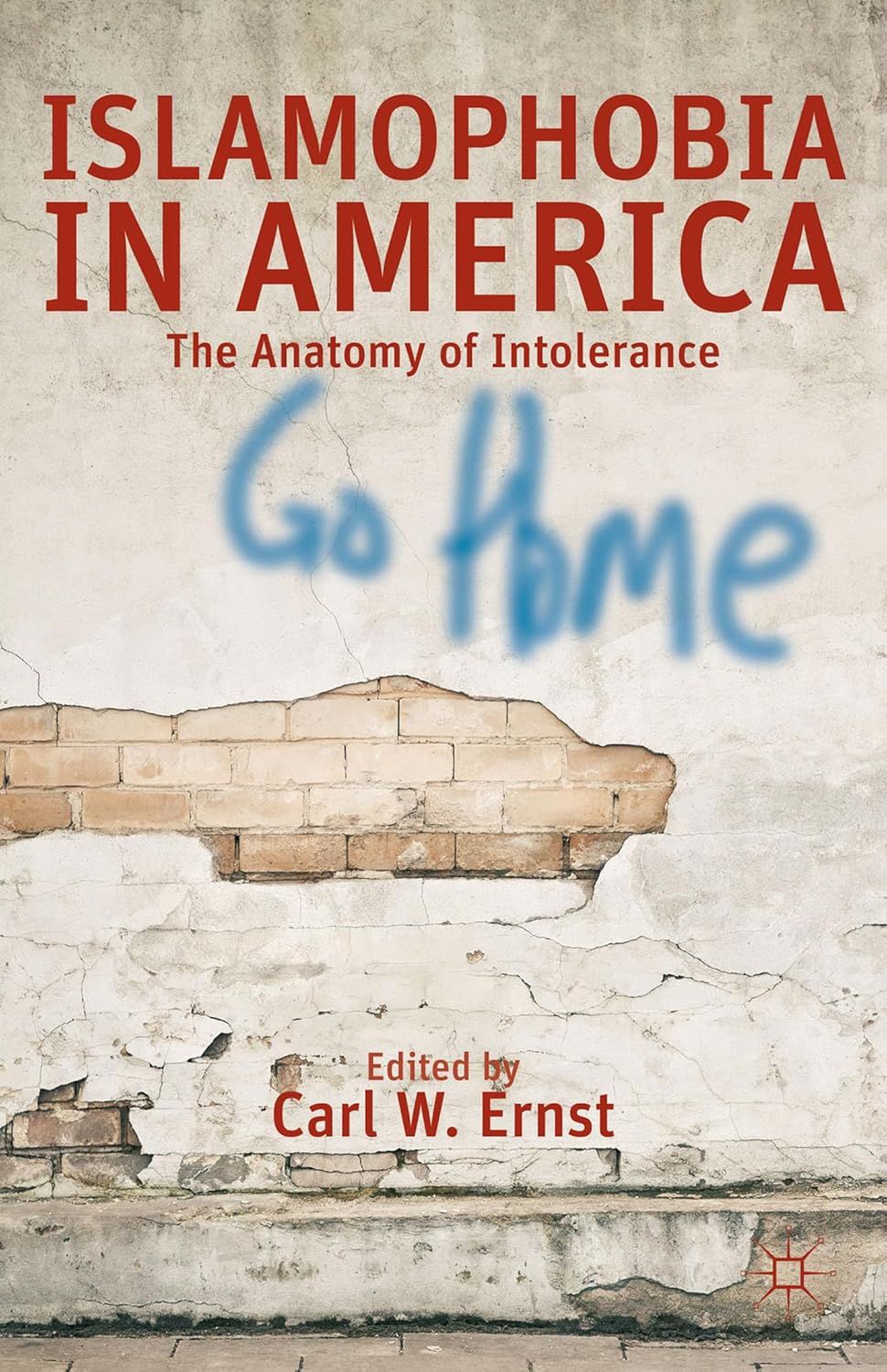
Download Table of Contents and excerpt from the introduction by Carl Ernst
Amazon Link (*Kindle and Hardcover versions available. Excerpt from the introduction, written by Carl Ernst, is available to read)
TABLE OF CONTENTS
Introduction: The Problem of Islamophobia; Carl W. Ernst

Carl Ernst is the William R. Kenan, Jr. Distinguished Professor of Islamic Studies in the Department of Religious Studies at UNC-Chapel Hill co-director of UNC Chapel Hill’s Carolina Center for the Study of the Middle East and Muslim Civilizations. He is a specialist in Islamic studies, with a focus on West and South Asia. His most recent books include an edited volume Islamophobia in America and How to Read the Qur’an: a New Guide, with Select Translations (UNC Press, 2011).
Ch. 1. Common Heritage, Uncommon Fear: Islamophobia in the United States and British India, 1687-1947; Peter Gottschalk and Gabriel Greenberg
Peter Gottschalk is professor of Religion at Wesleyan University. His research and teaching concentrate on the dynamics of cultural interpretation and conflict in the context of Islam, Hinduism, and the West. He is interested particularly in understanding how assumptions of mutual antagonism form between groups despite evidence of religious confluence.

Gabriel Greenberg is Assistant Professor of Philosophy at University of California, Los Angeles. He specializes in the philosophy of language and the philosophy of the mind. He is interested in the semantics of symbols, images, and everything in between.
Ch. 2 Islamophobia and American History: Religious Stereotyping and Out-grouping of Muslims in the United States; Kambiz GhaneaBassiri
Kambiz GhaneaBassiri is Associate Professor of Religion and Humanities (Islam) at Reed College and is the author of “A History of Islam in America” (Cambridge Univ. Press). He is also a Carnegie Scholar.
Ch. 3 The Black Muslim Scare of the Twentieth Century: The History of State Islamophobia and Its Post-9/11 Variations; Edward E. Curtis
Edward Curtis IV is a religious studies professor at Indiana University-Purdue University Indianapolis, and a Carnegie Scholar. A student of U.S. history, Islamic religion, and the African diaspora, he is the author or editor of six books, including the two-volume Encyclopedia of Muslim-American History (2010).
Ch. 4 Center Stage: Gendered Islamophobia and Muslim Women; Juliane Hammer

Juliane Hammer is Assistant Professor and Kenan Rifai Fellow in Islamic Studies at University of North Carolina at Chapel Hill. Her research interests include American Muslims; gender discourses in American Muslim communities; Muslim women’s and gender studies; theory and method in the study of Islam; Sufism and food; modern and contemporary Muslim approaches to the Qur’an; marriage, family, and sexuality in religions.
Ch. 5 Attack of the Islamophobes: Religious War (and Peace) in Arab/Muslim Detroit; Andrew J. Shryock
Andrew J. Shryock is Professor of Anthropology at the University of Michigan and jointly affiliated with the Center for Middle Eastern and North African Studies. He has done ethnographic fieldwork in Yemen, Jordan, and among Arab immigrant and ethnic communities in Detroit. His research in the Arab world centers on matters of historicity, nationalism, oral tradition, tribe-state relations, and modernity (both its cultural politics and its alternative forms). His work in North America focuses on ethnicity, mass mediated culture, transnational communities, and identity politics.
Tags: Abdullah Antepli, Amna Baloch, Andrew Shryock, Carl Ernst, Carolina Center for the Study of the Middle East and Muslim Civilizations, David Schanzer, Edward Curtis IV, Gabriel Greenberg, How to Read the Qur'an, Islamophobia, Islamophobia in America: Anatomy of Intolerance, Juliane Hammer, Kambiz GhaneaBassiri, Peter Gottschalk, UNC Chapel Hill, US Muslims, WRAL-TV
Category: Americas, Books, Featured Videos, History and Anthropology, Human Rights & Gender, i-Comment, Islamic Theology & Law, Muslim Life & Culture, Politics & Current Events, Science, Tech, Media & Social Media, Security & Civil Liberties