[ This article was originally published on the ISLAMiCommentary website, which is now only available via the Wayback Machine. Here is a direct link to this article: https://web.archive.org/web/20170214040711/https://islamicommentary.org/2014/12/erdogan-american-muslims-and-a-sense-of-belonging-would-a-muslim-discovery-of-america-have-made-a-difference/ ]
by ABDUL LATIF for ISLAMiCommentary on DECEMBER 1, 2014
curated and edited by Julie Poucher Harbin, Editor, ISLAMiCommentary

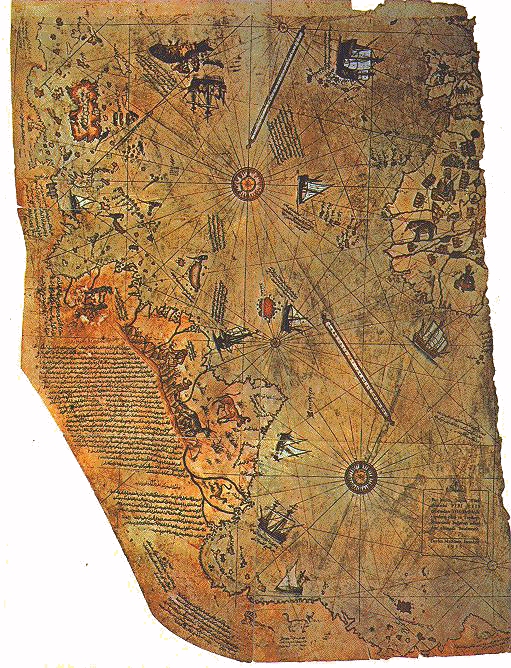
In a meeting with Latin American Muslim leaders last month Turkish President Erdogan claimed that Muslims discovered the Americas centuries before Columbus. This claim is not new. There are several well-meaning pieces of purported evidence: records of journeys from Muslim Spain; West African Mandinka inscriptions in the Americas; an accurate Ottoman map including the new world in the 1500s; and references by Columbus to a mosque in Cuba.
Unfortunately for Erdogan, many of these findings don’t have rigorous methodologies and their discoverers often failed to produce sound evidence. The (Piri Reis) Ottoman map, the oldest surviving map to show the Americas, was highly detailed but did not contain any information which suggest Ottoman journeys to the new world. And Columbus’ mosque was probably just a reference to natural land formations.
As Muslims, we should hold ourselves to a higher standard before making unequivocal proclamations. Not only because it makes us look foolish if we are wrong, but because the Qur’an urges us to investigate information that comes from uncertain sources (see Quran 49:6). So Erdogan’s claim rests on specious premises.
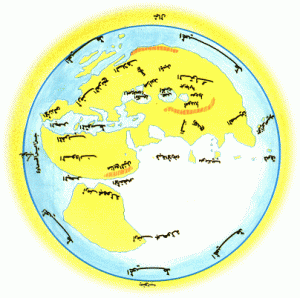
Arab historian and geographer Al-Masudi’s world map of 956 (Muslim Calendar) showing the “unknown land” across the Atlantic across from Africa (via Lost Islamic History blog)
The question then is why he, and many others, have made the claim. I believe I can postulate a couple reasons why they want it to be true.
- If Muslims discovered the Americas, it would mean we Muslims — who are repeatedly told to “go back to your country” — truly belong here.
- If Muslims discovered the Americans, we Muslims might have a monumental accomplishment to be proud of.
As it is, I often don’t feel as if we Muslims are welcome in America. Recently an Oklahoma state senator called Islam a cancer, and Bill Maher, the ‘great voice of liberalism,’ attacked Islam. Some people, including elected officials, believe Islam is somehow less worthy of first amendment protections, despite a legal and common-sense right for us to be here. Something is wrong with the national psyche.
Many Muslim Americans argue that we, as a religious group, do, in any case, have deep historical claims for belonging. About one-third of the African slaves brought to America were Muslim and Muslims are part of the history of America.
This is still not enough to counter xenophobia, however. Maybe this is why less grounded claims about Muslims discovering America are made?
Even if Muslims did discover the Americas, how far would or should that go towards making us feel proud to be ‘Muslim in the Americas’ today ? It’s not like we Muslims alive today were directly responsible for that discovery.
Furthermore, Native Americans are the ones who really ‘discovered’ the Americas. I for one am happy that Muslims didn’t ‘discover‘ the Americas in the way that Columbus did. At least my religion cannot be held responsible for the annihilation of most of the indigenous population — not that any religion should ever be blamed for death and destruction.
Erodogan and other proponents of the Muslim discovery theory would be better served by criticizing the apparatuses that question Muslim belonging, and by supporting indigenous populations’ struggle for rights and representation, including Native American efforts against discrimination.
As Berkeley professor Ramon Grosfoguel notes, techniques used in the Reconquista against Muslims and Jews were refined and employed in the colonization of the Americas. And, as Washington Post reporter Ishaan Tharoor wrote, “(Islam) still haunted the imagination of Europeans as they ventured into the alien unknown.”
A bit of decolonial solidarity is in order.
Abdul Latif is a junior at Duke University majoring in Religion and minoring in Linguistics and Evolutionary Anthropology.
—
ISLAMiCommentary is a public scholarship forum that engages scholars, journalists, policymakers, advocates and artists in their fields of expertise. It is a key component of the Transcultural Islam Project; an initiative managed out of the Duke Islamic Studies Center in partnership with the Carolina Center for the Study of the Middle East and Muslim Civilizations (UNC-Chapel Hill). This article was made possible (in part) by a grant from Carnegie Corporation of New York. The statements made and views expressed are solely the responsibility of the author(s).
Other web sites and print publications may re-publish this article as long as there is source attribution (author and ISLAMiCommentary) and a link back to ISLAMiCommentary.
Tags: Abdul Latif, African Slaves, Al-Masudi, Bill Maher, Christopher Columbus, decolonialism, Duke University, First Amendment, Ishaan Tharoor, Islamophobia, Lost Islamic History, Muslim Spain, Native Americans, Oklahoma, Ottoman Empire, Piri Reis Map, PM Erdogan, Quran, Ramon Grosfoguel, Reconquista, Turkey, UC Berkeley, US history, US Muslims, xenophobia
Category: Americas, Eurasia, Europe, History and Anthropology, i-Comment, Muslim Life & Culture, Politics & Current Events, Student